My Kanji Tattoo Means Something Else? 5 Error Types
Think your kanji tattoo means something else? A Tokyo native explains all 5 error categories — from charcoal grills to mistresses — and what to do next.
You wore it for two years before a Japanese colleague finally said something. Or maybe it happened in a restaurant in Shinjuku, or over a video call when someone paused and politely changed the subject. However the moment arrived, the realization is the same: your kanji tattoo means something else entirely — not what you researched, not what you asked for, and not what you have been telling people for years.
You are not alone, and this is not a story about carelessness. These errors happen to careful, thoughtful people — because the structural problems with cross-language tattoo research are real, systematic, and almost entirely invisible until a native speaker is in front of you. Across thousands of kanji tattoo verification reviews conducted by KIO's Tokyo-native team, the same five error categories appear over and over; this article walks you through each one so you can identify exactly what went wrong, where your tattoo falls on the severity scale, and what your options are from here.
Why Kanji Tattoo Errors Are So Hard to Catch
Kanji are visually dense. A single added radical — a small component that signals category, such as the disease radical 疒 — changes a character's meaning entirely while leaving its overall shape nearly intact. A non-reader cannot see this difference. Neither can a tattoo artist copying from a reference image.
The problem is structural, not personal. Tattoo artists in Western countries are not generally Japanese readers; their job is accurate visual reproduction, not linguistic verification. Flash art is frequently sourced from Chinese clip art libraries, not Japanese references. Online kanji generators return multiple possible characters per concept and have no mechanism to flag the wrong one.
Machine translation compounds every one of these issues: translation tools treat characters individually, cannot see stroke-level differences in an image, and produce the grammatically possible reading rather than the culturally natural one. AI-based generators add an additional risk beyond mistranslation: they can hallucinate and invent kanji characters that don't exist in Japanese dictionaries at all, making verification impossible. For a detailed breakdown of how AI kanji generators create hallucinated characters and how to detect them, see the AI-specific risks guide.
The result: a careful person can do genuine research, show their artist a design that looks correct, and still end up with a tattoo that says something entirely different from what they intended.
The Five Categories of Kanji Tattoo Error (With Real Examples)
Kanji tattoo errors are not random. They fall into five repeating categories, each driven by a specific mechanism. Knowing which category your tattoo falls into tells you both how it happened and how serious it is.
Category 1 — The False Friend Compound
Two kanji that are individually correct combine to form a fixed Japanese compound word with an entirely different meaning. The person researching their tattoo looked up each character separately and found both correct — but never checked what the pair means as a unit.
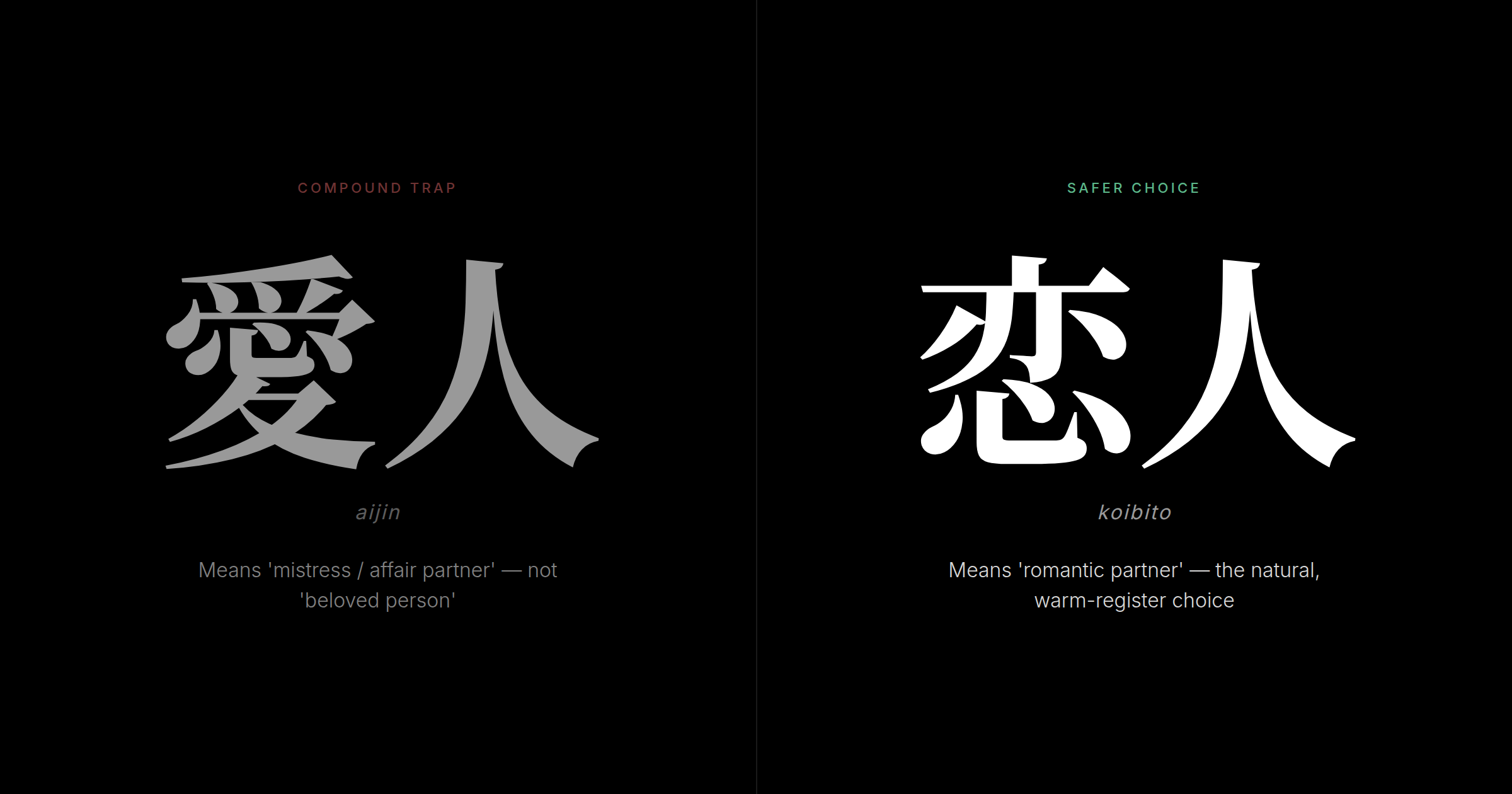
愛人 (aijin) — the "beloved person" that isn't.
愛 (ai — love) combined with 人 (hito/jin — person) seems to produce "beloved person" or "soulmate." In contemporary Japanese it means neither. 愛人 (aijin) is the specific, loaded word for a mistress or affair partner — it carries explicit moral stigma. Japanese readers see it immediately as the affair word, not a poetic title. If you wanted "romantic partner," the natural word is 恋人 (koibito — romantic partner; warm and idiomatic). If you wanted "the person I love" as a phrase, 愛する人 (aisuru hito) is the correct construction.
七輪 (shichirin) — the charcoal grill.
The intended meaning was "seven rings." 七 (shichi — seven) and 輪 (wa/rin — ring, circle, loop) are both correct individually. But 七輪 (shichirin) is a fixed compound word for the small portable charcoal grill used at izakayas. No Japanese adult reader parses it as "seven plus ring." Ariana Grande's widely reported 2019 tattoo is the canonical public example. The correct phrase requires 七つの指輪 (nanatsu no yubiwa — with the grammatical counter and noun a native speaker would actually use).
The same pattern applies to everyday compounds: two meaningful components combine into a functional product name rather than the symbolic concept the wearer intended. The matcha kanji tattoo case examines this exact trap through the lens of wellness culture — where "powdered tea" encodes a kitchen ingredient, not mindfulness.
痛風 (tsuufuu) — gout.
痛 (itami/tsuu — pain) plus 風 (kaze/fuu — wind) seems to evoke a poetic phrase for grief or intensity. In fixed compound form, 痛風 (tsuufuu) is the medical diagnosis for gout, caused by uric acid buildup. There is no poetic reading once the compound snaps into place.
Error mechanism: Kanji generators return individual character lookups. The client combines them. No tool checks whether the combination is a fixed compound with an unrelated meaning.
Category 2 — The Lookalike Swap
A character that is visually close to the intended one gets substituted — either by a tattoo artist tracing from a low-resolution reference, or by the client printing the wrong character from a search result.
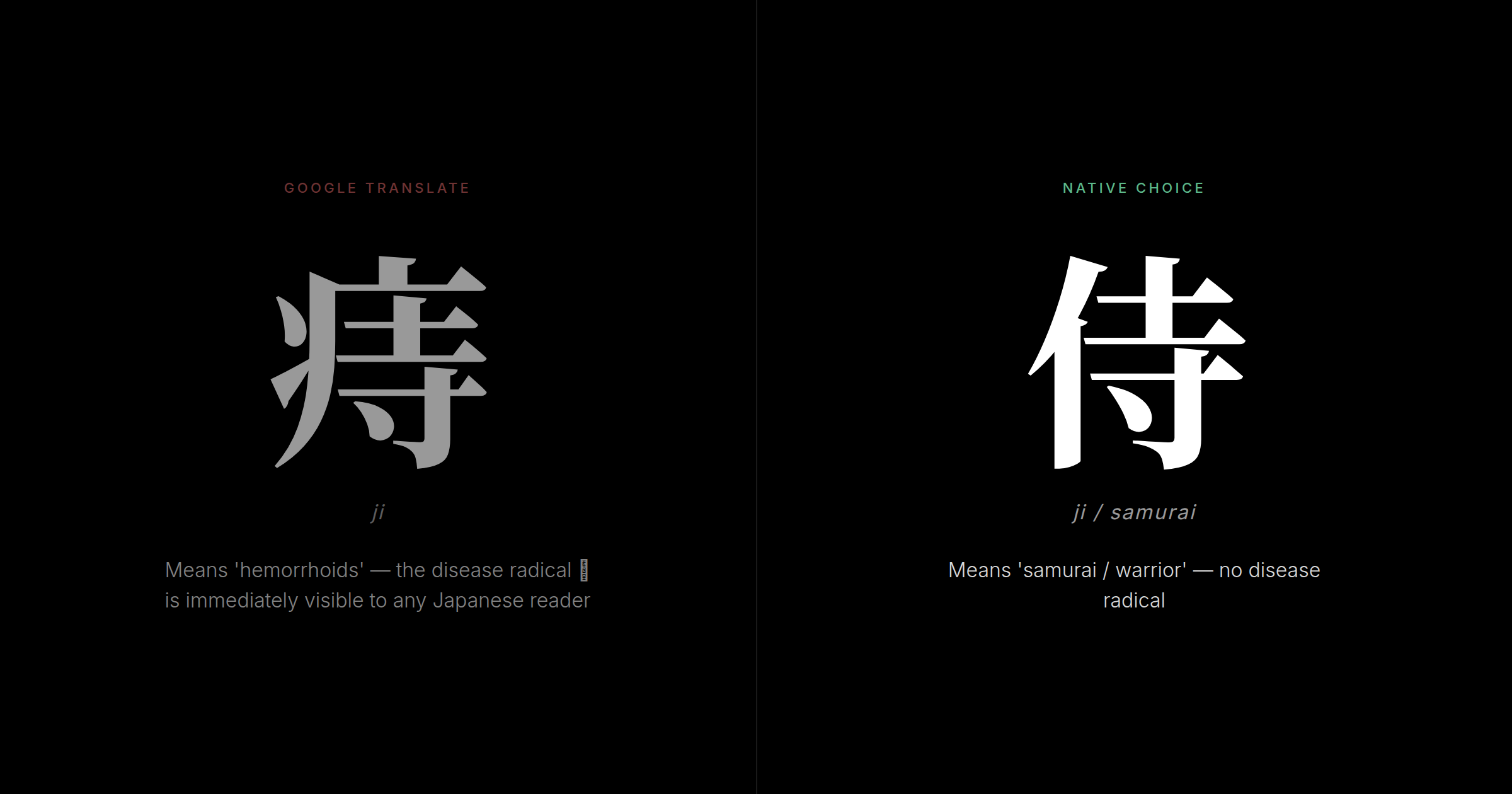
侍 (samurai) vs 痔 (hemorrhoids).
侍 (ji — samurai, warrior) and 痔 (ji — hemorrhoids) share a pronunciation and a similar overall silhouette. The difference is the disease radical 疒 at the top of 痔 — taught in Japanese elementary school and immediately recognized by every literate adult. A native reader looking at 痔 cannot see 侍. The disease radical signals "medical condition" as unmistakably as a red cross on a first-aid kit.
侘 vs 詫 — wabi-sabi or letter of apology.
侘 (wabi — the aesthetic of finding beauty in imperfection; root of 侘寂, wabi-sabi) and 詫 (wabi as in apologizing; used in 詫び状, a formal letter of apology) are separated by the speech radical 言 on 詫's left side. One announces acceptance of imperfection; the other announces contrition. Philosophically opposite, even if not socially embarrassing. For a deep dive into what wabi-sabi philosophy actually is and how it reads to Japanese people, learn more in our wabi-sabi kanji tattoo guide.
自由 vs 無料 — freedom or no-charge.
自由 (jiyuu — freedom, liberty; the philosophical concept of autonomous will) and 無料 (muryou — free of charge; the word on supermarket sale signs) both share the character 由. A person who wanted "freedom" and received 無料 is permanently labeled like a free sample. The native reader reaction is bemusement: "Do they know they're a free sample?"
Error mechanism: Stroke errors during tattooing; low-resolution reference images; search results returning the wrong character for an English query.
Category 3 — The Single-Word Ambiguity
English words with multiple meanings produce multiple valid Japanese translations. Machine tools pick one. It is frequently not the one the person intended.
"Strength" — which one?
Three kanji are commonly translated as "strength," and they are not interchangeable:
- 力 (chikara — raw physical power, the most fundamental and visually direct choice)
- 強 (tsuyoi / kyou — the quality of being strong, resilience, mental toughness; what a coach means when they call an athlete 強い)
- 剛 (gou — unyielding, immovable strength; less common, carries more formal philosophical weight)
None is wrong in isolation. But getting 力 when you wanted 強's meaning — resilience rather than raw force — is a Level 2 mismatch: not embarrassing, but imprecise. Google Translate returns different answers depending on phrasing, with no explanation of the difference.
The same ambiguity affects "family" (家族, kazoku — the people themselves vs 家庭, katei — the household environment), "peace" (平和, heiwa — absence of conflict vs 和, wa — harmony or Japanese aesthetic), and "spirit" (魂, tamashii — the soul vs 気, ki — life force vs 精, sei — essence, which also has anatomical meanings in specific contexts).
Error mechanism: English disambiguation is not performed. The tool returns one word; the person assumes it is the only correct word.
Category 4 — The Register Failure
The kanji is technically correct Japanese but reads as bureaucratic, clinical, or mechanical rather than personal and resonant.
This category includes a major subcategory: "untranslatable" viral Japanese words (komorebi, tsundoku, mottainai, shouganai, mono no aware) where Western perception of profundity crashes into how native speakers actually use them. For a complete breakdown of how these five most-shared words mislead and what a Tokyo native actually reads, see our guide to untranslatable Japanese words as tattoos. The same register-failure principle applies: the words are real, but the register has shifted.
Consider "never give up." A direct translation produces 決して放棄するな (kesshite houki suru na). This is grammatically valid. But 放棄 (houki — abandonment, renunciation) is legal and administrative vocabulary — forfeiting a right, relinquishing a claim. The construction するな is a command from a superior. Tattooed on a forearm, it reads like an internal compliance memo, not a personal declaration.
The emotionally resonant version is 決して諦めない (kesshite akiramenai — I will never give up), a first-person declaration using 諦める, the verb that carries the weight of resigning oneself to failure. The difference is not vocabulary — it is register.
Other documented register failures: 未成年者後見人 (a legal term for guardian of a minor — somebody wanted something about protecting family), 無毒 (non-poisonous — clinical; somebody wanted something about purity), and 日本製 (made in Japan — a manufacturing label).
Error mechanism: Word-by-word translation of an English phrase without asking "how would a Japanese person naturally express this feeling?"
Category 5 — The Chinese-Japanese Confusion
A character or phrase correct in Mandarin or Cantonese reads as foreign, archaic, or simply wrong in Japanese.
Flash art sourced from Chinese calligraphy clip art frequently uses traditional Chinese characters (繁體字 — fantizi) that differ from their Japanese equivalents. Japanese readers recognize these as "Chinese-style writing" — almost never what the wearer thought they were getting. Cantonese slang produces a further layer: a character meaning "chicken" in Cantonese slang contexts can read as something entirely unrelated through a Japanese lens, or simply be unrecognizable. Someone searched for "Japanese tattoo" on an image platform, selected a result that was Chinese calligraphy, and received a design their artist then reproduced. For a systematic side-by-side breakdown of where kanji and Chinese hanzi overlap, diverge, and produce false cognates, see our kanji vs Chinese hanzi tattoo guide.
Error mechanism: "Japanese tattoo" searches on image platforms return Chinese calligraphy results; tattoo artists who do not read either language cannot distinguish between the two.
What Japanese People Actually Think When They See Your Tattoo
"Japanese people are offended by wrong kanji tattoos" is an oversimplification. The actual reaction is more nuanced. For the complete native perspective on kanji tattoo reactions — including why mistakes land as amusement rather than anger — see what Japanese people actually think when they see your kanji tattoo.
For clearly wrong characters, the most common response is polite silence. 社交辞令 (shakoujirei — social courtesy norms) means that commenting on a stranger's permanent body modification is considered intrusive. Silence is not approval. For medical or food characters, there is suppressed amusement. For heartfelt but imprecise choices, there is often genuine sympathy.
Consider a pattern we see frequently at KIO: a professional had worn a forearm tattoo for years believing it said 和 (wa — harmony, balance; also used formally to mean "Japanese-style" or as part of the historical name for Japan, 大和, Yamato) in the universal peace sense. A Japanese colleague gently explained it read more specifically as "Japanese aesthetic" in that context. The tattoo was not wrong — 和 is a real character — but it did not say what the wearer intended. Level 2: no embarrassment, but a meaning gap that had existed for four years. This is a composite example based on common cases we see.
Another pattern: someone deeply studying kintsugi philosophy may choose 金継ぎ to express acceptance of impermanence, unaware that native readers see only "pottery repair technique" — technically correct characters, but a craft label rather than philosophy. The kintsugi tattoo kanji article explores how this specific gap between Western concept and Japanese function creates regret.
What still registers is the confidence gap — someone wearing 愛人 as though it means "beloved" signals a carelessness that, to a native reader, diminishes something meaningful about the language.
The Severity Scale
Level 1 — Harmlessly funny. Foods, objects, mundane labels: 七輪 (shichirin — charcoal grill), 無料 (muryou — no charge), 痛風 (tsuufuu — gout). Japanese readers smile. No social harm. Laser removal is a personal choice.
Level 2 — Semantically off. Wrong word, right concept: 力 (chikara — raw power) when 強 (kyou — resilience) was intended; 家庭 (katei — household environment) instead of 家族 (kazoku — family members); 和 (wa — harmony/Japanese aesthetic) when 平和 (heiwa — peace as absence of conflict) was meant. Not embarrassing, but does not communicate what the wearer believes.
Level 3 — Social awkwardness. The tattoo implies something unintended: 愛人 (aijin — affair partner), 痔 (ji — hemorrhoids). Creates a gap between what the wearer presents and what readers see.
Level 4 — Genuinely offensive. Characters associated with discrimination, slurs, or criminal organization terminology. Rare but documented. Requires immediate verification.
The internet's appetite for Level 3-4 examples distorts the picture. Most documented errors fall in Levels 1-2.
If You Already Have the Tattoo — What Now?
The worst response is to do nothing while hoping it is fine. Knowing what your tattoo actually says — even if you keep it — is better than uncertainty. If you are not sure whether your tattoo falls into any of the five categories above, our companion piece walks you through a five-minute self-check for whether your kanji tattoo is wrong — red flags, error categories, and what each finding actually means.
Option 1 — Accept it. For Level 1 errors, the tattoo is a conversation piece. Many people with documented grill-character or gout tattoos have learned to tell the story with good humor.
Option 2 — Confirm what it actually says first. Have a native Japanese speaker look at a photo of the actual tattoo — not just the characters typed into a text field. Stroke errors during tattooing can change a character. A photo shows what is actually on your skin.
Option 3 — Incorporate into a larger design. Some errors can be absorbed into a design context that shifts the reading. This requires a tattoo artist who reads Japanese, not just reproduces visuals.
Option 4 — Laser removal and redo. If the redo is still in kanji, follow the step-by-step verification process before confirming the new design. The same mechanisms that produced the original error will still be present in your next search.
For a detailed comparison of all three correction paths — including the two-week window for early rework, cover-up design considerations, and laser removal timelines — our guide to kanji tattoo removal and cover-up options walks through each in depth.
For a definitive answer from a Tokyo-native reader, Kanji Ink Oracle was built for exactly this situation — submit a photo and receive a native-reader assessment.
The Native Verdict — What Only a Japanese Reader Would Tell You
The most misunderstood thing about kanji tattoo errors is the assumption that "wrong" and "offensive" are the same category. They are not.
What actually registers to a native reader is the snap-recognition problem. Japanese readers do not process kanji one character at a time the way a learner does. They read in chunks, pattern-matching to known compound words faster than individual components can be evaluated separately. The brain matches the whole shape to a known word before the parts can be parsed.
This is why 七輪 will never read as "seven plus ring" to a native reader. The pattern for shichirin — the charcoal grill — snaps into place before the components can be processed. The reader does not think "seven rings... wait, that's a grill." They simply see: grill. The component-by-component reading that felt logical during tattoo research ("七 means seven, 輪 means ring, so together...") is structurally unavailable to the person reading your skin.
This is the honest explanation of why careful, diligent people end up in this situation. It is not carelessness. It is the natural result of a non-reader using tools that also cannot perform native pattern-matching.
In Tokyo today, the reaction has shifted from "how disrespectful" to something closer to "how did no one tell them?" — nearer to watching someone confidently mispronounce a word in a language they clearly love than to outrage at a cultural transgression.
The native speaker's actual wish is not that foreigners stop getting kanji tattoos. It is that they care enough to get them right. A kanji tattoo verified by someone who actually reads the language signals care, not appropriation. The gap that produces discomfort is the one between effort spent on the visual and effort spent on the meaning.
Before Your Next Tattoo — Three Non-Negotiable Steps
Step 1: Cross-reference, do not just translate. Follow the step-by-step verification process — check against multiple sources, run a compound dictionary check to confirm your combination does not snap to a fixed word with an unrelated meaning, and verify that your character is not a lookalike for something else.
Step 2: Have a native reader review the physical design. Show a photo of the final stencil — not just the character typed into a message. Stroke execution matters. A modified stroke can change the character entirely.
Step 3: Slow down. Give your verification process a week, not an afternoon. The anxiety of waiting one week is considerably less than the anxiety of wearing the wrong thing for decades.
Kanji Ink Oracle offers exactly that — Tokyo-based reviewers working from your actual design, returning a clear verdict before you commit.
Frequently Asked Questions
How do I know if my kanji tattoo means something wrong?
The only reliable method is to have a native Japanese speaker — not a learner, not a translation app — look at a photo of the actual tattoo on your skin. Stroke errors introduced during tattooing can change a character, so typing the characters into a text field is not sufficient. For a systematic process, follow the step-by-step verification checklist.
Is my kanji tattoo offensive to Japanese people?
Usually not. Most wrong kanji tattoos land in the harmlessly funny or semantically imprecise range, not the genuinely offensive range. The spectrum runs from amusing (food, objects, medical terms) to socially awkward (愛人/mistress) to genuinely inappropriate (slurs, criminal associations). What registers more than offense is sympathy that no one told the person before the tattoo became permanent.
Can I fix a kanji tattoo that means the wrong thing?
Yes. Options range from accepting it as a conversation piece, incorporating it into a larger design that changes the reading context, or laser removal followed by a verified redo. If the redo will also be in kanji, a proper native-reader verification process is essential before confirming the new design.
Why does my kanji tattoo look right but mean something else?
Two reasons. First, kanji that look visually similar can have completely different meanings — 侍 (samurai) and 痔 (hemorrhoids) differ by a single radical that any Japanese reader recognizes immediately. Second, combinations of individually correct characters create fixed compound words with unrelated meanings — 七輪 is a charcoal grill, not "seven rings." Looking correct visually and reading correctly to a native are entirely different tests.
Does my tattoo artist know if my kanji is correct?
Most tattoo artists in Western countries do not read Japanese and work from reference images. Even Japanese tattoo artists trained in Western studios may specialize in the visual artistry of applying kanji rather than their linguistic accuracy. Linguistic verification is the client's responsibility — not because artists are negligent, but because this is structurally outside what a tattoo professional is trained to provide.
Is getting a kanji tattoo cultural appropriation?
The more actionable question is: is your kanji tattoo accurate? Most Japanese people are more concerned by inaccurate kanji than by the act of getting them. A kanji tattoo chosen with understanding and verified for accuracy is generally welcomed. The concern is accuracy and respect, not gatekeeping the script. For a full treatment of the appropriation question — including why effort matters more than ethnicity and what Japan's generational nuances actually look like — see whether a kanji tattoo is cultural appropriation.
What is the most common kanji tattoo mistake?
The compound-word trap is the most common class of error: combining individually researched characters without checking what they mean as a fixed pair. The 愛人 (mistress) case is among the most socially awkward single examples. The Ariana Grande 七輪 (charcoal grill) case is the most widely documented celebrity example.
Can Google Translate tell me if my kanji tattoo is correct?
No. Google Translate cannot reverse-engineer whether your tattoo design uses the right strokes, and it cannot flag lookalike-character errors from a photo. Even for text input, it shares the same structural limitations that produced the error in the first place. For a full explanation, see why machine translation fails for kanji tattoos.