How to Verify a Kanji Tattoo Before Getting Inked
A five-layer kanji tattoo verification framework — compound word traps, script choice, and what Tokyo-native readers actually see when they review your design.
You've found a kanji character you love, the design looks right, and the appointment is booked. The one thing you haven't done is confirm — through a process that reflects how Japanese readers actually read — that it means what you think it means. That gap between confidence and verification is where permanent regret lives.
This guide gives you a concrete, step-by-step framework for closing that gap before you sit in the chair. The framework is built from patterns we see repeatedly in KIO's verification work — thousands of kanji tattoo reviews assessed by our Tokyo-native team — and addresses the specific failure modes that machine translation, online generators, and Western tattoo studios consistently produce. If you have not yet settled on which character you want, the companion piece on choosing meaningful kanji for tattoos covers the selection step that precedes verification.
Why "Just Google It" Is the Most Dangerous Advice in Kanji Tattoos
The core problem with machine translation as a verification tool is not that it always gets things wrong — it's that it looks right often enough to breed false confidence, and then fails in ways that require a native reading brain to catch.
Machine translation produces four distinct failure modes that together make it unreliable as a final check for permanent body art:
- Wrong-word selection: the correct English word maps to multiple Japanese words with different cultural registers, and the machine picks the wrong one
- Compound errors: two individually correct kanji combine into a fixed compound noun with an unintended meaning
- Register mismatch: the output is technically correct Japanese but reads like a government form or a medical chart, not a personal declaration
- Script confusion: the output is written in kanji when hiragana or katakana would be the more accurate, natural choice
AI-based kanji generators (ChatGPT, Stable Diffusion, etc.) add a fifth, more severe failure mode: hallucination, where the system invents entirely new characters that don't exist in Japanese dictionaries. For a detailed breakdown of AI-specific risks and how to detect hallucinated characters, see how AI kanji generators hallucinate characters that don't exist.
For a detailed breakdown of why machine translation fails structurally for kanji, see Why Google Translate Gets Kanji Tattoos Wrong. This article focuses on what to do instead: a layered verification process you can run before you commit to ink. (If you have already been inked and are reading this with a knot in your stomach, our five-minute self-check for whether your kanji tattoo is wrong is the right starting point — it covers red flags, the three error categories that account for nearly all real-world mistakes, and what to do at each finding.)
The Five-Layer Verification Framework
Think of this as a set of quality gates, not a single-pass checklist. Each layer is designed to catch a different class of failure. Passing Layer 2 does not give you license to skip Layer 4. The layers build on each other.
Layer 1 — Input Audit: What Are You Actually Trying to Translate?
Before you run anything through any tool, classify what type of content you're working with. The risk level rises sharply as content complexity increases.
| Content Type | Example | Risk Level | |---|---|---| | Single concrete noun | water, mountain | Low | | Single abstract noun | strength, peace | Moderate | | Phrase or sentence | "live without regret" | High | | Personal name | your first name | Very High |
The risk level tells you how many subsequent layers you must run. A concrete noun like 水 (mizu — water; used in everything from restaurant menus to traditional poetry, with zero register ambiguity) can survive a lighter check. A phrase needs every layer. A personal name almost always requires a script switch to katakana rather than a kanji assignment — more on that in the Script Choice section below.
Layer 2 — Multi-Tool Cross-Reference
Run your concept through Google Translate, DeepL, and Jisho.org independently — without looking at the previous output before you run the next tool. Record all three results.
Here's the counterintuitive part: if all three tools agree, that is a yellow flag, not a green one. These tools share training data, which means they share biases and blind spots. Agreement is not independent confirmation; it is correlation. Three tools that all agree can all be wrong in the same direction simultaneously.
If the three tools disagree — returning three different characters or compounds for the same concept — that is a clear red flag. You're looking at a translation problem that machine tools cannot resolve.
When tools disagree, what you're seeing is evidence that the concept doesn't have a single natural translation. That's the signal to move to a native speaker — not to pick your favorite output.
Layer 3 — Compound Check
This is the layer most verification guides skip, and it's the one that catches the most embarrassing errors.
Japanese readers do not read multi-character strings as sequences of individual characters. They read them as compound words — single lexical units — automatically and involuntarily. This means that even if each character in your design is individually correct, the combination may already be a fixed compound word with an entirely different meaning.
The check is simple: search the full multi-character string as a unit in Jisho.org before searching individual characters. If Jisho returns a dictionary entry for the full string, that entry's meaning is what Japanese readers will see — regardless of what the individual characters mean in isolation.
Classic examples of compounds that pass individual-character checks but fail compound checks:
- 七輪 (shichirin — the small charcoal grill used for tabletop cooking; "seven" + "ring" individually, but Japanese readers see the kitchen appliance)
- 痛風 (tsuufuu — gout, the medical condition; "pain" + "wind" individually, but the compound means one specific disease)
- 愛人 (aijin — a person in an extramarital affair; "love" + "person" individually, but the compound is a loaded social term with a specific and unflattering meaning)
- 無料 (muryou — free of charge; not "freedom" or "without constraints" — this is a commercial term that appears on promotional materials and website banners)
- 抹茶 (matcha — powdered tea, a simple ingredient descriptor; "grind" + "tea" individually, but the compound encodes a functional product name, not philosophical meaning — explored in depth in the matcha kanji tattoo case study)
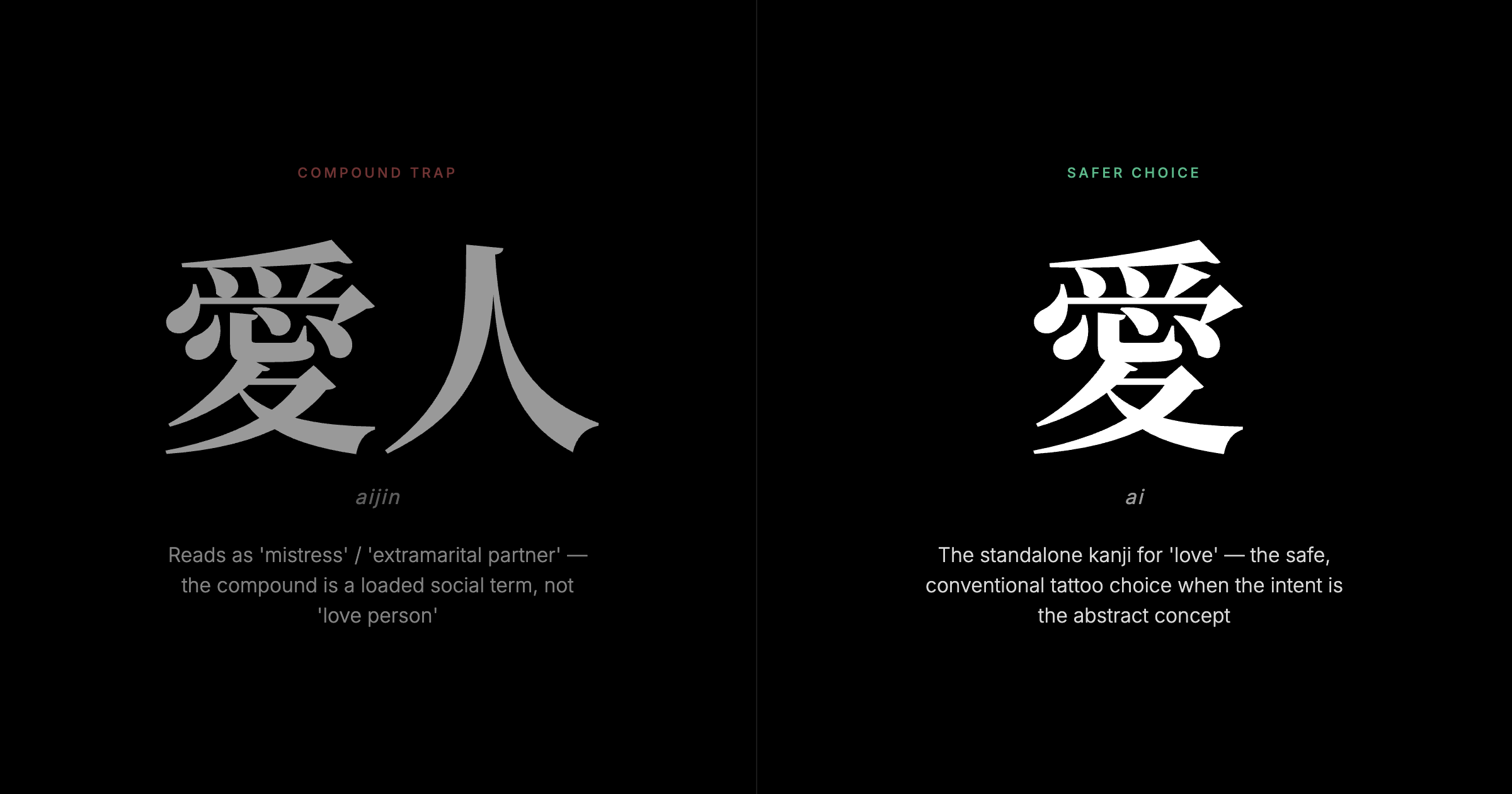
The three-step compound check:
- Search the full compound string in Jisho.org
- If a dictionary entry appears, note its primary meaning
- If that meaning does not match your intent, stop — do not proceed to tattoo
Layer 4 — Register and Naturalness Test
This is the layer that requires a human native reader.
The question is not "Is this grammatically correct Japanese?" Grammatical correctness is a low bar. The question is: "Does this read the way a Japanese person would actually say this — and would you write this on your body?"
These are the five specific questions to ask any verifier, whether a professional service or a trusted native friend:
- Is this grammatically correct Japanese?
- Is this the natural word a Japanese person would actually use for this concept?
- Does this read with the correct register — personal and expressive, not bureaucratic or clinical?
- Does the full compound have any secondary or loaded meaning?
- Is kanji the right script for this content, or would hiragana or katakana serve it better?
The fifth question matters more than most people expect — explored in full in the Script Choice section.
One important social note: Japanese culture maintains strong norms around avoiding embarrassment for others. A thoughtful Japanese friend who sees a problem with your design may soften their feedback to spare your feelings — confirming something is "fine" when it is technically correct but culturally flat. A professional verification service applies consistent tattoo-specific criteria without that social friction.
Layer 5 — Tattoo-Specific Criteria
The final layer applies criteria that are specific to permanent body art and don't apply to a translation you'd use in a letter or a conversation.
Ask four questions at this stage:
- Accuracy: Does this mean what you intend it to mean?
- Naturalness: Does this read the way a native speaker would express this concept?
- Aesthetic longevity: Will this read with the same dignity in 20 years? Trendy compounds age badly.
- Cultural resonance: What does this convey to a Japanese reader specifically? Does that match what you want to project?
The aesthetic longevity question is one most people forget to ask. Kanji fashionable in Western tattoo culture may carry a different weight to native readers — either because they've grown associated with foreign tattoo trends or because their register has shifted in modern usage.
How to Find a Qualified Native Verifier — And What to Ask Them
Not all native Japanese speakers are equally positioned to verify a kanji tattoo. The ranking by reliability: Tokyo-based professional verification service first, then a Japanese national raised and educated in Japan (ask the five questions explicitly), then a diaspora Japanese speaker (useful as a secondary check), then an advanced language learner (can catch grammar errors, unlikely to catch register errors), then machine translation (orientation only).
When evaluating a professional service, watch for: no mention of native speaker credentials; no specification of where verifiers were raised and educated; no distinction between "correct Japanese" and "reads naturally as a tattoo." A service that only confirms grammatical correctness is providing a fraction of the value you need.
The Compound Kanji Trap — The Mistake Most Verifiers Miss
The compound problem catches people who have already done a basic check. Its principle is simple and unforgiving: kanji compounds are not reversible from their components. The compound exists as an independent lexical unit in the Japanese mental lexicon. When a native reader sees a multi-character string, they are not doing addition — they are pattern-matching against a dictionary of fixed compounds, automatically and at the speed of reading. You cannot verify a compound by checking its characters one at a time.
The practical check takes two minutes: enter your full multi-character string into Jisho.org as a complete unit. If a dictionary entry appears, its meaning is what Japanese readers will see — regardless of what the individual characters mean in isolation. If that entry's meaning doesn't match your intent, stop before the appointment.
Real-World Verification Case Study — From Concept to Confirmed
Consider a typical scenario we see frequently in verification requests: someone wants the word "resilience" tattooed.
Layer 1 (Input Audit): Single abstract noun — moderate to high risk. The concept "resilience" is emotionally meaningful and untechnical in English, but it may map to very different registers in Japanese depending on which word is used.
Layer 2 (Multi-Tool Cross-Reference): Three tools, three different outputs:
- Google Translate returns 回復力 (kaifukuryoku — recuperative capacity; a term from physical therapy and engineering)
- DeepL returns 弾力性 (danryokusei — elasticity; a materials science term)
- Jisho returns 強靭さ (kyoujinsa — toughness; a nominalized form that sounds stiff as a standalone declaration)
All three are technically defensible Japanese. None is what the person would choose if they understood the registers. This is exactly the red flag the multi-tool check surfaces.
Layer 3 (Compound Check): 回復力 is a real dictionary compound confirmed by Jisho. Its definition is "recuperative power" or "resilience" in a clinical sense. Not wrong, but the register is a chart in a physical therapy office, not a personal declaration on someone's body.
Layer 4 (Native Naturalness Check): Asked the five questions, a native reviewer identifies two candidates that actually carry the emotional register of personal resilience:
- 不屈 (fukutsu — indomitable, unyielding; used in sports commentary, political speeches about perseverance, and news coverage of athletes returning from injury — carries the specific sense of refusing to be bent or broken)
- 忍耐 (nintai — patient perseverance through difficulty; appears in formal speeches and personal declarations; has Buddhist undertones that run through Japanese cultural expression)
Neither would have appeared in the machine translation outputs. Both are words a Japanese reader immediately recognizes as emotionally resonant personal declarations.
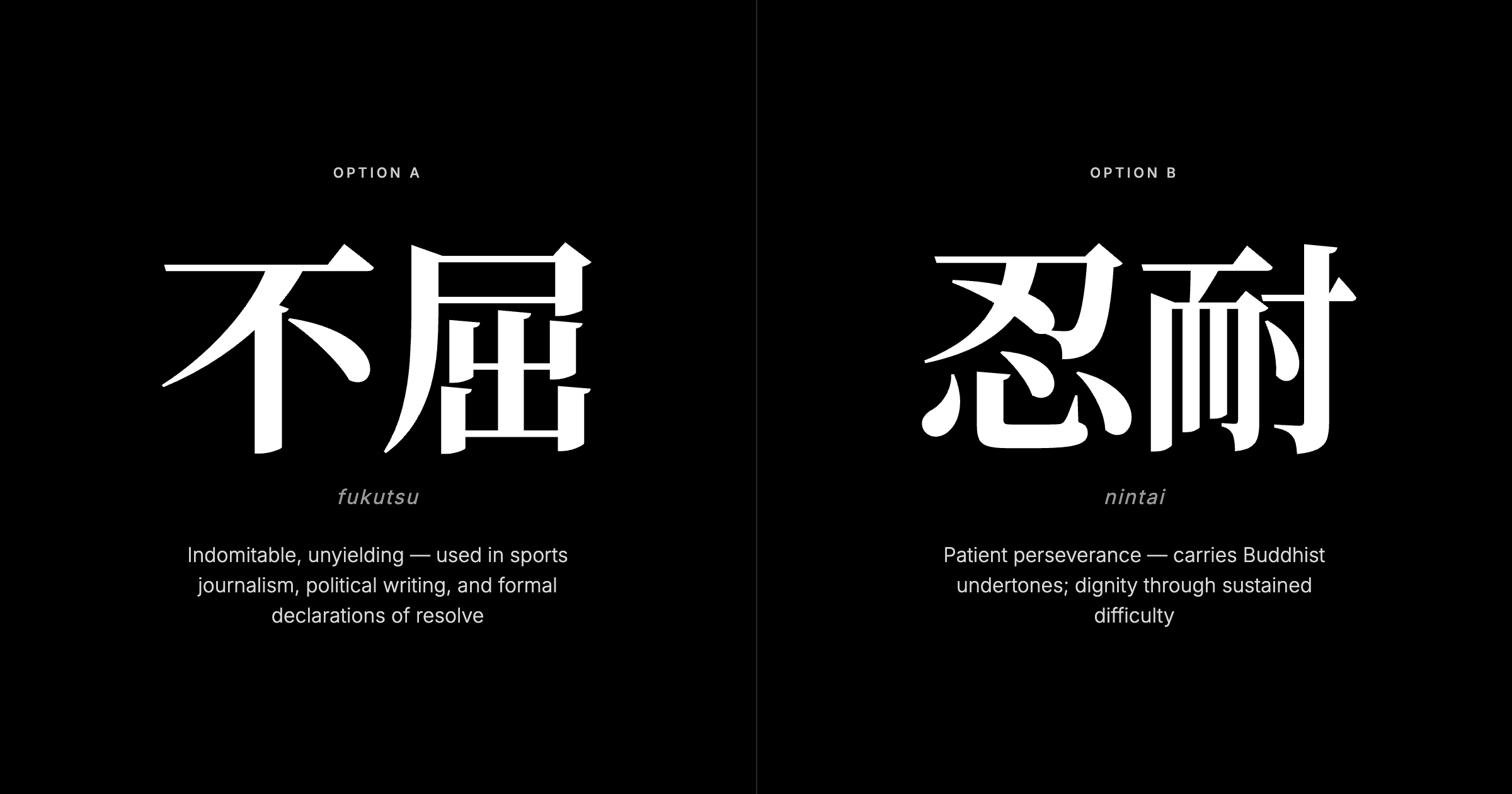
Layer 5 (Tattoo-Specific Criteria): The person chooses between 不屈 and 忍耐 based on which meaning feels truer to their own intent — not based on which one appeared first in a Google image search or looked more visually appealing as a standalone character.
The outcome: they go to the tattoo chair with a verified character, a clear explanation of its cultural register, and the knowledge of exactly what it will say to any Japanese reader who sees it.
If you're looking to start with a curated set of single kanji that have already passed native scrutiny at each layer, the guide to the best single kanji for tattoos provides 10 verified options ready for your own verification conversation.
Script Choice — When Kanji Is Not the Right Answer
Every verification guide in this space assumes you've already committed to kanji. That assumption deserves to be challenged earlier in the process.
Japanese has three scripts with distinct registers:
Kanji carries historical and literary weight — best for single-word declarations with deep cultural roots. Words like 誠 (makoto — sincerity, integrity; used in formal pledges and declarations of personal character) and 愛 (ai — love; ubiquitous in personal expressions and literature) belong here.
Hiragana reads with softness and intimacy. The word 愛 is a useful example: some people specifically prefer the hiragana form あい because it feels more direct and warm than the kanji character, which has grown visually associated with Western tattoo culture. One important caveat: あい is also a very common Japanese female given name written in hiragana, so a Japanese reader encountering this as a tattoo may read it as a personal name first, before the abstract concept of love. Confirm with your verifier whether that ambiguity suits your intent.
Katakana is the correct, dignified, immediately readable script for any non-Japanese name. When a non-Japanese name gets assigned kanji to match its sounds, three bad outcomes follow: the combination reads as an archaic Japanese name, a Chinese name, or a phrase with an unintended compound meaning. Katakana carries none of these risks. It signals to any Japanese reader: foreign name, written correctly. For the full breakdown of how katakana rendering works for foreign names — long vowels, double consonants, and phonetic approximations for sounds that don't exist in Japanese — see why foreign names belong in katakana, not kanji. The "reads as a Chinese name" failure mode is a specific subset of a broader trap — kanji and Chinese hanzi share most of their characters but diverge in meaning, register, and connotation in ways that catch even careful research. Our kanji vs Chinese hanzi tattoo guide maps that overlap and its false cognates.
Script choice belongs in Layer 5. A qualified native reviewer should address it explicitly.
Native Verdict — What Tokyo Readers Actually See
KIO Native Verdict
When I read kanji on a foreigner's body, I'm not reading it the way they intend it — as a personal statement to the world. I'm reading it as text. That's automatic. I can't turn it off. In the same instant I process the visual shape, I'm classifying the register (Is this formal? Casual? Literary? Bureaucratic?), checking for compound associations, and evaluating whether the form matches the intended context. This takes no effort and happens before any conscious evaluation.
What triggers 格好悪い (kakkowarui — uncool, embarrassing; the colloquial opposite of 格好いい kakkoii, "cool", used when something looks bad or visibly falls short of its apparent intent) is not an offensive kanji. Offense is rare. Japan doesn't apply a strong cultural appropriation framework to kanji, and Japanese people freely adopt elements of other cultures. What gets read as 格好悪い here is the mismatch between evident intent and actual execution: the person clearly wanted to project something meaningful, and the text is projecting something wrong. The intent was visible. The failure is visible too.
The register errors are the hardest ones to describe to someone who doesn't feel them automatically. A kanji that's technically correct but in the wrong register — the clinical word where a personal word belongs, the bureaucratic form where a living phrase belongs — reads as visibly foreign-produced. Not wrong in the dictionary sense. But immediately identifiable as something a native speaker would never have chosen for their own body. That gap is what native verification closes.
In Tokyo specifically, there's a second layer. The historical association between tattoos and organized crime hasn't disappeared from formal settings — it's present in onsen rules, workplace policies, the background awareness of any formal context. This doesn't make tattoos wrong or unwelcome; Tokyo's younger generation has a genuinely active tattoo culture. But it does mean that a wrong or comical kanji does double social work: it signals cultural outsider, and it signals a careless cultural outsider. For someone who travels to Japan and cares about how they're received, that compound social signal is worth thinking about before the appointment.
What professional verification actually provides is this: the tattoo is read the way it will actually be read, by a brain that reads Japanese natively, before it becomes permanent. That simulation is what the unverified tattoo skips.
Frequently Asked Questions
Can I just ask a Japanese friend to check my kanji tattoo?
Yes, and a native Japanese friend is far better than any machine translation tool. Three caveats apply: ask someone raised and educated in Japan, since diaspora speakers may have different intuitions about current native reading norms; ask the right questions — not just "is this correct?" but "would you write this on your body?" and "does this sound natural?"; and be aware that Japanese social norms around not embarrassing others may cause a thoughtful friend to soften their honest assessment. A professional service applies consistent tattoo-specific criteria without that social friction.
Is there a free way to verify kanji before getting tattooed?
Partially. Running the full five-layer framework described in this article — input audit, multi-tool cross-reference, Jisho.org compound check, native naturalness check, script-choice assessment — costs nothing if you have a qualified native Japanese contact. The compound check via Jisho.org is free. The native naturalness layer is free if you know the right person to ask. The bottleneck is finding a qualified native reviewer with tattoo-specific judgment who will give you honest feedback rather than polite reassurance.
What is the difference between kanji, hiragana, and katakana for tattoos?
Three scripts, three functions: kanji are Chinese-derived characters carrying historical and literary weight, best for single-word declarations with deep cultural roots; hiragana is the flowing phonetic syllabary that reads with softness and intimacy, appropriate for phrases and emotional words where flowing aesthetics contribute to the meaning; katakana is the angular phonetic syllabary Japan uses for foreign words and names — the correct and dignified choice for any non-Japanese name. Choosing the right script is part of the verification process, not a stylistic afterthought.
How do I know if my kanji forms a wrong compound word?
Run the full multi-character string through Jisho.org as a unit — not character by character, but as a complete string. If Jisho returns a dictionary entry for the full compound, check whether that meaning matches your intent. Japanese readers process multi-character strings as single compound words, not as sequences of individual characters. If your intended kanji forms an existing compound with an unintended meaning, that compound meaning overrides everything else.
Should my name be written in kanji or katakana?
Katakana for almost every non-Japanese name. Japan officially uses katakana for foreign words and names — it is immediately readable by any Japanese person as a foreign name and carries no false implications. Assigning kanji to foreign name sounds produces three bad outcomes: it may read as an archaic Japanese name, a Chinese name, or a random-seeming phrase depending on which characters are mapped to the sounds. Katakana is the honest, dignified, correct choice for foreign names.
Do Japanese people care if foreigners get kanji tattoos wrong?
Offense is uncommon — Japan does not have a strong cultural appropriation framework around kanji, and Japanese people freely adopt elements of other cultures. The more common reaction is 格好悪い (kakkowarui — uncool, embarrassing; the colloquial opposite of 格好いい kakkoii, "cool"). The social register reads less as contempt and more as secondhand embarrassment on the wearer's behalf when visible effort and visible execution don't line up. In Tokyo, historical associations between tattoos and organized crime persist in formal settings, so a wrong or comical kanji compounds the social signal: it reads simultaneously as "cultural outsider" and "careless cultural outsider." For the full picture of when a kanji tattoo is and isn't cultural appropriation, see whether kanji tattoos are cultural appropriation.
How long does professional kanji tattoo verification take?
Professional native-speaker verification services typically return results within 24–48 hours for standard requests. Compare this to the timeline for laser tattoo removal — multiple sessions scheduled weeks apart, each requiring healing time — or a cover-up tattoo that requires designing around a previous mistake. Pre-ink verification is measured in hours; post-ink correction is measured in months.
What happens if my tattoo artist says the kanji is fine?
A tattoo artist's endorsement of kanji accuracy is only as reliable as their Japanese language knowledge. Most non-Japanese tattoo artists have no ability to read kanji — they can reproduce a design accurately but cannot evaluate its meaning, register, or naturalness. Even Japanese tattoo artists whose strength is visual design rather than linguistic judgment may not catch register errors or compound failures. The verification must come from a qualified native reader with tattoo-specific criteria, not from the person holding the tattoo machine.
Pre-ink verification is the most efficient intervention in the kanji tattoo process — a few hours of careful checking against the permanent alternative of laser removal or a cover-up. Kanji Ink Oracle provides Tokyo-native verification by reviewers raised and educated in Japan, applying tattoo-specific criteria that go beyond grammatical correctness. If your appointment is approaching and the kanji isn't confirmed yet, that's the window to act.