Is My Kanji Tattoo Wrong? A 5-Minute Self-Check Guide
Wondering if your kanji tattoo is wrong? Use this Tokyo-native diagnostic: 5 red flags, 3 error categories, and real options if you find a problem.
You got inked, you were happy, and then someone planted a seed of doubt. A Japanese friend went quiet when they saw it. You read an article about mistranslations. That moment of uncertainty is exactly what this guide is for.
The good news: you can run a credible self-assessment right now. Even if something is off, "wrong" is rarely permanent — and it's not the end of your story.
The Question Everyone With a Kanji Tattoo Asks Themselves
You are far from alone in this. The structural problems in Western kanji tattoo research are real: Google Translate, online "kanji generators," Pinterest boards, screenshots passed to a tattooist who checked on the same tool. These errors are almost invisible until someone with native fluency looks at the result.
The canonical celebrity example is Ariana Grande's widely reported 2019 tattoo, which was intended to read "7 Rings" but initially read more like "small charcoal grill" (七輪, shichirin — a portable charcoal grill used for cooking). It was later corrected. Most people don't have Grande's resources. For a detailed breakdown of what went wrong in her case — and four other documented celebrity kanji fails, each tied to a specific, diagnosable error — see famous celebrity kanji tattoo fails.
Errors that cause genuine distress fall into three categories: words that mean something crude or embarrassing, characters that look right but aren't the right character, and grammatically possible phrases that no Japanese speaker would naturally write. This article is a diagnostic tool to identify which category you might be in — and what to do next.
The 5-Point Red Flag Checklist
Work through these questions honestly. Three or more flags means high-probability risk worth investigating.
Flag 1: You used Google Translate, an online kanji generator, or AI to choose the character. These tools produce dictionary-accurate outputs that often carry the wrong register — formal, clinical, or archaic — for a personal tattoo context. Many viral kanji trends on social platforms originate exactly this way; the TikTok aura kanji trend is a detailed case study of how a translation-tool output gains credibility through viral spread. If you specifically used AI generators like ChatGPT or Stable Diffusion, note that AI kanji generators carry a distinct risk beyond register issues: hallucination of characters that don't exist in Japanese.
Flag 2: You didn't show the design to a native Japanese speaker before getting inked. "Native" means someone who grew up reading and writing Japanese. The gap between studied and lived Japanese is significant enough to matter here.
Flag 3: You got it done at a shop without kanji or Japanese specialization. Most tattoo artists are excellent at their craft but are not language experts. They will confirm a design by searching online — which returns the same sources you started with.
Flag 4: Your artist confirmed the design using the same tool you used. This is a closed loop. The error can't be caught because no one in the chain actually reads Japanese.
Flag 5: You chose it based on how it looks, not what it means in context. Visually dramatic characters are often chosen precisely because they appear "powerful" to non-readers. Visual impact and semantic accuracy are independent variables.
If three or more flags apply, you have meaningful reason to investigate. That's not a verdict — it's a prompt.
Three Categories of Kanji Tattoo Errors
Not all kanji tattoo errors are equal. Understanding which category a potential error falls into changes your options and the urgency.
Category 1 — Mistranslation (Medium Severity)
The character or phrase is real Japanese, but it means something different from what you intended. This is the most common category and the most forgiving, because the gap is a meaning gap rather than a structural one.
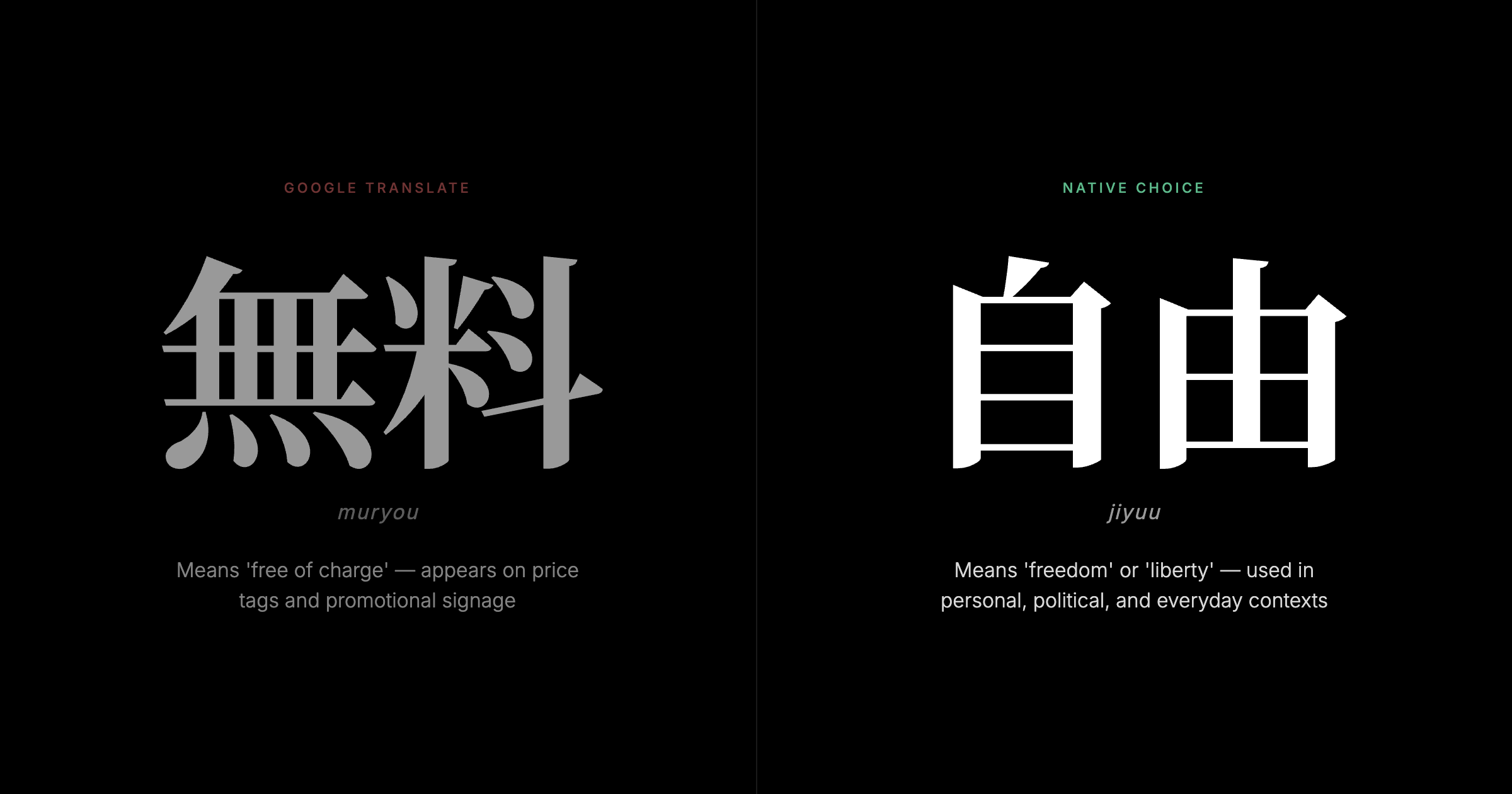
A common example: 無料 (muryou — free of charge; the word on price tags and service listings when something costs nothing). A non-reader sees "free" in the translation and chooses it for a tattoo about personal freedom. But 無料 is the commercial register for "no cost" — it has about as much poetry as a promotional flyer. The word for personal freedom is 自由 (jiyuu — freedom, liberty; used in everyday speech, political writing, and personal declarations across a wide range of registers).
Similarly, 愛人 (aijin — literally "love person," but the actual modern meaning is mistress or lover in the sense of an extramarital affair; appears in news reporting and drama plotlines to describe infidelity). Someone wanting to tattoo "lover" or "beloved" will find 愛人 is a dangerous choice. The character they likely want is 愛する (aisuru — to love; the verb, used in personal declarations) or simply 愛 (ai — love; used across registers from greeting cards to formal poetry).
Category 2 — Visual Confusion (High Severity)
The character tattooed is real, readable Japanese — just not what the person intended. These are errors invisible to non-readers but immediately apparent to any Japanese speaker.
The most notorious example involves 痔 (ji — hemorrhoids; a clinical term that appears in pharmaceutical advertising without embarrassment, but not a concept anyone intends as a permanent personal statement). The character has visual weight that reads as "complex and significant" to non-readers; to a Japanese speaker, it reads as a medical complaint.
This category also includes cases where a visually similar character — one radical different — was chosen by mistake. A single stroke change can shift a character's meaning entirely.
Category 3 — Compound Trap (Severe, Context-Dependent)
Individual characters are correct, recognizable Japanese — but the combination doesn't form a natural phrase. Japanese phrase-building follows rules that don't map neatly onto Western intuitions about combining "strong meaning" words.
Based on thousands of verification requests reviewed by KIO's Tokyo-native team, this is the most frequently occurring error category. The issue isn't a bad character — it's combining characters the way you'd translate literally from English, producing something technically parseable but unnatural or artificially formal.
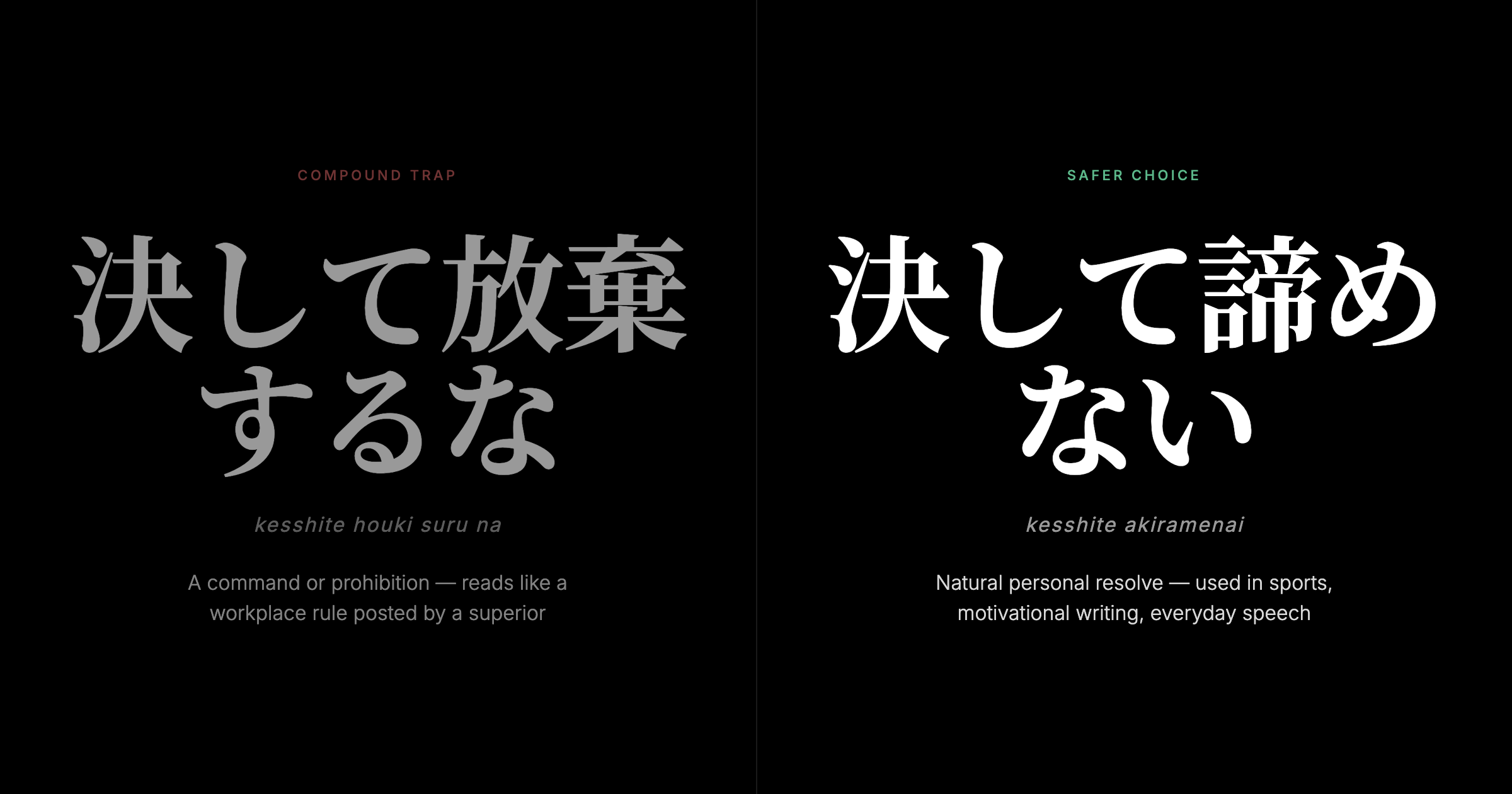
Consider a typical example: someone wanting "never give up" runs variations through translation tools. One output might be 決して放棄するな (kesshite houki suru na — literally "do not abandon"; a direct prohibition or command from a superior). The grammar works, but it reads as an order or prohibition — the grammar is a command issued to someone else, not a declaration of personal will. The natural phrase for personal resolve is 決して諦めない (kesshite akiramenai — never give up; used in sports commentary, motivational writing, and everyday speech).
A related trap: 家庭 (katei — household, the domestic unit; refers to home life and the household setting as a structural concept — rather than the warm relational sense of the people in your family) versus 家族 (kazoku — family, in the sense of the people you belong to; used in everyday speech and personal declarations). Both translate as "family" in a dictionary. They carry very different emotional registers in actual use.
Compound register shift — when the craft label obscures the philosophy. Someone deeply engaged with kintsugi philosophy—understanding wabi-sabi, impermanence, acceptance of damage—may choose 金継ぎ without realizing that to a Japanese reader it names the pottery repair technique, not the philosophical concept. The characters are technically correct; the gap is between what the wearer intended to express and what the kanji actually conveys. The kintsugi tattoo kanji article breaks down exactly why this happens and how native readers perceive the mismatch.
What a Native Japanese Speaker Actually Sees
When a Japanese person reads a kanji tattoo, they notice three things a non-reader cannot.
First: completeness. Kanji are built from radicals — the component strokes that carry semantic meaning. A missing or malformed radical changes the character entirely. The character 愛 (ai — love; used across registers from everyday affection to formal writing) contains 心 (kokoro — heart, mind; a core radical in emotion-related kanji) as a component. An artist who doesn't fully execute that radical produces something that reads as broken.
Second: register. Japanese vocabulary carries clear formality levels. Certain phrases belong in legal documents or formal speeches — and when these appear as tattoos, a native reader feels a specific kind of unease: technically possible, but contextually wrong. It's like hearing someone use correct grammar in the wrong context. You can parse it; you know something's off.
Third: calligraphy. Even a correctly chosen character can look wrong if drawn without knowledge of Japanese stroke-order conventions. Japanese calligraphy (書道, shodou — the art of calligraphy; taught in schools as a fine art) has aesthetic standards that a Western tattoo artist without specialist training may not reproduce accurately.
What natives generally don't do is judge the person. The reaction is closer to curious puzzlement than condemnation.
The Self-Diagnosis: Testing Your Tattoo at Home
If the red flag checklist has you worried, here is a practical process for an honest assessment.
Step 1: Get a clear image. Photograph the tattoo in good natural light, characters fully legible. If the tattoo has faded or healed unevenly, that affects readability — useful information in itself.
Step 2: Take it to a language community, not a tattoo community. Post anonymously to subreddits focused on Japanese language learning or linguistic communities where native speakers participate. Tattoo communities trend toward encouragement; language communities trend toward accuracy. You need accuracy here.
Step 3: Ask the questions that matter. Ask two things separately: "What does this actually mean, including unintended meanings?" and "Is this phrase something a native Japanese speaker would naturally write?" These are different questions.
Step 4: Distinguish wrong from unnatural. "Wrong" means the characters carry a different meaning from your intent. "Unnatural" means the characters are correct but the phrasing sounds odd — grammatically possible, but nobody writes this way in real Japanese. Wrong is a clearer problem; unnatural is more subjective.
For the most reliable result, a professional native verification service returns a structured, accountable verdict rather than a range of crowdsourced opinions.
If It's Actually Wrong: Your Real Options
Finding out your tattoo has an error is not the end of the story. Here are your genuinely viable paths — none of which involves shame.
Option 1 — Accept it as part of your story. Some people, on learning what their tattoo actually means, choose to own that as part of their history. If you're genuinely comfortable with the actual meaning, this is a valid path.
Option 2 — Cover or incorporate into a new design. A skilled kanji specialist can often work an existing character into a larger composition that changes or intentionally reclaims the meaning. Expect roughly 30–60% additional cost over the original, depending on complexity.
Option 3 — Remove and redo. Laser removal of kanji is generally effective — the characters are typically small and black. Plan for 6–12 months of sessions before the skin is ready for new work.
Option 4 — Reframe with a calligrapher. A Japanese calligrapher can sometimes assess whether existing strokes can be incorporated into a larger phrase or design. This requires the original work to have enough structural integrity to build from.
The worst option isn't any of the above — it's years of doubt without a decision. Getting a clear answer, then acting on it, is always better than sustained anxiety.
Native Verdict: What Tokyo Readers Actually Notice
Not all kanji tattoo errors carry the same visibility. Understanding the difference changes how urgent your situation actually is. For a deeper look at the native perspective on kanji tattoos — both correct and incorrect — from Tokyo-based reviewers, see what Japanese people actually think when they see your kanji tattoo.
Immediately visible: Characters with clinical or crude meanings — 痔 (ji, hemorrhoids) or 糞 (kuso — feces; recognizable to any literate Japanese person immediately) — are noticed the moment someone reads them. The reaction is typically private amusement rather than confrontation, but the recognition is automatic and unavoidable.
Subtle register errors: An unnaturally formal phrase reads more like an odd curiosity than a clear error. Many Japanese people would interpret it charitably without identifying the precise problem. These occupy a middle ground — not mortifying, but not quite right either.
Compound traps: An unnatural phrasing using correct individual characters often passes unnoticed until someone reads it carefully and thinks "nobody actually says this." In casual encounters, these can fly entirely under the radar.
Calligraphic issues: A correctly chosen character drawn without proper stroke-order knowledge reads as "non-native brushwork" — like hearing a foreign accent, the viewer perceives something is different without being able to name the specific issue. Understanding why stroke order matters for kanji tattoos helps explain what native readers are detecting: whether an artist grasps the anatomy of the character or is working purely from visual imitation.
The KIO angle on this is not about shaming people. It's about helping you understand the actual risk level so you can make an informed choice: accept it, modify it, or start fresh. A technically "wrong" tattoo can still be meaningful and worth keeping. A tattoo that reads as immediately crude to any Japanese speaker is a different situation. Knowing which one you have is the point.
Frequently Asked Questions
How can I tell if my kanji tattoo is wrong without showing it to someone?
You can't reliably self-assess without reading Japanese. Check the red flags: Did you use Google Translate or an online generator? Can you explain the grammatical structure — not just the intended meaning — of any phrase? If you can't answer that last question, it's high-risk. The most reliable next step is posting anonymously to a Japanese language community or using a native verification service.
I think I got a character that means something crude. How bad is this?
It depends on the character and your comfort level. Characters with crude meanings — 痔 (ji, hemorrhoids) is the most cited example — are immediately recognizable to Japanese readers. Many people carry these tattoos without serious regret, treating them as part of their story. Options: own it, cover it in a new design, or remove and redo. All are valid. Indefinite shame without a decision is the least useful response.
Can a tattoo artist fix it if it's wrong?
Yes, with limitations. A kanji specialist can often incorporate an existing character into a new design — typically 30–60% additional cost. For small, isolated characters, laser removal followed by new work is often more reliable than a coverup alone. Regardless of the approach, get a native speaker to approve the new design before sitting down.
What's the difference between a "wrong" kanji tattoo and one that just sounds unnatural?
"Wrong" means the character carries a different meaning from your intent — 無料 (muryou, "free of charge") when you wanted 自由 (jiyuu, "freedom"). "Unnatural" means the characters are correct but the phrase sounds odd or dated to native speakers — grammatically parseable, but not how anyone actually writes. Wrong has a clearer fix; unnatural is more subjective. Both are worth checking before inking.
Is it true that kanji can look different in tattoo form versus on a screen?
Yes, partly. Screen fonts are standardized; tattooed kanji depend on the artist's knowledge of the script style (regular, cursive, seal script, and others). An artist without Japanese calligraphy training may produce something technically correct in meaning but aesthetically off in execution — the strokes don't match what a native reader expects to see.
Should I be embarrassed if I find out my kanji tattoo is wrong?
No. The structural problems in Western kanji tattoo research are real and difficult to see from the outside. You made a good-faith decision with available tools; those tools failed you. Thousands of people have found themselves here after careful research. The move that matters is taking action: getting a clear assessment and making a decision about what comes next.
If any of what you've read here has raised a real question about your tattoo, the most useful move you can make is getting a clear, structured answer from a native Japanese reader — not a translation app, not a crowdsourced opinion thread, but someone who grew up reading and writing the language professionally.
Verify your kanji at Kanji Ink Oracle — Tokyo-native reviewers assess the meaning, register, naturalness, and calligraphic execution of your design and return a full written verdict. If you're still pre-ink, the same service helps you confirm that what you're planning to put on your body says exactly what you think it says.
Further Reading
Explore these related guides to deepen your understanding of kanji tattoo verification:
- Why Google Translate Fails for Kanji Tattoos — How machine translation tools miss register, context, and natural phrasing
- What to Do If Your Kanji Tattoo Means Something Else — Repair options and next steps if your tattoo has an error
- How to Verify a Kanji Tattoo Before Getting It — The complete checklist before you commit to permanent ink
- What to Do If You Already Have a Wrong Kanji Tattoo — Detailed cost and timeline comparison for quick rework, cover-up, and laser removal options