Kanji vs Hanzi Tattoos: How Japanese and Chinese Characters Diverged
Kanji and hanzi share roots but diverged for centuries. Learn visual, meaning, and cultural differences a Tokyo native checks before your tattoo.
You've landed on a character that looks powerful, elegant, or deeply personal — and now you're second-guessing whether it's actually Japanese kanji or Chinese hanzi. That anxiety is well-placed. The kanji vs hanzi difference matters more than most tattoo seekers realize: these two writing systems share a long common history, which makes them easy to confuse and hard to distinguish without guidance. The difference between the right character and the almost-right one is the difference between a tattoo you wear proudly and one you quietly cover up.
This guide explains, in plain terms, exactly how kanji and hanzi diverged, where they still overlap, and what that means for your tattoo decision.
The Historical Origin Story
What's the difference between kanji and hanzi at the root? Japan had no written language before the 4th or 5th century CE. When writing arrived through contact with China, it came in the form of Chinese characters. The Japanese adapted that writing system to map onto words that already existed in spoken form — they didn't borrow a language, they borrowed a notation system. That distinction matters for everything that follows.
Defining the terms: Kanji (漢字) are the characters used in modern Japanese writing, evolved from Chinese origins but shaped by centuries of independent development. Hanzi (汉字) refers to Chinese characters as used in China, Taiwan, and Hong Kong. While they share visual and historical roots, they've diverged significantly in form, meaning, and cultural usage.
Over the centuries, this adaptation produced kanji: characters that often look identical or nearly identical to their Chinese counterparts but carry different pronunciations, nuances, and sometimes entirely different meanings.
The divergence accelerated after World War II. Japan introduced shinjitai (新字体 — shinjitai, "new character forms"; Japan's 1946 post-war simplification standard), streamlining several hundred characters. Mainland China undertook its own, far more sweeping simplification after 1949. Taiwan and Hong Kong retained the traditional forms. A single concept can now exist in three visually distinct forms: Japanese kanji, traditional Chinese, and simplified Chinese.
When someone searches "kanji for strength," what they find is a mix of all three with no labels telling them which is which.
Visual Differences: Why the Same Character Looks Different
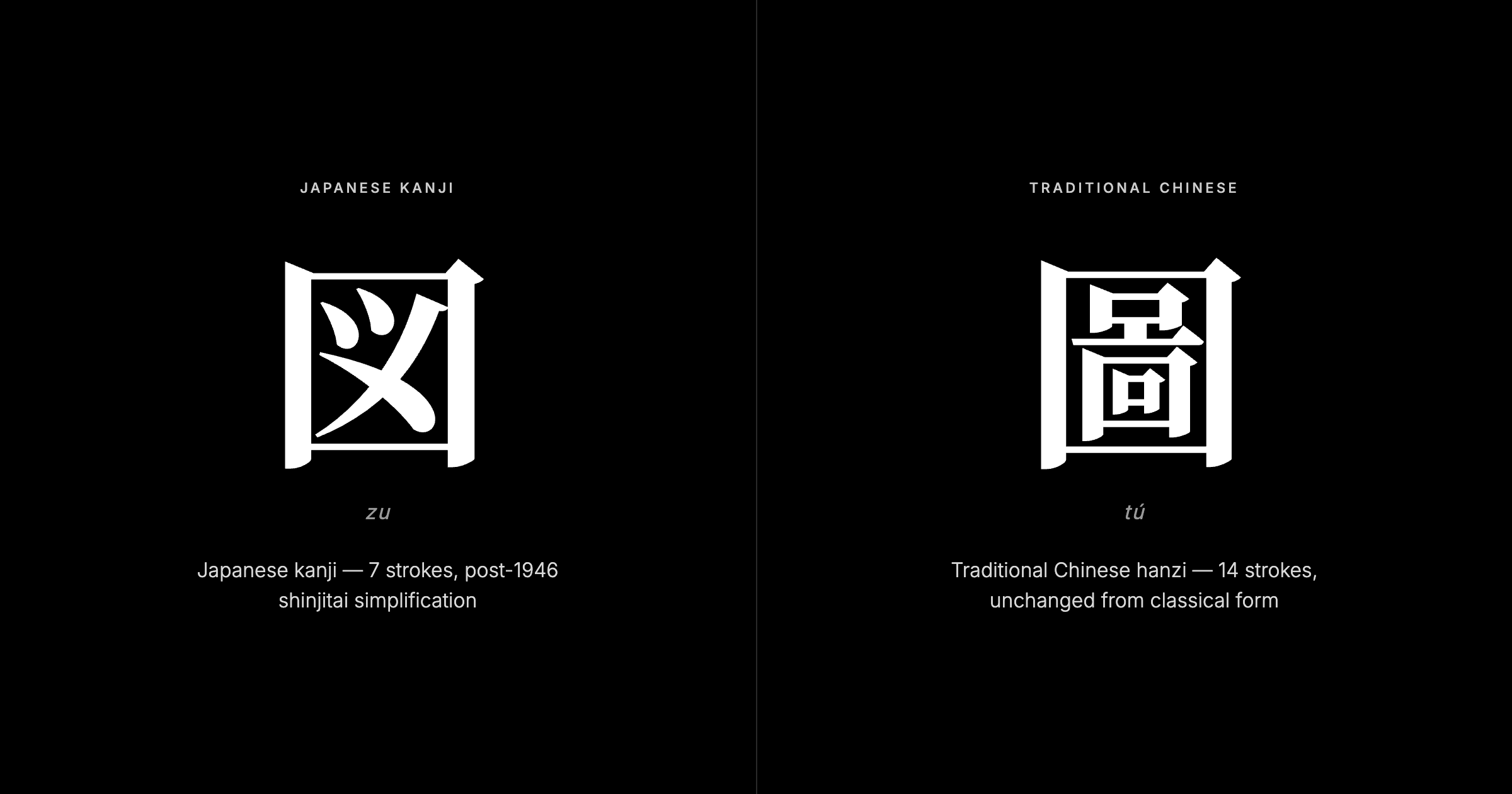
The simplification systems diverged in different directions and to different degrees. Japan retained more strokes than mainland China in many characters; some Japanese forms look closer to traditional Chinese than to simplified Chinese hanzi. The following comparison illustrates how common characters split and why visual confusion is common among people researching Japanese vs Chinese characters for tattoos:
For 図 (zu — diagram, map; used in Japanese school textbooks, signs, and design contexts): the Japanese kanji uses 7 strokes; the traditional Chinese form 圖 uses 14; simplified Chinese 图 uses 8. They're recognizably related but visually distinct.
A similar split appears in 学 (gaku — learning, study; the character on school crests and graduation certificates throughout Japan) versus traditional 學 and simplified 学. Japan and simplified Chinese happen to share the same reduced form here, but the traditional form looks entirely different.
Based on analysis of thousands of verification requests reviewed by KIO's Tokyo-native team, the most common visual error occurs when a client presents a simplified Chinese character — sourced from a tattoo flash sheet or a Pinterest board — while believing they've researched a kanji. According to native Japanese speakers who review these requests, the two writing systems can look similar or even identical at small sizes, but a native reader will spot the difference immediately through automatic pattern recognition developed over a lifetime of reading.
The practical implication for tattoo seekers: when you see a character online, the source matters as much as the character itself. A result from a Mandarin dictionary is not a kanji result even if the characters overlap visually.
Pronunciation and Meaning: The Hidden Landmine
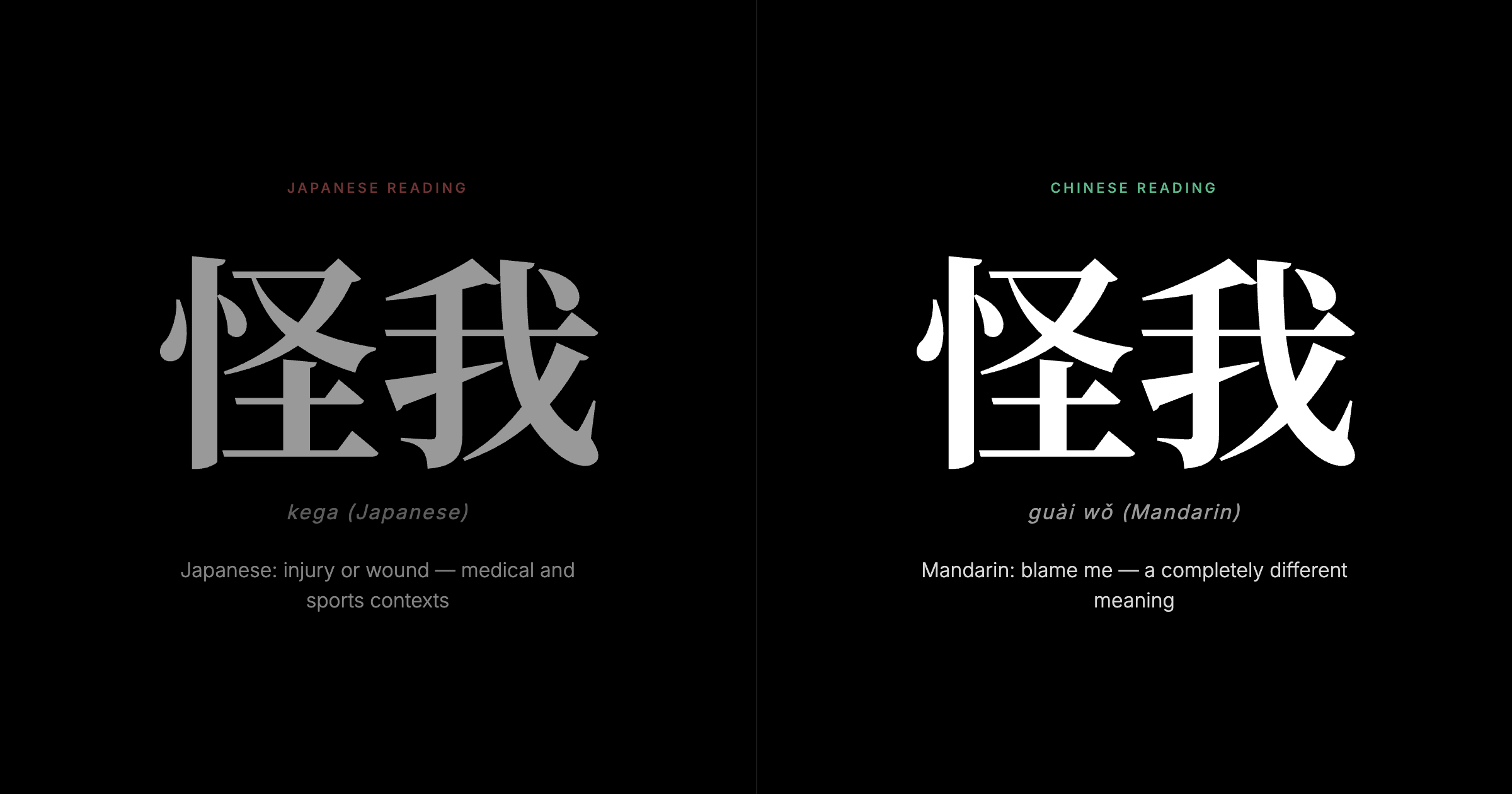
Shared origin does not guarantee shared meaning. In some cases, kanji characters and their Chinese hanzi counterparts have developed into false cognates — characters that look the same visually but mean different things in Japanese versus Chinese. This is one of the most dangerous traps in kanji vs hanzi tattoo selection because visual verification alone will miss it entirely.
The clearest example: 怪我 (kega — injury, wound; a word you'd see on medical intake forms and sports injury reports) is how it reads in Japanese. In modern Mandarin, the same two characters 怪我 (guài wǒ) mean "blame me." A tattoo reading "injury" in Japanese and "blame me" in Chinese is not a hypothetical risk — it is a documented type of false cognate error that a monolingual verification check will miss entirely.
Another example: 勉強 (benkyou — study, learning; the word Japanese students use for homework and exam prep) carries a markedly different sense in Mandarin. The Chinese reading 勉强 (miǎnqiǎng) means doing something reluctantly or with difficulty, or being barely sufficient — closer to "grudgingly" or "just barely" than to the Japanese meaning of dedicated effort. The Japanese word celebrates the act of studying; the Chinese word implies the effort is grudging or only marginally enough.
This divergence has a structural cause. Japanese adopted Chinese characters to represent an already-existing spoken language, so the meanings evolved independently over centuries. Kanji in Japanese also carry two reading systems — on'yomi (Chinese-derived pronunciation) and kun'yomi (native Japanese pronunciation) — while Mandarin generally has one reading per character. That structural gap is wider than the visual similarity suggests.
The tattoo consequence: if your goal is a Japanese kanji tattoo, meaning verification in Mandarin alone is not sufficient. A tattoo that reads cleanly in both languages requires independent verification from native speakers of both.
Kokuji: Characters That Only Exist in Japanese
Definition: Kokuji (国字, literally "national characters") are kanji characters created in Japan without any Chinese precedent. Unlike most kanji, which evolved from Chinese forms, kokuji were invented by Japanese scholars and calligraphers, typically by combining existing radicals in new ways. They are a small but culturally significant part of the Japanese writing system, and they represent one solution to the kanji vs hanzi ambiguity problem.
The most widely used kokuji is 働 (hataraku — to work, labor; the character you see on employment contracts, job listings, and labor law documents throughout Japan). It was formed by combining the person radical 人 with the character for movement 動. No Chinese dictionary contains 働 because it was never a Chinese character.
Kokuji cannot be misread through the false-cognate mechanism — they don't exist in Chinese. A Chinese-speaking person seeing 働 would recognize the component radicals but wouldn't assign it a Mandarin reading, because there isn't one.
The trade-off is recognition. Kokuji are less familiar to Western tattoo seekers and don't appear in mainstream tattoo flash sheets. A Japanese tattoo artist would know them well; an online image search is unreliable for finding them accurately labeled.
The Tattoo Minefield: Why You Can't Just Google It
Tattoo gallery sites, Pinterest boards, and even dedicated "kanji tattoo" blogs frequently mix Japanese kanji, traditional hanzi, and simplified hanzi without clearly labeling them. The photographs look authoritative. The calligraphy looks beautiful. The captions say "kanji." But the character in the image might be simplified Chinese. This is the core reason kanji vs hanzi tattoo confusion remains so common: the web has no visual distinction system for distinguishing between Japanese and Chinese character forms.
Consider a typical scenario: someone researching a tattoo for "strength" runs a Google search, finds a character in multiple flash sheets, and books an appointment. At no point did they verify whether the character was the Japanese kanji 力 (chikara — power, physical strength; used in motivational contexts, sports media, and everyday declarations of effort) or one of its Chinese forms, or whether the specific form was even the most natural choice in modern Japanese.
For concrete examples of kanji that have been verified to be the correct Japanese forms — including 力 and nine other best choices for single kanji tattoos — see the verified guide to the best single kanji for tattoos.
A character can be technically valid in one writing system but feel dated or strange to native readers in the target culture. Characters common in classical texts may read oddly on a contemporary tattoo to a native speaker under 50. This is the "technically correct but culturally off" problem that no dictionary flags — because dictionaries don't measure how a word actually feels in current use.
For a closer look at how machine translation fails at exactly this kind of register and nuance question, see Why Google Translate Gets Kanji Tattoos Wrong. And if you've already been tattooed and are now uncertain about the result, the five-minute self-check for whether your kanji tattoo is wrong is the right next step.
Native Verdict: What Only a Japanese Native Knows
Native Verdict — KIO's Tokyo-native reviewers share what they see in kanji vs hanzi distinctions that visual verification alone will miss.
How native readers distinguish kanji from hanzi: A Japanese native reads kanji the way a native English speaker reads English — not character by character, but in whole-word and whole-phrase pattern recognition. That means the wrong form of a character registers as wrong immediately, before they've consciously analyzed it. This automatic recognition happens because kanji characters are learned through years of reading newspapers, books, and digital media in modern Japanese.
What separates native expertise from dictionary knowledge: When a KIO reviewer encounters a simplified Chinese character presented as a kanji tattoo, the visual mismatch registers instantly — it's the difference between seeing a word spelled with the wrong letter. That mismatch is invisible to anyone who learned the characters from an image search rather than from reading Japanese fluently over decades.
Beyond the visual, a Tokyo native brings something no dictionary provides: the sense of which characters feel alive in modern Japanese and which have retreated into formal or archaic registers that would read as unusual on a personal tattoo. Some characters are standard in Chinese but carry literary weight in Japanese that shifts the tattoo's meaning in ways the wearer never intended.
A KIO review asks not just "is this character correct in Japanese?" but "is this character choice culturally intelligent for the meaning you're expressing?" Only a native can answer both.
The cases documented in my kanji tattoo means something else show exactly how this gap between intent and reception plays out — and what people did next.
How to Choose: A Pre-Ink Verification Checklist
The most important decision happens before you pick a character: commit to one writing system. Kanji for a Japanese cultural connection; hanzi if your intent is Chinese. Trying to find a character that "works in both" requires independent verification in both languages — and the cases where it works cleanly are narrower than most people expect. If you've committed to the kanji path, our framework for choosing meaningful kanji for tattoos covers the selection logic — register, compound traps, and what to bring to a native verifier — before we get into the kanji-vs-hanzi specifics below.
Once you've committed, follow the six-step kanji vs hanzi verification process below to catch the errors that dictionaries miss:
-
Commit to the target culture. Japanese or Chinese? This determines everything downstream. If Japanese, your research sources should be modern Japanese: newspapers, textbooks, native social media, contemporary tattoo artists based in Japan.
-
Verify the specific form. Confirm you have the right variant by checking Japanese kanji in sources like Jisho.org, not just image results. Don't rely on appearance alone.
-
Check all three forms. Look at the traditional Chinese, simplified Chinese, and Japanese shinjitai versions. Understanding the differences tells you what you're committing to and helps you spot if the artist has the wrong variant.
-
Research meaning in context. Look up the character in actual sentences, not just a dictionary gloss. Is it formal, casual, archaic, or contemporary?
-
Check for false cognates. Search the character in both Japanese and Chinese. If you're getting a Japanese kanji, confirm the same character doesn't carry unintended meaning in Mandarin, since Chinese-speaking people will encounter your tattoo too.
-
Native verification before the appointment. This is the step most people skip. It is the only step that catches register problems, culturally unusual usage, visual form errors, and false cognates that all previous steps can miss.
The full framework is in How to Verify a Kanji Tattoo Before Getting It, which covers each layer in detail and explains what a verification review actually examines.
Ready to run your character through a Tokyo-native verification before you commit to ink? Kanji Ink Oracle provides professional assessments from native Japanese reviewers — covering visual form, meaning accuracy, register, and cultural fit — returned within 24 hours.
FAQ
Can I get a kanji tattoo if I want something that works in both Japanese and Chinese?
Technically possible, but narrower than most people expect. If the character hasn't diverged in meaning between the two systems, it could work — but you'd need independent verification from native Japanese and native Mandarin speakers. False cognates exist even among characters that look identical, so visual agreement doesn't guarantee meaning agreement. Most people find it cleaner to commit to one culture and verify deeply. KIO specializes in Japanese cultural authenticity.
If I get a Chinese hanzi tattoo, will a Japanese person think it's wrong?
Not wrong, but potentially awkward. A Japanese reader will often recognize the visual form as hanzi rather than kanji — the simplification differences are second nature to anyone who grew up reading Japanese. They won't be offended, but the tattoo may read as "Chinese aesthetic" in ways you didn't intend. The real concern: a character that reads one way in Mandarin may carry different connotations in Japanese. That mismatch is where "not wrong" becomes "culturally confusing."
How do I know if the character I want is a kanji or a hanzi?
The same character can exist in both systems — that's the core confusion. The more useful question is: what culture am I honoring? If Japanese, research in modern Japanese sources (Jisho.org, Japanese-language media). If Chinese, use Mandarin sources. Then cross-reference with a native speaker. See How to Verify a Kanji Tattoo Before Getting It for the full process. Short answer: start with culture, not character.
What's the difference between traditional Chinese hanzi and simplified Chinese hanzi?
Mainland China simplified many characters after 1949, reducing stroke counts significantly. Taiwan and Hong Kong retained the traditional forms. Japan simplified to a lesser degree under the 1946 shinjitai system. One concept can therefore look three different ways: traditional Chinese, simplified Chinese, or Japanese kanji. For tattoos: commit to the form you want, verify that specific form, and confirm your artist is working from the right source.
Are there any kanji that are safe because they don't have a Chinese equivalent?
Yes — kokuji, characters invented in Japan. 働 (hataraku — work, labor) is the most commonly cited example. Because these characters were never part of Chinese writing, they can't be misread by a Mandarin speaker through the false-cognate mechanism. The limitation is recognition: kokuji are less familiar to Western tattoo seekers, and they don't appear in mainstream tattoo flash sheets as often. A Japanese-native tattoo artist would know them well. They're worth considering if you want a character with no cross-cultural ambiguity.
Can a character mean something offensive in one language but not the other?
Yes — and this is the scenario that worries most Western tattoo seekers for good reason. As kanji and hanzi evolved separately, some characters acquired entirely different cultural baggage. A character that reads neutrally in Japanese might carry unintended weight in Mandarin, or vice versa. Verification in the target language alone is not sufficient; you need to know how the same character lands in the other language too. The Is My Kanji Tattoo Wrong article covers the error categories this produces.
Should I just get my tattoo from a Japanese tattoo artist? Won't they automatically use the right character?
A Japanese artist is significantly more likely to make culturally intelligent choices than a Western artist without Japanese-language background. But "more likely" isn't "guaranteed." Not all Japanese artists specialize in advising Western clients on cross-cultural meaning, and a client who arrives with a specific character may simply have it executed without deep cultural review. The safest sequence: run native verification before you enter any shop. Verification and artistry are separate steps.
What if I get a kanji and it's technically correct but a Japanese person says it's weird?
This happens more than people expect. A character might be grammatically valid Japanese but feel unusual — archaic, overly formal, or simply not used this way in modern contexts. This is the gap between "technically correct" and "culturally intelligent." A Tokyo native steers you toward characters with living, current meaning rather than dictionary accuracy alone. KIO's verification review addresses exactly this: not just whether the character is correct, but whether it communicates what you actually intend.