Untranslatable Japanese Words as Tattoos: Native Verdict
Komorebi, tsundoku, mottainai—untranslatable Japanese words explained by Tokyo natives. Which make good kanji tattoos? Expert verdict on each.
Every few months, a viral list emerges: "Beautiful untranslatable Japanese words with no English equivalent." Komorebi. Tsundoku. Mottainai. Shouganai. Mono no aware. These posts collect hundreds of thousands of saves, and for good reason — these words do capture something real that a single English word cannot express. For many readers, that discovery triggers an impulse: could one of these untranslatable Japanese kanji make a meaningful tattoo? The viral appeal is undeniable, but the tattoo reality is more complex than the lists suggest.
The "Untranslatable" Japanese Words Trend
The format is reliable. A blog publishes a list of Japanese words described as "untranslatable." The words feel poetic in isolation, evoking concepts that seem alien to English thought but profoundly human. The list travels because it delivers two things: the flattery of discovering that other languages perceive things English misses, and a format — one word per entry, brief explanation — that moves frictionlessly across platforms.
Japanese words dominate these lists. Komorebi (木漏れ日 — light filtering through leaves), tsundoku (積ん読 — buying books and letting them pile unread), mottainai (もったいない — regret about waste), shikatanai (仕方ない — it can't be helped; viral lists often label this as "shouganai," a colloquial variant from 仕様がない), mono no aware (物の哀れ — the bittersweet awareness of impermanence). All real words. All used by real Japanese people. And all, in different ways, understood differently in Japan than in the viral posts.
What "Untranslatable" Actually Means
Here is what a linguist — or a native speaker — will point out: these words are not actually untranslatable in the literal sense. They are just less concise in English.
Definition: "Untranslatable" vs. "Difficult to Translate" — A truly untranslatable word cannot be understood or explained in another language at all. Most viral Japanese words are not untranslatable; they are difficult to compress into a single English word. The distinction matters for tattoo decisions because it changes how the word will read to native speakers.
Japanese builds specific descriptive nouns by combining kanji and kana — the same efficiency as German compound words. Komorebi breaks down into 木 (ki — tree), 漏れ (more — filtering through), and 日 (hi — sun, daylight): "light filtering through tree leaves." That is a translation. It takes seven English words instead of one, but the concept is not a mystery and not uniquely Japanese.
The viral framing takes this linguistic difference and treats it as evidence that Japanese culture perceives things English speakers cannot. That is a romanticization. English has plenty of compressed concepts that Japanese must express with phrases; Japanese speakers do not find English words mystical for that reason.
For tattoo decisions, the "untranslatable" label does real psychological work: it makes a word feel rare and culturally weighty. When the label fits, it is useful. When applied to everyday words a Japanese grandmother uses without philosophical intent, it misleads. Based on thousands of KIO verification requests, the "untranslatable word" category produces avoidable mistakes — not wrong kanji, but wrong register.
The Top Five Viral Words: Kanji and Cultural Reality
Komorebi — 木漏れ日
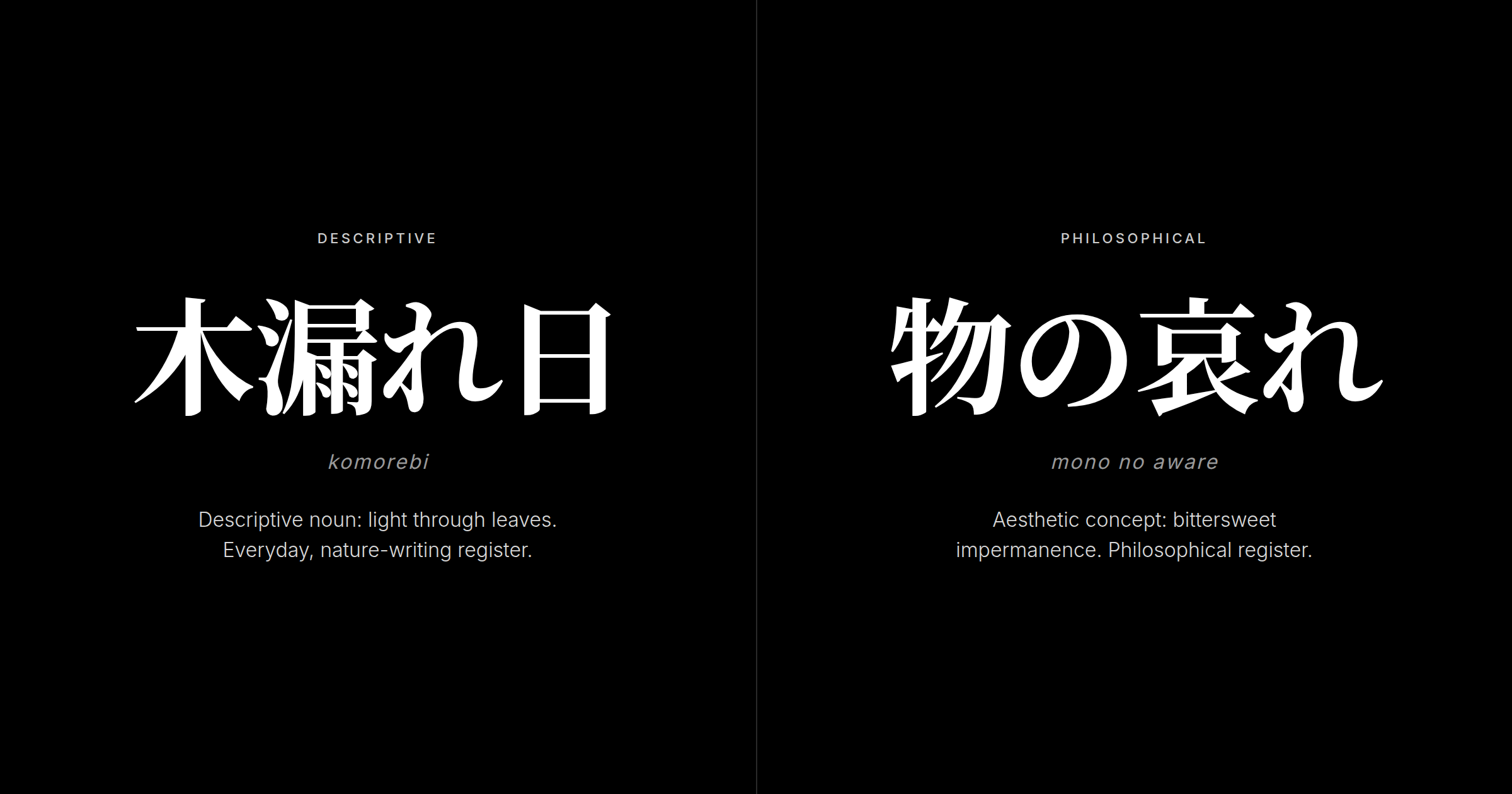
木漏れ日 (komorebi — こもれび) describes dappled sunlight filtering through tree leaves. It is a real, commonly used word — nature writers, hikers, and photographers use it naturally. What it is not: philosophically loaded. Komorebi is a precise descriptive noun, closer to "drizzle" or "overcast" than to a cultural worldview. The sense that it is profound comes almost entirely from how English speakers encounter it: "a word for sunlight through leaves that English doesn't have."
For tattoos, the kanji are visually attractive: 木 (ki — tree), 漏 (more — leak, filter), and 日 (hi — sun). A native seeing this on a forearm will recognize it, and may find it unusual but genuine — particularly if you can explain why it holds specific meaning for you. Of the five words on this list, komorebi is among the more defensible tattoo choices.
Tsundoku — 積ん読
積ん読 (tsundoku — つんどく) is the practice of buying books and letting them pile up unread. The word is a pun on 積んでおく (tsunde oku — to pile up and leave) and 読 (doku — reading). It is, fundamentally, a joke — a gentle, self-deprecating joke about a relatable failing.
In Japan, tsundoku is used with wry affection. It is the word you say when a friend sees your towering to-be-read pile. It belongs to the register of self-mocking humor, not aspiration. Getting it tattooed is roughly equivalent to tattooing "I never finish what I start" on your forearm and presenting it as a cultural insight. Native speakers will recognize it immediately — and be puzzled, because nobody in Japan would tattoo their self-deprecating reading habit as a permanent declaration.
Mottainai — もったいない
もったいない (mottainai — occasionally written 勿体無い in kanji) expresses regret or reluctance about waste — the feeling when you discard food that could have been eaten, or throw away something still useful. The concept carries real cultural weight: it connects to Buddhist ideas about not wasting what exists, and to the post-war Japanese ethic of conservation. The word is genuinely meaningful.
The tattoo challenge: mottainai's standard form is hiragana (もったいない), making it visually weak for tattoo art. The kanji form 勿体無い is more striking but less recognizable — most Japanese write it in kana and a native seeing the kanji form would note the unusual formality.
Shikatanai / Shouganai — 仕方ない
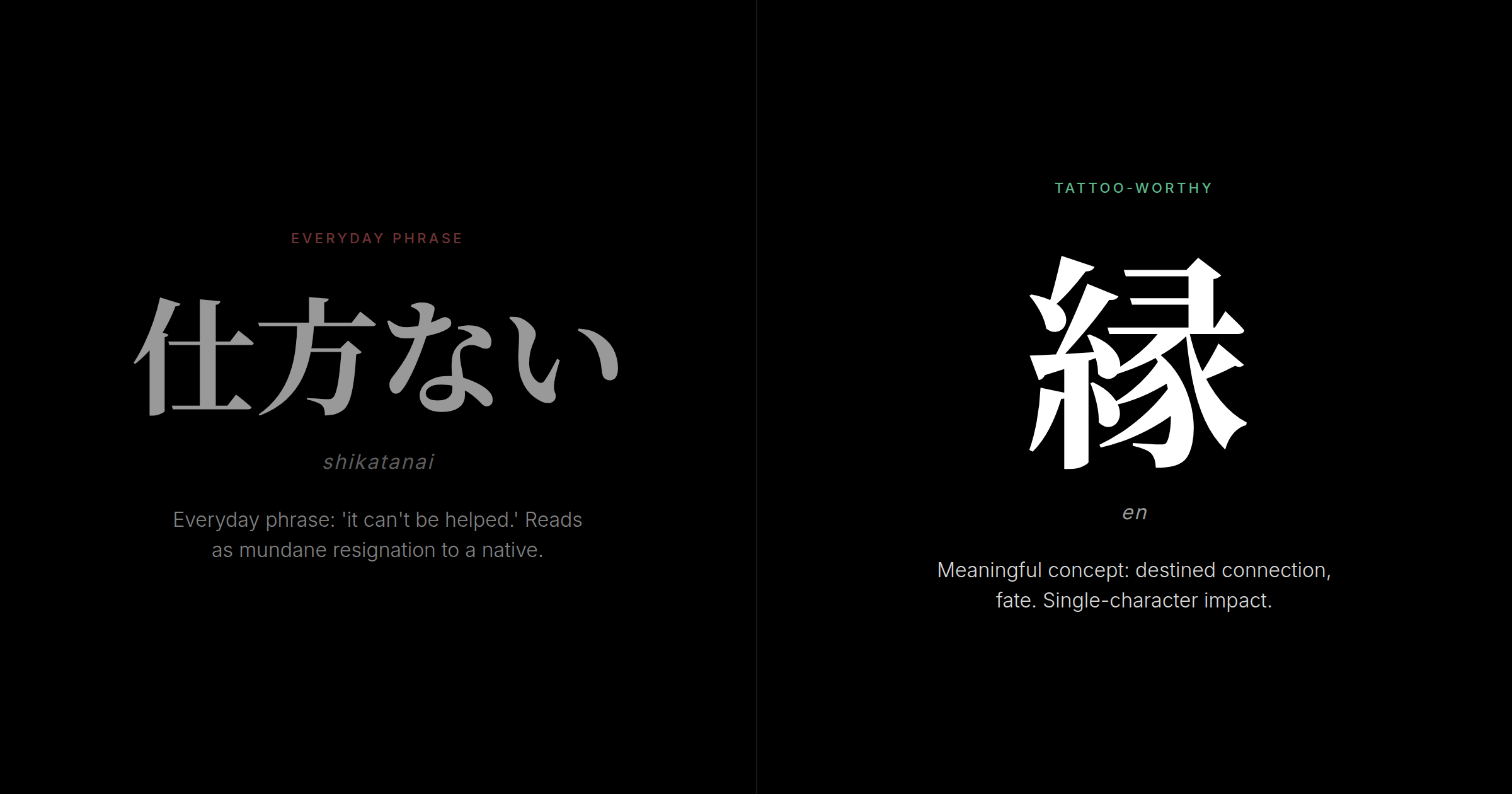
仕方ない (shikatanai — しかたない) means "it can't be helped" — resigned acknowledgment that a situation is outside one's control, and one of the most common expressions in daily Japanese. A note on spelling: viral lists label this word "shouganai" (しょうがない), which is actually a colloquial contraction from 仕様がない (shiyou ga nai) — a different phrase. Both mean the same thing, but 仕方ない is read shikatanai, not shouganai.
This is the word that most clearly illustrates the danger of the "untranslatable" framing. In viral lists, shikatanai/shouganai is described as a profound Japanese philosophy of stoic acceptance. In actual Japan, it carries resignation more than philosophy. Saying it when the bus is late is not a Zen act — it is sighing in Japanese. A native seeing 仕方ない tattooed on a forearm will likely think: "That person has tattooed 'oh well' on themselves and seems to think it is deep." The gap between intention and reception is large.
Mono no Aware — 物の哀れ
物の哀れ (mono no aware — もののあわれ) is the one on this list that genuinely carries the philosophical weight that viral posts attribute to all five. The phrase — "the pathos of things" or "bittersweet awareness of impermanence" — was coined by 18th-century literary scholar Motoori Norinaga as a framework for understanding classical Japanese literature. It describes moving beauty that arises from transience: the sadness of cherry blossoms falling precisely because they will fall.
Mono no aware is not everyday speech — it belongs to literary criticism, aesthetic philosophy, and formal discussion of Japanese arts. But unlike some archaic terms, it is well-known to any Japanese person with secondary education. The kanji are broadly recognized: 物 (mono — things), 哀れ (aware — pathos, bittersweet feeling). Of the five, this one most consistently matches what the viral framing claims.
Why These Words Go Viral — And What Natives Actually Think
The "untranslatable words" format works because it creates a sense of access to hidden cultural knowledge. The problem is cumulative: if every Japanese word is framed as ineffably profound, the impression emerges that Japanese is a language of wisdom while English is merely functional. That misrepresents both languages, and produces tattoo decisions based on exoticism rather than genuine personal meaning.
From a Japanese perspective, much of this is gently amusing. Consider a typical scenario: someone drawn to the concept of accepting what cannot be changed encounters shouganai on a "beautiful untranslatable words" list. They research it, find it means "it can't be helped," and interpret this as Japanese Stoic philosophy. They get it tattooed. Then a Japanese person looks at their wrist and associates the word with every mundane resigned sigh they have ever heard — because that is where the word actually lives.
The gap between a word's cultural life and its perceived meaning in translation is exactly what a native perspective examines. The philosophy the wearer wanted to express is real. The word chosen does not carry it.
So What Happens When You Put This on Your Skin?
Choosing an untranslatable Japanese word as a tattoo requires two checks: that the kanji are correct, and that the word carries what you believe in register and daily use, not just in translation. If you are already questioning an existing tattoo, what your kanji tattoo really means covers the verification process.
Native Verdict: What a Tokyo Native Reads on Your Forearm
A Tokyo native seeing these words responds differently to each. Understanding what Japanese people actually think about kanji tattoos on Westerners is key to interpreting these verdicts — the reactions below are informed by how native speakers genuinely perceive these choices, not how they might politely respond.
木漏れ日 (komorebi): Recognition and mild curiosity. The word is real and the kanji are legitimate. The reaction is genuine interest — "why that word?" — rather than concern. If you have a specific reason this word matters to your experience, this tattoo holds up.
積ん読 (tsundoku): Immediate recognition followed by genuine puzzlement. The word is well-known, but its register is self-deprecating humor, not aspiration. A native wonders whether you understood the joke.
もったいない (mottainai): Recognition, with a note about form. The native will observe you have chosen either hiragana (casual for a tattoo) or the kanji form (unusually formal for a word that lives in kana). The concept is meaningful. The form choice matters.
仕方ない (shikatanai): The highest-risk choice on this list. A native reads it as "oh well / it can't be helped" — an everyday resigned expression. The philosophical weight the wearer intends is not present in how the word is actually used. The gap between intention and reception is real.
物の哀れ (mono no aware): The strongest choice here. A native recognizes a genuine philosophical and aesthetic concept with documented intellectual history. The reaction is respectful curiosity rather than amusement.
Better Untranslatable Japanese Kanji Tattoo Choices
If you are drawn to words that name something hard to say in English, these alternatives carry genuine philosophical weight — they align what you believe the word means with how Japanese speakers actually use it. Our guide to choosing meaningful kanji for tattoos covers the broader framework.
縁 (en — fate, destined connection) names connections that arise by circumstance rather than choice — the bond between people whose paths crossed unexpectedly. Used in daily speech and formal reflection alike; visually strong as a single character.
刹那 (setsuna — a fleeting moment) names the briefest unit of perceptible time in Buddhist philosophy. In modern Japanese it is used poetically for any fleeting moment. Visually striking, philosophically grounded.
諸行無常 (shogyou mujou — impermanence of all things) is a Buddhist four-character compound (yojijukugo — 四字熟語) expressing the same insight as mono no aware. It appears in formal Buddhist contexts and literary use; four characters make a striking tattoo design.
For deeper background on how wabi-sabi kanji reads to Japanese people — another concept in this genre — that guide covers the philosophical register in full. The ikigai kanji captures meaning that wellness marketing obscures, where centuries of Japanese usage diverges significantly from how the West frames the concept. If you are researching whether your chosen word choice is culturally respectful, our kanji tattoo cultural appropriation guide addresses the framework directly.
FAQ
What exactly does "untranslatable" mean when people talk about Japanese words?
"Untranslatable" is usually a misnomer. Most viral Japanese words can be translated — they just require longer English phrases. Komorebi means "light filtering through tree leaves." That is a translation. The label captures concision: one Japanese word compresses what English needs seven to express. Linguistically interesting, but it does not make the concept mystical or uniquely Japanese.
Is komorebi actually a poetic, meaningful word in Japan, or is that just how Westerners see it?
Both, depending on context. Komorebi is a real word — nature writers and hikers use it naturally. It can sound poetic when intentional. But the weight viral lists attach to it — that it unlocks a uniquely Japanese perception of sunlight — is added by English speakers, not inherent to the word. For a tattoo, the question is whether you are choosing it because it genuinely means something to your life, or because a list made it sound more mysterious than it is.
Would Japanese people actually get these viral "untranslatable" words tattooed on themselves?
Rarely, and their reasons differ from Western motivations. Most natives would not tattoo tsundoku (too self-deprecating) or shikatanai (too mundane). Mono no aware could support a thoughtful tattoo, but the "untranslatable" novelty would not factor into the appeal. The Western draw often rests on the word seeming mysterious because it resists English — a quality that disappears for a native who has known it since childhood.
What's the difference between getting a translation that's technically correct versus one that's culturally appropriate?
A technically correct translation means the kanji accurately represents the word you intend. Culturally appropriate means a native speaker would recognize the choice as meaningful rather than a tourist gimmick or an inside joke. Tsundoku is technically correct — the kanji are real. But it is culturally awkward as a tattoo because Japanese speakers associate it with wry self-mockery, not aspiration. Getting a native verdict means checking both boxes: is this correct, and does it land the way I intend?
How do I know if an "untranslatable" word is worth getting tattooed versus just a trendy phase?
Ask yourself three questions. Would I still want this word if the "no English equivalent" mystique disappeared? Have I researched how native speakers use it in daily life, not just in viral list contexts? Can I explain why this word matters to my life specifically? Real tattoo choices survive those questions. Choices built on mystique alone often do not.
Which viral untranslatable Japanese words actually work well as tattoos?
Of the five most viral words, mono no aware (物の哀れ) is the strongest choice: genuine philosophical weight, literary history, and visually compelling kanji. Komorebi (木漏れ日) can work if you have a specific personal reason it matters to you. Mottainai (もったいない) is meaningful culturally but its standard form is hiragana, which is visually weak for tattoo design. Tsundoku (積ん読) reads as a self-deprecating joke — it can work as intentional irony if you understand and own that register. Shouganai (仕方ない) is the weakest choice: the philosophical weight assigned by viral lists does not exist in how native speakers use the word.
How do I verify my untranslatable Japanese kanji tattoo before getting it done?
Verification requires two steps: confirming the kanji are accurate and rendered correctly, and confirming the word reads as intended to a native speaker — not just in meaning but in register. Google Translate is not reliable for either; it misses register and usage context entirely. Our guide to how to verify a kanji tattoo before getting it covers what a proper native review includes, including cultural context that machine translation cannot assess.
Before any of these untranslatable Japanese words go to needle, have them verified by someone who reads Japanese natively — not just for accuracy, but for register and cultural fit. Kanji Ink Oracle provides Tokyo-native reviews that assess whether your chosen word reads as intended, whether the form is appropriate for a tattoo, and whether the cultural context matches what you believe you are expressing. The "untranslatable" label tells you something is interesting. A native verdict tells you whether it is what you think it is.