Are Kanji Tattoos Cultural Appropriation? A Tokyo Native's Honest Take
Is a kanji tattoo cultural appropriation? Tokyo native reveals when it's respectful, what signals disrespect, and how to avoid costly mistakes.
You've found the kanji you want. You've sketched the placement. And then someone says "isn't that cultural appropriation?" — and suddenly you're not sure if you're about to do something beautiful or something embarrassing. That discomfort is worth sitting with, not brushing aside. The permanent nature of a tattoo means this question genuinely matters, and you deserve an honest answer — not a lecture, and not a reflexive "just don't."
The honest answer is this: it is not a simple yes or no. Whether a kanji tattoo is appropriation depends almost entirely on how you approached it, not on where you were born.
Context Is Everything
A lot of content online lands in one of two camps: "absolutely don't, it's always offensive" or "who cares, it's just ink." Both miss what is actually happening when a non-Japanese person gets a kanji tattoo. The real question is not whether you have cultural permission — it is whether you demonstrated any respect for what the character actually means.
Japan's stance on this is neither monolithic nor static. It varies by generation, by region, and — critically — by what the tattoo actually says. A Tokyo resident in their twenties has a fundamentally different relationship to both tattoos and Western cultural interest than their grandparents do. The internet discourse tends to flatten this into a simple prohibition. The reality in Japan is more layered, and more forgiving to people who did the work.
Why Some Japanese People React Negatively — And When They Don't
To understand the reaction, you need to understand two things that the Western conversation often collapses together: the association of tattoos with organized crime in Japan, and the separate question of whether a non-Japanese person getting a kanji tattoo is disrespectful.
Tattoos in Japan carry a historical association with the yakuza. For decades, public baths, gyms, and hot springs have enforced "no tattoo" policies — not out of aesthetic prudery, but because tattoos historically signaled criminal affiliation. This stigma is real, particularly among older generations. It is not aimed at non-Japanese people specifically; it is a cultural context that shapes how any tattoo is perceived in Japan.
But that stigma is softening. Younger Japanese people, shaped by global tattoo culture and decades of exposure to Western music, fashion, and celebrity ink, are increasingly neutral or even positive about tattoos. The yakuza association is not gone, but it is no longer the only frame.
What remains across generations is a distinct reaction to seeing foreign characters worn without apparent understanding. Imagine a tourist in Tokyo whose tattoo reads 熱湯 (nettou — boiling water, the warning label on a kettle). They found it on a random website and liked how it looked. The reaction from Japanese people who notice is not anger — it is secondhand embarrassment. Not for the person's background, but for the fact that they clearly did not try to find out what they were putting on their skin.
That is the crux of the appropriation question. The offense is not "you are not Japanese." It is "you treated Japanese characters as decoration without caring what they mean."
The Three Red Flags That Actually Signal Appropriation
Based on patterns that emerge consistently from KIO's work reviewing kanji tattoo requests from clients around the world, three behaviors reliably signal that a kanji tattoo has crossed from genuine interest into appropriation territory.
Red flag one: aesthetic-first, meaning-last. You chose the character because it "looks cool" or "has great energy" before you knew what it meant. The visual appeal of kanji is real — they are genuinely beautiful script forms. But treating a writing system as graphic design, without engaging with its meaning, is the core of the problem. This is not about your heritage. It is about whether you viewed the character as a symbol with meaning or as a shape you liked.
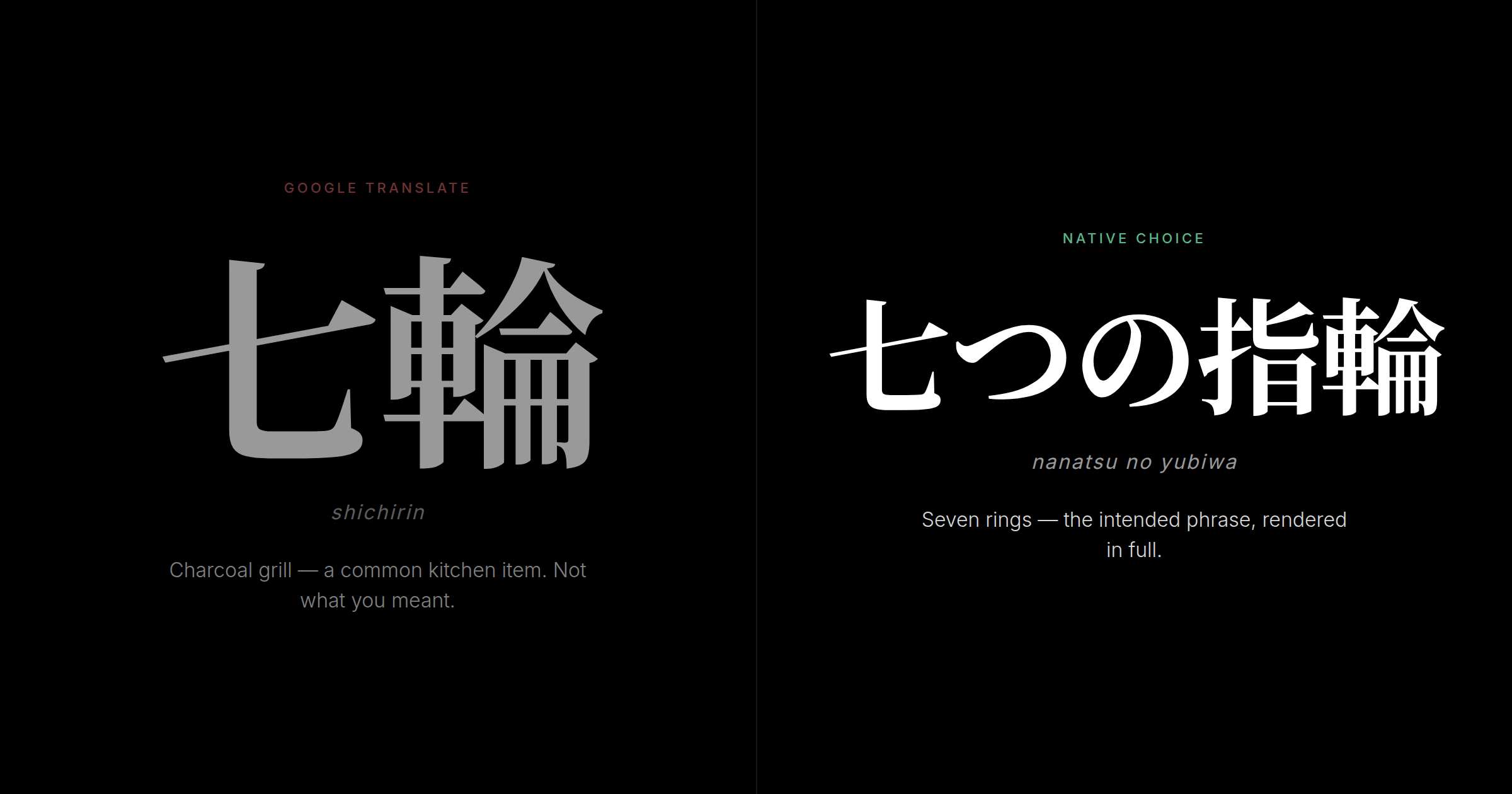
Red flag two: translation app as final authority. If you typed an English word into Google Translate, got a kanji back, and went straight to the tattoo parlor, you skipped the most important step. Why Google Translate isn't enough for kanji is a longer story involving homophones, context collapse, and the gap between machine output and living language — but the short version is that apps produce plausible-looking results that are frequently wrong or contextually inappropriate. Ariana Grande's widely documented 2019 tattoo incident is the canonical example: she intended to commemorate her song "7 Rings" with 七つの指輪 (nanatsu no yubiwa — seven rings), but the abbreviated version she ultimately wore read more like 七輪 (shichirin — a small charcoal grill used for barbecue). The tattoo was later corrected, but the story circulated globally precisely because it illustrated how a single wrong character choice, made without verification, produces something the opposite of what was intended.
Red flag three: cultural tourism as the frame. "I visited Kyoto for a week and came back with this" is a different posture than genuine engagement. Brief tourism does not confer the cultural literacy to make an informed kanji choice. It is an honest assessment of what you can and cannot know after a week.
When a Kanji Tattoo Is Actually Respectful
There are clear situations where a non-Japanese person choosing a kanji tattoo is not appropriation. They all share a common thread: effort and intentionality that go beyond aesthetics.
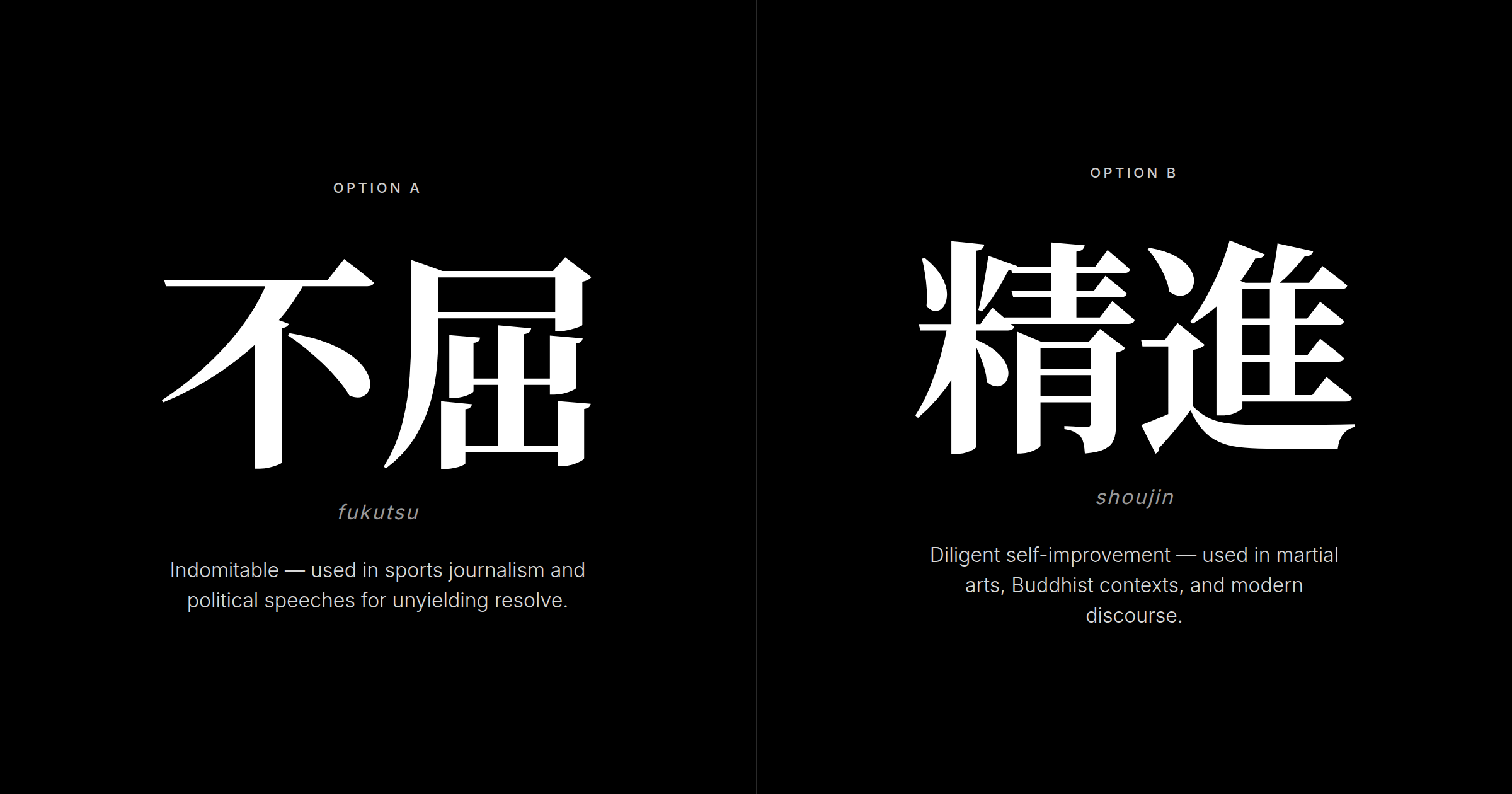
Consider someone who studied Japanese for several years and wants to tattoo 不屈 (fukutsu — indomitable, unyielding; used in sports commentary, political discourse, and formal writing to describe someone who persists through adversity). They know this word appears in newspapers and political speeches, not just on training room walls. They chose it because it reflects something real about their experience. That is not appropriation.
Consider someone with Japanese grandparents who wants to tattoo their grandmother's name in kanji as a memorial. The connection is direct and personal.
Consider someone who has been in Japanese martial arts for fifteen years and wants to tattoo 精進 (shoujin — diligent self-improvement through practice; used in Buddhist contexts and modern everyday speech to describe committed effort). They encountered the word inside the culture, not on a design website.
What unites these cases is not ethnicity. It is demonstrated engagement and a genuine personal reason that goes beyond "it looks interesting."
One thing all three of these people should still do: verify their kanji's accuracy with a native speaker before committing to the design. Even people with genuine Japanese cultural knowledge can make errors in stroke order, character choice, or register.
The Verification Question: How Do You Know Your Kanji Is Right?
This is the step most people skip, and it is the step that matters most. Choosing a meaningful kanji and then failing to verify it is like writing a letter in a language you don't speak and assuming the dictionary got it right. The step before verification — actually identifying which kanji captures what you mean — has its own structure; our framework for choosing meaningful kanji for tattoos walks through that selection process layer by layer.
Common verification failures include: homophone errors (Japanese has many words that sound identical but mean entirely different things), using simplified Chinese characters instead of Japanese kanji (they are related but distinct — see the full breakdown in the difference between Japanese kanji and Chinese hanzi), incorrect stroke order that changes the character's appearance entirely, and choosing a character that is technically correct in translation but contextually bizarre or inappropriate in actual Japanese usage.
Verification means more than running a word through an app. It means consulting at least one native Japanese speaker — ideally someone who can speak to the specific register of the word you chose. Formal? Poetic? Colloquial? Used on grave markers or in casual conversation? These distinctions matter for a tattoo.
If you are not sure whether your kanji is correct, or if you want to know how to tell if your kanji tattoo is incorrect before you sit in the chair, that is exactly the problem verification services exist to solve. And if you are reading this because you already have a tattoo that may be wrong, there is guidance on what to do if your kanji tattoo is wrong — it is not the end of the story.
What Japan Actually Expects From You
Japan has welcomed foreign interest in its culture throughout its modern history. The concern is not about keeping Japanese things for Japanese people. It is about the kind of interest: superficial or substantive, extractive or genuine.
Japan respects effort. If you researched what your chosen kanji means in contemporary Japanese life, verified it with a native speaker, and chose an artist who understands proper character rendering, that effort is visible. Younger Japanese in particular are increasingly open to global tattoo culture and many are enthusiastic tattoo enthusiasts themselves.
What registers as disrespectful is not a non-Japanese person having kanji on their skin. It is the combination of permanent commitment with zero curiosity about meaning.
The practical checklist: research the kanji using Japanese-language dictionaries (Jisho, Kotobank) rather than translation apps; verify with at least one native speaker who can assess the register and rendering; work with an artist who specializes in kanji specifically, not just "Japanese-style" work (see how to find a qualified kanji tattoo artist for vetting criteria); and be able to articulate why you chose this character. The burden of demonstrating thoughtfulness is yours — not as a punishment, but because that is what genuine respect for another culture's writing system looks like.
Native Verdict
What impresses Tokyo-native reviewers when they see a non-Japanese person's kanji tattoo: precision. A character that is specifically chosen — existing in the register the person intended, rendered correctly, with a clear personal meaning. When someone can articulate "I chose 忍耐 (nintai — patience, endurance; used in everyday Japanese to describe perseverance in work, health, and relationships) because this word came to me through a Japanese friend during a difficult period" — that carries real weight.
What generates discomfort — "embarrass" is the right word, not "offend" — is an elaborate, beautifully executed tattoo that says something the wearer has never bothered to understand. It is not rage-inducing. It is just sad.
The Western discourse on kanji tattoos is considerably more restrictive than Japan's actual stance. Japanese people are more curious than hostile when they encounter a non-Japanese person with a kanji tattoo, especially one who can demonstrate they took it seriously. Effort changes everything. For a detailed breakdown of what Japanese people actually think across different categories of tattoos—from research-backed choices earning respect to honest mistakes drawing gentle amusement—read how Japanese people react to Western kanji tattoos.
Your Quick Verification Checklist
Complete this checklist before you sit in the chair:
-
Research deeply — Use Japanese-language dictionaries (Jisho, Kotobank), not translation apps. Understand the word's register and how it appears in contemporary Japanese life.
-
Verify with a native speaker — Consult someone who speaks Japanese natively and can assess both meaning and character rendering.
-
Choose the right artist — Work with someone who specializes in kanji and understands stroke order, spacing, and structure.
-
Have a personal reason — Articulate why you chose this character in a way that goes beyond "it looks cool."
-
Know your character — Before the appointment, be able to explain your kanji's meaning, how it's used in modern Japanese, and why it resonates with you.
This is what Tokyo reviewers look for. Complete it, and the appropriation question resolves itself through action. For 10 specific examples of single kanji that pass all these criteria with native verification built in, see the best single kanji for tattoos — each with the cultural weight and register analysis already completed.
Frequently Asked Questions
Do kanji tattoos offend Japanese people?
Not inherently. A poorly researched kanji tattoo generates secondhand embarrassment more than rage — the concern is "you didn't care what this means," not "you are not Japanese." Younger Japanese people are increasingly positive about tattoos as the yakuza stigma weakens. What matters most is demonstrating you researched and verified your choice.
Is it cultural appropriation to get a kanji tattoo if you're not Japanese?
It depends on your approach. Choosing kanji purely for aesthetics without understanding meaning is appropriation; choosing kanji after genuine research, verification with native speakers, and understanding cultural context is appreciation. Respect and intentionality matter more than ethnicity — both Japanese-heritage people and non-Japanese language students get meaningful kanji tattoos.
What's the difference between appreciation and appropriation with kanji tattoos?
Appreciation means researching, verifying accuracy, and understanding the cultural context of your chosen character. Appropriation means taking the aesthetic without doing the work — choosing based on looks, using translation apps as final authority, or treating characters as fashion. The burden is on you to demonstrate respect through effort.
What's the most common mistake people make with kanji tattoos?
Trusting online translation tools without verification. Apps like Google Translate produce homophone errors, contextually inappropriate characters, or technically correct but unusable output. The second mistake: not consulting a native speaker before permanent commitment. Verification services exist specifically to catch these errors.
Can I get a kanji tattoo if I'm not Japanese but I studied the language?
Yes. Language study demonstrates understanding of nuances, cultural context, and how characters are actually used in living speech. You are in a strong position to choose meaningful, accurate kanji. Language study is one of the clearest ways to show respect through genuine engagement.
What do I need to do to make sure my kanji tattoo isn't offensive?
Follow these steps: research the kanji's meaning thoroughly using proper Japanese dictionaries and resources rather than translation apps; verify the meaning and stroke rendering with at least one native Japanese speaker; choose a tattoo artist who specializes in kanji and understands proper character structure; understand the cultural context and register of your chosen kanji; and be prepared to explain your choice. Skipping any of these steps increases the risk of a tattoo that is meaningless, incorrect, or contextually inappropriate.
What was the deal with Ariana Grande's kanji tattoo?
Ariana Grande intended to commemorate her song "7 Rings" with kanji meaning "seven rings," but the abbreviated version she wore read as 七輪 (shichirin — a small charcoal grill). This is one of the most widely documented examples of the risks of skipping the verification step. She later had the tattoo corrected, but the story became well known because it illustrated how a single character omission produces something entirely different from the intended meaning. It is not an unusual mistake — but it is entirely preventable with proper verification before committing to ink.
Is there a right way to get a kanji tattoo as a non-Japanese person?
Yes. Research and understand the meaning; verify accuracy with native speakers; choose an artist who specializes in kanji and understands proper stroke order; and have a personal, thoughtful reason for the choice beyond aesthetics. It is not about your ethnicity — it is about demonstrating respect through effort.
If you are at the point of choosing a kanji and want to be certain it means what you intend — in the register you intend, rendered correctly — Kanji Ink Oracle connects you with Tokyo-native reviewers who assess your design and return a full verification report within 24 hours. Across hundreds of client submissions KIO has reviewed, the pattern holds: people who verify before they ink report relief rather than regret, and respect rather than rejection from Japanese readers. Getting it right before you commit is the most direct way to answer the appropriation question with action rather than anxiety.