AI-Generated Kanji Tattoos: When ChatGPT Invents Characters
AI kanji generators can produce hallucinated characters that look real but don't exist in Japanese dictionaries. Learn how to verify before getting tattooed.
You found a kanji design on an AI generator — it looks authentic, it means exactly what you want, and the whole process took thirty seconds. Before you take that image to your tattoo artist, there is one thing you need to know: the character may not exist anywhere in the Japanese language. AI systems can invent kanji that are visually convincing but entirely fictional, and to a Western eye there is no way to tell the difference without expert verification.
This is not a minor technicality. A tattoo of a non-existent character is not a mistranslation — it is meaningless ink. Every Japanese person who sees it will know something is wrong, even if they cannot say exactly why.
The AI Kanji Tattoo Boom: Why Everyone's Using ChatGPT for Designs
Services like TattooAI.design, BlackInk.ai, and Vondy offer free, instant, customizable kanji designs. ChatGPT can describe a character and explain its meaning in seconds. Midjourney and Stable Diffusion produce brush-stroke kanji that look indistinguishable from calligraphy done by hand.
For someone planning a tattoo, this feels like a solved problem. The AI's confident, polished output signals that verification is unnecessary. That confidence is the danger.
How AI Actually Hallucinates Kanji (And Why You Can't Tell the Difference)
"Hallucination" in AI means the system generates plausible-sounding output for a prompt it cannot actually answer correctly. For kanji, this means the AI invents a character.
What makes this particularly dangerous is that hallucinated kanji can look completely authentic. Generative image models like Stable Diffusion are trained on vast libraries of real kanji. When asked to produce a character for a concept with no established kanji, the model synthesizes a new glyph from genuine stroke patterns and radical components. The result follows real kanji logic — correct stroke weights, plausible radical placement, authentic visual rhythm — but it does not exist in any Japanese dictionary.
Research into AI kanji generation has documented this directly. Neural network models have produced original glyphs for concepts like "Deep Learning" and "Elon Musk" — characters that are structurally coherent but completely fictional. A native speaker knows immediately they are invented. A non-native speaker, which describes approximately ninety percent of Western tattoo clients, cannot tell.

ChatGPT presents an additional risk beyond image generators. As a large language model trained on internet text rather than authoritative kanji databases, it can confidently suggest character combinations that do not exist, pair characters in ways that produce unintended meanings, or present archaic characters as natural choices. The confidence of the output makes the error invisible to someone who cannot independently verify the characters.
Real-World Disasters: What's Actually Happening Right Now
Across Reddit and TikTok, a recurring pattern has emerged: people post photographs of their AI-generated kanji tattoos asking native speakers to translate them, and the response is confusion — because the characters do not mean anything. Some are real kanji applied to the wrong context. Others are characters that do not exist.
The verification gap is built into most AI tattoo services. TattooAI.design's own terms make no explicit claims about linguistic accuracy. When speed and aesthetics are the product, accuracy becomes the user's problem — one most users do not know they have until the tattoo is already done.
This is a composite scenario based on common cases verified by our team: someone wants the kanji for "resilience" to commemorate a difficult period in their life. They run the concept through ChatGPT, which suggests a character combination. It looks right. The tattoo artist replicates it faithfully. Six months later, a Japanese colleague pauses at the tattoo. The character is not "resilience." It is either wrong kanji or an invented glyph that carries no meaning at all. Laser removal starts at $200 per session and typically requires multiple sessions.
The Accuracy Problem: Why These Generators Get Kanji Wrong
Not all AI kanji tools carry equal risk. The most dangerous are pure generative systems — Stable Diffusion, Midjourney, image-based generators — which produce visually plausible results with no check against Japanese dictionaries. The character they generate may not exist.
A middle category includes services claiming some human review, but the scale of these operations often limits how thorough that review can be. Template-based generators pull from stored libraries of real kanji rather than generating new glyphs, avoiding hallucination but introducing a different error: misapplying real kanji to wrong contexts. A character that exists and means "virtue" in a Buddhist context may be an odd choice for a personal tattoo.
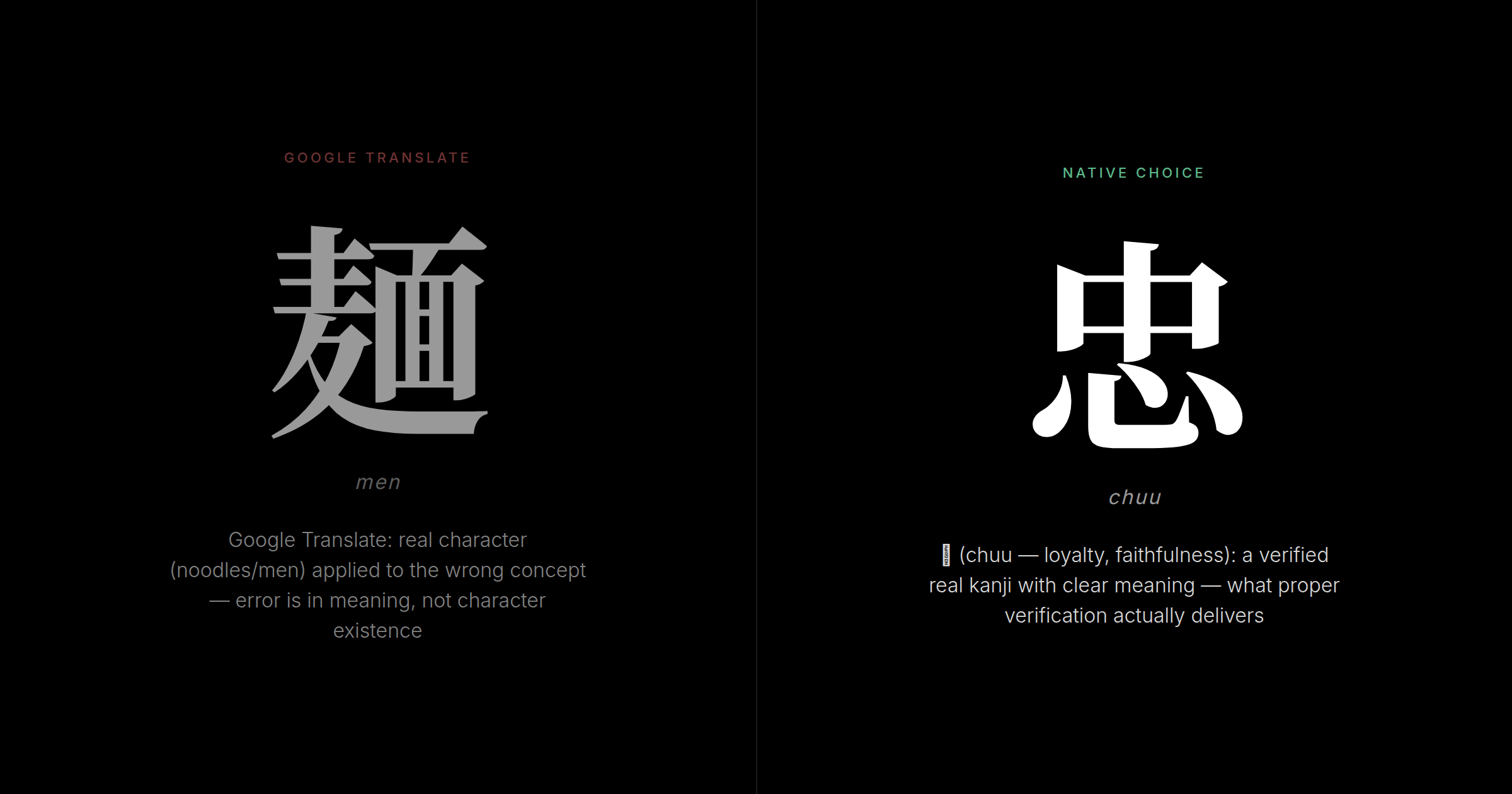
The comparison to Google Translate for kanji tattoos is instructive. Google Translate often misapplies real kanji — suggesting a character meaning "noodles" when a user asks for "loyalty." But the character it returns exists in Japanese dictionaries. With AI generation, the character itself may be fictional. You cannot verify a hallucinated glyph against any reference source, because it appears nowhere.
Based on verification requests reviewed by KIO's Tokyo-native team, the most common AI error is not hallucination but confidently wrong context — real characters, wrong register, wrong pairing. Even this error category can be permanent.
Native Verdict: What Tokyo Insiders Know About AI Kanji Risks
Japanese native speakers recognize hallucinated or incorrect kanji immediately — not because they have memorized every character, but because kanji literacy is built on pattern recognition beyond the visual. A character that follows stroke logic but does not appear in any known word reads as "off" in the same way a grammatically structured but meaningless English sentence reads as wrong to a native English speaker.
The cultural stakes go beyond aesthetics. 不屈 (fukutsu — indomitable, unyielding; used in sports commentary, political speeches, and formal writing about perseverance) means something specific and significant. An AI that returns a visually similar but invented character has not approximated that meaning — it has replaced it with nothing.
What makes AI particularly dangerous from the native perspective is that it gets the easy parts right and fails silently at the hard parts. Stroke weights look authentic. The visual rhythm feels correct. But layered meaning — on'yomi (Chinese-origin reading) versus kun'yomi (Japanese-origin reading), generational associations, formal versus casual register — is exactly what large language models handle poorly, because that knowledge lives in cultural context rather than text patterns.
A Japanese calligrapher or tattoo designer working with a client will cross-reference multiple sources, ask about the intended meaning, consider placement, and flag characters that carry unintended connotations. An AI generator does none of this. It produces an image. The gap between those two processes is where tattoo mistakes are made.
The native perspective reframes what verification means: it is not optional quality checking for perfectionist clients. It is the baseline step that ensures you know what you are putting on your skin. Verification is not luxury — it is minimum due diligence.
For context on how Japanese natives actually respond to foreign kanji tattoos, see what Japanese people actually think about kanji tattoos.
How to Spot a Fake AI-Generated Kanji Before You Get It Tattooed
Several red flags reliably indicate a kanji design may be invented or wrong.
Service red flags:
- Results delivered in seconds with no human review step and no mention of verification
- Claims that "AI knows all languages" or that AI accuracy equals native fluency
- No option to see the character's dictionary entry, radical breakdown, or stroke order
- No warning labels about hallucination risks
Design red flags:
- The character does not appear when searched on Jisho.org or a reliable kanji dictionary
- Native Japanese speakers react with confusion or cannot identify the character
- The radical components look plausible but the combination appears in no compound word you can find
The verification ritual: Show the design to a Japanese person who does not know your intended meaning. If they look uncertain, cannot read it, or say it looks "a bit off," the character may be invented or wrong. This test works by removing confirmation bias — they are reacting to the character itself, not to your explanation.
If you suspect your current design is already compromised, checking whether your kanji tattoo is wrong walks through the full diagnostic process.
The Right Way to Use AI for Kanji Tattoo Planning
AI tools are genuinely useful for kanji tattoo planning when they stay in their lane: ideation, not verification.
The safe workflow has four stages. First, use AI to brainstorm the meaning you want to express. Second, verify the actual character against a trusted source — a kanji dictionary, a native speaker, or a professional verification service. Third, show the verified design to a tattoo artist who specializes in Japanese calligraphy. Fourth, before the needle touches skin, confirm the meaning one final time with a Japanese speaker who is seeing the design fresh.
This workflow uses AI's speed for the phase where being wrong costs nothing, and human expertise for the phase where being wrong is permanent.
For how to take that second step effectively, verifying a kanji tattoo before getting it covers the full process in detail. If you are already dealing with a tattoo that may be wrong, options for wrong kanji tattoo removal and cover-up explains the practical paths forward.
The cost math is straightforward: professional verification adds approximately $20 to $50. Laser removal starts at $200 per session and typically requires multiple sessions. Verification is the cheapest part of the entire tattoo project.
FAQ
Can ChatGPT actually invent kanji characters that don't exist?
Yes, and this is a critical risk. ChatGPT can confidently suggest character combinations that don't exist in any Japanese dictionary. Unlike Google Translate, which pulls from real dictionaries even if it applies them wrongly, ChatGPT hallucinates — generating plausible-sounding output when it does not have a correct answer. VAE and Stable Diffusion models produce fake kanji that look convincing to untrained eyes because they follow authentic stroke patterns and radical logic. AI models have been documented producing original glyphs for concepts like "Deep Learning" and "Elon Musk" — structurally coherent characters that exist nowhere in the Japanese language.
How can I tell if my AI-generated kanji tattoo design is real before I get it tattooed?
Use a three-step check. First, run the character through a kanji dictionary like Jisho.org or have a native Japanese speaker verify each character exists. Second, check stroke order and radical structure — if something looks "off" or the radicals don't form a recognizable compound, it may be fabricated. Third, search for the character across multiple sources: if it appears only in the AI generator's output but nowhere else, it is likely invented. The only reliably safe path is verification by a native Japanese speaker who specializes in kanji.
What's the difference between AI kanji generators? Are some safer than others?
Major differences exist. Stable Diffusion-based generators create purely visual designs with no character verification — these carry the highest hallucination risk. Services like inkanji.com take a more responsible approach by building in native-speaker verification and explicitly warning against mistranslation. Kanji Sensei refuses machine translation entirely, using only human native speakers. The safest pattern is AI for idea generation followed by a mandatory human verification step. Always choose services that make their verification process transparent and explicitly acknowledge the risks of AI-generated characters.
If I used ChatGPT to design my kanji tattoo, is it definitely wrong?
Not definitely, but it needs immediate verification. ChatGPT may suggest characters that are real but carry the wrong meaning, the wrong register, or connotations you did not intend. It may also suggest characters that do not exist at all. The only way to know is to verify each character through a kanji dictionary and have a native speaker confirm the meaning in context. Do not assume the design is correct because ChatGPT delivered it confidently — hallucination is a documented limitation of large language models.
Why is AI-generated kanji worse than Google Translate?
Google Translate often misapplies real kanji — returning a character that means "noodles" when a user asks for "loyalty," for instance. But the character it returns exists in Japanese dictionaries; the error is meaning-application. AI like ChatGPT can hallucinate, inventing plausible-looking characters that exist nowhere. To a non-native speaker, a hallucinated kanji looks real because it follows authentic stroke patterns. That is the specific danger: you may get tattooed with a character no Japanese person has ever seen. With Google Translate, at least the character exists and the mistake is identifiable. With a hallucinated character, there is nothing to correct against.
What do Japanese people think about AI-generated kanji tattoos?
Native Japanese speakers often spot AI-generated or incorrect kanji immediately — the character looks "off" or "made-up" in a way unmistakable to a fluent reader. Getting a wrong kanji tattoo signals carelessness or cultural ignorance. Beyond visual detection, native speakers understand kanji layering: on'yomi (Chinese-origin) and kun'yomi (Japanese-origin) readings, generational associations, formal versus casual register. One stroke change can flip meaning entirely, or a character might be archaic or carry associations the wearer would not want. The native perspective: verification is the baseline standard before permanent skin art.
What should I do if I realize my AI-designed kanji tattoo is wrong?
First, confirm it is actually wrong by having a native Japanese speaker verify the character against a dictionary. If confirmed wrong, your options are: a cover-up with a properly verified kanji design; removal via laser or surgical excision, which typically costs $200 to $500 or more per session with multiple sessions required; or accepting it as a learning experience. The cost and discomfort of removal make prevention the only practical strategy. Spending $20 to $50 on native verification before your appointment saves hundreds of dollars and multiple painful sessions.
Is there a kanji tattoo generator that's actually safe?
No generator is safe on its own. The safest approach treats AI as a brainstorm tool only, followed by independent human verification. Services that explicitly offer native-speaker verification and acknowledge AI risks represent better practice — but even these require you to trust their process. For maximum safety: use AI to explore meaning ideas, then have a Japanese native speaker with tattoo design experience verify each character before committing. Human verification is where safety actually lives — and it is far less expensive than any alternative.
Before any AI-generated kanji design becomes permanent, have it assessed by a native Japanese speaker who understands tattoo context. Kanji Ink Oracle connects you with Tokyo-based reviewers who verify that your character exists, means what you intend, and carries the register appropriate for skin art — with assessments returned within 24 hours.