Wrong Kanji Tattoo? Removal and Cover-Up Options
Your complete guide to kanji tattoo removal and cover-up options: quick rework, laser removal, cost comparison, timelines, and what Tokyo natives actually think.
A wrong kanji tattoo is one of the few mistakes you wear in public every day. You got the tattoo. A few weeks later, a Japanese-speaking coworker glanced at your wrist and went quiet. Or you posted a photo online and someone replied with a link to what your character actually means. Or you simply looked at it one morning and realized the strokes don't match anything in a reputable kanji dictionary.
That sinking feeling is real, and you are not alone. Thousands of people carry kanji tattoos that contain errors ranging from the nearly invisible to the mortifyingly obvious. The good news: you have concrete options. The harder truth: none of them are cheap, fast, or painless — which is exactly why this article exists.
Why So Many Westerners End Up With Wrong Kanji Tattoos
Based on thousands of verification requests reviewed by KIO's Tokyo-native team, errors cluster into three predictable patterns. Homophone confusion is the most frequent: Japanese has hundreds of words that sound identical but are written with entirely different characters. A tool that processes phonetic input without cultural context returns the wrong character. Second: simplified Chinese characters passed off as Japanese kanji — visually similar, but immediately recognizable to a native reader as a foreign script. Third: archaic or ceremonial characters that are technically legitimate kanji but feel theatrical in a modern context, the way "thee" and "thou" would read as odd in a casual English text.
The tattoo studio's role is limited. Most Western studios, however talented their artists, do not employ native Japanese consultants. An artist can reproduce a character flawlessly while having no way to evaluate whether it means what the client intends.
Google Translate's kanji failures follow their own specific patterns — the short version is that it processes phonetic frequency, not usage register or cultural context.
How to Know If Your Kanji Tattoo Is Actually Wrong
Before deciding on a correction path, you need a confident diagnosis. Uncertainty is not enough to start a removal process, and "someone online said it looks weird" is not a sufficient basis for a cover-up.
A solid self-assessment starts with the article Is My Kanji Tattoo Wrong?, which walks through a structured checklist: stroke count verification, radical composition, and usage context. If you complete that checklist and still cannot determine whether your tattoo is correct, the next step is professional review.
Consulting native speakers informally — through language-exchange communities or Reddit's r/translator — can be a starting point, but the quality of feedback varies. A professional kanji tattoo verification service gives you a documented, authoritative assessment you can bring to an artist when you discuss correction options.
One important note: if your tattoo might be correct but culturally awkward — meaning the character exists but reads oddly to modern Japanese speakers — that is covered in My Kanji Tattoo Means Something Else. Linguistic accuracy and cultural appropriateness are not the same thing.
Option 1 — Quick Rework or Touch-Up (Best Case Scenario)
This is the path you want if your error is small and caught early. A quick rework applies when the base structure of the character is sound but something minor is wrong: a single misdrawn stroke, an incorrect radical component, or a spacing issue between multiple characters.
The window for this option is narrow. Within two weeks of your original session, the ink has not fully settled into the dermis and a skilled artist can work over the design with more flexibility. After the tattoo has fully healed — typically four to six weeks out — the ink is stable and rework becomes significantly harder.
Artist selection matters here in a specific way. Any competent tattoo artist can apply ink, but correcting kanji requires someone who understands the internal logic of character construction: which strokes cross which, which radicals anchor the meaning, and where line weight creates legibility. A studio that specializes in Japanese-style work is your best starting point. Ask directly: have you corrected kanji before, and can I see examples?
Cost for a quick rework typically runs $100–$300 for one or two touch-up sessions. This is the least expensive correction path by a significant margin.
Option 2 — Cover-Up Tattoo (Middle Ground)
A cover-up incorporates the existing tattoo into a new design that obscures or recontextualizes it. Common approaches include expanding into a larger sleeve where the original character becomes one element among many, or replacing it entirely with a botanical, animal, or geometric design large enough to cover the ink area.
The physical constraint is important: a cover-up almost always needs to be larger than the original. Ink cannot be lightened by layering — it can only be obscured by surrounding it with sufficient pigment density. A small character on your wrist may require a design that extends partway up your forearm.
You need an artist experienced in both Japanese aesthetic conventions and cover-up technique — specifically, knowing how old ink bleeds through and how to design something that reads well whether or not the original faintly shows through over time.
Cost: $300–$1,000 and up, one to three sessions. Poorly executed cover-ups look obviously patched — this is not a place to cut costs on artist selection.
Option 3 — Laser Removal (Permanent Solution)
Laser removal is the only option that eliminates the tattoo entirely. It is also the most expensive, time-consuming, and physically demanding path.
A Q-switched laser breaks ink particles into fragments small enough for the body to absorb. Black ink responds best; red and yellow inks are significantly harder to clear. A typical course runs six to ten sessions spaced six to eight weeks apart — six months to over a year total. Each session takes fifteen to thirty minutes and is commonly described as more painful than the original tattooing. Most people use numbing cream.
Complete removal is not guaranteed. Dense or deep ink sometimes leaves a ghost image after the full course. Cost: $200–$500 per session, totaling $2,000–$5,000 or more for moderate-sized work.
Cost and Timeline Comparison
| Option | Typical Cost | Sessions | Total Timeline | |---|---|---|---| | Quick rework | $100–$300 | 1–2 | Days to weeks | | Cover-up | $300–$1,000+ | 1–3 | Weeks to months | | Laser removal | $2,000–$5,000+ | 6–10 | 6–12+ months | | Prevention (verification) | $50–$150 | 1 | Before inking |
The prevention row is included deliberately: the entire cost and pain curve above is avoidable with one professional review before the appointment.
Composite Case Studies
These are illustrative patterns from the types of errors KIO's reviewers encounter regularly. They are composites, not accounts of specific individuals.
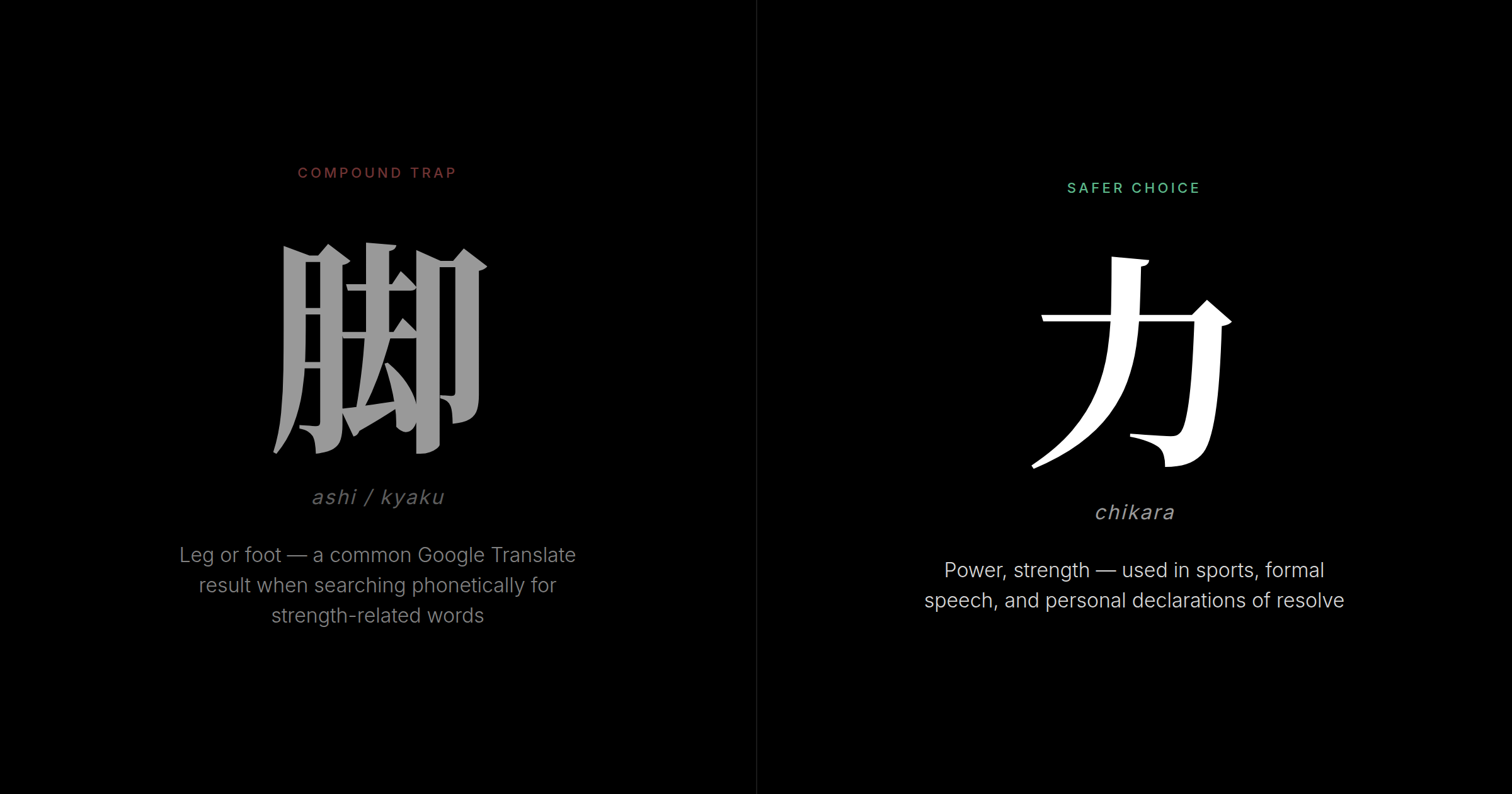
Pattern A — The Phonetic Lookup Error: Consider a typical reader who searched phonetically and received a result showing 脚 (ashi — leg, lower limb; an ordinary everyday word for leg or foot), assuming it matched the strength-related concept they intended. The error is legible to any Japanese speaker within seconds. If caught within two weeks and the design is small, a skilled artist can often rework it in a single touch-up session.
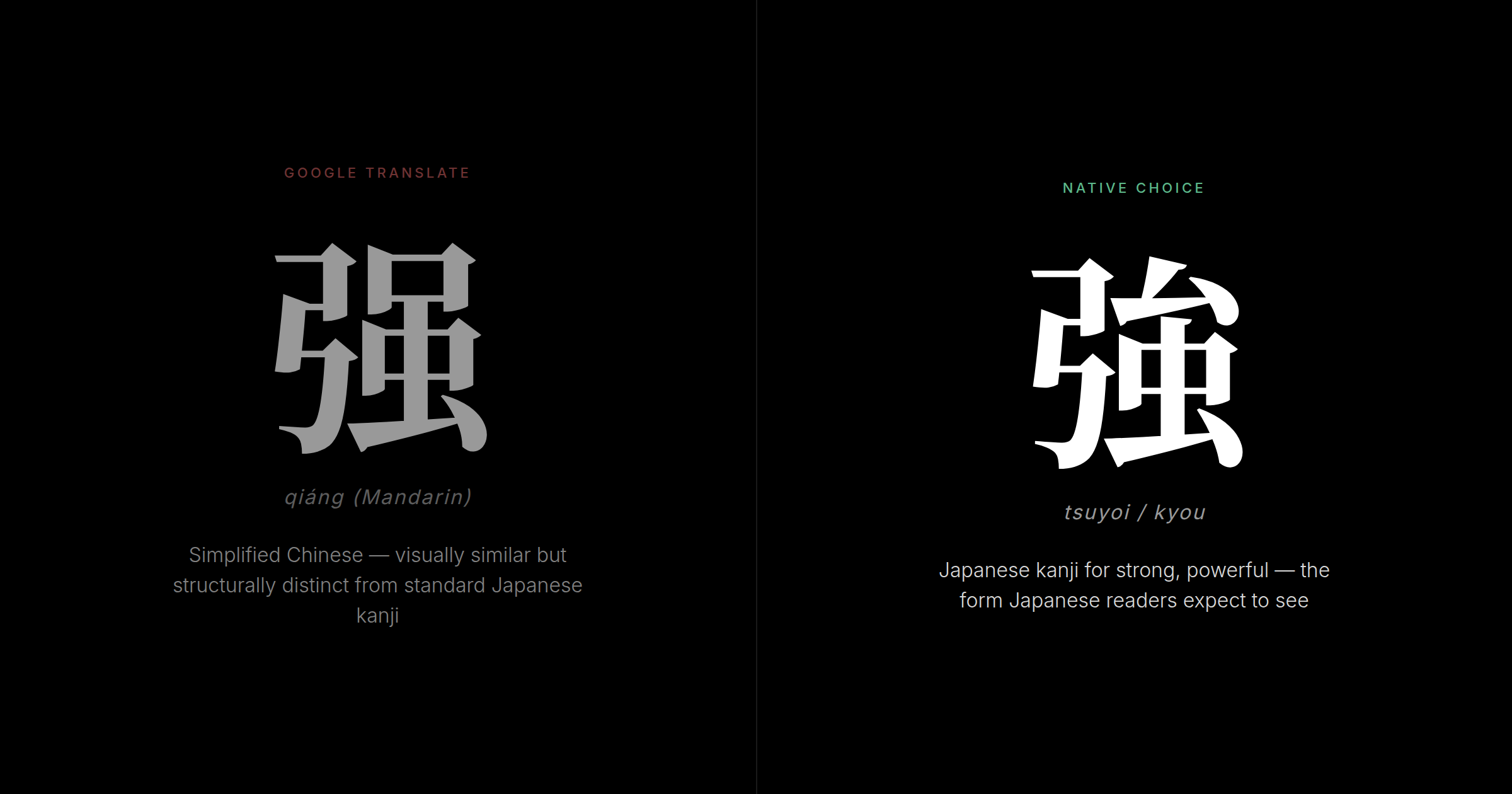
Pattern B — The Simplified Chinese Import: A design sourced from a Chinese-language font site uses simplified Chinese rather than the traditional forms standard in Japanese. The structural stroke differences that a non-specialist would not notice are immediately visible to a native Japanese reader. Cover-up into a larger Japanese-style design is typically the chosen path.
Pattern C — The Failed Cover-Up: A stroke-order error was covered through a non-specialist studio. Within two years the original character showed through, leaving both designs visible. The only remaining option was laser removal — far more expensive than the original rework would have been if caught early.
Native Verdict: What Tokyo Speakers Actually Think
The cultural embarrassment factor is something Westerners consistently underestimate. It is not that Japanese people are judgmental of foreigners who love the written form of their language — most find it flattering that someone cares enough to get kanji inked permanently. What reads as careless is the evidence of shortcuts.
When a Japanese speaker sees 脚 (ashi — leg, lower limb) where someone clearly intended a word about strength or resilience, the immediate read is not "this person made a sophisticated linguistic error." It is "this person copied a result from a translation tool without checking it." The error signals process, not just outcome.
Outdated or ceremonial characters carry a different social signal. Kanji like 剛 (gou — hard, unyielding; a character that appears in classical literature, formal personal names, and some martial arts contexts) are not wrong when used in modern Japan, but they carry a register that feels deliberately theatrical when worn casually by a non-Japanese person with no connection to those contexts. It reads the way an English-speaker tattooing a passage from Beowulf in Old English script might read — committed, but also slightly performative.
Stroke-order errors and malformed radicals signal something else again: that neither the client nor the artist paused to verify the design against any reference source. Japanese children spend years learning that stroke order is not arbitrary — it governs how a character flows and how it is recognized. A kanji with inverted or missing strokes does not simply look imprecise; it looks incomplete.
The consistent observation from KIO's Tokyo-native reviewers is that the errors most painful to see are the ones that would have taken fifteen minutes to catch. Not the subtle contextual mismatches that require genuine linguistic expertise — those are understandable — but the phonetic lookups and font-site imports that a single conversation with a native speaker would have flagged immediately. This is not about gatekeeping Japanese culture. It is about the straightforward frustration of watching a preventable mistake become permanent.
How to Prevent This Going Forward
Use multiple independent sources. A Google Translate result cross-checked against a Japanese dictionary app is not verification — it is the same database accessed twice. Independent sources means a native speaker, a formal reference like Jisho.org, and ideally a professional review.
Check usage register, not just meaning. The dictionary definition of a kanji is one data point. How that character is actually used in modern written Japanese — in news articles, formal documents, social media — tells you whether the choice will read as meaningful, pretentious, or odd.
The article on choosing meaningful kanji for tattoos covers the research process in depth, including how to evaluate whether a character reflects what you intend.
The only correction path that costs nothing is the one you take before the ink goes in. Verify your kanji at Kanji Ink Oracle — Tokyo-based reviewers return an assessment within 24 hours, covering meaning accuracy, stroke correctness, cultural register, and modern usage.
FAQ
Will my kanji tattoo look obviously wrong to Japanese people?
Often yes, and usually within seconds. Several common error types are immediately noticeable: homophone substitutions (a character that sounds similar but means something unrelated), simplified Chinese characters used in place of standard Japanese kanji, and stroke-order errors that alter a character's visual structure. Some errors require a linguist to catch; others would be apparent to any literate Japanese adult. The social experience of having someone recognize the error — and then decide whether or how to tell you — is one of the more uncomfortable outcomes people describe.
Can a bad kanji tattoo be fixed without removal or a full cover-up?
Yes, but only within specific constraints. If the error is limited to a single stroke, an incorrect radical, or a minor spacing issue, and if you catch it within the first two weeks after getting the tattoo, a skilled kanji-experienced artist can often rework the design in one to two touch-up sessions. After the tattoo has fully healed, this window closes. The healed ink is stable and working over it requires more aggressive intervention — at which point cover-up or removal become the realistic options. Cost for a quick rework: $100–$300.
How long does laser removal take and does it really hurt?
Six to ten sessions spaced six to eight weeks apart — six months to over a year total. Pain is real and most people describe it as more intense than the original tattooing; numbing cream is commonly used. Side effects include redness, blistering, and scabbing after each session. Complete removal is not guaranteed; ghost images sometimes remain with dense or deep ink.
Is a cover-up tattoo better than laser removal for kanji?
It depends on your goal. A cover-up is faster, less cumulative pain, and cheaper upfront — but you end up with a larger tattoo that incorporates rather than erases the error. Laser removal gives you a clean slate at the cost of months of sessions. Many people choose cover-up for the immediate visible result; others are uncomfortable carrying the error under a new design. Both are legitimate. What is not a good choice is a cheap cover-up through a non-specialist artist, which often bleeds through within a few years.
What should I do if I caught the error before the tattoo fully healed?
Contact your artist immediately. Within two weeks, the correction window is open. Explain the specific error clearly — bring documentation from a native source if you have it — and ask whether they can rework it in a follow-up session. If your original artist denies the error or refuses to fix it, get a second opinion from a studio that specializes in Japanese-style work before the healing window closes. Do not wait. The difference between an early catch and a fully healed error is the difference between a $200 touch-up and a $3,000 removal course.
Can I just tattoo a different character over the wrong one?
Not effectively. Layering two kanji in the same space creates a visual mess — the underlying strokes bleed through and both characters become illegible. What you would actually be doing is a cover-up with a kanji-specific design brief, which requires the same considerations described in the cover-up section: a larger design that incorporates rather than overlays, executed by a specialist who understands both the technical challenge and the Japanese aesthetic conventions you want to maintain.
How do I know if my kanji tattoo artist is trustworthy?
Red flags: the artist uses Google Translate to verify meaning, has no portfolio of kanji-specific work, dismisses questions about stroke order or radical composition, or cannot explain where their reference materials come from. Green flags: the artist maintains a relationship with a native Japanese consultant, can discuss stroke order and radical structure, and welcomes scrutiny rather than finding it insulting. Before booking, ask to see at least five examples of kanji work from their portfolio, ask how they verify meaning before applying ink, and ask whether they will revise the design if a native speaker flags an error. An artist confident in their kanji work will have clear answers to all three.