Kintsugi Tattoo Kanji 金継ぎ: What Tokyo Natives Read
Discover what kintsugi kanji (金継ぎ) actually means to Japanese people. Learn why the characters read as a pottery repair craft label, not a philosophy.
Kintsugi has become one of the most shared ideas in Western wellness culture. Instagram pages devoted to resilience and healing quote it daily. Self-help books open with it. Ceramic workshops offering "kintsugi experiences" sell out months in advance in New York, London, and Sydney. The concept travels beautifully: broken things mended with gold, the repair itself made visible and precious. Yet what many people planning a kintsugi tattoo don't realize is that the kanji 金継ぎ, when read by a Japanese person, conveys something much narrower than the philosophy the West has adopted.
The gap between the Western meaning and what the kanji actually says is exactly where tattoo regret lives. This is what native Japanese speakers consistently identify in kintsugi tattoo verification: the mismatch between intention and linguistic reality.
What Kintsugi Actually Is in Japan
Kintsugi (金継ぎ) is, at its core, a craft technique. The name describes a method of pottery repair in which broken ceramics are mended using urushi lacquer mixed with powdered gold, silver, or platinum. The repaired breaks become visible seams of precious metal rather than hidden fractures. A repaired piece is not disguised — it is altered, and its history of damage is made part of its surface.
The practice took recognizable form during the Edo period (1603–1868), shaped by the aesthetic philosophies already running through Japanese tea culture and Zen Buddhism. The tea ceremony, chanoyu, provided both the setting and the objects: tea bowls (chawan) were valued precisely for their imperfections, their age, their irregularities. When a prized bowl broke, discarding it was not the only option. Kintsugi offered a path in which the break itself became part of the object's story.
This is where Western accounts often make a subtle error. Kintsugi is not about celebrating damage. It is not saying that your cracks are beautiful, or that suffering makes you stronger, or that brokenness is a gift. The Zen and wabi-sabi philosophy underlying kintsugi says something different and more precise: impermanence and change are facts of existence, and resistance to them causes suffering. The repaired bowl is not "better" for having been broken. It is different, and its difference is acknowledged honestly rather than hidden.
Wabi-sabi (侘寂, wabi-sabi) as an aesthetic framework is central here. 侘 (wabi) carries connotations of humble simplicity and rusticity — the beauty of a mossy stone, an asymmetric cup. 寂 (sabi) carries age and the bittersweet awareness of things passing. Together they describe an aesthetic that finds meaning in imperfection and transience by accepting it without flinching. This is the philosophical register kintsugi inhabits.
There is a related Zen concept worth knowing: mushin (無心, mu-shin), meaning "no mind" or "empty mind" — a state of action unencumbered by attachment or judgment. In the context of kintsugi, the craftsperson does not mourn the break or celebrate the repair. They attend to what is. And then there is mono no aware (物の哀れ, mono no aware) — "the pathos of things," a bittersweet awareness that all things pass. A cherry blossom is beautiful partly because it falls. A kintsugi bowl carries awareness of its own fragility. This emotional register — not "your pain made you stronger" but "all things pass, and that is worth sitting with" — is the actual philosophical ground kintsugi grows from.
One more corrective note: a kintsugi-repaired vase is typically more fragile after repair than before. The gold seams are not structural reinforcement. They are honest acknowledgment. The object is not stronger — it is more fully itself.
In contemporary Japan, the practice lives in a clearly demarcated space: ceramics, craft, Zen-adjacent aesthetics. It does not function as a mental-health metaphor in Japanese daily speech. When a Japanese person encounters 金継ぎ, they think of a ceramic repair workshop, a handcraft tradition — not personal resilience or trauma recovery.
Kintsugi Tattoo Kanji: What 金継ぎ Actually Says
Understanding the individual characters is essential before any ink decision, so here is the full breakdown of 金継ぎ.
金 (kin — gold; the most common kanji for the metal, read as きん in modern compounds; appears on jewelry, currency, and grading systems; vivid and unambiguous)
継 (tsugi — to join, continue, splice; in 金継ぎ it carries okurigana ぎ, marking the verb ending; appears in 継承 (keishou — succession) and 中継 (chuukei — relay broadcast), consistently carrying the sense of connection between two states)
Together, 金継ぎ translates literally to "gold joining" or "gold splicing." It is a technical process description — a craft label. It names what the technique does: it joins broken pieces with gold. The philosophical framework of wabi-sabi, the Zen acceptance of impermanence, the emotional register of mono no aware — none of that is encoded in these characters. Reading 金継ぎ does not call up those ideas for a Japanese person. It calls up the technique.
This is the distinction most Western accounts of kintsugi tattoos miss. A Japanese reader encountering 金継ぎ tattooed on a forearm does not think "beauty from brokenness" — they think "pottery repair technique," in the same register as a tattoo reading "watercolor brushwork" or "glaze firing." The craft term is correct, the technique is real, but the philosophical depth was loaded onto the phrase from outside, not extracted from within it.
Patterns emerging from KIO's verification work consistently show this gap: clients bring 金継ぎ designs intending to encode personal resilience, the healing of past trauma, or a philosophy of accepting imperfection — and the kanji delivers none of that meaning to a native reader. The technique name and the Western metaphor occupy different conceptual spaces.
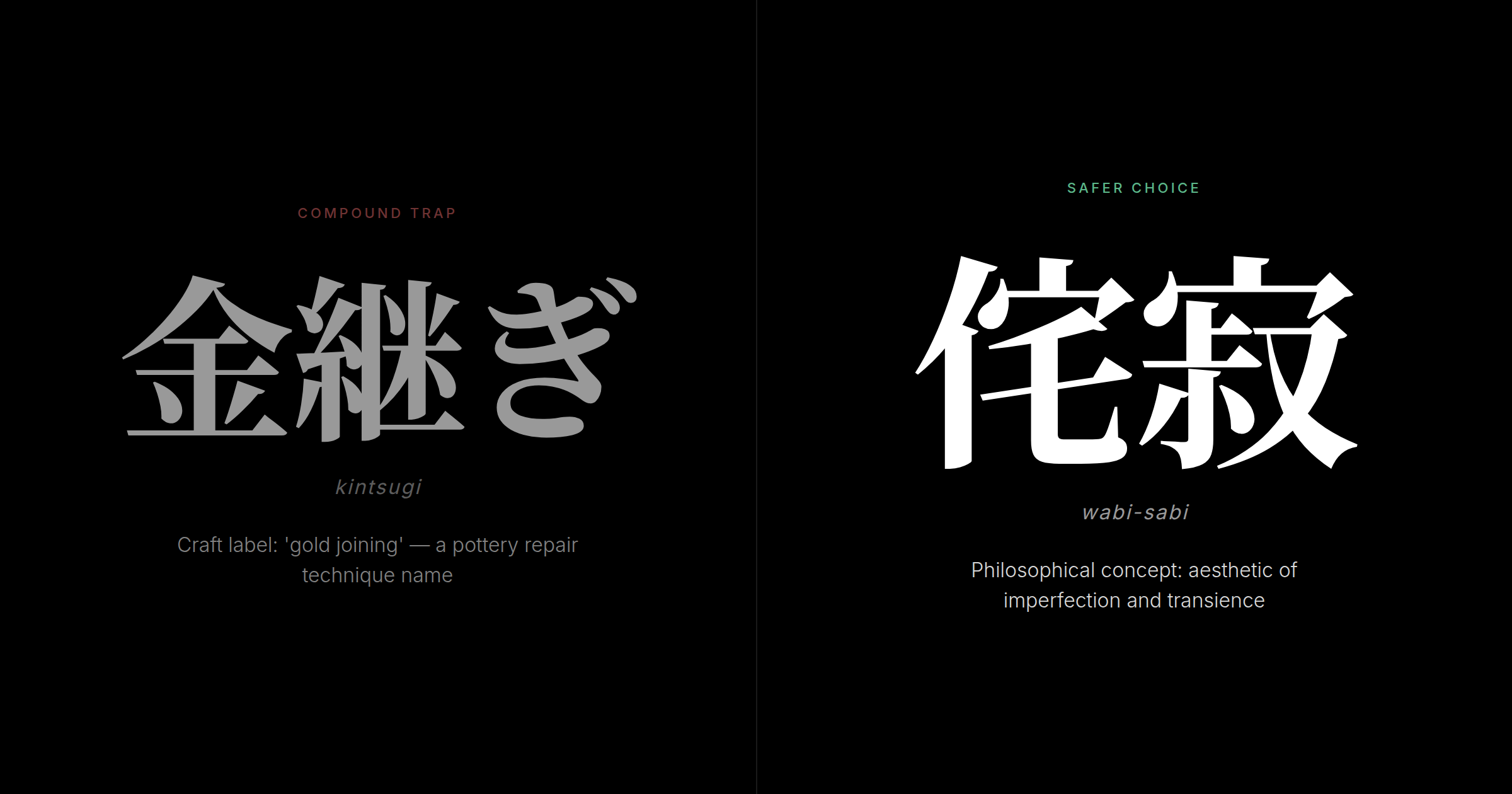
A note on script: the okurigana ぎ in 金継ぎ matters. Without it, 継 alone is ambiguous in isolation; 金継 (without ぎ) looks like a truncated compound. There is no clean abbreviation of 金継ぎ that retains the meaning — the full form is the minimal unit, and even that unit is a technique name rather than a symbol.
So What Happens When You Put This on Your Skin?
The cultural depth is real. The philosophy is genuine and worth knowing. But tattooing 金継ぎ transfers the craft label onto skin, not the Zen framework behind the craft. And here is what that means in practice.
Native Verdict: What a Japanese Person Reads
A Tokyo native seeing 金継ぎ tattooed on a forearm will read it as a label for the pottery repair technique — accurate, technically correct, and about as symbolic as tattooing "tempura batter" or "indigo dyeing." The metaphorical layer — transformation of damage into beauty, acceptance of impermanence — is not present in the characters themselves.
This is the finding KIO's native reviewers return consistently on kintsugi requests: the person wearing the tattoo has deeply internalized the philosophy, but the kanji is a craft term that predates and outlives any philosophy attached to it. The mismatch is not between intention and cultural respect — it is between intended meaning and what the characters actually encode. In what Japanese people actually think about kanji tattoos, native readers distinguish between the beauty of cross-cultural engagement and the accuracy of the kanji choice — and they prefer both.
The verdict: 金継ぎ as a tattoo is defensible if chosen consciously — if you accept that you are tattooing a craft label and own that choice, paired with personal context that makes it your story. If you are reaching for the philosophy rather than the technique name, there are better kanji.
Better Alternatives for the Kintsugi Concept
The underlying intentions behind kintsugi tattoos — acceptance of imperfection, engagement with impermanence, acknowledgment of personal history — are worth encoding well. These alternatives come closer.
金 (kin — gold) alone removes the craft-label problem. As a standalone character, 金 functions as a symbol for preciousness and transformation. Its register is broad — it appears on gold medals, shop signs, and currency — but as a single character it invites personal interpretation in a way the compound does not.
侘寂 (wabi-sabi) is the most philosophically precise choice. 侘 (wabi — humble simplicity, the beauty of the incomplete) and 寂 (sabi — the pathos of age and transience) together name the aesthetic directly. One caution: 侘 is relatively obscure kanji that many modern Japanese people would not recognize cold — it lives in the realm of classical aesthetics and literary Japanese. Worth knowing, not disqualifying. For a complete breakdown of the wabi-sabi philosophy and how it differs from kintsugi, see the full wabi-sabi kanji tattoo guide. Learn more about registers and how they're perceived in choosing meaningful kanji for tattoos.
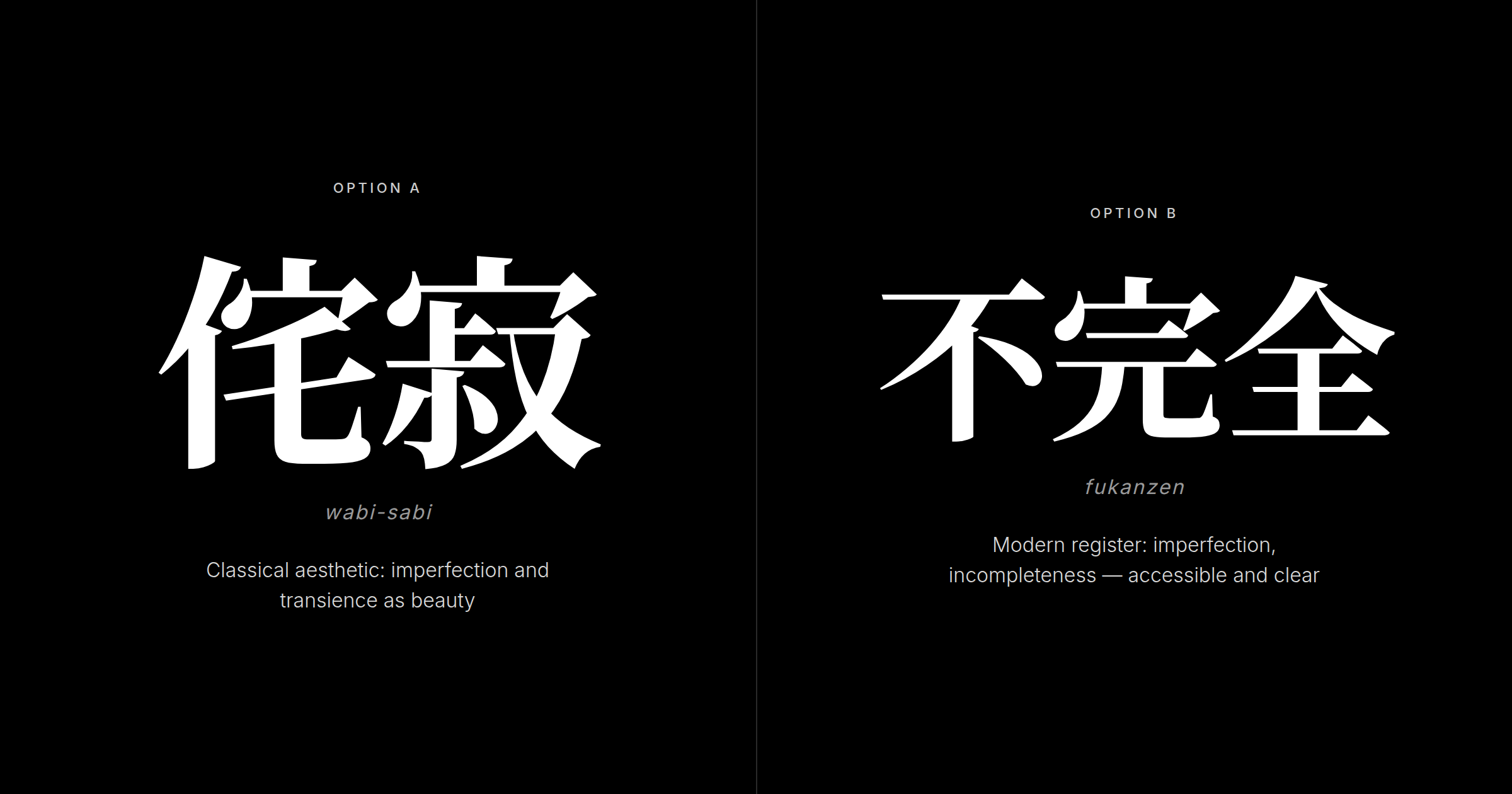
不完全 (fukanzen — imperfection, incompleteness) is the most direct modern encoding of the idea. 不 (fu) negates; 完全 (kanzen) means complete or perfect. The compound says, simply, "not-complete" — modern, unambiguous, readable by any Japanese speaker. For someone whose connection to kintsugi is about accepting imperfection, 不完全 may be the most honest choice.
一期一会 (ichi-go ichi-e — one time, one meeting) captures Zen acceptance of transience without any craft-label problem. It describes each encounter as unique and unrepeatable. The compound is well-known in Japan — formal speeches, sports commentary, tea ceremony discourse — and reads as considered rather than decorative. Explore the full spectrum of single-kanji options at best single kanji for tattoo.
物の哀れ (mono no aware — the pathos of things) captures the bittersweet awareness of transience at kintsugi's emotional core. It is classical Japanese and will read as literary to a native eye. The only practical note: at four characters plus の, it is longer than most single-concept tattoos.
A hybrid approach worth considering: kintsugi imagery (the gold-seamed bowl) combined with a single kanji encoding the personal meaning — 金 for transformation, 侘 for the aesthetic, 無 (mu — void, emptiness in Zen) for acceptance. Visual and linguistic elements do different work; neither needs to carry the full philosophical load.
If your concern is whether an existing or planned design correctly captures what you intend, learn about options and next steps in what to do when your kanji tattoo means something else — including when to live with the gap and when it matters enough to revisit.
FAQ
What does 金継ぎ kintsugi tattoo kanji actually mean in Japanese?
金 (kin) means gold. 継ぎ (tsugi) means joining or splicing — the verb form of 継 with its okurigana ending. Together, 金継ぎ translates to "gold joining" and is the Japanese craft term for the technique of mending broken pottery with gold lacquer. It describes the technique, not a metaphor. To a Japanese person, 金継ぎ tattooed on skin reads as a label for the pottery repair craft — accurate, but literal in the same way "watercolor painting" would be. The philosophical depth most Westerners associate with kintsugi (acceptance of imperfection, wabi-sabi, Zen transience) is not encoded in the characters themselves.
Is getting a kintsugi tattoo cultural appropriation?
Not inherently. The question turns on execution and understanding. If you engage genuinely with kintsugi philosophy and your tattoo reflects that understanding, the choice is respectful. If you are using 金継ぎ as shorthand for "scars equal strength" (which inverts the original philosophy), or borrowing the aesthetic without engaging with what the kanji means, that is the appropriation risk. Japanese culture welcomes sincere cross-cultural interest; the concern is surface-level use that presents itself as depth. For deeper context, see kanji tattoo cultural appropriation.
What do Japanese people actually think about kintsugi tattoos on Westerners?
Reactions are mixed but more nuanced than simple approval or disapproval. Japanese people who encounter kintsugi tattoos generally appreciate the intent — the connection to their culture and engagement with a real philosophical tradition. What they observe is the frequent gap between the wearer's meaning (personal resilience, acceptance of imperfection) and the kanji's meaning (pottery repair technique). The native response is not offense but something closer to gentle puzzlement. If the tattoo demonstrates genuine understanding of the philosophy, it reads as respectful. If it is aesthetic borrowing without philosophical grounding, Japanese viewers tend to find it shallow.
Should I get 金継ぎ kanji alone, or with imagery?
Kanji alone (金継ぎ) without context reads as a craft term and loses the personal metaphor for any Japanese-speaking viewer. Imagery alone — broken pottery with gold repair lines — communicates the visual concept across language barriers but lacks linguistic grounding. The strongest combinations pair kintsugi imagery with a different kanji that encodes the specific philosophy you are reaching for: 金 for precious transformation, 侘寂 for the wabi-sabi aesthetic, 不完全 for imperfection, 一期一会 for Zen acceptance of transience. If you are committed to 金継ぎ specifically, pairing it with personal context — a name, a date, a phrase in your own language — anchors it as your story rather than a borrowed label.
Does "scars make us beautiful" match kintsugi philosophy?
No — it inverts the original Zen philosophy. Kintsugi comes from wabi-sabi and mushin: the approach is not "your damage is valuable" but "accept what has changed without resistance." Kintsugi does not celebrate the damage; it acknowledges the object's history of change and makes the repair honest. A kintsugi-repaired vase is typically more fragile after repair, not stronger — the gold seams are honest acknowledgment, not reinforcement. If your connection to kintsugi is about healing from scars, that is a genuine intention — but it is worth being honest about the philosophical gap rather than borrowing a craft term that says something more subtle.
What's a better kanji choice if I want the "brokenness = beauty" meaning?
The closest options: 侘寂 (wabi-sabi) directly encodes the aesthetic of beauty in imperfection and impermanence. 不完全 (fukanzen — imperfection) states the concept clearly in modern Japanese. 一期一会 (ichi-go ichi-e — one time, one meeting) captures Zen acceptance of transience. 金 (kin — gold alone) suggests precious transformation without the craft-label problem of the full compound. 無 (mu — void, emptiness in Zen) encodes non-attachment. Any of these lands closer to the intended meaning than 金継ぎ does. Learn more about register and register-appropriate choices at how to verify your kanji tattoo.
How can I verify my kintsugi tattoo kanji is accurate before getting it?
The verification checklist: confirm kanji strokes match standard Japanese forms; confirm the artist has researched kintsugi philosophy rather than only the visual aesthetic; confirm you can articulate the difference between the pottery technique and your personal metaphor; confirm you are choosing 金継ぎ intentionally as a craft label with full awareness of how it reads to native speakers. Then have a native Japanese speaker review the complete concept. Get Tokyo-native verification at Kanji Ink Oracle for professional review covering kanji accuracy, register, and whether your design communicates your actual intention.
Why has kintsugi become so popular in Western mental-health culture?
The visual metaphor is immediately powerful: broken, mended, gold — transformation of damage into something precious. Wellness culture needed accessible language for the idea that healing is possible after harm, and kintsugi's aesthetic fit perfectly. Instagram simplified it further: kintsugi equals "scars are beautiful," full stop. This reframe is emotionally resonant even if it departs from the Zen source. The original philosophy — accept impermanence without attachment, let change be change — is harder to compress into a caption. The Western version gains emotional accessibility at the cost of philosophical precision.
Before you book your appointment, have a Tokyo-native reviewer read your kintsugi tattoo kanji design — not just for stroke accuracy, but for the gap between what you intend and what the characters say. Verify your kintsugi tattoo kanji at Kanji Ink Oracle — our Tokyo-based team reviews the full concept, including kanji choice, register, and whether your design communicates what you actually mean. Assessment returned within 24 hours.