Matcha Kanji Tattoo: What 抹茶 Really Means to Tokyo Natives
Thinking about a matcha kanji tattoo? Here's what Japanese people see when they read 抹茶 — and why this wellness symbol might not mean what you think.
You've been thinking about a matcha kanji tattoo. Matcha is your ritual, your calm, your whole aesthetic — and 抹茶 looks clean, minimal, unmistakably Japanese. You've imagined it on your wrist or forearm, a quiet statement about mindfulness and the things you love.
Here is what a Tokyo native sees when they look at those two characters: the label on a bag of tea powder at a convenience store.
This is not a reason to abandon the idea entirely — but it is a reason to read this before you book an appointment.
The Matcha Trend and the Tattoo Instinct
Matcha's rise in Western culture over the past decade has been extraordinary. It moved from specialty tea shops to Starbucks menus, from health blogs to mainstream skincare, from niche Japanese import to a symbol of an entire lifestyle. Today, 抹茶 appears on lattes, protein powders, face masks, and mood boards with the same visual shorthand: calm, Japanese, sophisticated, wellness-adjacent.
That cultural weight is real. But it belongs to the experience of matcha in the West — to the ritual of preparing it, the color, the quiet — not to the kanji characters themselves.
The tattoo instinct makes sense: if matcha represents something meaningful to you, encoding it on your body feels like a way to carry that meaning. The problem is the encoding. What you feel when you hold a bowl of matcha is not what 抹茶 says in Japanese.
Breaking Down 抹茶: What the Characters Actually Say
Before any ink touches skin, every kanji compound deserves a character-level breakdown. Here is what 抹茶 contains.
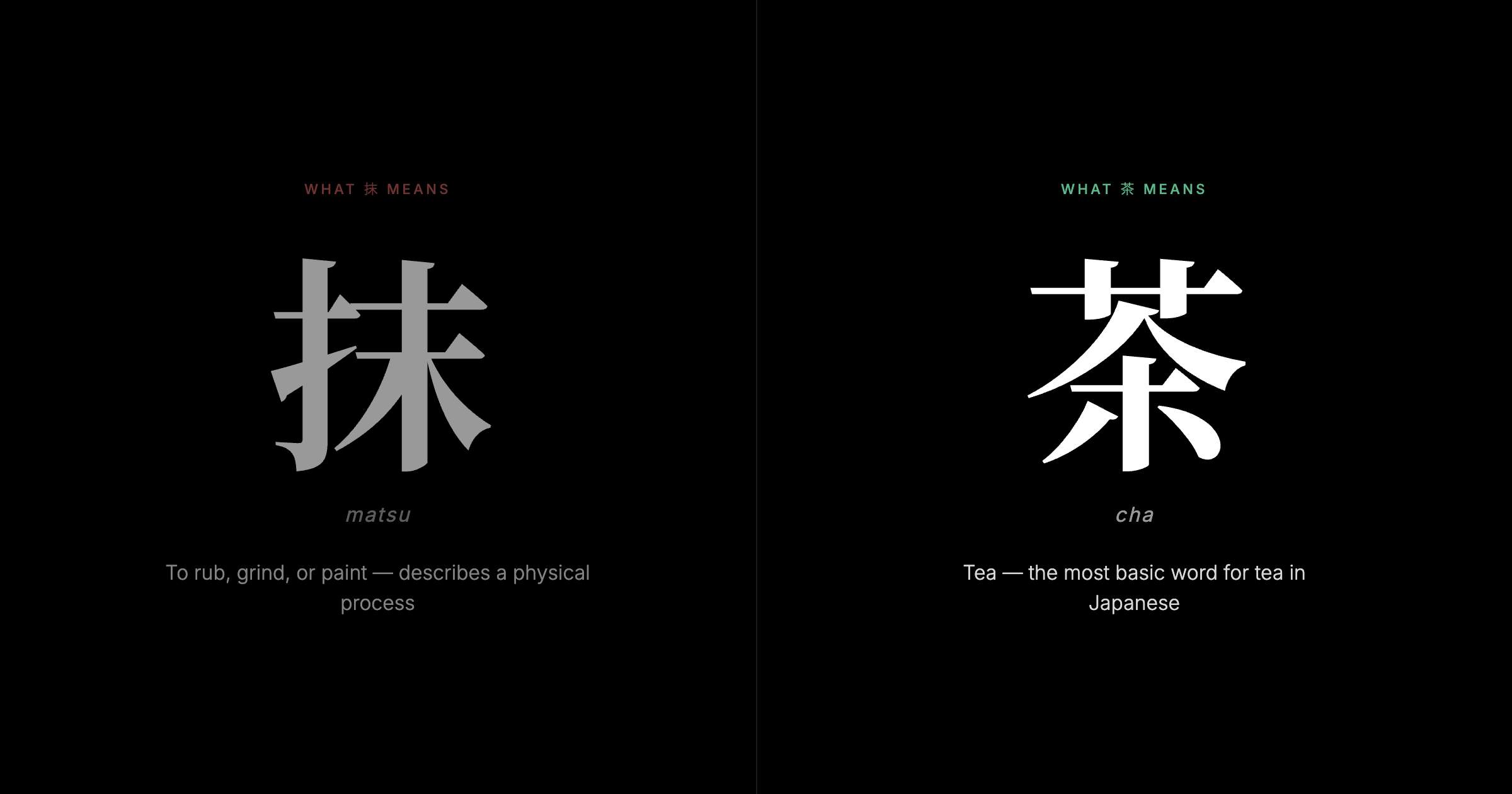
抹 (matsu — to rub, grind, or paint; this character describes a physical action, specifically the grinding or rubbing motion used to process pigments, ointments, and — in this context — tea leaves into fine powder)
茶 (cha — tea; the most common and basic kanji for tea, used across contexts from tea ceremony to a cup of green tea at a convenience store)
The compound 抹茶 (maccha) translates directly to "ground tea" or "powdered tea." That is the full meaning. The characters describe the preparation method — leaves stone-ground into fine powder — and nothing more. There is no metaphorical layer, no philosophical encoding, no hidden resonance. The kanji does exactly what it says: it names an ingredient.
Based on the verification requests KIO's Tokyo-native team reviews, this type of compound — two characters whose literal meanings add up to a functional product description — represents one of the most common sources of tattoo regret. The reader believes the characters hold symbolic depth; the kanji is actually doing the equivalent of saying "ground coffee" or "instant noodles." The ingredient is real, the product is real, the kanji is correct — but the depth the wearer imagined was never encoded there.
Contrast this with how other popular wellness kanji work. 禅 (zen — the tradition and practice of Zen Buddhism; carries genuine philosophical weight as a school of thought rooted in meditative discipline) carries philosophical meaning built into its etymology and usage. 和 (wa — harmony, peace, or the Japanese spirit; used in formal contexts to describe interpersonal balance and appears in compound words relating to Japanese culture and diplomacy) functions symbolically in ways that 抹茶 simply does not. When you're choosing meaningful kanji, the critical distinction is between characters that work as symbolic anchors versus those that function only as literal descriptors — a principle that guides the entire decision-making process behind choosing meaningful kanji for tattoos.
But Doesn't Matcha Have Ceremony Behind It?
This is the most common pushback, and it deserves a direct answer: yes, matcha is genuinely central to chanoyu (the Japanese tea ceremony), one of the most formalized and philosophically rich cultural practices in Japan's history. The tea ceremony spans more than five hundred years of refinement, and the act of preparing and receiving matcha within it is dense with meaning around presence, respect, hospitality, and transience.
But the depth of chanoyu comes from the ritual — from the exact movements, the seasonal awareness, the relationship between host and guest, the philosophy of wabi-sabi underlying the whole practice. None of that is encoded in the word 抹茶. For a full exploration of wabi-sabi philosophy and how it shapes Japanese aesthetics, read our guide to the wabi-sabi kanji tattoo.
Think of it this way: getting 抹茶 tattooed to honor the tea ceremony is like getting "spaghetti" tattooed to honor Italian culinary tradition. The ingredient is correct, the association is real, but the word itself is an ingredient name — not a vessel for the tradition's meaning.
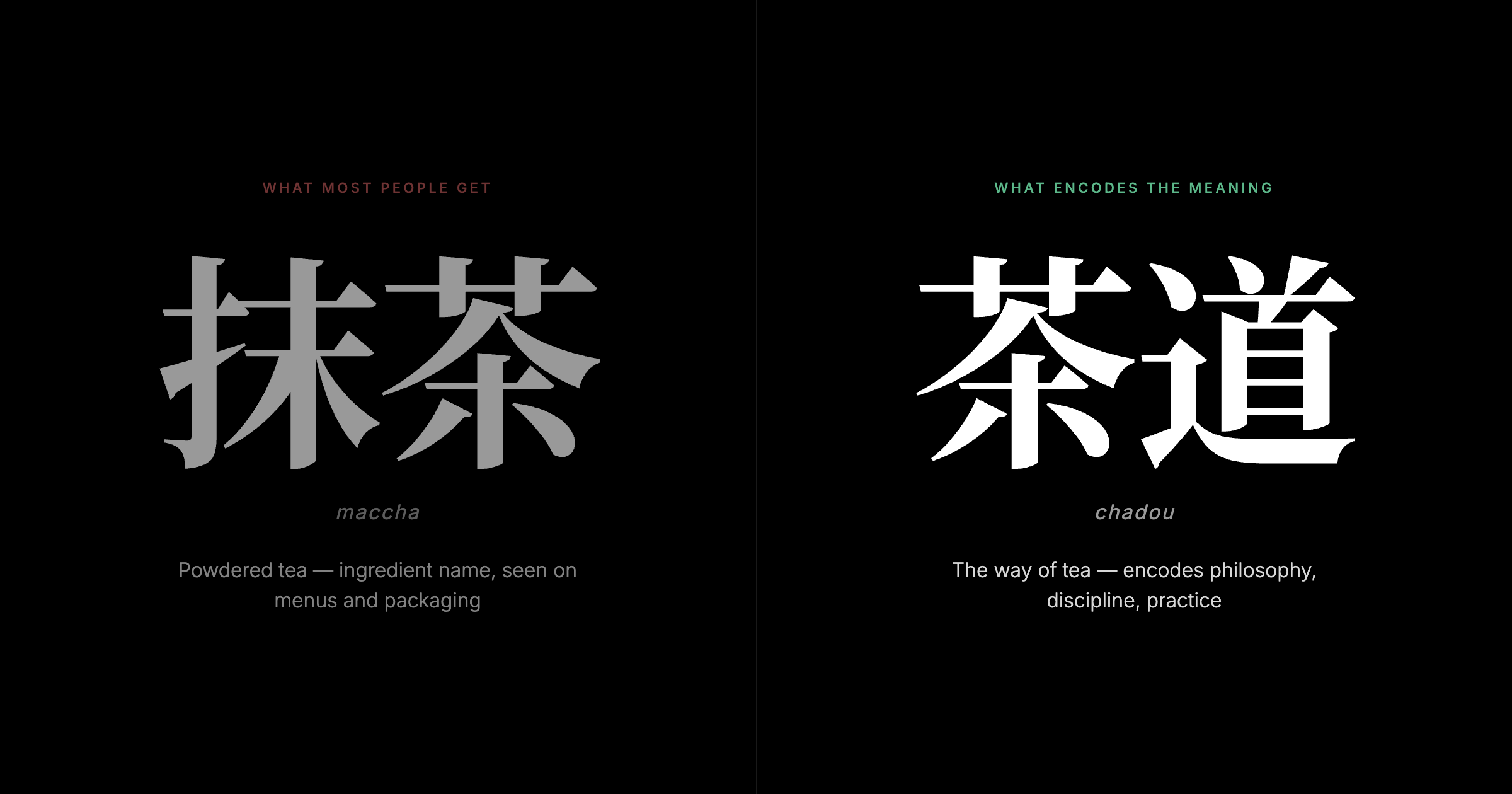
If you want to honor the philosophy of tea ceremony, Japanese people who practice chanoyu would point to different kanji. 茶道 (both ちゃどう (chadou) and さどう (sadou) are correct readings — the major tea schools including Urasenke, Omotesenke, and Mushakoji-senke typically use さどう (sadou) in formal contexts; the way of tea, a compound that encodes the philosophical path and discipline of tea practice, not just the ingredient) actually names the practice. 静 (shizuka — stillness, quiet; used in both everyday speech and formal contexts to describe calm and tranquility, appearing in poetry, formal writing, and tea ceremony discourse) speaks to the quality of presence the ceremony cultivates. These carry the meaning you are probably reaching for.
What Japanese People Actually See
Imagine a Tokyo native on their commute. They see someone with 抹茶 tattooed on their forearm. Here is what registers: the label from a tin of matcha powder at a tea shop, the flavor name on a pastry menu, the text on a plastic bottle of matcha latte at the convenience store.
There is no judgment — the kanji is correctly written, the interest in Japanese culture is clearly genuine. But the reaction is closer to puzzlement than admiration. Why would someone permanently tattoo a product name?
This gap between intention and reception is what Japanese people actually think when they see kanji tattoos — and it's one of the most important factors in choosing characters that will resonate across cultures and contexts. The Western wellness meaning of matcha — the mindfulness, the ritual, the aesthetic — exists as a cultural projection. That projection built up through years of lifestyle branding, Instagram aesthetics, and the genuine beauty of the tea's color and flavor. It is meaningful to you. It does not live inside the characters.
A comparable scenario in English: consider someone who deeply loved French bread culture and the ritual of the boulangerie, and chose to express that by tattooing "baguette" on their arm. The affection is genuine. The symbolism is not there.
Another honest consideration: matcha is experiencing a specific cultural moment right now, concentrated in Western wellness circles between approximately 2022 and 2026. Tattoos that capture trend moments age in ways that tattoos encoding timeless values do not. A matcha tattoo is likely to read, in fifteen years, as a marker of early 2020s Western wellness aesthetics — the same way "Namaste" forearm tattoos from 2012 mark that particular era of cultural borrowing. The kanji itself is timeless; the reason for choosing it may not be.
What You Actually Want — And Kanji That Encode It
The reason this conversation matters is that the underlying desire behind a matcha kanji tattoo is usually entirely valid. Identifying what you actually want to encode is the path to a tattoo that will hold meaning for decades.
Here are the most common underlying intentions and kanji that genuinely carry them:
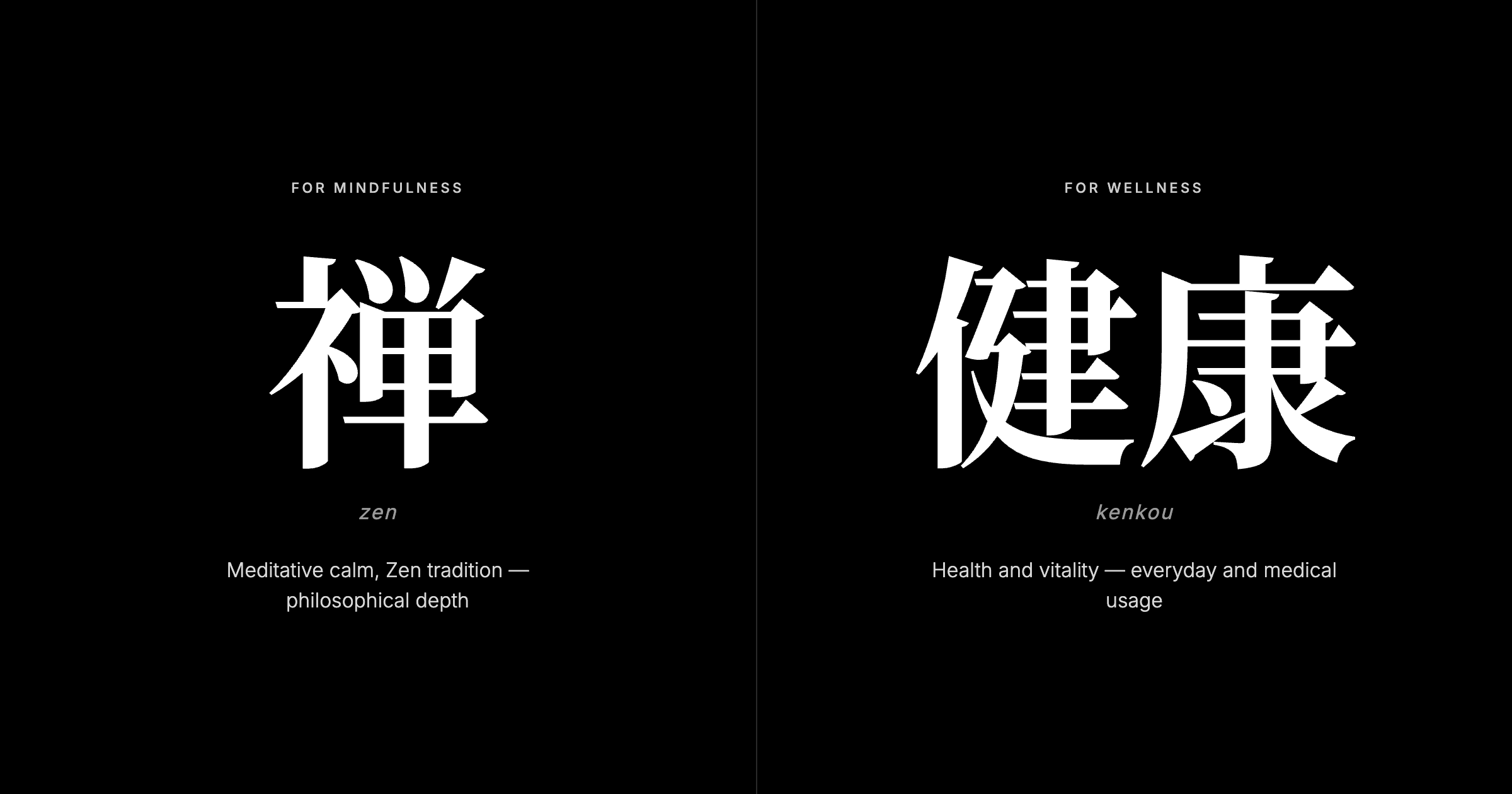
For mindfulness and meditative calm: 禅 (zen — meditative practice, the tradition of Zen Buddhism; appears in formal religious and philosophical contexts, popular in Japanese and Western usage to describe contemplative stillness) or 静 (sei/shizuka — stillness and quiet; used widely in everyday and formal Japanese, from place names to poetry)
For wellness and vitality: 健康 (kenkou — health; a common compound used in compounds like 健康診断 (kenkou shindan — health checkup), 健康食品 (kenkou shokuhin — health food), and 健康増進 (kenkou zoushin — health promotion); note that 健康 does not appear in greeting formulas — the standard wellbeing inquiry uses 元気 instead) or 気 (ki — life force, energy, spirit; used constantly in everyday Japanese expressions and appears in concepts like 元気, meaning good health and vitality)
For the tea ceremony philosophy specifically: 茶道 (chadou — the way of tea; this is what practitioners and scholars actually call the discipline, and the kanji 道 adds the philosophical "way" or "path" dimension that 抹茶 entirely lacks)
For harmony and Japanese aesthetic values: 和 (wa — harmony, peace, Japan; one of the most meaningful single-character options available, used in formal contexts, diplomacy, and cultural identity) or 美 (bi — beauty; used in both everyday and elevated Japanese contexts, appearing in art criticism, literature, and philosophical discussions of aesthetics)
If you're drawn to single-character options specifically, our guide to the best single kanji for tattoos explores which individual characters carry the most symbolic weight and cultural resonance across different values and intentions.
The right question before any kanji tattoo is not "what do I love?" but "what philosophy, value, or identity am I trying to carry permanently?" Once you have that answer, the kanji choice becomes much easier to get right.
How to Avoid the Compound Trap: A Pre-Ink Checklist
The matcha situation is a specific version of a general problem: kanji compounds that describe things rather than encode meaning. Working through these questions before any kanji tattoo helps:
Does this kanji work as a symbol or only as a label? 抹茶 is a label — it names an ingredient. Contrast with 禅 or 和, which function symbolically in Japanese culture and discourse. A label can be personally meaningful, but you should be clear-eyed about what you are encoding.
Would a Japanese person choose this kanji for the same reason? Japanese people with matcha tattoos exist — they tend to be people in the tea industry, food professionals, or individuals making a deliberate choice to honor their relationship to the beverage as a product. If your reason is "matcha represents wellness and mindfulness to me," that reasoning is unlikely to track for a native speaker.
Is this tied to a current trend? Matcha is not trendy in Japan — it is a staple. But it is very trendy in Western wellness culture right now. If the tattoo is partly about participating in that trend, it will show.
Does the compound hold together, or are the individual characters doing separate work? 抹 alone is rarely used; 茶 alone just means tea. The compound reads as a unit, but neither character adds philosophical weight. Compare to 茶道, where 道 specifically adds the philosophical "way" dimension that changes the entire meaning.
Consulting a native speaker or a kanji-focused review service before committing is the simplest safeguard. Kanji Ink Oracle's verification service is built exactly for this: submit the kanji you are considering, and Tokyo-native reviewers assess both technical accuracy and cultural resonance — including whether the kanji will land the way you intend.
Native Verdict: Is There Any Scenario Where 抹茶 Works?
There are narrow, specific circumstances where 抹茶 as a tattoo makes genuine sense. According to Kanji Ink Oracle's Tokyo-based review team, approximately 15% of matcha kanji tattoo inquiries come from people working professionally in the tea industry, where the ingredient name carries genuine workplace and cultural significance.
If you are a practicing chanoyu teacher or a serious student of the tea ceremony, 抹茶 carries professional meaning — though even then, most practitioners would choose 茶道 because it names the discipline rather than the ingredient.
If you work in the tea industry as a producer, blender, or specialist, the ingredient name carries a legitimate identity marker. This is rare and deliberate.
If your relationship with matcha is intensely personal — a beverage that carried you through a specific period of life, a sensory anchor to a meaningful time — and you are fully aware that Japanese readers will see a product name rather than a symbol, that is an informed choice. Tattoos do not have to encode meaning for everyone, only for you. But you should make that choice with clear information.
The honest Tokyo-native verdict: 抹茶 belongs on cafe menus, tea packaging, and matcha lattes — not because it is wrong or broken, but because its register is functional and mundane. It is a perfectly normal, useful word that does exactly what it says. What it does not do is carry the wellness philosophy, cultural sophistication, or mindfulness symbolism that Western matcha culture has projected onto it.
If you love what matcha has meant to your life, choose kanji that encode what you actually love. The philosophy is available. It just lives in different characters.
Verify your kanji at Kanji Ink Oracle — submit the characters you are considering, and Tokyo-based reviewers return a cultural and linguistic assessment within 24 hours, including whether the kanji encodes what you think it does and what alternatives are worth considering.
FAQ
What do the individual kanji in 抹茶 mean?
抹 (matsu) means "to rub, grind, or paint" — it literally describes how matcha powder is made from stone-ground tea leaves. 茶 (cha) simply means "tea." Together, they create a compound with no metaphorical or symbolic layer — just the literal description of a finely ground tea powder. Unlike some kanji combinations that evolve meaning through pairing, 抹茶 stays grounded in its functional, descriptive definition.
Isn't matcha connected to Japanese tea ceremony? Shouldn't that make it deep enough for a tattoo?
Matcha is central to chanoyu (tea ceremony), which is a profoundly philosophical and ritualistic practice. However, the depth of tea ceremony comes from its discipline, philosophy, and mastery — not from the kanji name itself. A Tokyo native wouldn't tattoo 抹茶 to honor the ceremony any more than a chef would tattoo "spaghetti" to honor Italian culinary culture. If you want to honor tea ceremony, choose kanji that encode its philosophy: 茶道 ("the way of tea"), 静 ("stillness"), or 禅 ("zen").
Is this kanji trendy in Japan right now? Will it feel dated?
Matcha has exploded in Western wellness culture (2024-2026), but it is not trendy in Japan — it is simply a staple ingredient. When trends are encoded in tattoos, they age poorly because they are tied to a specific cultural moment. Matcha tattoos will read as "early 2020s Western wellness fixation" in ten years the way "Namaste" arm tattoos read today. The kanji itself is timeless, but your reason for choosing it may not be.
What would a Japanese person think if they saw 抹茶 tattooed on me?
Honestly? They would read it as the product name for powdered tea, typically seen on cafe menus, grocery store packaging, and tea shop signage. There is no judgment, but the reaction would be similar to seeing "Ground Coffee" permanently tattooed — technically accurate, but tonally unusual for something you are committing to forever. Matcha in Japan is a versatile ingredient without singular symbolic meaning strong enough to warrant permanent body art.
If I really love matcha, should I still get this tattoo?
Loving matcha is valid — but tattoos that hold up over time typically encode philosophy, aspiration, or identity rather than product preference. If you are devoted to matcha, ask yourself: are you honoring the tea ceremony discipline? The wellness practice? Japanese aesthetics? Once you identify the underlying value, you can choose kanji that actually encode it. For example: 禅 (zen mindfulness), 健康 (health and wellness), 和 (harmony), or even the simpler 茶 (tea) rather than the full compound.
What kanji should I get instead if I want something related to wellness or Japan?
It depends on what you are trying to honor. For mindfulness: 禅 (zen), 心 (heart and mind). For wellness: 健康 (health), 気 (life force and ki). For nature: 緑 (midori — green), 自然 (shizen — nature). For tea ceremony specifically: 茶道 (the way of tea). For core Japanese values: 和 (harmony), 静 (stillness), 美 (beauty). Each of these carries cultural weight and philosophical depth that 抹茶 does not.