Wabi-Sabi Kanji Tattoo 侘寂: What Tokyo Natives Read
Thinking about a wabi-sabi kanji tattoo? Here's what Japanese people actually see when they read 侘寂 — and the philosophical paradox every wearer should know.
Wabi-sabi kanji tattoos have become increasingly popular in Western culture, appearing everywhere from interior design magazines to mindfulness podcasts to "slow living" newsletters as shorthand for a particular aesthetic sensibility — rough textures, asymmetric ceramics, the beauty of the imperfect. For people drawn to this philosophy, tattooing 侘寂 on their skin feels like a way to carry the concept permanently. The problem, as with most tattoos rooted in a deeply Japanese idea, is that what the kanji communicates in Japan is not quite what the West has made of it.
Understanding the true meaning of a wabi-sabi kanji tattoo matters because it shapes how native Japanese speakers will perceive your decision. This is not about gatekeeping — it is about the gap between what travels globally and what the philosophy actually says.
What Wabi-Sabi Really Is in Japan
Wabi-sabi is a 700-year-old Japanese aesthetic philosophy rooted in Zen Buddhism. It did not begin as a design trend — it began as a way of perceiving reality. The philosophy emerged most visibly through chanoyu, the Japanese tea ceremony, shaped by the influence of tea master Sen no Rikyuu (千利休) in the late 16th century. Rikyuu championed a style of tea practice deliberately opposed to the ornate, gilded aesthetic of the era: rough, asymmetric bowls over lacquered ones, worn objects over pristine ones. This was not poverty — it was a deliberate philosophical choice made within extraordinary material abundance.
The three Buddhist principles underlying wabi-sabi philosophy are impermanence (無常, mujou — all things change and pass), incompleteness (不完全, fukanzen — nothing is ever finished), and emptiness (空, kuu — no object, experience, or self is fixed). Wabi-sabi does not mourn these facts. It finds them clear-eyed and honest: this is how things are, and accepting that is preferable to resistance.
This is where most Western accounts of wabi-sabi go wrong. The popular version — "broken things are beautiful," "your cracks make you interesting" — attaches positive emotional valence to damage. The actual philosophy is more precise: impermanence and imperfection are simply facts, not metaphors for personal growth. There is no celebration of trauma. The philosophy is about non-attachment to perfection, not the romanticization of imperfection.
In contemporary Japan, wabi-sabi (侘寂) lives in philosophy texts, traditional arts, ceramics, tea culture, and garden design — not in everyday speech. The term belongs to classical aesthetics and philosophical discourse. A Japanese person does not say "that's very wabi-sabi" as a casual aesthetic shorthand. When a Japanese person encounters 侘寂, they recognize a serious philosophical reference. The word, when it appears, signals seriousness of intent.
Breaking Down the Kanji 侘寂
The two characters deserve careful attention individually before considering how they work together.
侘 (wabi — わび) originally meant loneliness, desolation, or a kind of forlorn sadness. The character fell out of everyday use centuries ago but was revitalized by tea culture aesthetics in the Muromachi period (14th–16th centuries), where it came to describe something more precise: the austere, subdued beauty of voluntary simplicity, the contentment found in solitude and humble surroundings. It is not a common kanji in modern written Japanese — you will not find it on street signs, in newspaper headlines, or in standard office correspondence. It lives in dictionaries and in literary, philosophical, and art-critical contexts.
寂 (sabi — さび; also read jaku in Buddhist contexts) is older and broader. Dating to 8th-century texts, 寂 carries the sense of "withered," "lean," "hushed" — the bittersweet awareness of aging and decay, the quiet acknowledgment that things pass. Notably, 寂 shares its sound with 錆 (sabi — rust), a connection that runs through Japanese aesthetic discussions of natural patina. In modern Japanese, 寂 appears in compounds like 静寂 (seijaku — silence, stillness) and the everyday 寂しい (sabishii — lonely). As a standalone character with the aesthetic reading "sabi," it is more literary than everyday.
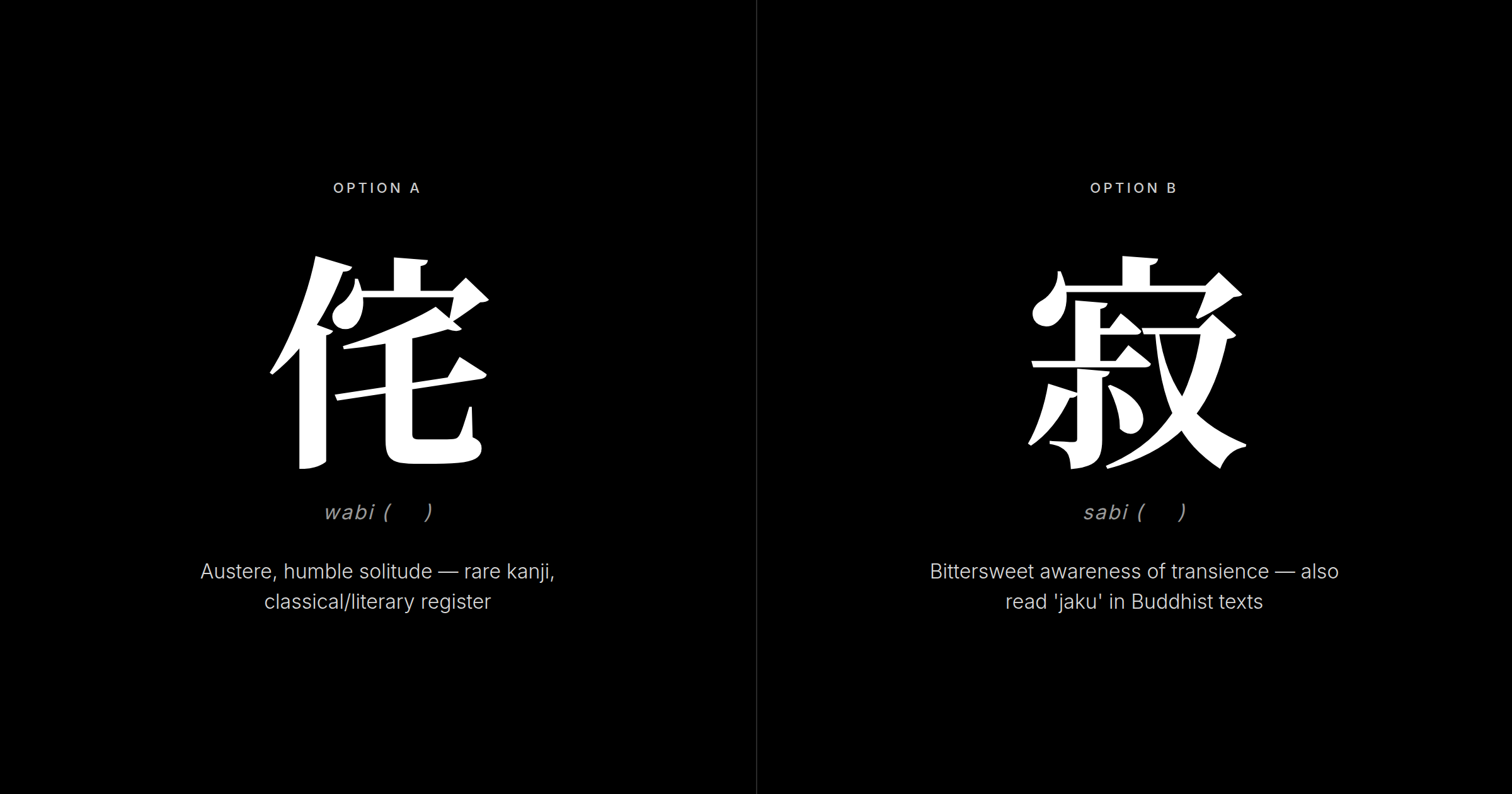
The compound 侘寂 (wabisabi) does appear in Japanese — in art criticism, philosophy texts, and design journalism. It is not an invented Western concept. But its register is formal and literary, not conversational. A Japanese reader encountering 侘寂 will recognize it as an intentional philosophical reference — not a product label, not a common word. Unlike 抹茶 (matcha, which names an ingredient) or 金継ぎ (kintsugi, which names a craft technique), 侘寂 directly names a philosophical framework.
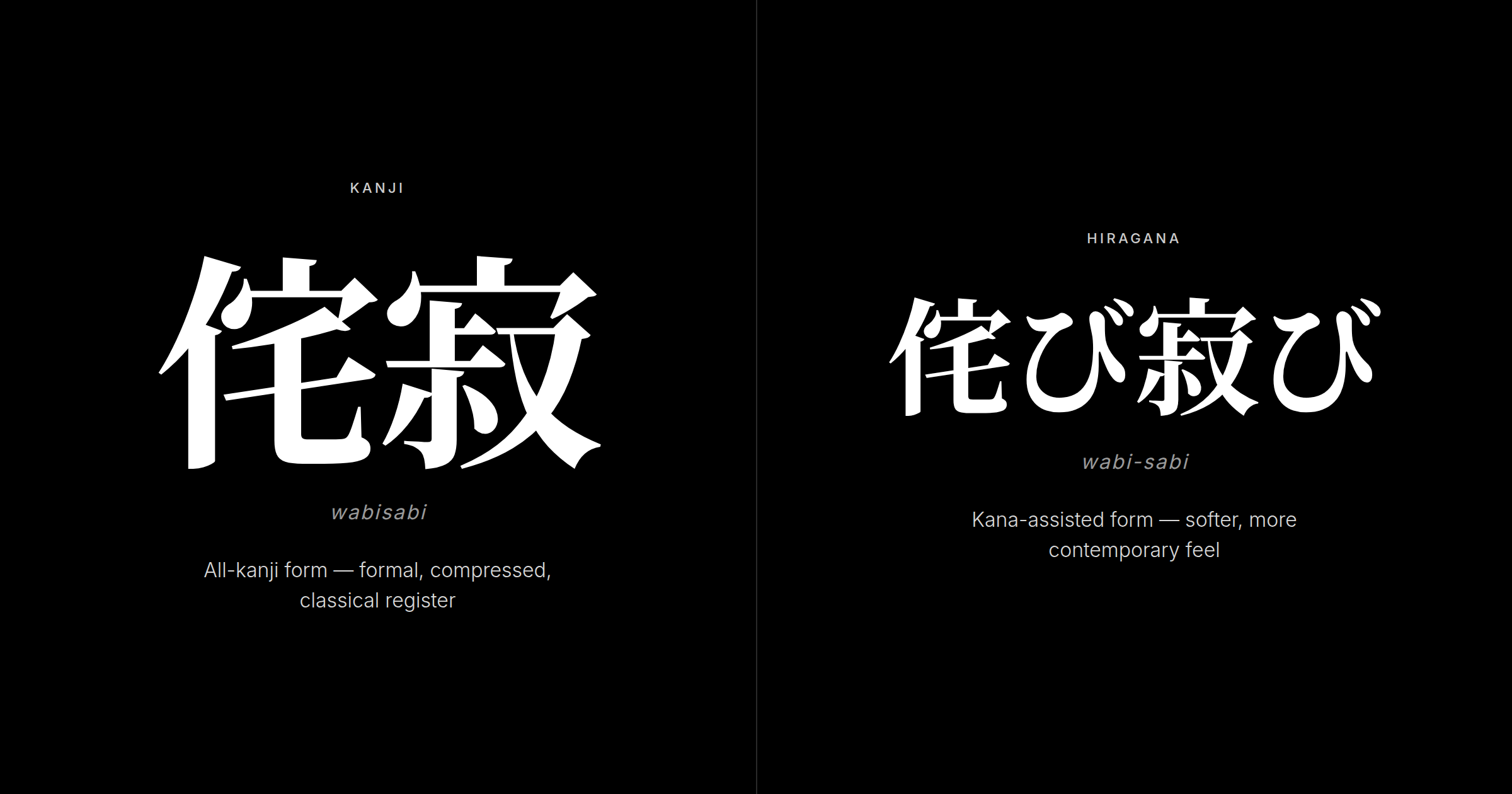
The mixed writing forms 侘び寂び (with hiragana) or 侘び寂 are also used in Japanese texts, particularly when the goal is softening the archaic weight of the all-kanji form. Each carries a slightly different visual register: the all-kanji 侘寂 reads as more formal and compressed; the hiragana-assisted forms feel more approachable and contemporary. For a tattoo, this stylistic choice matters: the all-kanji form signals philosophical seriousness; the mixed form softens toward the aesthetic.
Based on KIO's verification work across hundreds of Japanese philosophy and concept tattoo reviews, this compound sits in an unusual position: it is philosophically accurate, linguistically real, and genuinely used by Japanese people — but it carries significant register weight that most wearers do not anticipate. The kanji signals to a native reader that this person is making a serious philosophical statement, not a casual aesthetic choice.
So What Happens When You Put This on Your Skin?
The cultural weight of 侘寂 raises a sharper question the moment you consider wearing it permanently: the philosophy at the center of wabi-sabi is about impermanence — and a tattoo is the most permanent thing most people do to their body.
Native Verdict: What a Tokyo Native Actually Reads
A Tokyo native seeing 侘寂 on a forearm will not be confused. They will not mistake it for a product name, a common word, or a mistaken Google Translate output. They will recognize immediately that you have chosen a serious philosophical concept and made it permanent. This is a different reaction from the one most kanji tattoo wearers get — and it is worth understanding exactly what comes with it.
The first thing a native reads is the philosophical weight. Unlike single-character tattoos meaning "strength" or "peace," 侘寂 names an entire aesthetic worldview with 700 years of history. The native will register that you have not chosen this casually. This typically produces respect — or at least curiosity — rather than amusement or gentle mockery.
The second thing a native reads is the paradox. Wabi-sabi philosophy holds that attachment to permanence causes suffering. Tattooing that philosophy permanently onto skin creates an immediate logical tension that a Japanese person educated in Buddhist thought will notice. It can be read as ironic, intentional, or simply accepted as the nature of the medium — but it will be noticed.
The third thing a native reads is a calibration question: how deeply does this person actually understand wabi-sabi? The Western popularization through Marie Kondo, Japandi interior design, and "slow living" content is well known in Japan. Educated Japanese people recognize that the version of wabi-sabi that travels globally is significantly simplified — often reduced to an aesthetic of rough textures, detached from its Zen and Buddhist roots. A native reading 侘寂 on Western skin will instinctively assess which version of the concept this person has engaged with.
This tattoo will be read as a serious philosophical statement — never as a mistake, never as a product label. The respect that comes with it is genuine. But it arrives with an unspoken challenge: "can you live the philosophy you've made permanent?" If you are drawn to wabi-sabi because of how it looks, the aesthetic alone will not hold up to that evaluation. If you have genuinely wrestled with Buddhist non-attachment and acceptance of impermanence, the tattoo reflects that engagement honestly.
Better Alternatives: Kanji That Capture the Same Depth
If the philosophical paradox of tattooing a transience philosophy, or the classical register of 侘寂, gives you pause, there are kanji that reach for the same underlying values with different strengths.
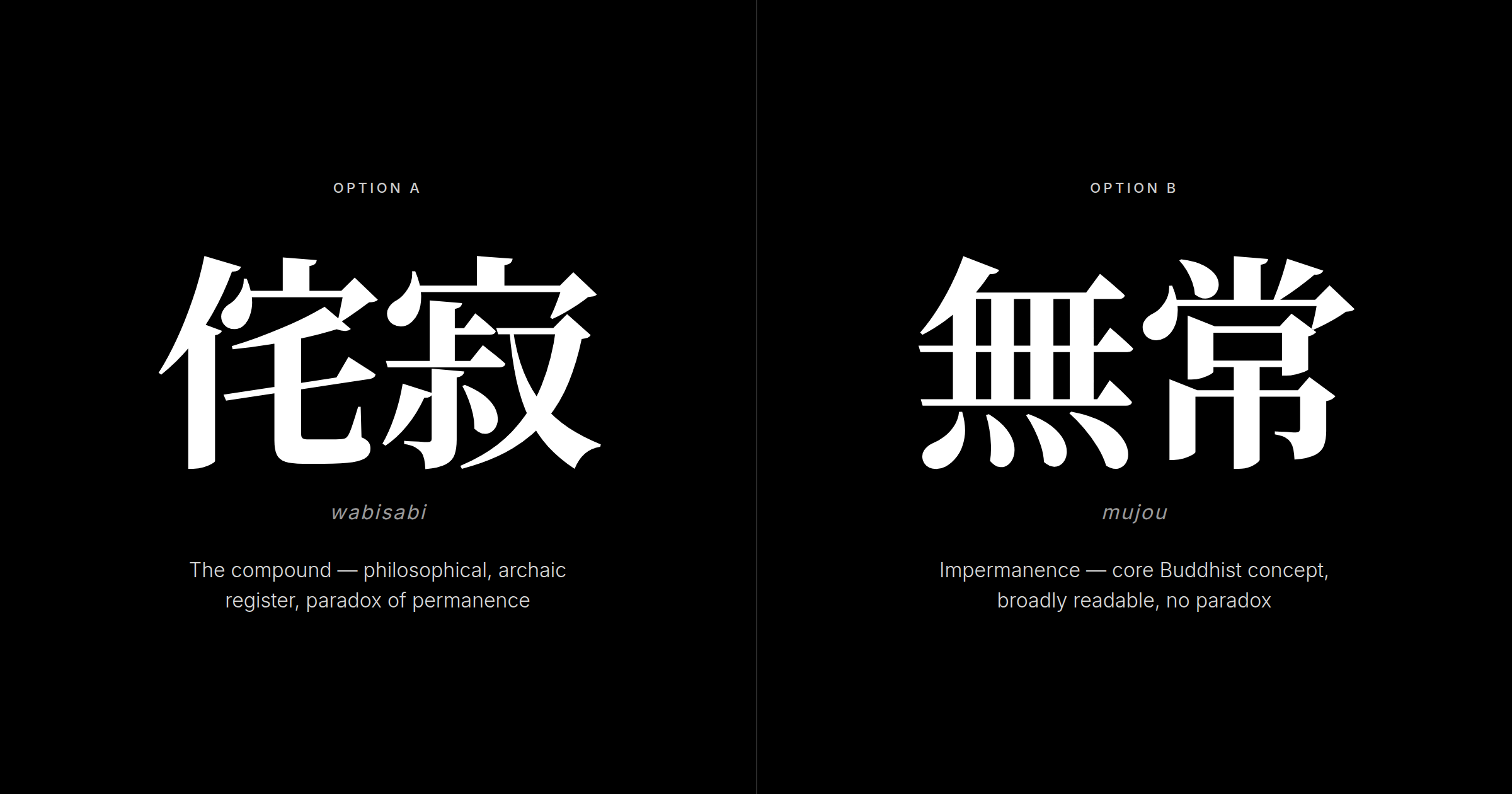
無常 (mujou — impermanence) is the direct Buddhist term for the impermanence that underlies wabi-sabi philosophy. 無 (mu — nothing, absence) and 常 (jou — constancy, permanence) together mean the absence of permanence. It appears in both classical texts and modern Japanese discussion of Buddhist philosophy and is immediately readable by any educated Japanese person. If the core insight you are reaching for is impermanence itself — the fact that nothing lasts, and acceptance of that fact is freedom — 無常 encodes it more directly than 侘寂.
静寂 (seijaku — silence, stillness) uses 寂 in a compound widely understood in modern Japanese. 静 (sei — quiet, still) and 寂 (jaku — hushed, empty) together name the profound quietness that wabi-sabi aesthetics cultivate. If meditative stillness is what resonates with you, 静寂 delivers it with full readability.
空 (kuu — emptiness) is the Zen concept of sunyata: no thing has fixed, permanent essence. As a single character it is simple, legible, and resonant. Its register spans from the everyday (sky, air) to the deeply philosophical — a layered quality appropriate to serious tattoo work. See our guide to the best single kanji for tattoos for broader options.
Wabi-sabi is the broader philosophical framework; kintsugi is one specific practice that embodies it. If you are drawn to the kintsugi concept of visible repair, know that kintsugi tattoo kanji reads to Japanese people as a craft technique label, not a philosophy — covered in depth in our kintsugi article. If you are exploring other viral Japanese concepts that carry philosophical weight in the West but land differently in native speech — komorebi, tsundoku, mono no aware, and others — our guide to untranslatable Japanese words as tattoos shows what a Tokyo native actually reads in each choice. The question of cultural appropriation is addressed in our kanji tattoo cultural appropriation guide: thoughtful engagement with Japanese philosophy is generally received as respectful.
FAQ
What do the kanji 侘寂 mean individually?
侘 (wabi, read わび) originally meant loneliness or desolation and evolved through 14th–16th century tea culture aesthetics to describe austere, humble beauty and spiritual contentment found in solitude. 寂 (sabi, read さび — also jaku in Buddhist contexts) dates to 8th-century texts and conveys a bittersweet awareness of aging and decay: not grief, but a quiet acknowledgment that things pass. Together, 侘寂 names the aesthetic philosophy that finds meaning in impermanence, imperfection, and incompleteness — not by romanticizing them, but by accepting them without resistance.
Are these kanji difficult to read for Japanese people?
No. 侘 and 寂 are recognizable to educated Japanese readers and appear in standard dictionaries. They are not among the hardest kanji to read. The character 侘 is rarer in everyday modern writing, but a reader familiar with classical aesthetics, philosophy texts, or traditional arts will recognize it immediately. The compound 侘寂 is not used in daily conversation — it belongs to philosophical, artistic, and cultural discourse. The perception of 'difficulty' comes from its archaic register in modern Japan, not from kanji complexity itself.
Is a wabi-sabi tattoo contradictory since wabi-sabi celebrates impermanence?
Yes — and that is worth acknowledging honestly before committing. Wabi-sabi philosophy holds that impermanence and change are fundamental to existence, and that resistance to them causes suffering. A tattoo is among the most permanent choices a person makes about their body. This creates a real philosophical tension that a Japanese person educated in Buddhist thought will notice. Whether you read that as a disqualifying contradiction, an acceptable paradox, or an intentional irony depends on your relationship to the concept — but going in with your eyes open about it is part of taking the philosophy seriously.
What will Japanese people think when they see my wabi-sabi kanji tattoo?
A Japanese person will recognize 侘寂 as an intentional philosophical statement — not a product label, not a Google Translate mistake, and not a casual choice. The typical reaction is respectful curiosity, not amusement. Natives will register that you have engaged with something serious rather than grabbing a convenient kanji. What follows internally is an assessment: has this person genuinely engaged with the philosophy, or are they carrying the Western lifestyle-trend version? That evaluation is not hostile — it is simply what happens when you wear 700 years of aesthetic philosophy on your skin.
Can I use the mixed form 侘び寂 or 侘び寂び instead of 侘寂?
Yes. The mixed forms — 侘び寂 (kanji with hiragana okurigana) or 侘び寂び (both elements kana-assisted) — are used in Japanese texts and carry slightly softer visual register than the all-kanji 侘寂. The all-kanji form reads as more formal and compressed; the hiragana-assisted forms feel more contemporary and approachable. For a tattoo, this is a meaningful stylistic choice. Communicate clearly with your artist about which form you want, and consider what the visual weight of each form says about your relationship to the concept.
How is wabi-sabi different from kintsugi? Should I get kintsugi instead?
Kintsugi (金継ぎ) is a specific pottery repair technique in which broken ceramics are mended with gold. Wabi-sabi (侘寂) is the broader philosophical framework that kintsugi inhabits. When a Japanese person reads 金継ぎ, they think of a pottery repair method — not the Western metaphor of healing from trauma or brokenness becoming beautiful. If your goal is expressing the wabi-sabi philosophy, 侘寂 is more direct and philosophically honest. If you are attracted to the specific craft technique, kintsugi works — but understand the gap between what the kanji communicates and what Westerners typically attach to the concept. Our kintsugi tattoo kanji guide covers this in full.
Is getting a wabi-sabi kanji tattoo cultural appropriation?
No, when approached with genuine engagement. Tattooing a serious Japanese philosophical concept reflects study and interest in the culture, not mockery or trivialization. Japanese people are generally welcoming of non-Japanese people who engage authentically with Japanese aesthetics and philosophy. The key distinction is depth of engagement: a wabi-sabi tattoo motivated by genuine philosophical study reads differently from one motivated by a Japandi aesthetic board. Natives can often tell the difference, and their reaction reflects it. For a full treatment of this question, see our kanji tattoo cultural appropriation guide.
What calligraphy style should I choose for the kanji?
Four main options: block style (kaisho — 楷書) is the most formal and legible, readable at a glance by any Japanese speaker; semi-cursive (gyousho — 行書) balances artistry and readability; cursive (sousho — 草書) is flowing and painterly but may be harder for a Japanese reader to parse quickly; design-style variations offer artistic freedom but risk making the kanji harder to recognize. For 侘寂 specifically, the aesthetic weight of the concept makes a considered calligraphy choice especially important — the style should reinforce, not contradict, the philosophical register you are committing to.
What should I know before getting this tattoo?
Understand wabi-sabi as a Zen Buddhist philosophy about accepting impermanence — not a lifestyle trend about celebrating brokenness. Accept the paradox: you are permanently tattooing a philosophy centered on transience. Be ready for thoughtful questions from Japanese people about what the concept means to you. If you can explain wabi-sabi without referencing broken objects or personal resilience, you are likely engaging with the genuine concept. Before finalizing any design, have it reviewed by a native speaker — the KIO verification process covers exactly what that review should include.
Before any design goes to a needle, have the kanji verified by someone who reads them natively. Kanji Ink Oracle offers a review by Tokyo-based native speakers who assess not just whether the characters are correct, but whether the form, style, and combination communicate what you intend — including the register and philosophical weight that a native reader actually picks up. A wabi-sabi tattoo deserves that level of scrutiny.