Jujutsu Kaisen Kanji Tattoo: 呪 and Sukuna's Real History
Learn what Jujutsu Kaisen kanji tattoos really mean to Tokyo natives. Discover the history behind Sukuna's marks and verify your design before inking.
Jujutsu Kaisen kanji tattoos carry cultural weight that most Western fans never discover. Jujutsu Kaisen became one of the fastest anime series to generate global tattoo demand, and the reasons go deeper than Gege Akutami's striking visual design. The series is saturated with real Japanese history, Buddhist philosophy, and spiritual vocabulary — layers that most international fans sense but cannot fully decode. That depth is exactly what makes JJK kanji so compelling to tattoo, and exactly what makes them worth understanding before committing to ink.
Why Jujutsu Kaisen Fans Are Drawn to Kanji Tattoos
Anime series come and go as tattoo inspirations, but JJK has unusual staying power because the kanji embedded in its world are not invented. When Gege named techniques, enemies, and concepts, the choices were deliberate — words with roots in Shinto ritual, Heian-period history, and Buddhist cosmology. Fans who look closely can sense that 呪術廻戦 is doing something more than cool naming, even if they cannot say precisely what.
The series also has a visual grammar that invites kanji engagement. Unlike many shonen anime where special moves are pure sound effects, JJK spells out its techniques in written form on screen. Characters announce their techniques in full kanji — 領域展開 (ryouiki tenkai — Domain Expansion), 黒閃 (kokusen — Black Flash), 赫鱗躍動 (kakurinyakudou — official English localization: "Piercing Blood"; the characters literally mean blazing-crimson scales leaping into motion) — and the written form is central to how those moments feel. For a fan designing a tattoo, this visual vocabulary is the natural starting point.
Based on the volume of verification requests KIO's Tokyo-native team receives, JJK-related kanji queries now rank among the top five anime tattoo categories globally — and the single most common issue is fans bringing designs sourced from anime screenshots rather than verified stroke-order references.
The Cultural and Historical World Behind 呪術廻戦
To understand JJK kanji as a Tokyo native reads them, you need to understand the world Gege built the title from.
呪 — More Than "Curse"
The single character 呪 (ju, when read in its Chinese-derived on'yomi reading; noroi in its native Japanese kun'yomi) sits at the heart of the series title. Its meaning in modern Japanese is not simply "curse" in the Hollywood horror sense. The character encompasses a spectrum: a verbal spell, a protective charm, a hex, an incantation. It appears in the word 呪文 (jumon — magic words, an incantation), in 呪縛 (jubaku — a binding curse or psychological fixation), and in 呪術 (jujutsu — the technique of wielding curses, which is the series title's first word).
The character's construction is instructive. The outer radical on the left is 口 (kuchi — mouth), the channel through which spoken power flows. The component on the right, 兄 (ani — older brother), adds a layer of hierarchical authority — the mouth of someone with authority over you, speaking power into the world. Together, 呪 describes a spoken act of spiritual consequence. In pre-modern Japan, words were considered to have real power — a concept called kotodama (言霊, the spirit of words). Curse techniques in JJK draw directly on this tradition.
In modern Japanese, 呪 appears primarily in compound words and in literary or ritual contexts. It is not a word a Tokyoite uses in ordinary conversation the way English speakers say "cursed." It carries historical and spiritual weight that elevates it above casual slang. When someone sees 呪 tattooed on a forearm, they recognize it immediately as a meaningful spiritual and literary term — not a generic "edgy" word.
呪術廻戦 — The Full Title Decoded
The complete title 呪術廻戦 breaks into two compound words: 呪術 (jujutsu — curse technique) and 廻戦 (kaisen — revolving battle). Most fans know "jujutsu" from Brazilian jiu-jitsu, but the kanji version in the series title has a different character: this 術 is technique or art in the sense of a specialized skill or method, not martial grappling.
The more philosophically loaded character is 廻 (kai/mawaru — to revolve, to cycle around). This is not the simpler 回 (also kai/mawaru — to turn, to go around), which appears in everyday words like 回転 (kaiten — rotation) and 一回 (ikkai — one time). Gege's choice of 廻 — with the road radical 辶 added to 回 — points toward Buddhist samsara, the eternal cycle of death and rebirth. The title therefore carries a reading closer to "the eternal cycle of sorcery battles" than the blunter "sorcery fight." A Tokyo reader who notices the character choice will read the title as a statement about fate and recurrence, not just action.
領域展開 — Domain Expansion's Buddhist Roots
Domain Expansion (領域展開, ryouiki tenkai) is the highest-tier technique in JJK, and its name is philosophically dense. 領域 (ryouiki) means domain or territory — the compound appears in formal academic and legal Japanese for "field of expertise" or "territorial boundary." 展開 (tenkai) means deployment or unfolding, used in modern Japanese for strategic rollouts and narrative development.
The deeper layer is Buddhist. The concept of a personal sacred space draws on mandala theory and the kekkai (結界, a ritual barrier used in Shinto and Buddhist practice). Gege explicitly layered this cosmology into the technique's naming — the philosophical vocabulary is not decoration, it is the point.
Sukuna's Tattoos and 入れ墨刑 — The History Most Fans Miss
Ryomen Sukuna's body markings are the visual signature of JJK. Most Western fans read them as a design choice that communicates "powerful and dangerous." That reading is correct, but it misses the historical layer that Japanese audiences recognize immediately.
Sukuna's marks are visually coded to reference 入れ墨刑 (irezumi kei — literally "tattooing punishment"), the system of punitive tattooing used in Japan from the Heian period through the Edo period. Under this system, criminals were permanently branded with tattoos. The placement encoded the crime: tattoos on the arm for theft, marks on the forehead or face for severe offenses including murder. The more extensive the tattooing, the more severe and repeated the criminal history. It was a form of social death — permanent, visible, impossible to hide, designed to mark someone as permanently outside respectable society.
Gege Akutami designed Sukuna with this historical register in mind. Sukuna wears markings that in historical Japan would have identified him as a catastrophically violent criminal. The design is not accidental. It communicates, to an audience that knows this history, that Sukuna is humanity's worst — not just powerful, but permanently, historically condemned.
This is the layer most Western fans copying Sukuna's marks do not know they are wearing.
The Kanji Breakdown: What Each Character Carries
呪 in Isolation
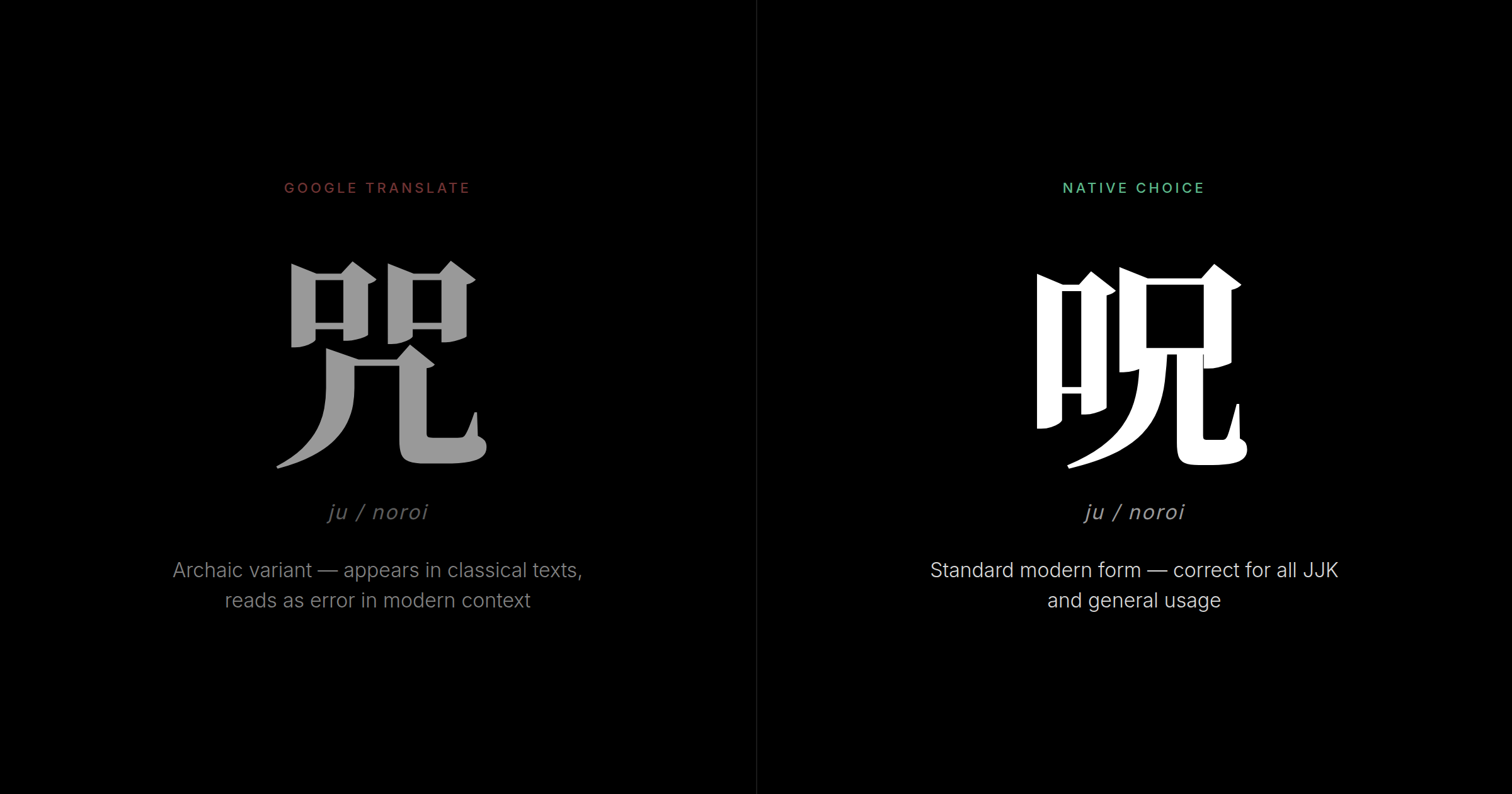
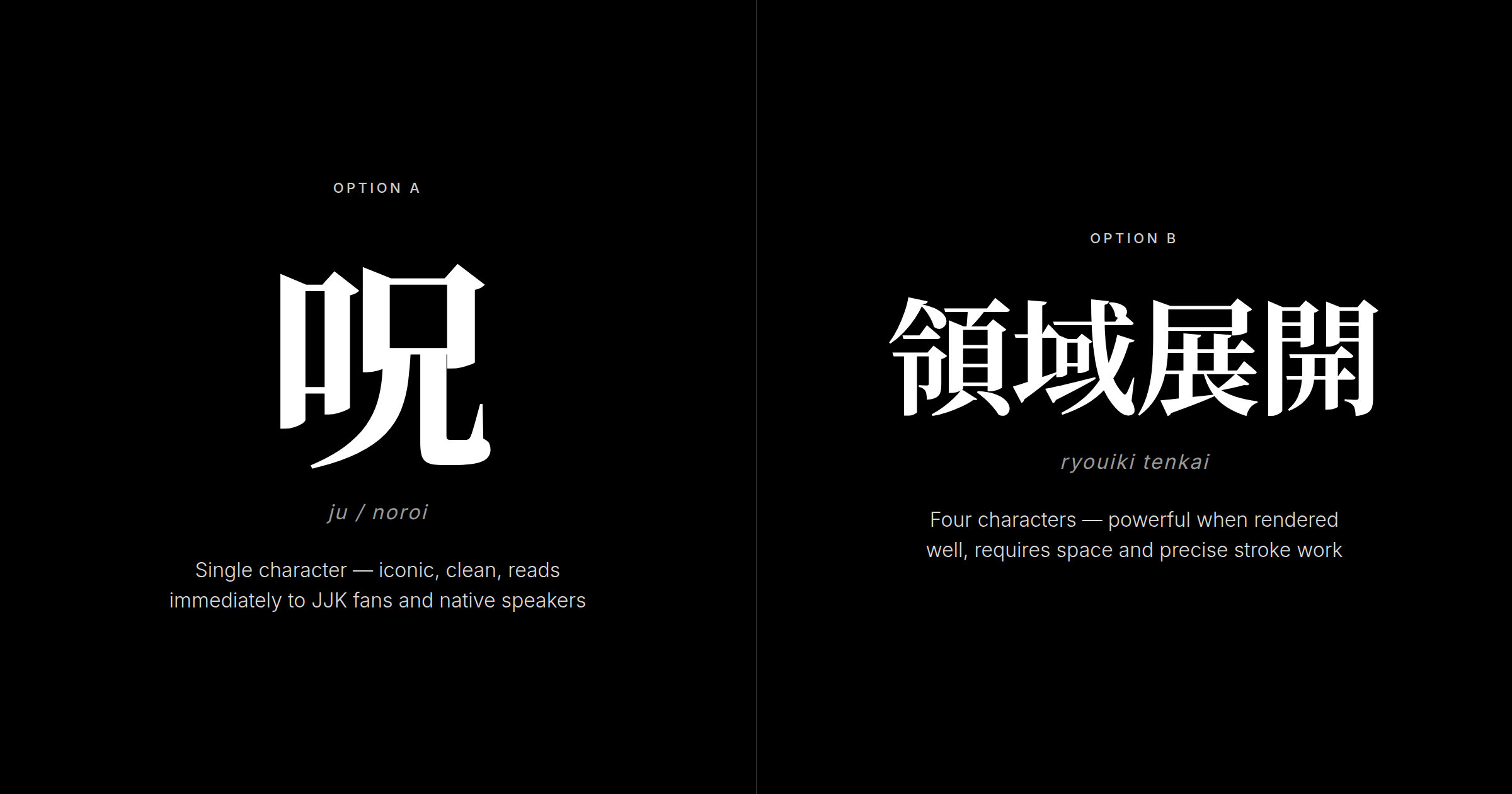
As a standalone tattoo character, 呪 (ju / noroi) is the most iconic choice for JJK fans. It is immediately recognizable to anyone who has seen the series and carries genuine linguistic weight in Japanese.
Structurally: eight strokes, left component 口 (mouth/speech), right component 兄 (elder/authority). The standard form is unambiguous — there is a lookalike variant 咒 (an older classical form, structurally similar) that appears in ancient texts, but 呪 is the modern standard. A tattoo of 咒 instead of 呪 would read as either archaic or simply wrong to a native eye; this is the kind of one-character substitution error that KIO's verification process specifically flags.
領域展開 Character by Character
For fans committed to a four-character phrase, 領域展開 (ryouiki tenkai) breaks down as:
- 領 (ryou — to govern, to hold territory; 14 strokes)
- 域 (iki — domain, region, boundary; 11 strokes)
- 展 (ten — to deploy, to spread out, to open; 10 strokes)
- 開 (kai — to open, to begin, to unlock; 12 strokes)
Total: 47 strokes across four characters. That is a serious calligraphic commitment. At tattoo scale, each character needs adequate space to render legibly with proper stroke weight. Rushing the sizing or spacing is where Domain Expansion tattoos most often go wrong. The phrase is most often seen rendered in a vertical column, which is also the traditional calligraphic orientation for Japanese.
Native Verdict: What a Tokyo Native Reads
Native Verdict
A single 呪 on a forearm reads clearly to any Japanese speaker: spiritual force, magical consequence, the vocabulary of ritual and incantation. In an anime context, anyone under 40 in Tokyo will also read it as a JJK reference immediately — it is one of the most culturally saturated single characters of the past five years. The reaction is generally neutral-to-positive curiosity, with a note of respect for the cultural weight the character carries.
Sukuna's specific mark arrangement is where the native reading becomes more complex. A Japanese person with historical literacy will recognize the irezumi kei reference and understand exactly what Gege was communicating about Sukuna's character. They will likely find it intellectually interesting — and then note, sometimes with dark humor, that the wearer may not know they are displaying historical criminal branding. This is not a reason to avoid the tattoo, but it is the layer of meaning a native brings to the reading that no Western tattoo portfolio site will mention.
領域展開 reads as technical and aspirational — clean, no negative associations. A native familiar with JJK will immediately recognize it as a technique name. One unfamiliar with the series will read it as an oddly formal phrase about deploying territory. Either reading is fine.
Full title 呪術廻戦 on skin is a statement of fandom, and a knowledgeable native will appreciate the 廻 character choice — the samsara reading signals that the wearer either chose deliberately or got very lucky.
Better Alternatives: What to Consider Instead
Here are JJK kanji choices with strong cultural footing and no criminal-history baggage.
呪 (ju / noroi — curse, incantation) remains the clearest single-character representation of the series' philosophy. Understanding what it means deepens the choice rather than complicating it.
術 (jutsu — technique, art, skill) is the second character of "jujutsu" and stands well independently. It appears in modern Japanese in contexts from surgery (手術, shujutsu) to technique-heavy sports commentary. Its register is skilled craft — the word a native uses when describing mastery.
廻 (kai / mawaru — to revolve, the eternal cycle) is the philosophically richest character in the title and the least likely to be recognized as JJK-specific. For a fan who wants the samsara reading without the full series reference, 廻 alone is a striking choice — unusual enough to invite explanation, rooted enough to reward it.
For fans wanting single kanji with broader meaning and cultural depth, explore our comprehensive guide to best single kanji for tattoos covering the full spectrum of options, and the detailed walkthrough on choosing meaningful kanji for tattoos to evaluate cultural fit before inking.
For fans exploring kanji designs across other anime franchises, the Demon Slayer kanji tattoo guide and Naruto kanji tattoo guide offer series-specific context with the same depth. The studio-ghibli kanji tattoo guide covers non-combat anime designs if you're interested in alternatives. If you're interested in how other anime handle cultural and geographic complications — where symbols carry radically different social weight depending on context — the Tokyo Revengers manji tattoo guide explores exactly this challenge with 卍, a sacred Buddhist symbol that reads dangerously in Western contexts. For anime that mixes real Japanese with invented compounds — the same challenge JJK faces with 廻戦 — Bleach kanji tattoos present similar choices with 卍解 and 斬魄刀, where fans must distinguish between kanji that exist in real Japanese versus pure anime vocabulary. For register mismatch where correct kanji reads as mundane to natives despite emotional weight in the story, the Chainsaw Man kanji tattoo guide explores exactly this gap with 契約, a legal-register word that carries no power outside the narrative. Hunter x Hunter's 念 kanji offers another case study in this same pattern, where the character's real meaning in Buddhist and philosophical contexts diverges sharply from how fans interpret it through the anime.
FAQ
What is a jujutsu kaisen kanji tattoo?
A jujutsu kaisen kanji tattoo uses one or more Japanese characters from the anime series Jujutsu Kaisen (呪術廻戦). Popular choices include the single character 呪 (ju — curse), the four-character technique name 領域展開 (ryouiki tenkai — Domain Expansion), or the full series title. Because the series draws on real Japanese history and Buddhist philosophy, these kanji carry genuine cultural weight beyond their anime context.
Which single kanji from Jujutsu Kaisen makes the best tattoo?
呪 (ju / noroi — curse, incantation) is the most iconic and linguistically rich choice. It is the literal foundational character of "jujutsu," carries real spiritual vocabulary from Japanese ritual history, and is immediately recognizable to JJK fans and native Japanese speakers alike. 領域展開 is powerful but requires four characters — it works best as a vertical phrase with proper sizing, not as a compact single-character design.
Is it offensive to get Sukuna's tattoo marks if I'm not Japanese?
The concern is less about appropriation than about understanding what you are wearing. Sukuna's marks reference 入れ墨刑 (irezumi kei), Japan's system of punitive criminal tattooing. Getting inked with Sukuna's design without knowing this means carrying a historical meaning you did not choose. The kanji tattoo cultural appropriation guide has fuller context.
Will a Japanese person recognize my JJK kanji tattoo?
Yes, especially 呪 or 領域展開. The series is a genuine cultural phenomenon in Japan, not just overseas — a native under 40 will likely recognize a JJK reference immediately. The additional layer: if you have Sukuna-specific markings, a historically literate Japanese person will also recognize the irezumi kei reference and understand the irony. Most will find this intellectually interesting; some will wonder if you know.
What's the difference between 呪 and other "curse" kanji?
呪 is the standard modern form used in 呪術廻戦 and in modern Japanese compounds. The archaic variant 咒 uses a slightly different structural arrangement and appears in classical texts; seeing it on a tattoo today reads as either scholarly or simply incorrect. The radical structure of 呪 — 口 (mouth) + 兄 (elder brother) — is specifically tied to the spoken-word power meaning. A character that looks similar but uses a different radical construction will carry a different meaning and read as an error to a native eye. This is exactly the kind of distinction the fake anime kanji tattoo guide was written to prevent.
Is there a correct way to write 領域展開 for a tattoo?
Yes. Each of the four characters (領域展開) has a standard stroke order and weight that proper calligraphy follows. The most authentic rendering styles are standard regular script (楷書, kaisho) or sumi-e brush calligraphy. Avoid anime-font stylizations sourced from screenshots — they look visually striking but deviate from proper kanji form in ways a native reader will notice. Provide your artist with references from authoritative sources (Jisho, JapanDict) rather than anime stills. The total stroke count is 47 strokes across four characters; proper rendering requires adequate scale.
What if my tattoo artist gets the stroke order wrong?
A single off stroke is often unnoticed by most — but a native speaker will catch it on close inspection. A completely wrong character (咒 instead of 呪, for example) reads as an error to any Japanese reader. This is especially critical with jujutsu kaisen kanji, where precision matters to the meaning. Verification before inking is the only reliable protection. The how to verify kanji tattoo before getting it guide covers the full process; is my kanji tattoo wrong addresses next steps if you suspect an existing error.
Should I get a jujutsu kaisen kanji tattoo if I don't understand Japanese?
Understanding the meaning deepens your choice and prevents regret. A jujutsu kaisen tattoo that carries unexamined cultural baggage (like Sukuna's criminal-history marks) becomes a permanent symbol of something you didn't actively choose. Take time to research the specific kanji, learn its etymology, and verify the design with a native speaker. The fake anime kanji tattoo guide explains the most common verification mistakes, and google translate kanji tattoo shows why machine translation fails for cultural context.
Ready to get a jujutsu kaisen kanji tattoo that holds up to native scrutiny? Kanji Ink Oracle connects you with Tokyo-native reviewers who can verify your chosen characters — stroke order, register, and cultural context — before you commit to ink. Assessments are returned within 24 hours.