Demon Slayer Kanji Tattoos: Real Japanese vs. Manga-Only Characters
Demon Slayer kanji tattoos verified by Tokyo natives: which 鬼滅 characters are authentic Japanese and which are series-only. Safe choices and execution risks.
You've watched Demon Slayer, you've felt it, and now you're seriously considering a tattoo. The kanji on the Corps uniforms, on Tanjiro's sword, on the Hashira themselves — the series is visually stunning. But a question is nagging you: are these kanji actually real Japanese, or did the manga creator just invent them? The answer matters, because it's going on your skin permanently.
The short version: most of what you see in Kimetsu no Yaiba is genuinely real, ancient Japanese. But the details separate a tattoo you'll be proud of from one a native speaker quietly cringes at.
The Core Series Kanji: 鬼滅の刃
The title itself is the starting point. Written 鬼滅の刃 (Kimetsu no Yaiba — Blade of Demon Destruction), every character in this title is a real, centuries-old Japanese kanji.
- 鬼 (oni or ki — demon, ogre; the character appears in Japanese folklore, classical literature, and Buddhist texts going back over a thousand years. In modern Japan it turns up in idioms, Halloween decorations, and proverbs. It is not invented.)
- 滅 (metsu — destruction, annihilation, extinguishing; this kanji carries a nuanced visual etymology: its components suggest water overwhelming fire, yielding the concept of something being completely extinguished. In modern usage it appears in words like 絶滅 zetsumetsu, meaning extinction, and in Buddhist contexts meaning the cessation of suffering.)
- の — the possessive particle, written in hiragana, no kanji
- 刃 (yaiba or jin — blade, sword edge; used in contemporary contexts from kitchen knives to political metaphors about cutting through problems)
Creator Koyoharu Gotouge made deliberate choices in these characters, selecting kanji that fit the story's Taisho-era (1912–1926) setting. This was not accidental aesthetics. The vocabulary and kanji style of that period had a particular formality that Gotouge leaned into, which is why the series title reads as both archaic and immediately legible to modern Japanese speakers.
For tattoo purposes, any of these three kanji — 鬼, 滅, or 刃 — are 100% legitimate. A Tokyo native reading one of them on someone's arm would see it as a real, meaningful character, regardless of whether they knew the series.
The Corps Uniform and Blade Kanji
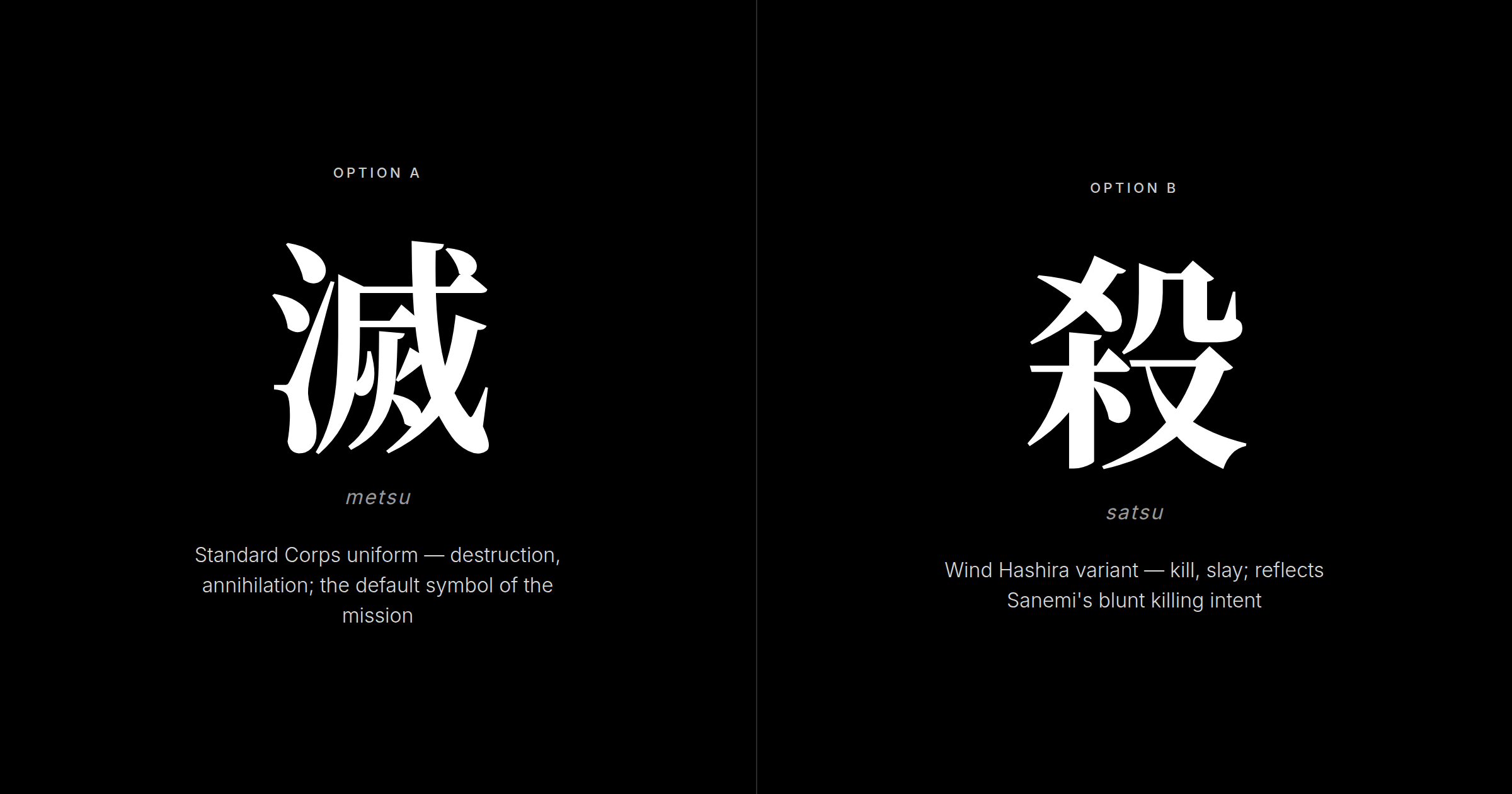
The Demon Slayer Corps uniform is where most Western fans first notice kanji as a design element. The standard uniform features 滅 prominently, and for good reason — it's the defining symbol of the organization's mission.
But not every Corp member wears the same character. Sanemi Shinazugawa, the Wind Hashira, wears 殺 (satsu — kill, slay; a stark, direct character used in modern Japanese in legal contexts, crime journalism, and medicine. It is emphatically not a mystical or archaic word — it is the ordinary modern term for killing). His choice of 殺 rather than 滅 signals his particular relationship with violence: where the Corps destroys demons, Sanemi's orientation is pure killing intent.
Both 殺 and 滅 are real. Both appear in standard Japanese dictionaries. Neither is invented for the manga.
The blades of Hashira carry the inscription 悪鬼滅殺 (akki messatsu — kill and annihilate evil demons). This is a four-character compound (yojijukugo, 四字熟語) constructed from real kanji. Its component characters are authentic; the specific combination was created for the series but reads as coherent, formal Japanese — the kind of phrase you might find on a temple inscription or historical document.
The Breathing Style Kanji: Real Characters, Fictional Framework
This is the section most Western fans need to read carefully, because this is where the real vs. invented question gets complicated.
The breathing styles themselves are fictional techniques within the story's universe. There is no real-world concept of "Water Breathing" as a combat discipline. However — and this is the critical point — the kanji used to name those styles are entirely real, dictionary-standard Japanese characters.
The five foundational breathing styles use these elemental kanji:
- 水 (mizu — water; one of the most fundamental characters in the language, appearing everywhere from weather forecasts to menus to company names)
- 炎 (honoo — flame, blaze; distinct from the more common 火 hi/fire in that 炎 implies an intense, roaring fire. It appears in modern Japanese in poetry, brand names, and descriptions of fever.)
- 雷 (kaminari — thunder; used in everyday weather contexts and in place names across Japan)
- 岩 (iwa — rock, boulder; a foundational character in geology, geography, and in phrases about steadfastness)
- 風 (kaze — wind; ubiquitous in Japanese, from weather to idioms to music)
Derivative styles — Love (恋, koi), Sound (音, oto), Beast (獣, kemono), Insect (蟲/虫, mushi), Serpent (蛇, hebi) — also use real kanji. None of these elemental characters were invented by Gotouge.
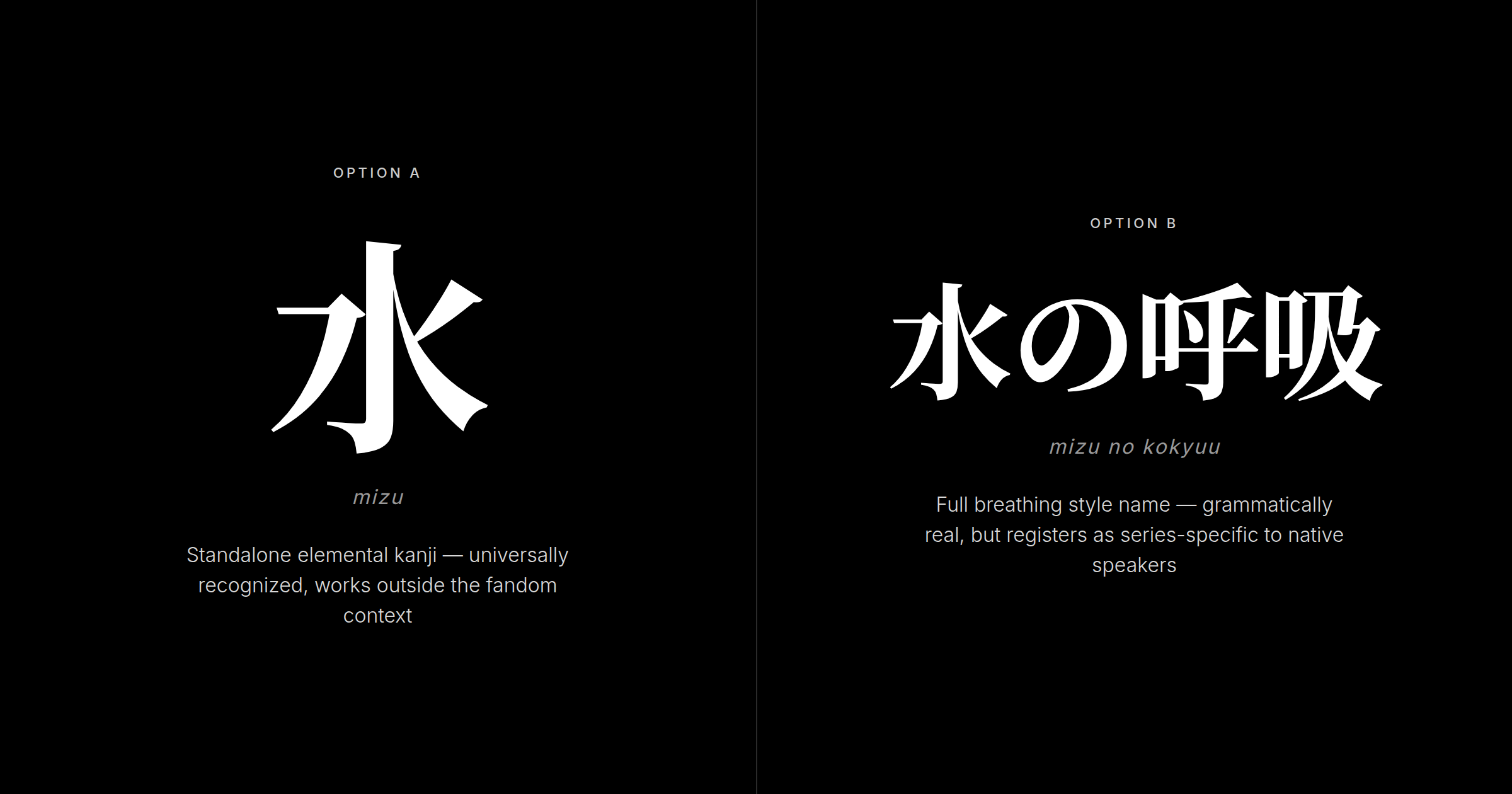
Where it gets tricky is the full breathing style names as compounds. "水の呼吸" (Mizu no Kokyuu — Water Breathing) is a phrase constructed from real words, and it is grammatically correct Japanese. A Japanese speaker would understand it immediately. But it would also register as fiction-specific vocabulary, not something you'd encounter in everyday speech or formal writing. It exists in the same category as phrases created for Harry Potter or Star Wars — real words assembled into a fictional concept.
For tattoo purposes: a single elemental kanji (水, 炎, 風, 雷, or 岩) is universally legitimate. The full breathing style name in compound form is technically real Japanese but reads as fan-specific. That's a legitimate choice if you want the fandom reference to be explicit, but understand what you're getting.
Character Name Kanji: Gotouge's Hidden Symbolism
Tanjiro Kamado's full name in kanji — 竈門炭治郎 — encodes the character's entire identity.
- 竈 (kamado — hearth, traditional cooking stove; an old-fashioned kanji rarely used in modern names, signaling family, fire, and rural Taisho-era life)
- 門 (mon — gate; combined with 竈 as a surname, it evokes the family threshold)
- 炭 (tan — charcoal; the Kamado family sold charcoal, so Tanjiro literally carries his livelihood in his name)
- 治 (chi/ji — to heal, to govern; reflects his role as protector)
- 郎 (rou — young man; a classical Taisho-era male name suffix)
Nezuko's name — 竈門禰豆子 — includes two contrasting choices: 禰 (ne — related to ancestor shrines; archaic, marking her lineage) and 豆 (mame/zu — beans; entirely ordinary and domestic, which mirrors her dual nature). 子 (ko — child) is the standard feminine suffix.
These are all real kanji. Gotouge's naming reflects genuine knowledge of classical Japanese conventions — each character encodes personality and narrative role.
Based on thousands of verification requests reviewed by KIO's Tokyo-native team, character name kanji from Japanese media are among the most frequently submitted for accuracy checks — and names from Demon Slayer consistently hold up as legitimate, well-constructed choices. This authentic grounding distinguishes Demon Slayer from series that prioritize visual impact over linguistic accuracy; by contrast, Chainsaw Man's kanji are linguistically correct but face a register mismatch where the emotional weight fans project doesn't transfer to native speakers who read the characters as ordinary everyday words.
What's Actually Safe vs. What Needs Verification
Not everything in the series carries the same tattoo risk profile. Here is a clear breakdown:
Safest choices (all confirmed real, standalone Japanese kanji):
- 鬼 — demon/oni
- 滅 — destruction, annihilate
- 刃 — blade
- 殺 — kill (understand the directness of this word)
- 水, 炎, 風, 雷, 岩 — the elemental kanji
- Character surnames and given names: 炭治郎, 禰豆子
Acceptable with context:
- 悪鬼滅殺 (akki messatsu) — a real compound constructed for the series, but reads as formal and coherent
- Full breathing style names (水の呼吸, etc.) — grammatically real, fan-context specific
Requires careful verification:
- Specific Hashira-only kanji inscriptions from the manga (some appear only in panels without definitive reading confirmation)
- Fan-art renderings of kanji (stroke order is frequently incorrect in non-native art)
- Any kanji you've seen only in a screenshot or social media post, not in a verified reference
For any design with uncertainty, a professional verification step before you commit is not optional — it's the difference between a tattoo that holds up and one that gets quietly corrected by every Japanese person you meet. Verifying kanji before getting a tattoo is a straightforward process that applies equally to anime-inspired and traditional designs.
The Cultural Depth Behind These Choices
Gotouge's Taisho-era setting is not set dressing. The Taisho period (1912–1926) sits at a specific cultural inflection point: Western modernity was arriving while classical vocabulary and kanji usage were still dominant. The series' language reflects that tension deliberately.
鬼 (demon/oni) draws from folklore that predates written history. Oni appear in the oldest recorded Japanese myths, in Buddhist hell imagery, and in seasonal rituals like Setsubun. Reaching for 鬼 was not a generic "monster" choice — it was a precise folkloric reference.
The 藤 (fuji — wisteria; the aristocratic plant associated in Japanese history with the powerful Fujiwara clan, whose name literally means wisteria plain) motif — the plant that repels demons — is another layer of cultural grounding. The creator drew from genuine cultural material throughout.
This is why the kanji design holds up under scrutiny. It was not invented.
Native Verdict: What a Tokyo Native Actually Sees
Native Verdict
When a Tokyo native encounters 鬼滅 or 滅 on someone's arm, the immediate reaction is recognition — of both the character and the series. Neither reaction is negative.
Gotouge made genuinely sophisticated kanji choices. The title characters are real and historically grounded. The character names follow classical naming conventions. The elemental kanji are standard. From a native-speaker perspective, most popular Demon Slayer tattoo choices are well-constructed — which is not something you can say about every anime franchise. Many other popular series use stylized, decorative kanji designed for visual impact rather than linguistic accuracy — understanding the difference is critical before tattooing any anime-inspired design. In contrast, Studio Ghibli kanji tattoos, Naruto's choices like 愛 and 火の意志, Dragon Ball's gi kanji rooted in martial arts tradition, One Piece's authentic vocabulary like 仲間, 最強, and 自由, Hell's Paradise's 地獄 grounded in Buddhist theology and irezumi history, and Jujutsu Kaisen's 呪 and 廻 drawing on Buddhist philosophy take the same approach as Demon Slayer, drawing from authentic classical Japanese tradition rather than designing characters for visual storytelling alone. A separate category: Tokyo Revengers uses the historically sacred manji symbol 卍 with complete cultural accuracy in Japan but faces geographic complications in Western contexts, illustrating why understanding where you live shapes your tattoo's social reception.
Where a native would pause is execution. Stroke order errors are immediately visible to someone who grew up writing kanji daily. A 滅 with a misplaced radical, or a 竈 with incorrect proportions, signals the artist was working from reference they didn't fully understand — often fan art rather than a proper source.
The Tokyo-native verdict: the source material is a good foundation. The risk is not in choosing this series — it's in assuming that because you've seen a kanji in the show, you have a verified reference for your tattoo. Those are different things.
Pre-Ink Planning: Before You Commit
For main series symbols, the question is no longer "is this kanji real?" — we've established that it is. The question is: "is my specific reference accurate enough to put on my skin permanently?"
Verify your reference source. Fan wikis aren't reliable for kanji accuracy — stroke order and character proportions need to come from a Japanese dictionary, not fan art.
Talk to your artist about kanji experience. An artist who has done kanji work approaches reference differently than one working from a screenshot. Read about choosing a Japanese tattoo artist for kanji work before your consultation.
Understand the full meaning in isolation. 殺 (satsu — kill) is real and legitimate, but it is direct and unambiguous. The guide on choosing meaningful kanji for tattoos covers how to think about long-term meaning.
Think about placement. Single kanji like 滅 or 水 work well in vertical placement. Multi-character names like 竈門炭治郎 have compositional implications for sizing and layout. See kanji tattoo placement, size, and direction.
Check for execution issues. Wrong stroke order or incorrect radical proportions are immediately visible to native speakers. Read why stroke order matters for kanji tattoos to understand what to avoid.
Frequently Asked Questions
Is 鬼滅 a real kanji combination, or did the manga creator make it up?
Both kanji are real and ancient Japanese. 鬼 (demon) and 滅 (destroy/annihilate) each have centuries of documented use in Japanese literature and everyday language. Combining them into the title Kimetsu no Yaiba was Gotouge's creative choice, but the individual characters are fully legitimate. As a tattoo, 鬼滅 is completely authentic and will be recognized by Japanese speakers as real kanji — the manga origin doesn't change what the characters are.
Can I get a Hashira breathing style kanji tattooed, like 水 (water) or 炎 (flame)?
Yes. The elemental kanji — 水 (water), 炎 (flame), 風 (wind), 雷 (thunder), 岩 (rock) — are all standard dictionary characters that appear in everyday Japanese. Full breathing style names like 水の呼吸 use real words but exist as fictional compound phrases, so they register as fandom-specific. For a universally recognized tattoo, the single elemental kanji is the cleaner choice.
What's the difference between getting Tanjiro's name (炭治郎) vs. just getting the kanji 炭 (charcoal)?
Tanjiro's given name 炭治郎 encodes layered meaning — charcoal (炭) for his family trade, heal/govern (治) for his character, and young man (郎) as a classical suffix. Getting 炭 alone is a legitimate standalone symbol but loses the narrative richness. The full name is more powerful as a character tribute; the single kanji is cleaner as a design element.
I've seen fans saying some Demon Slayer kanji are "made up." Which ones should I avoid for a tattoo?
The main series kanji (鬼滅の刃), Corps symbols (滅, 殺), character names, and elemental breathing style kanji (水, 炎, 風, 雷, 岩) are all real. What fans sometimes call "made up" are typically the full breathing technique names used as compound phrases, or highly specific Hashira inscriptions that appear only in manga panels without authoritative reading guides. For safe tattoo choices: use the title kanji, individual character names, or single elemental characters. The further you move from those anchors into fan-specific combinations, the more verification you need.
If I get a Demon Slayer tattoo, what will Japanese people think?
Japanese people will recognize the series immediately. If you've chosen legitimate kanji — 鬼滅, 炭治郎, 水, 滅 — they'll see it as a thoughtful choice. The series is popular in Japan and Gotouge's kanji choices are considered well-crafted. What would draw a negative reaction is execution errors: incorrect stroke order, misshapen radicals, or kanji copied from an inaccurate source. See also: what Japanese people actually think about kanji tattoos.
Does stroke order matter for Demon Slayer kanji tattoos?
Absolutely. Stroke order determines the proportions, balance, and visual rhythm of the character — it is not arbitrary. A tattoo artist must work from a verified Japanese-language source, not fan art or screenshots. Common errors include wrong stroke count and incorrect proportions in complex characters like 竈 (Tanjiro's surname kanji). Read why stroke order matters for kanji tattoos before finalizing any design.
What's the best single kanji from Demon Slayer for a first-time kanji tattoo?
滅 (metsu — destruction, annihilation) is the strongest choice: it's iconic to the series, has genuine depth of meaning, is real Japanese kanji, and works as a standalone symbol. 鬼 (oni — demon) is also solid, with the added richness of deep roots in Japanese folklore. Both are immediately recognizable to fans and meaningful to Japanese speakers who have never heard of the series. For a first kanji tattoo, avoid complex compound names — start with a single character that you fully understand and that carries meaning beyond just the fandom reference.
Uncertain about a specific Demon Slayer kanji design? Bring it to Kanji Ink Oracle — Tokyo-native reviewers assess your reference material and flag stroke order issues before you commit to the design.