Naruto Kanji Tattoo: What Japanese Natives See
Before you ink Gaara's 愛 or the Will of Fire, understand what a Tokyo native actually reads. The real register, placement rules, and pre-ink checklist.
Naruto has sold over 250 million manga volumes worldwide, and its kanji have quietly become some of the most-searched tattoo symbols on the internet. Fans who spent formative years watching Gaara's redemption arc, Naruto's stubborn loyalty, and the Hokage's burden don't want merchandise — they want to carry the story permanently. That impulse is understandable, even admirable. But the gap between what an anime kanji means inside the story and what it reads like to a native Japanese speaker on the street is wider than most fans realize.
Why Naruto Resonates So Deeply — and Why That Matters for Ink
Naruto Uzumaki's world is built on a set of philosophical tensions that translate cleanly across cultures: the outsider seeking belonging, the cycle of hatred and forgiveness, the question of whether a person can be defined by their origins or must define themselves through choice. These are not uniquely Japanese themes, but they arrive wrapped in a specifically Japanese aesthetic — the village system, the concept of nindou (忍道, one's personal ninja way), the Hokage's role as servant-leader.
The series draws directly from real Japanese values. The "Will of Fire" (火の意志, hi no ishi) echoes the Confucian principle of responsibility to community. Gaara's transformation maps onto concepts of rehabilitation and social reintegration that appear in Japanese social policy discussions. Even the village hierarchy — where a leader's legitimacy is earned through sacrifice, not lineage — reflects ideals that appear in modern Japanese organizational culture.
This cultural rootedness is why Naruto kanji carry genuine weight in Japan, not just in fandom circles. A Japanese person who sees the kanji 愛 on your forearm does not immediately think "Gaara." They see a real Japanese character with a real reading history that stretches back centuries. The anime gives you a reason to want it. The kanji's own cultural weight is what makes the tattoo mean something beyond a fan tribute.
Based on thousands of verification requests reviewed by KIO's Tokyo-native team, anime-originated kanji tattoos are among the most likely to carry unintended connotations — not because the kanji are wrong, but because fans choose them based on narrative context and miss the register the kanji carries outside the story.
The Icon: Gaara's 愛 (ai) — Love in Layers
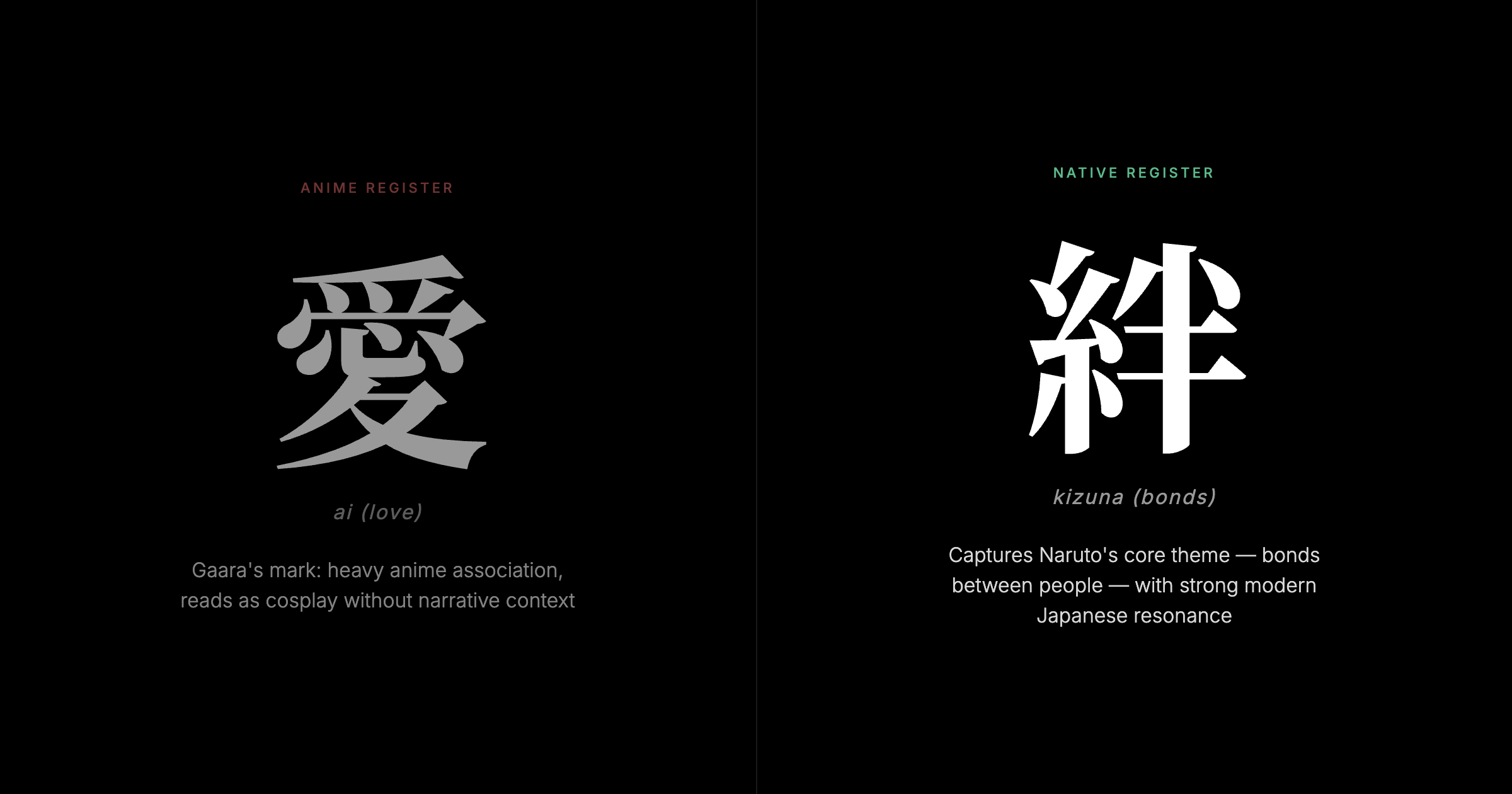
The kanji 愛 (ai — love, affection; one of the most emotionally loaded single characters in the Japanese writing system) appears on Gaara of the Desert's forehead as a self-carved mark. The origin story: his mother died cursing him as a monster, wishing through her last breath that he would "become a demon who loves only himself." The kanji records that curse and that love simultaneously.
In standard Japanese usage, 愛 occupies a formal, literary register. Japanese people rarely use it in casual conversation the way English speakers say "love" — you wouldn't say 愛 to mean you love coffee. It appears in formal declarations, poetry, philosophical writing, and meaningful contexts: 愛国心 (aikokushin — patriotism, lit. "love-country-heart"), 愛情 (aijou — affection, devotion), 人類愛 (jinruiai — love of humanity). Isolated as a single character on the body, it reads as a grand statement — not a light one.
Gaara's use of it is doubly layered. His 愛 connects to 自愛 (jiai) — but here the everyday Japanese meaning matters: in modern usage 自愛 means "take care of yourself," the word in the stock letter-closing 御自愛ください (go-jiai kudasai — please take care of your health). Within the Naruto narrative, Gaara's relationship to his own existence gives 自愛 a darker inflection — love that turns inward and closes out the world rather than sustaining the self — but that isolating reading is the story's gloss, not the baseline Japanese one. By the time of Shippuden, his guiding concept has become 慈愛 (also romanized jiai but written with a different first character — 慈, meaning compassionate mercy), the loving-kindness that extends toward others. The same sound, opposite orientations. That shift from one jiai to the other is the emotional spine of his entire arc.
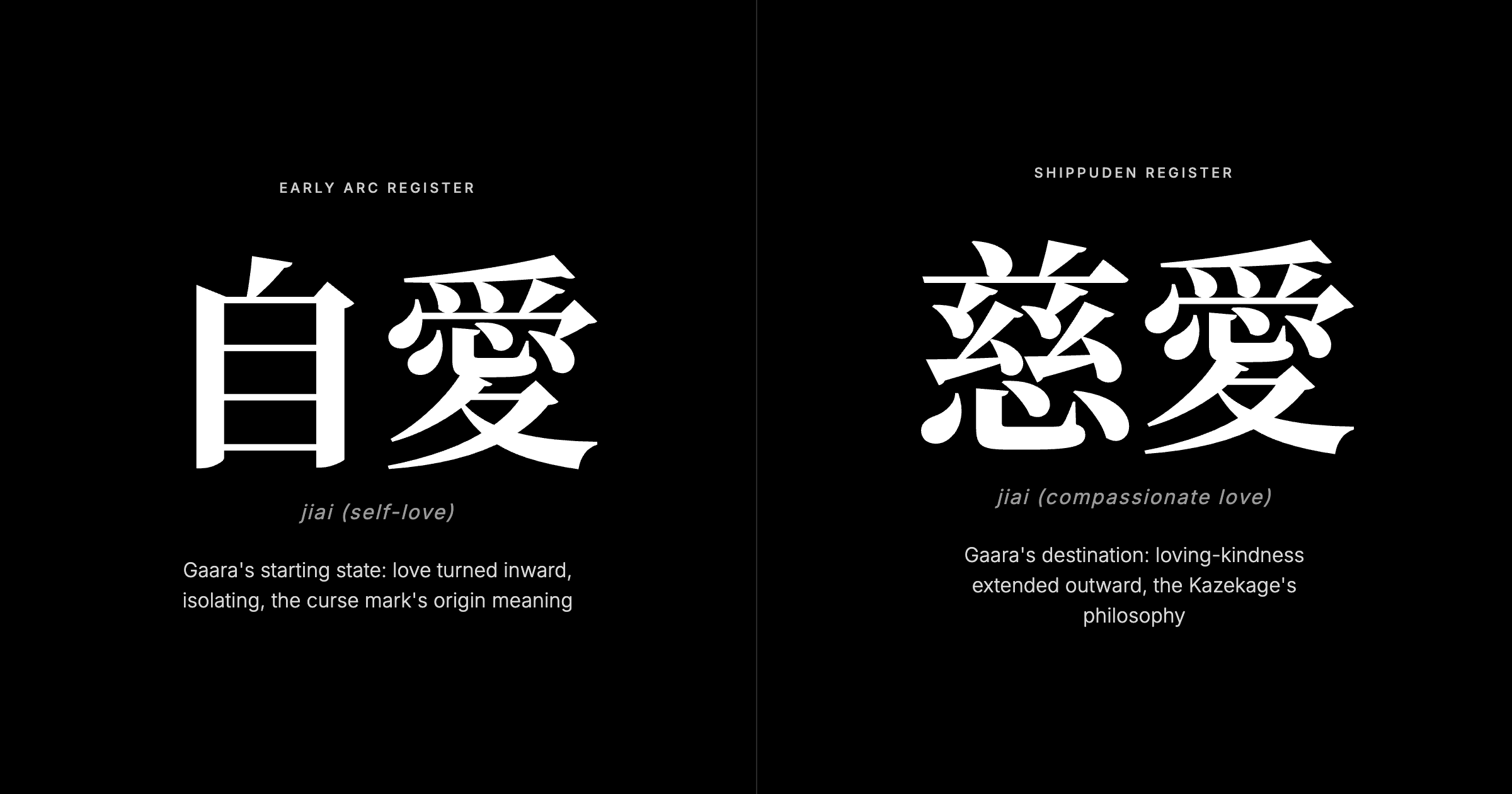
What does this mean for a tattoo? If you want to honor Gaara's journey — not just his forehead mark — you need to understand which jiai you're anchoring yourself to. Most fans who get 愛 are reaching for the completed arc, the Kazekage who protects his village. But the kanji alone, stripped of the narrative, can't carry that distinction.
Breaking Down the Will of Fire: 火の意志
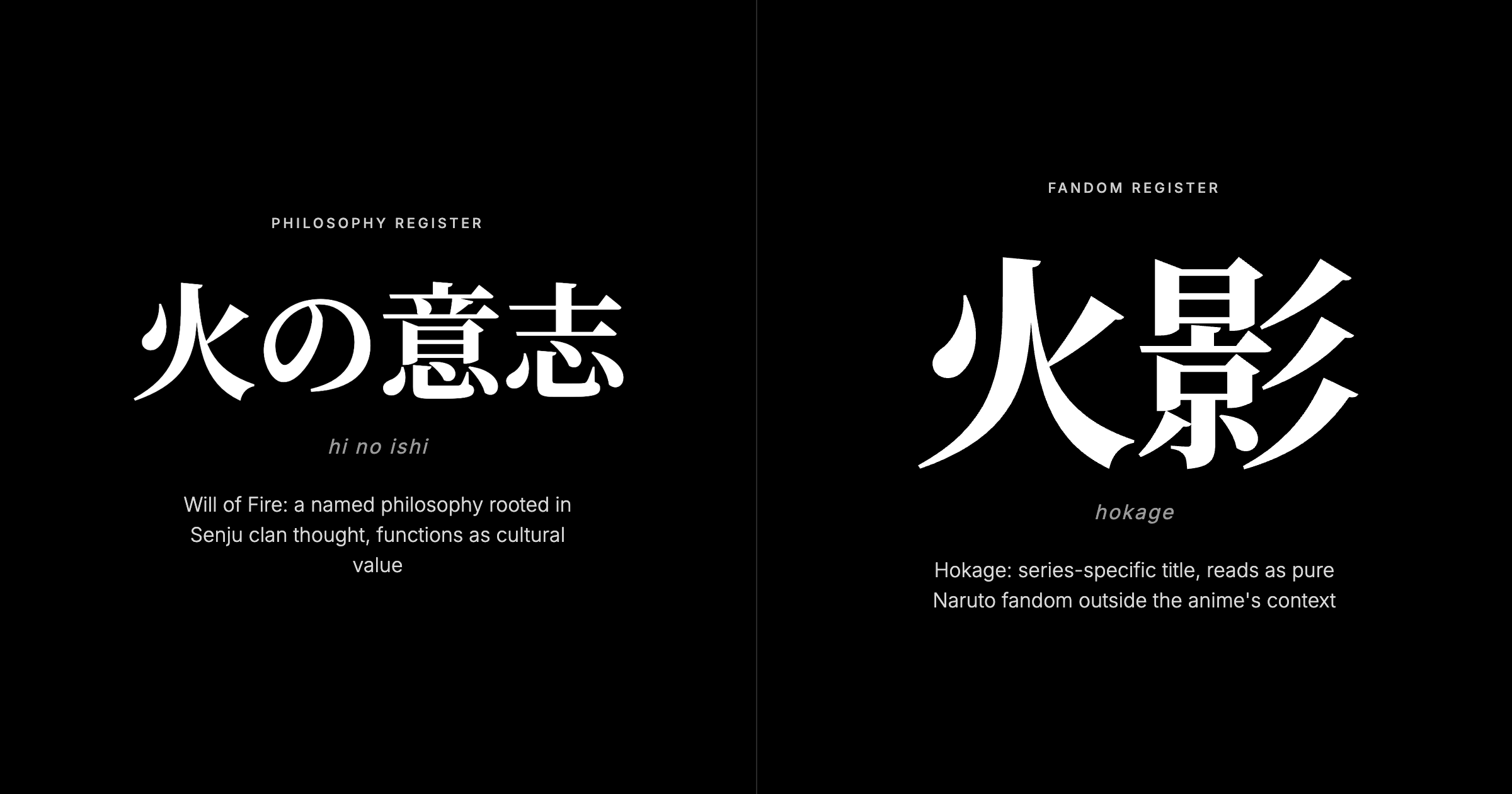
The Will of Fire (火の意志, hi no ishi — "the will of fire") is the ideological heart of the Hidden Leaf Village, attributed to the First Hokage, Hashirama Senju. It holds that the village's strength comes from bonds between people, not individual power.
The three kanji in this phrase each carry their own register:
火 (hi — fire; here referring to the Land of Fire and the Leaf Village's lineage) is a completely ordinary character on its own — fire-warning signs, cooking, industrial safety. What makes it significant is the compound it enters. 意志 (ishi — will, deliberate intention; sustained commitment rather than momentary desire) is likewise everyday formal Japanese — medical, legal, and motivational contexts, not archaic.
Together, 火の意志 functions as a named philosophy: the capitalized Will of Fire, a proper noun within the Naruto universe. Outside the series a Japanese reader would parse it as "the fire's will" — poetic but not immediately meaningful.
火影 (hokage) is an existing literary Japanese word for the glow or flickering shadow cast by firelight — it appears in classical poetry centuries before Naruto, and Kishimoto borrowed it deliberately for the village-leader title. It combines 火 (fire) and 影 (kage — shadow, reflection, or the play of light). A Japanese reader unfamiliar with the anime will recognize it as poetic, archaic-flavored vocabulary meaning firelight, not a nonsense compound. What is Naruto-specific is the political register — using it as the leader's title — not the word itself, which reads to a native as evocative classical imagery.
The Uzumaki and Uchiha Symbols: A Different Category
The Uzumaki clan's red spiral (based on uzumaki — whirlpool, vortex) and the Uchiha clan's fan crest are not kanji. They are clan emblems — visual marks that function more like heraldry than written language, and that distinction matters for the tattoo decision.
Kanji carry cultural and linguistic weight outside the Naruto universe; the clan emblems do not. A Japanese person seeing the Uchiha crest on your shoulder reads "that person likes Naruto" — full stop, no register to misread or cultural literacy test to pass. You are wearing a logo, recognized as one. That is not a criticism — fandom expression through visual marks is legitimate. The point is simply that these symbols operate in a different category than kanji, and choosing between them is a question of what kind of statement you want to make.
So What Happens When You Put This on Your Skin?
This is where the anime context and the tattoo context diverge — and where decisions made without that awareness become permanent.
Native Verdict: What a Tokyo Native Actually Reads
A Japanese speaker encountering Gaara's 愛 on a Western person's body runs through a quick assessment that happens in less than a second. The order matters:
Placement comes first. Forehead placement is an immediate anime signal — it is Gaara's exact positioning, and it reads as cosplay tribute before it reads as anything else. This is not negative if that is your intention. But it means you are primarily signaling fandom, not personal philosophy. Wrist, collarbone, or upper back shifts the reading toward something more personal — a value the wearer has adopted rather than a character they admire.
Execution comes second. 愛 has a specific stroke structure that a native eye can evaluate in a glance. A correctly rendered 愛 with clean proportions reads as someone who took care. A malformed one — dropped strokes, wrong proportions — reads as someone who did not verify before inking. Stroke order and kanji anatomy matter less for the finished look than for the artist's structural understanding of the character.
Context comes third. If you're wearing 愛 on your wrist and someone asks about it, your answer reveals everything. "It means love" closes the conversation and signals surface engagement. "It's from Gaara's arc — he carved it as his mother's dying curse, and I got it after his redemption because I've been through my own version of that journey" shows cultural and narrative literacy. Japanese people, as documented in reactions to Western kanji tattoos, consistently assess depth over subject matter.
A composite perspective from Tokyo-based tattoo artists: "When I see a Western customer with Gaara's 愛 on their wrist and they can explain the character's journey from self-isolation to compassionate leadership, I see someone who engaged seriously with the material. When they say 'it means love,' I know the research stopped at the dictionary."
The cultural appropriation question around anime kanji is answered more by how you carry the knowledge than by whether you got the tattoo at all.
Better Alternatives and Complements
If you want the emotional territory Gaara's arc maps to — self-acceptance, transformation through difficulty, love that extends outward after being turned inward — there are kanji that carry those values outside the anime context. (This is the same register challenge that faces Chainsaw Man's 契約, a kanji that is thematically rich in the series but reads as mundane — "legal contract" — to natives, shifting the emotional weight fans expect from anime narrative into everyday bureaucratic language. Bleach kanji presents a different problem: mixing real Japanese like 死神 with invented compounds like 卍解 that don't exist in standard Japanese, forcing fans to decide whether they're getting a reference or a linguistic statement. For anime grounded in genuine Buddhist philosophy like Hell's Paradise's 地獄 and authentic Edo-period context, the kanji carry historical weight that extends far beyond the series.)
受容 (juyou — acceptance, receiving; used in psychology and therapy for self-acceptance): works across multiple registers without anime association. In Japan, 受容 appears in mental health literature, Buddhist discourse on equanimity, and everyday conversation about processing difficulty.
再生 (saisei — regeneration, rebirth, restoration; used in ecology, in music for "playback," and philosophically for personal renewal): for someone whose Naruto connection is about rebuilding. Carries genuine cultural weight outside the series.
慈悲 (jihi — compassion, mercy; a Buddhist term used in formal religious contexts and modern writing about empathy): the deeper-register version of the compassionate love Gaara reaches by Shippuden. For someone who wants the endpoint of his arc, not just the visual marker.
For the Will of Fire's community-over-self value, consider:
絆 (kizuna — bonds, ties between people; widely used after the 2011 Tohoku earthquake as a symbol of social solidarity; common in everyday speech about meaningful relationships): the most culturally resonant single kanji for Naruto's themes of loyalty and connection. It carries its own weight in modern Japan without requiring anime knowledge to read.
See also our placement guide — the same kanji reads differently depending on where it sits on the body, and that conversation is worth having before you commit to a location.
FAQ: Your Naruto Kanji Tattoo Questions Answered
Will Japanese people think my Naruto kanji tattoo is stupid?
Respect and accuracy matter more than the subject. If you understand Gaara's arc and can explain why 愛 represents his journey from self-isolation to compassionate leadership, Japanese people generally read that as genuine cultural engagement. What reads as dismissible is surface-level enthusiasm — getting 愛 because it "looks cool" without knowing the narrative. A Tokyo perspective: an anime tattoo that shows homework earns respect; a poorly researched or badly executed one reads as a souvenir, regardless of the subject.
Is the love kanji 愛 really what Gaara has on his forehead?
Yes, 愛 (ai — love) is the canonical mark, and it is correctly written in the anime. The critical nuance is that its meaning shifts through the series: it begins as self-love in its most isolating form (his mother's curse) and transforms into compassionate, outward-directed love by Shippuden. Understanding this arc matters. Without it, the symbol reads as a generic love declaration or shallow fandom, neither of which matches the character's actual journey.
Where should I place my Naruto kanji tattoo to avoid looking like a cosplayer?
Placement carries its own cultural signal. Forehead placement is Gaara's exact location and reads immediately as anime cosplay tribute to a native Japanese observer. Wrist, collarbone, or upper back positions the kanji as a personal philosophy — self-acceptance, loyalty, transformation — rather than character imitation. The same kanji in two different placements tells a fundamentally different story. Choose based on whether you are celebrating the anime or adopting the kanji's meaning as your own lived value.
What is a Naruto kanji tattoo and which symbols are actually kanji?
Of the main Naruto symbols, 愛 (ai — love, Gaara's mark), 火の意志 (hi no ishi — Will of Fire), and 火影 (Hokage — fire shadow) are genuine kanji or kanji compounds. The Uzumaki spiral and Uchiha fan crest are clan emblems — heraldic symbols, not written language. They function differently: kanji carry cultural and linguistic weight outside the Naruto universe, while the clan symbols are recognized as anime-specific logos and read purely as fandom expression.
What is the difference between getting kanji vs. clan symbols (Uzumaki/Uchiha)?
Kanji like 愛 or 火の意志 root you in Japanese linguistic and cultural history that extends beyond Naruto. A native speaker reads them and processes both the anime reference and the character's pre-anime meaning simultaneously. Clan symbols operate differently — they are recognized as Naruto-specific visual marks, and a Japanese viewer reads them as "this person likes Naruto" without a second layer of meaning. Both are legitimate; they are just different commitments. Kanji requires you to understand and carry the cultural register; symbols require artistic vision and fandom clarity.
What is the most common mistake people make with Naruto kanji tattoos?
Treating the kanji as interchangeable with a generic meaning. 愛 without Gaara's arc becomes just "love" — a word that 愛 is too formal and weighty to carry casually. 火の意志 without understanding Senju clan philosophy reads as "I like loyalty" rather than "I am committed to something larger than myself." The secondary mistake is execution: malformed strokes or incorrect proportions are immediately visible to a native eye. Verify your design with a kanji-fluent person before inking; the Demon Slayer kanji tattoo guide covers similar execution concerns for anime-sourced kanji, as does the Dragon Ball guide for authentic anime kanji choices.
Is it cultural appropriation to get a Naruto kanji tattoo?
No, approached with research and respect. Anime is a Japanese cultural export designed for global audiences, and fans worldwide engage with it legitimately. The appropriation question is answered by how you carry the knowledge: did you understand the kanji's meaning, the character's narrative arc, and the cultural register before inking? Getting 愛 after genuinely understanding Gaara's transformation reads as appreciation to a native observer. Getting it because it looks cool without that foundation reads differently. Intention combined with homework is what distinguishes appreciation from appropriation.
Can I get a Naruto tattoo in a shop in Japan?
Yes. Modern tattoo studios in Tokyo and larger Japanese cities will take anime commissions. Traditional artists working in the tebori or classic yakuza-influenced style may decline, but contemporary shops are generally open to anime work. Japanese artists often ask detailed questions about your understanding of the character and meaning — this is not gatekeeping, it is their professional standard for verifying you understand what you are permanently committing to. Some artists view prior research as a plus and move through consultation quickly; others prefer to walk you through the narrative themselves before proceeding.
Before you commit to ink, have a Tokyo-native reviewer look at your exact design. Kanji Ink Oracle provides native-speaker assessments that cover character accuracy, placement register, and whether the kanji you've chosen matches the meaning you're reaching for — returned within 24 hours.