Studio Ghibli Kanji Tattoos: A Tokyo Native Verdict
Studio Ghibli kanji ranked by Tokyo natives. Spirited Away and Mononoke verified. Learn what works on skin and what carries darker cultural meanings than expected.
Matcha is everywhere, wabi-sabi is on every design blog, and Studio Ghibli is on everyone's skin. A generation raised on Spirited Away and Princess Mononoke is now old enough to get serious ink, and kanji from those films are appearing on wrists and ankles across the world. Most Western fans sense that Ghibli feels different from other anime franchises — culturally weightier, more grounded. That instinct is correct. And understanding why changes everything about the choices you make before going under the needle.
Ghibli kanji — Japanese characters drawn from Studio Ghibli film titles and character names — stand apart because they are linguistically authentic rather than stylized anime inventions. Unlike other anime franchises that create compounds for visual impact, Hayao Miyazaki sources from classical Japanese naming conventions and real folkloric traditions. Other anime creators share this commitment: Arakawa's Yomi no Tsugai draws on authentic Shinto mythology rather than generic fantasy conventions, grounding the series' supernatural concepts in actual Japanese cultural tradition. For anyone considering a Ghibli kanji tattoo, this authenticity is both an asset and a responsibility: it means the characters have real, documented meanings that a Tokyo native will read with full cultural weight.
Why Studio Ghibli Stands Apart From Other Anime Franchises
Ghibli's filmography spans more than 35 years and has been embraced by viewers who aren't primarily anime fans at all — that cross-generational breadth is part of what makes Ghibli kanji tattoos a distinct category.
More importantly: Miyazaki's world-building draws on a classical Japanese literary tradition most manga creators don't use, with naming conventions reflecting the Taisho era (1912–1926) in which several films are set. The kanji in Ghibli titles and character names are almost universally real, dictionary-standard Japanese — not stylized invented compounds designed to look striking on a uniform.
Based on KIO's verification reviews covering Ghibli-inspired tattoo inquiries, one pattern appears consistently: clients choose Ghibli kanji because they sense authenticity — and they're right. The difficulty is going deeper than the first layer of meaning.
Spirited Away (千と千尋の神隠し) — The Cultural Weight Behind the Title
The full Japanese title is 千と千尋の神隠し (Sen to Chihiro no Kamikakushi). Each element carries weight the English translation softens.
千 (sen — thousand; a foundational numeric kanji appearing in pricing, poetry, and place names across Japan) is the name Yubaba forces on Chihiro. In the film's logic, Chihiro becomes 千 — her entire identity compressed into a single character meaning "thousand," impersonal and minimal.
千尋 (Chihiro — literally "a thousand seekings"; 千 = thousand, 尋 = to seek, to ask, to look for someone) is her full name. 尋 appears in words like 尋問 (jinmon — interrogation) and 尋ねる (tazuneru — to ask, to visit). It carries the sense of earnest searching. Yubaba strips 尋 from Chihiro's name — and with it, her drive to question and seek. Japanese audiences register this connection intuitively because the character for seeking is literally removed from her identity.
神隠し (kamikakushi — literally "hidden by the gods"; 神 = god/deity/spirit, 隠し = hiding/concealment) is the element Western fans most often misread. The English "spirited away" suggests whimsy. Kamikakushi is a real folkloric term predating the film by centuries, describing children who disappeared without explanation and either never returned or came back transformed and disoriented. The folklore is genuinely dark — these disappearances were attributed to malevolent spirits, not benign ones. This cultural layering is precisely what separates Ghibli from most anime franchises: Miyazaki lifts real folkloric concepts and uses their existing weight to anchor his story.
The Kanji Breakdown: Character Names and What They Encode
Chihiro (千尋) and Haku (白 vs. 伯)
千尋 works as a tattoo because it is a real Japanese given name with philosophical resonance independent of the film. 千 (sen/chi) appears in countless modern contexts. 尋 (hiro) is less common in contemporary naming but genuine. Together they encode endless searching — a meaning that holds whether the viewer knows Spirited Away or not.
Haku's name has two main kanji candidates, and the choice matters considerably.
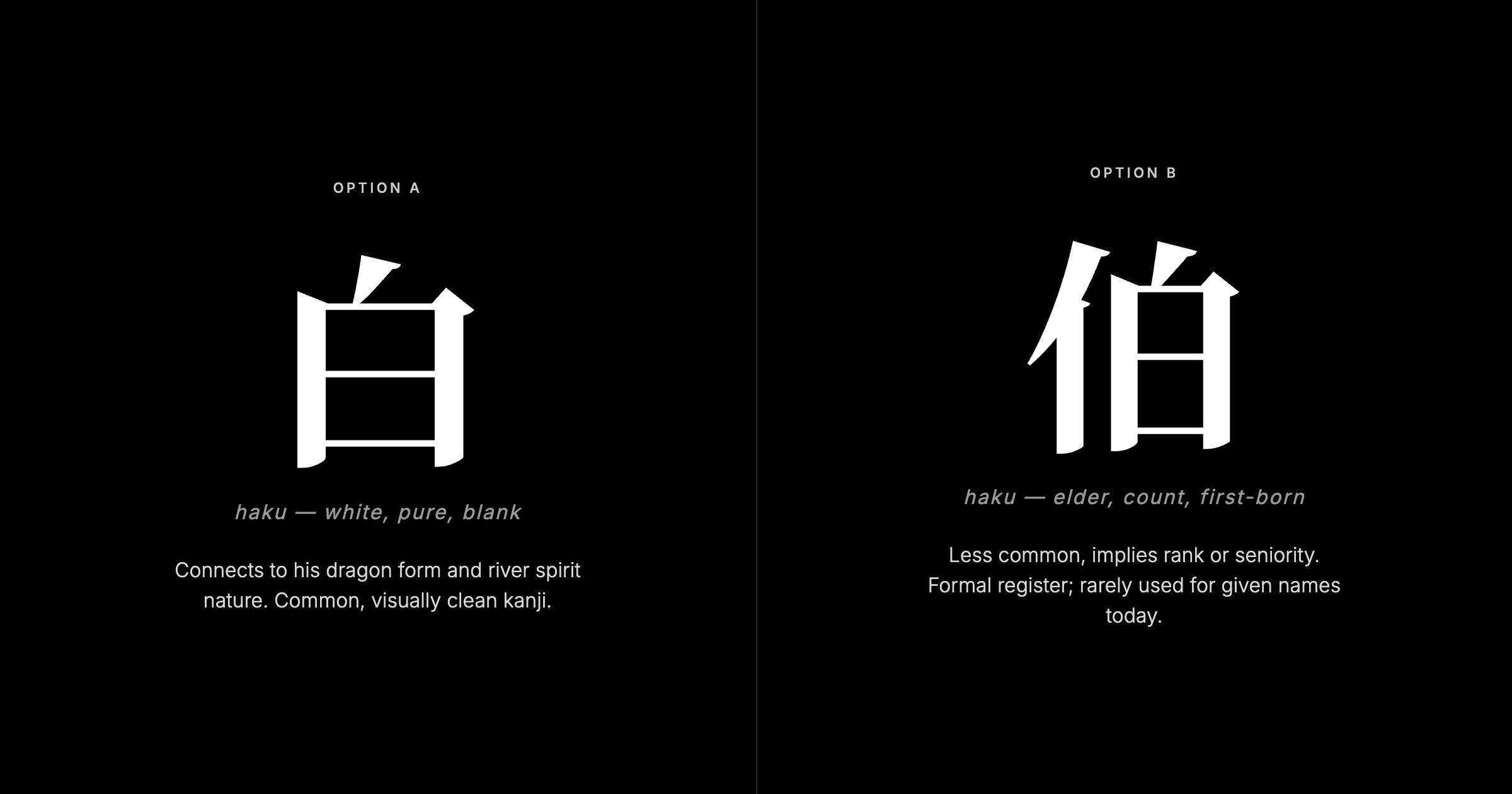
白 (haku — white, pure, blank; appearing in everyday words like 白米 hakumai, white rice, and 白紙 hakushi, blank paper) connects directly to Haku's nature: his dragon form is white, his identity is associated with the purity of water. For a tattoo, 白 is visually simple and immediately legible without requiring explanation.
伯 (haku — elder, count, first among brothers; a formal, archaic character used in historical titles) connects less naturally to the character and makes a Japanese reader pause. If you are tattooing Haku's name, 白 is the choice a native speaker will find contextually appropriate.
San and Ashitaka: The Katakana Problem
San (サン) and Ashitaka (アシタカ) from Princess Mononoke are written in katakana in all official materials, not in kanji. San (サン) is widely interpreted by fans as deriving from the numeral 三 (three — san), as she is the third child raised by the wolf god Moro, though Miyazaki has not officially confirmed this kanji connection. The katakana rendering itself is intentional, encoding her liminal status between human and animal worlds without fixing a single character meaning. Ashitaka's name similarly carries phonetic rather than kanji encoding.
For Ghibli tattoo purposes: if you want kanji honoring San or Ashitaka, you're choosing adjacent characters rather than their actual written forms. Katakana tattoo names carry a different aesthetic register from kanji, and the script choice signals something meaningfully different about your design intent.
神隠し as a Standalone Tattoo
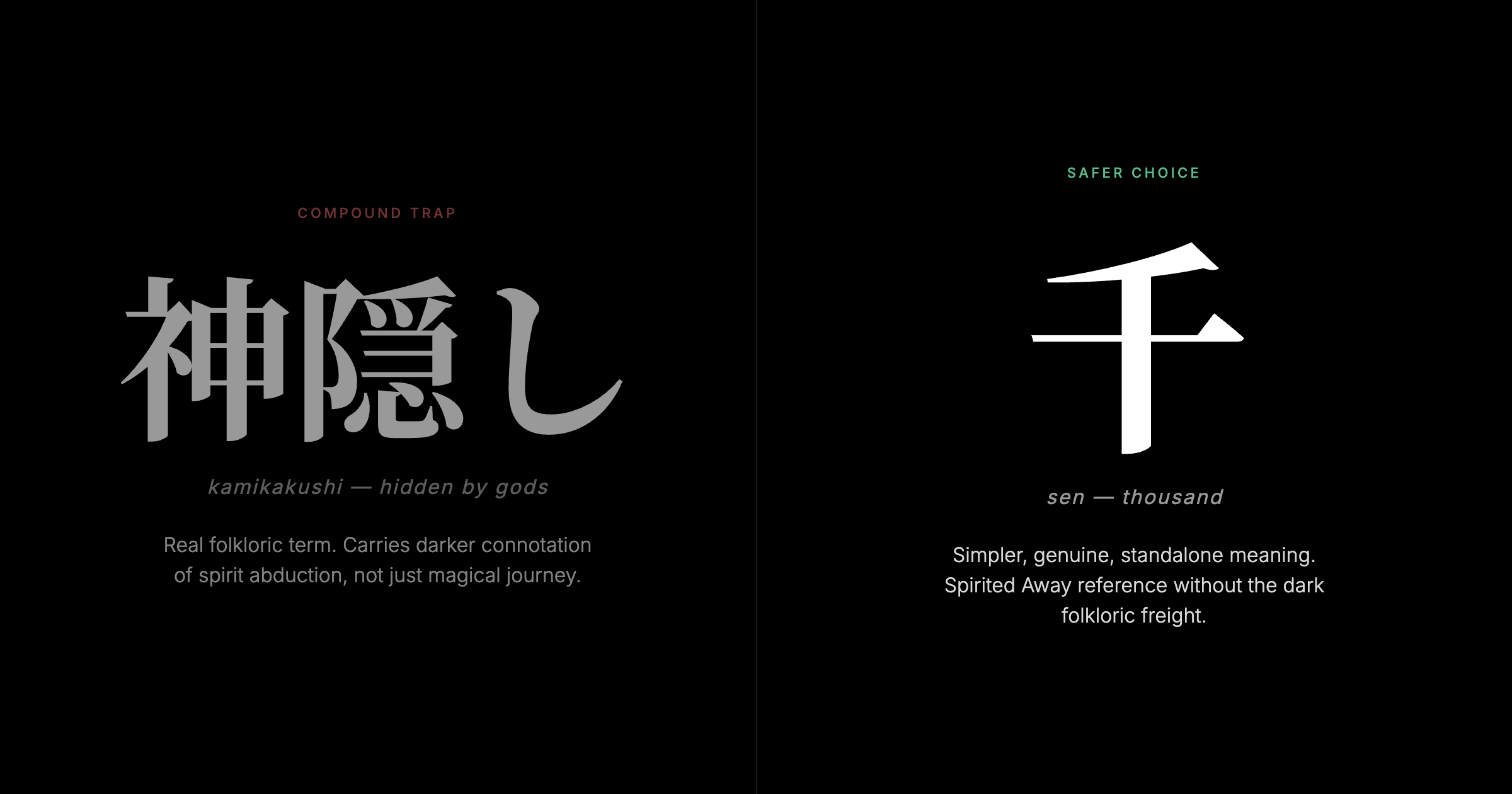
神隠し is a genuine compound — every character is real, the combination is historically attested. But what it means to a Japanese reader is not what "spirited away" implies. It describes a disappearance caused by spirits, with all the dread that implies. If you're tattooing it for the film's sense of wonder, understand that the Japanese word carries grief and fear underneath that wonder. Spirited Away is ultimately about loss and transformation — kamikakushi holds both. But that should be a conscious choice, not a surprise.
The Pivot: What Happens When You Put This on Your Skin?
The cultural and linguistic depth behind Ghibli kanji separates this conversation from a generic anime tattoo discussion. Now the question shifts: how does that depth translate to ink on skin, and what does a Tokyo native actually read when they encounter these characters on someone's arm?
Native Verdict: How Japanese Speakers Read Studio Ghibli Kanji Tattoos
Native Verdict: A Tokyo native seeing 千 on a forearm recognizes both the kanji (a completely ordinary character they encounter daily) and the Spirited Away connection — simultaneously, without choosing between them. The reaction isn't "oh, an anime fan" but "oh, interesting" — because 千 has enough standalone meaning that the film reference reads as one of several possible interpretations. That ambiguity is an asset: it signals either cultural knowledge or fandom depth, and neither reads as embarrassing.
The same native seeing 千尋 has a different reaction: immediate recognition of Chihiro's name. Spirited Away is one of the highest-grossing films in Japanese cinema history, and 千尋 is strongly associated with it. The reaction is closer to "ah, a Spirited Away fan" — affectionate recognition, not criticism. The kanji are real, the name is solid, the cultural connection is visible. This reads as intentional.
The reading changes when the native encounters poor stroke order. Kanji are written in a specific sequence Japanese speakers learn from childhood, and deviation is immediately visible — proportions look slightly wrong, a stroke sits at an odd angle, weight distribution is off. A misstroked 千 signals the artist sourced reference from a screenshot rather than a dictionary. The character's authenticity doesn't protect against execution errors. See stroke order and kanji tattoos for the checks that matter most.
A Tier Guide for Studio Ghibli Kanji Tattoo Choices
The risk profile for a Ghibli kanji tattoo depends less on source authenticity (all Ghibli kanji are real) and more on how easily the design stands alone without film context. For a detailed comparison of how other anime franchises approach kanji authenticity — from Dragon Ball's martial arts tradition to Naruto's philosophical depth — see our anime kanji comparison guide. Here's how Tokyo natives and international audiences read each tier.
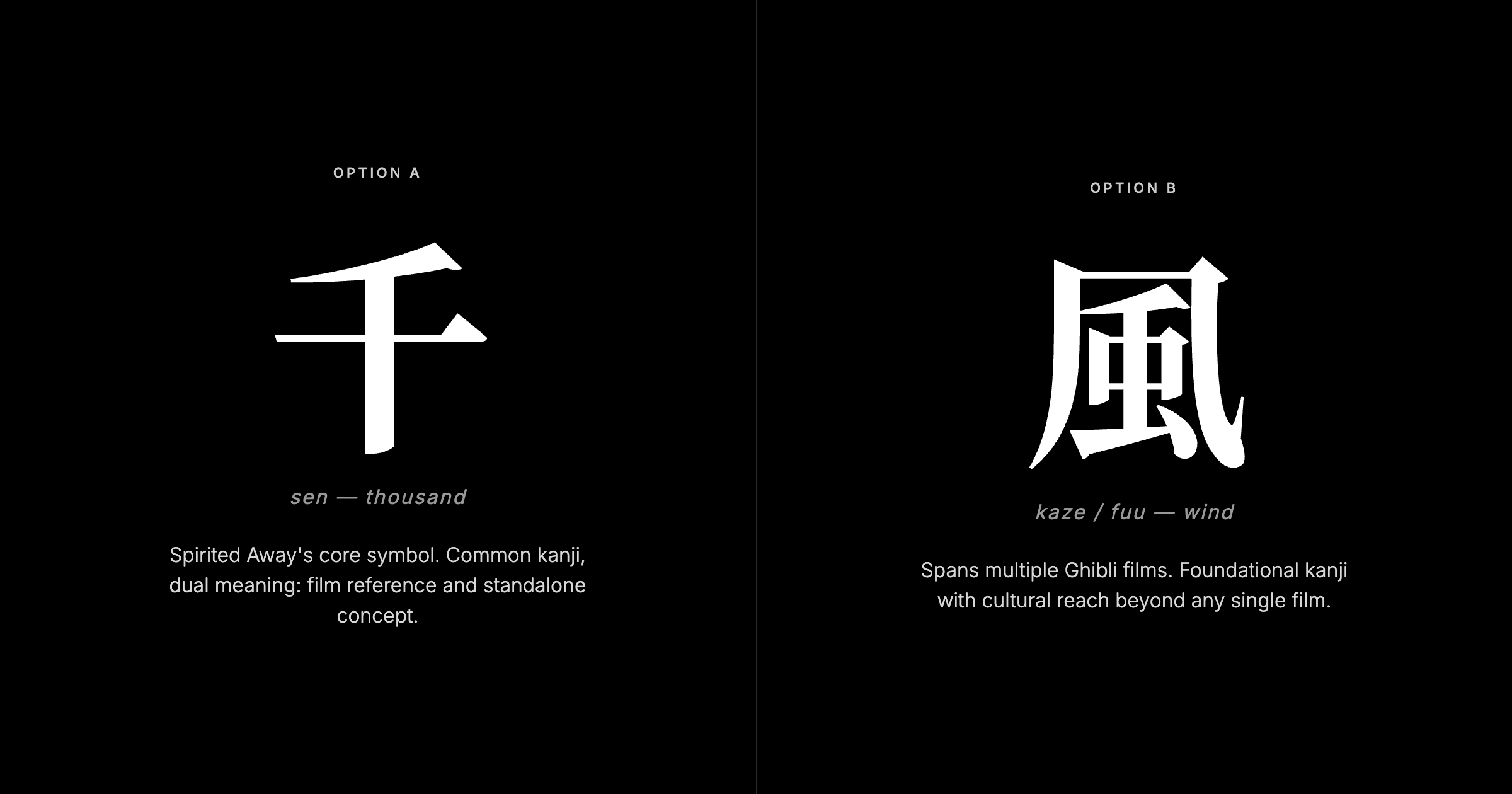
Tier 1 — Strongest Ghibli kanji choices (lowest risk)
- 千 (sen — thousand): Real, common, immediately legible. Works as philosophical statement AND Spirited Away reference. The double meaning is a feature, not a weakness. Tokyo natives recognize both layers simultaneously.
- 風 (kaze/fuu — wind): Appears across multiple Ghibli films. Foundational kanji with genuine cultural reach beyond any single title. Works standalone as a concept.
- 姫 (hime — princess): Reads as "princess" standalone; Princess Mononoke connection secondary. Strong, culturally coherent kanji character.
Tier 2 — Works with film context understood
- 千尋 (Chihiro): Real name, real meaning, explicitly signals Spirited Away fandom. Solid if that's the intentional statement. Native speakers immediately recognize the character reference.
- 白 (haku — white/pure): Works as Haku's name or as standalone purity/clarity concept. Aesthetically clean, minimal design footprint.
- 城 (shiro/jou — castle): From Howl's Moving Castle. Foundational kanji that holds without film context. Multiple legitimate uses.
Tier 3 — Requires careful cultural consideration
- 神隠し (kamikakushi): Authentic folkloric compound with darker historical weight. Verify you're comfortable with the full meaning before inking.
- 耳 (mimi — ear): From Whisper of the Heart. Reads as either literal body part or deep Ghibli fandom. Insider reference only.
- Multi-character Ghibli tattoos: require careful consideration of placement, size, and stroke order. Character-specific designs demand flawless execution.
Why Studio Ghibli Kanji Risk Is About Execution, Not Source Material
Fake kanji in anime is a genuine phenomenon — some series use stylized invented compounds designed purely for visual impact. Studio Ghibli is fundamentally different. Miyazaki's classical education means his naming choices are linguistically and culturally grounded in real Japanese tradition. When 千 appears in Spirited Away, the concept of a name stripped to its most impersonal form is philosophically coherent in classical Japanese thought about linguistic and personal identity.
Compare this to Demon Slayer kanji tattoos: authentic characters used within a fictional framework that Japanese natives immediately recognize as series-specific vocabulary. Both approaches are legitimate; they carry different cultural registers and different levels of standalone meaning.
The actual risk in Ghibli kanji is almost entirely in execution quality, not choice authenticity. A Tokyo native won't judge you for choosing 千尋 (Chihiro) as a tattoo — but they will immediately notice if proportions are off or stroke order deviates from standard Japanese writing. Working with a tattoo artist experienced in real kanji character design is the single most important step for any multi-character Ghibli film or character design. Execution flaws are visible to anyone who writes kanji daily.
FAQ: Studio Ghibli Kanji Tattoos
Is 千 (sen/thousand) from Spirited Away a good standalone tattoo, or does it only make sense as a film reference?
千 is genuinely real and carries strong standalone meaning. Japanese speakers recognize it both as a common kanji and as the core of Spirited Away's Japanese title. It works either way — as a statement about scale, vastness, or multitude (the concept of a thousand), or as a Ghibli reference. The double meaning is a strength. Unlike character-specific kanji, 千 has multiple legitimate contexts that hold independent of whether you know the film.
If I want to tattoo Chihiro's name (千尋), will Japanese people understand it's from the film, or will they just see kanji?
Both — they'll read 千尋 as "Chihiro" immediately and understand you're a Spirited Away fan. This is not a negative reaction. The name is real, grammatically coherent Japanese. The distinction a native makes is that it reads as fandom-specific — the same way someone might tattoo "Arya Stark" in English. The kanji is solid; natives are simply aware of the context.
Why do some Ghibli character names seem to work better as tattoos than others? Should I avoid names like Ponyo or Howl?
Ponyo and Howl are written in katakana in official materials, not kanji — which is why they feel less suitable for a traditional kanji tattoo than names like Chihiro (千尋) or Haku (白). If you want kanji specifically, choose character names that have meaningful kanji compounds. These encode cultural symbolism and work aesthetically as designs. Ponyo remains a valid tattoo choice, but it reads differently — more like a cute nickname — compared to names with kanji depth.
I've seen 神隠し (kamikakushi/spirited away) as a tattoo design. Is this a safe choice?
神隠し is a real kanji compound — a genuine folkloric term predating the film by centuries. But it carries darker implications than the English title suggests: it specifically describes disappearances caused by spirits, with historical dread attached. Japanese natives reading it understand the full weight of that meaning. If you're comfortable with the nuance and your stroke order is correct, it works. But verify with a native speaker first — it's more complex than the English title implies.
How do I make sure my Ghibli kanji tattoo doesn't have stroke order errors obvious to native Japanese speakers?
Source reference from a Japanese dictionary (Jisho.org, NHK Kanji Dictionary) rather than anime screenshots or Pinterest. Ask your artist to show you how they'll handle stroke proportions before committing. If possible, have a native Japanese speaker — or a KIO verification — review the design before you sit down. Stroke errors are immediately visible to people who write kanji daily, and they are one of the most common failure points in anime-inspired tattoos.
Which Ghibli film title kanji would a Tokyo native recognize instantly as a studio ghibli kanji tattoo?
千 (Spirited Away) is the instant-recognition choice — common kanji and unmistakably tied to that film. 城 (castle, from Howl's Moving Castle) is a strong alternative with multiple legitimate uses. 姫 (princess, from Mononoke) reads more broadly as "princess" than film-specific. Lesser-known choices like 耳 (ear, from Whisper of the Heart) signal fandom depth. Ultimately, execution matters more than choice: a correctly stroked 千 always outperforms a sloppy one.
Are Ghibli kanji tattoos more or less risky than other anime franchises like Demon Slayer or Naruto?
Ghibli is in the lowest-risk category. Unlike some anime that invent compounds for visual impact, Miyazaki draws from real, dictionary-standard kanji and authentic Japanese naming conventions—the same approach Naruto takes with characters like 愛 and 火の意志, where authenticity takes precedence over visual design. His character naming reflects classical Japanese linguistic knowledge. The risk is in execution, not source. A native won't judge you for choosing Chihiro — they'll notice if the stroke order is wrong. That's a different and solvable problem.
What's the difference between a Ghibli film title (like 千) versus a character name (like 千尋) as a studio ghibli kanji tattoo?
Film title kanji like 千 are shorter, carry broader meaning, and work as standalone philosophical concepts with multiple legitimate interpretations. Character names like 千尋 are more complex, explicitly signal Spirited Away fandom, and carry deeper symbolic weight — the name encodes the character's entire arc and psychological transformation. Choose a film title for layered ambiguity and cultural versatility; choose a character name if you're deeply invested in that specific character's story and want the Ghibli reference unmistakable. Understanding how Japanese people actually interpret kanji tattoos covers the full spectrum of native reactions that shape how each choice lands in real-world contexts.
Verify Your Ghibli Kanji Design With Tokyo Native Experts
Before committing to a Ghibli tattoo design, get your kanji verified by Kanji Ink Oracle's Tokyo-native reviewers. Within 24 hours, you receive a detailed assessment of stroke order accuracy, compound meaning, cultural context, and exactly how a Tokyo native will read and interpret the characters on your skin. This verification step is especially important for multi-character designs like 千尋 (Chihiro) or 神隠し (kamikakushi), where execution precision determines whether the tattoo reads as intentional cultural knowledge or accidental error.