Chainsaw Man Kanji Tattoo: 悪魔, 契約, 血 Explained
The Chainsaw Man title is katakana, not kanji. This guide breaks down 悪魔, 契約, and 血 — what each really means to a Tokyo native, and which is safest to tattoo.
Chainsaw Man arrived in the West like a freight train — brutal, absurdist, and soaked in blood. The manga topped global sales charts, the MAPPA anime adaptation generated millions of social media posts, and somewhere inside that wave of enthusiasm, fans started looking up the kanji. Problem is, Chainsaw Man's title isn't kanji at all. It's チェンソーマン — three katakana words spelling out "che-n-so-o-ma-n," the Japanese phonetic rendering of "Chainsaw Man." There is no kanji in the title to tattoo.
So when fans search for a Chainsaw Man kanji tattoo, what they're actually reaching for is something deeper: the thematic language of the series. The devils, the contracts, the blood. And that's where the real conversation starts — because those words exist in Japanese, they carry weight in the series, and they also live completely different lives outside of it.
Why the Title Being Katakana Matters
Katakana (the angular script used for loanwords and foreign names) is used for "Chainsaw Man" because the premise is imported. Denji, Aki, Power, Makima — all of the main characters' names are also written in katakana (デンジ, アキ, パワー, マキマ). This is standard for contemporary manga with a more gritty, Western-influenced aesthetic. The series leans into foreign-word phonetics as part of its identity.
This explains a common pattern we see in KIO's verification queue: fans submitting a design that spells チェンソーマン in katakana and asking whether it's correct as a tattoo. It's accurate, but it's not kanji — it's essentially writing "Chainsaw Man" using Japan's alphabet for English loanwords, which would read to a Tokyo native the way writing "CHEEN-SO-MAN" in block letters reads to an English speaker. Recognizable to fans, but phonetically thin as a permanent mark.
The fans who want the language of the series — the ideas, the mythology — are right to look past the title to the kanji that drive the story's engine.
The World Tatsuki Fujimoto Built: Devils, Fear, and Contracts
To understand which kanji matter in Chainsaw Man, you have to understand the cosmology. Devils in this universe are born from human collective fear. The more people fear something, the more powerful the devil representing that concept becomes. The Gun Devil grew powerful because humanity fears bullets. The Chainsaw Devil exists because people fear chainsaws — or, at a thematic reading, because they fear something that tears, destroys, and erases.
This fear-as-fuel mechanic is philosophically specific to the series. It draws on a tradition in Japanese horror that treats fears as living entities — similar conceptual ground to yokai mythology, where every unnamed dread eventually takes a form. That tradition runs deep in Japanese culture, from the oni (鬼) of classical folklore through to J-horror's grudge-spirits.
Humans can form contracts with these fear-born entities. A devil hunter trades part of their body, their lifespan, or something precious to gain the devil's power. Aki sacrifices years of his life. Power makes blood-contracts. Denji himself is the most extreme case: his heart is Pochita, the Chainsaw Devil, making him the contract itself. The contract mechanic isn't a plot device — it's the series' moral spine. Every character's power comes with a cost, and that cost is always personal.
This is the cultural frame that makes the kanji choices meaningful. Knowing what 悪魔 and 契約 actually represent in this universe — and then knowing how those same words live in everyday Japanese — is the entire point of the kanji conversation.
Kanji Breakdown: The Three Core Words
悪魔 (akuma — devil)
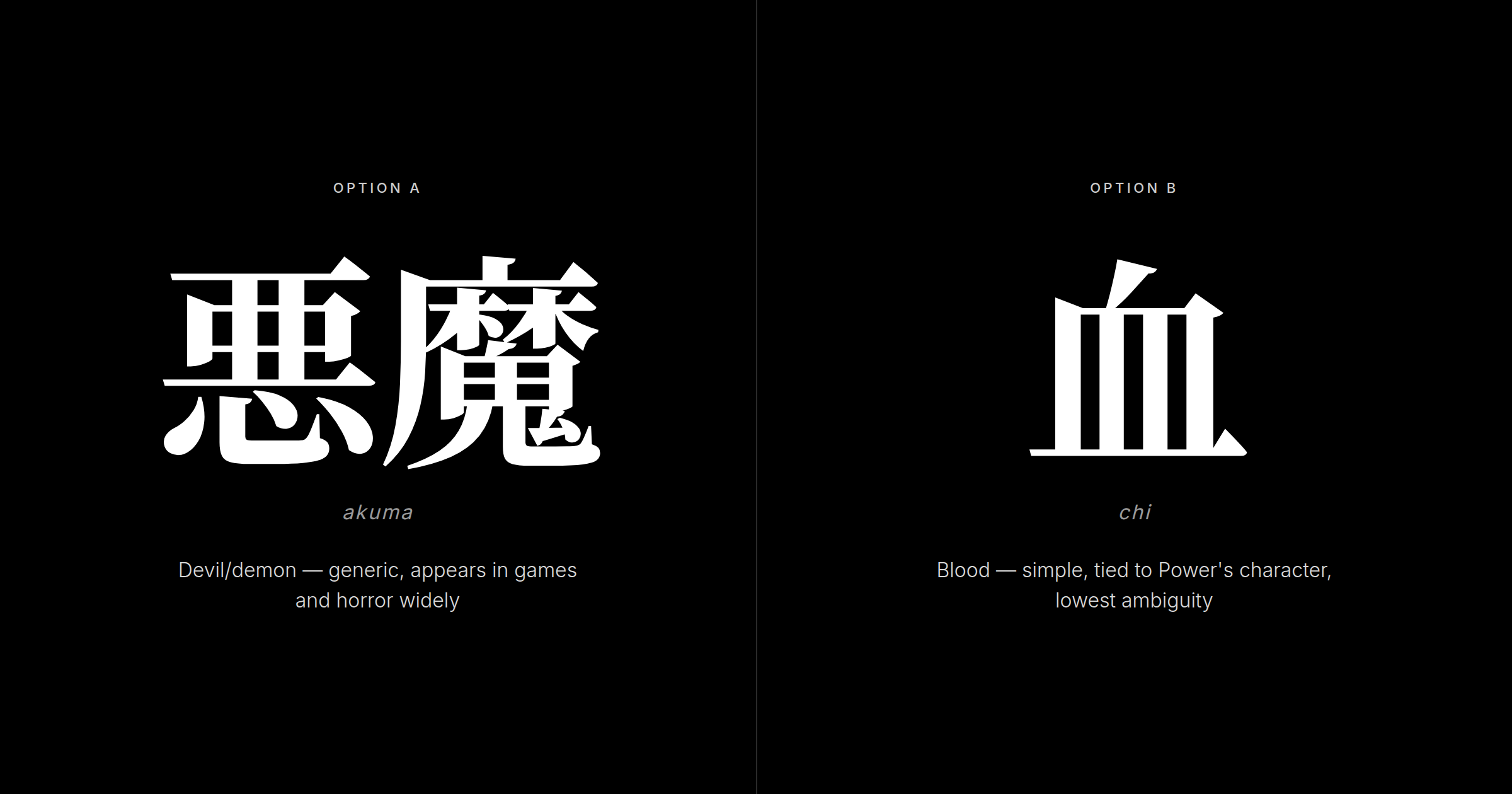
悪魔 breaks down as 悪 (aku — bad, evil; the same character you see in 悪口 akuguchi, "trash talk," or 悪意 akui, "malice") combined with 魔 (ma — demon, fiend; appears in 魔法 mahou, "magic," and 魔王 maou, "Demon King"). Together, 悪魔 means devil or demon — the standard modern Japanese word for a malevolent supernatural being.
It's used in video games (the Shin Megami Tensei franchise literally puts 悪魔 in the center of its identity), horror films, anime, religious contexts, and everyday speech. You can call someone who plays a dirty trick on you a "小悪魔" (ko-akuma, "little devil") without anyone flinching. It is not an archaic or ceremonial word. It doesn't arrive with the weight of a specific mythology the way "Lucifer" or "Mephistopheles" do in Western contexts.
In Chainsaw Man, 悪魔 is the word for the entities Denji fights and eventually becomes. When a native reader sees this kanji on a forearm, they read "demon." They might think: anime fan, horror fan, or someone who just likes the aesthetic. They probably won't think Chainsaw Man specifically unless you have other Chainsaw Man context nearby.
契約 (keiyaku — contract)
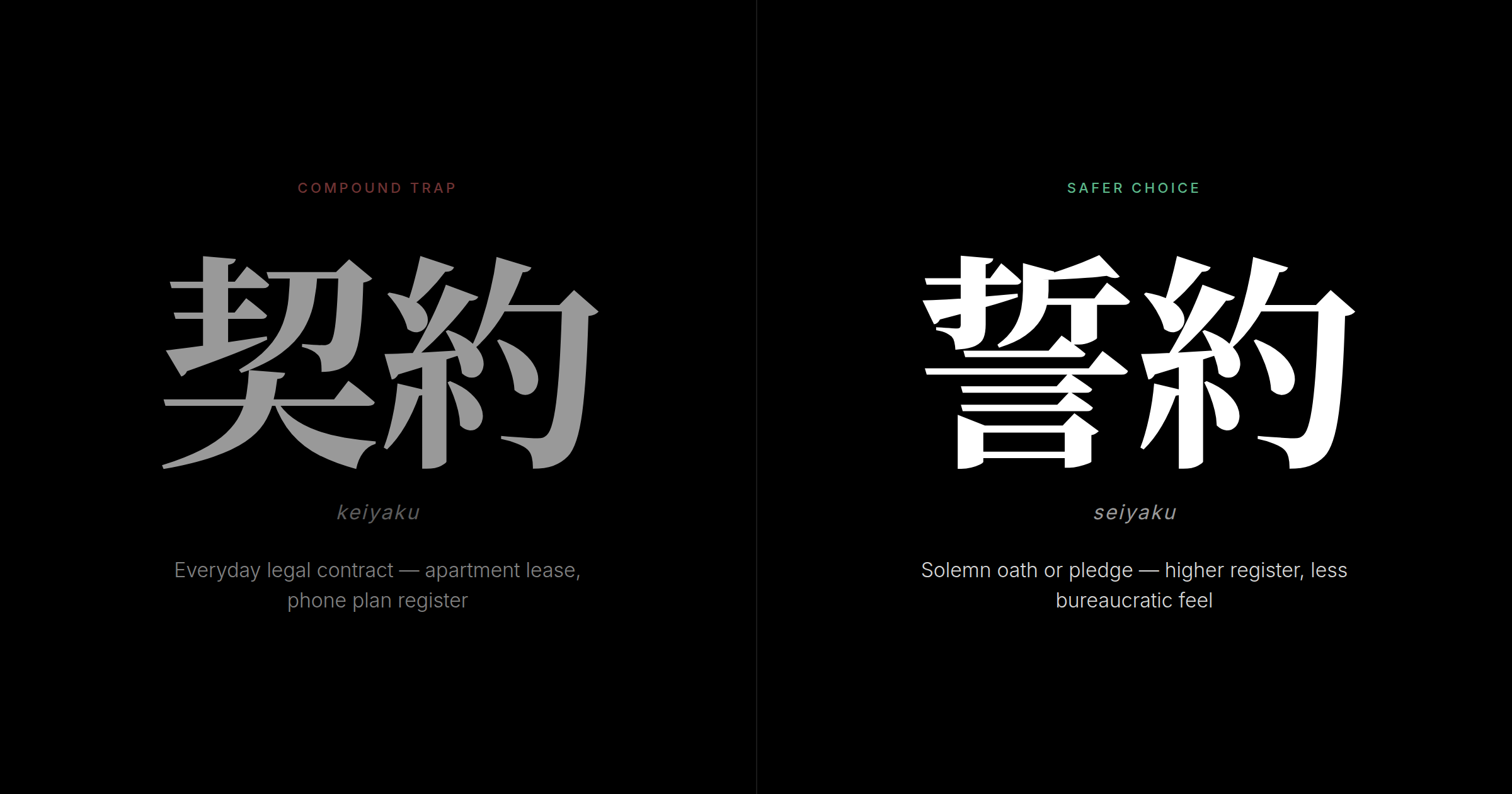
契約 is two characters that both deal with agreement: 契 (kei — pledge, covenant; a formal commitment) and 約 (yaku — promise, agreement; the same character in 約束 yakusoku, "promise," and 予約 yoyaku, "reservation"). Together they form 契約 (keiyaku), the formal Japanese word for a contract or legal agreement.
This is the word on your apartment lease. The word on your phone plan. The word your employer uses when they hand you an employment contract on your first day. In everyday Japanese, 契約 is dry, transactional, and slightly bureaucratic — it belongs to the register of official documents and commercial exchanges.
In Chainsaw Man, this same dry, legal word describes supernatural binding agreements between devils and humans — trades of flesh and years of life. Fujimoto's choice to use the mundane legal term rather than an invented mystical word is itself a kind of authorial coldness. These contracts aren't dramatic or romanticized; they're just terms and conditions you agree to, enforced by something that will kill you.
A Tokyo native seeing 契約 tattooed on skin would pause. The word is immediately legible — everyone knows it — but it's also the word for "phone contract." The register mismatch is the point: the fan has chosen a word that is simultaneously conceptually rich within the series and completely ordinary outside it.
For comparison: 誓約 (seiyaku — solemn oath, sacred pledge) is the higher-register cousin. It appears in vows, oaths of loyalty, and ceremonial commitments — nowhere near an apartment lease. The contrast between 契約 and 誓約 illustrates how dramatically register can shift within the same thematic territory.
血 (chi — blood)
血 (chi or ketsu depending on context) is one of the first kanji Japanese schoolchildren learn. It's in blood type (血液型 — ketsuekigata), blood vessel (血管 — kekkan), and idioms involving intense focus ("目が血走る" — me ga chihashiru, eyes bloodshot with intensity). It's a simple, clear, four-stroke character that everyone can read instantly.
In Chainsaw Man, blood is Power's element. She is the Blood Fiend — her devil powers work through blood manipulation, and her character arc turns on blood contracts and survival at any cost. 血 is genuinely the most legible of the three main kanji choices: simple, unambiguous, and clearly tied to a specific character archetype.
A native seeing this would most likely read "blood" and move on. If they know the series, they might connect it to Power. If they don't, they'd assume the wearer likes the aesthetic — which is a neutral read, not an embarrassing one.
So What Happens When You Put This on Your Skin?
The cultural context is set. You understand the cosmology, the register, the kanji themselves. The question now is: what does it mean to make one of these words permanent?
Native Verdict: What a Tokyo Native Reads on Your Tattoo
(Based on patterns from KIO's verification requests.)
A Tokyo native reading 悪魔 (akuma) would think "demon" — accurate, but not series-specific. Chainsaw Man is popular, but 悪魔 appears in games, horror, and everyday speech. They'd assume "anime fan" without making the series connection.
A Tokyo native reading 契約 (keiyaku) would pause. The kanji is correct Japanese, but it reads as "legal contract" — the word on apartment leases and phone plans. The register mismatch is stark: tattooing "TERMS AND CONDITIONS" in English would feel similarly jarring.
A Tokyo native reading 血 (chi) would have the least friction. It's simple, clear, and connects to Power's character arc. This is the choice that passes the "native encounter test" best.
The surprise for Western fans is that 悪魔 and 契約 — the most thematically rich choices — land with natives as utterly ordinary words. The darkness fans project doesn't travel. That's a gap worth knowing before you ink.
This pattern repeats across anime kanji tattoos. Our guide to what Japanese people actually think of kanji tattoos covers the full range of native reactions — and the register-mismatch surprise is one of the most consistent findings. A similar structure applies to Hunter x Hunter's 念 (nen) kanji, where fans read "power" but natives read "contemplative focus" — the emotional weight doesn't transfer.
Better Alternatives: Kanji That Carry More Weight
If the main three feel too ordinary, consider:
恐怖 (kyoufu — fear). The philosophical engine of the Chainsaw Man universe. 恐怖 describes existential terror rather than everyday nervousness — more evocative and directly thematic.
生死 (seishi — life and death). Appears in high-stakes literary and rhetorical contexts — 生死をかけた戦い (seishi wo kaketa tatakai, "a battle staking one's life"), philosophical essays, and formal writing. Not everyday conversation. Fits Denji's core arc about survival and meaning, and carries weight precisely because it belongs to serious discourse rather than genre signaling.
絆 (kizuna — bond). Captures the Denji/Aki/Power friendship without shouting "Chainsaw Man." This kanji carries genuine emotional weight from its use in post-earthquake Japan solidarity messaging.
KIO's guide to choosing meaningful kanji for tattoos walks through how our verification team evaluates register and resonance for every submission.
FAQ
Can I tattoo "Chainsaw Man" in kanji?
No. The title チェンソーマン is written in katakana — the phonetic script used for foreign loanwords — not in kanji. There is no "Chainsaw Man" kanji to tattoo. Fans seeking a Chainsaw Man kanji tattoo are choosing thematic kanji from the series: 悪魔 (akuma — devil), 契約 (keiyaku — contract), or 血 (chi — blood) are the three primary options.
What does 悪魔 mean, and is it a good Chainsaw Man tattoo?
悪魔 (akuma) means "devil" or "demon" — widely used in games, anime, and everyday speech. It's thematically central to the series but not series-specific. A native reads "demon" without automatically connecting to the manga. It works as a tattoo but reads as a generic demon marker, not Chainsaw Man fandom specifically.
Is 契約 (contract) a good tattoo if I love the series' supernatural agreement mechanic?
契約 (keiyaku) is conceptually rich — the contract mechanic is the series' spine. But it reads as "legal agreement" to natives (apartment leases, phone plans). Natives recognize it immediately but feel the register mismatch. If you choose this, own the paradox: the word's mundanity mirrors what makes Fujimoto's writing brilliant.
What's the safest Chainsaw Man kanji tattoo?
血 (chi — blood) is the safest choice. It's simple, unambiguous, has no embarrassing alternate reading, and connects clearly to Power's character arc. A native would read "blood" without pause, and a Chainsaw Man fan would likely make the Power connection. It's the option that carries the least cultural friction.
What would a Japanese person think if I got a Chainsaw Man kanji tattoo?
It depends. 悪魔 reads as "demon" (neutral, generic). 契約 reads as "legal contract" (register-jarring). 血 reads as "blood" (simple, clear). A Tokyo native would understand the literal meaning immediately and likely assume "anime fan." They wouldn't feel impressed by mystical depth, because to natives these are ordinary everyday words.
How do I verify my Chainsaw Man kanji tattoo before getting inked?
Check your kanji against multiple sources (Jisho.org over Google Translate), research readings and uses, and have a native speaker review meaning and register. KIO's verification guide walks through the process. The most missed step is register — dictionary definition doesn't equal native intuition.
Can I tattoo Denji, Power, Makima, or other character names as kanji?
No — these names are all written in katakana (デンジ, パワー, マキマ), not kanji. They're phonetic transliterations without symbolism. Katakana tattoos read differently than kanji — more like foreign names than symbolic characters. For honoring a specific character, thematic kanji (like 血 for Power) or visual designs are more legible.
Are there other kanji from Chainsaw Man besides 悪魔, 契約, and 血 worth considering?
Options worth exploring: 恐怖 (kyoufu — terror), the philosophical engine of the universe; 絆 (kizuna — bond), capturing the Denji/Aki/Power arc; and 生死 (seishi — life/death), fitting Denji's survival question. These carry more weight and signal deeper thematic engagement. See our piece on fake anime kanji tattoos for how register mismatches play out across fandoms.
Getting a Chainsaw Man kanji tattoo means choosing a permanent mark from a universe built on mundane language made terrifying. KIO's Tokyo-native reviewers can tell you exactly how your chosen kanji lands — not just the dictionary definition, but the register, the cultural associations, and what a native would actually think when they see it on your skin. Verify your kanji at Kanji Ink Oracle before the appointment.