Fake Japanese Kanji in Anime Tattoos: How to Spot Them
Fake Japanese kanji from anime deceive tattoo fans into getting meaningless designs. Discover why anime stylizes characters and how to verify before you ink.
You love a franchise. You want to carry something from it permanently. So you search the character's iconic kanji, copy the image, and bring it to a tattoo studio — trusting that fake Japanese kanji from anime must be accurate because it came from a professional Japanese media property. That trust is precisely where things go wrong.
Fake Japanese kanji anime tattoos are designed to look meaningful, not to read correctly. The distinction matters enormously when that design lives on your skin. Anime artists prioritize visual storytelling over linguistic accuracy, combining kanji in ways that evoke concepts rather than follow real Japanese word-construction rules.
What "Fake" Anime Kanji Really Means for Your Tattoo
The word "fake" here is slightly unfair to the kanji themselves. Every character you see in a Shonen Jump title or on a character's uniform is real — real brushstrokes, real etymology. What's "fake" is the meaning transfer fans assume is happening.
Anime writers, art directors, and letterers use kanji for visual and narrative impact. They combine characters in ways that evoke a concept rather than follow standard Japanese word-construction rules. A native Japanese speaker reading the same panel doesn't see a precise translation of the English dub line — they see a deliberately stylized choice that creates a feeling.
When fans treat that stylized choice as a direct window into Japanese meaning, the gap between aesthetic and accuracy opens up. And that gap is where anime kanji tattoos go sideways.
Jujutsu Kaisen and the Grammar That Doesn't Quite Exist
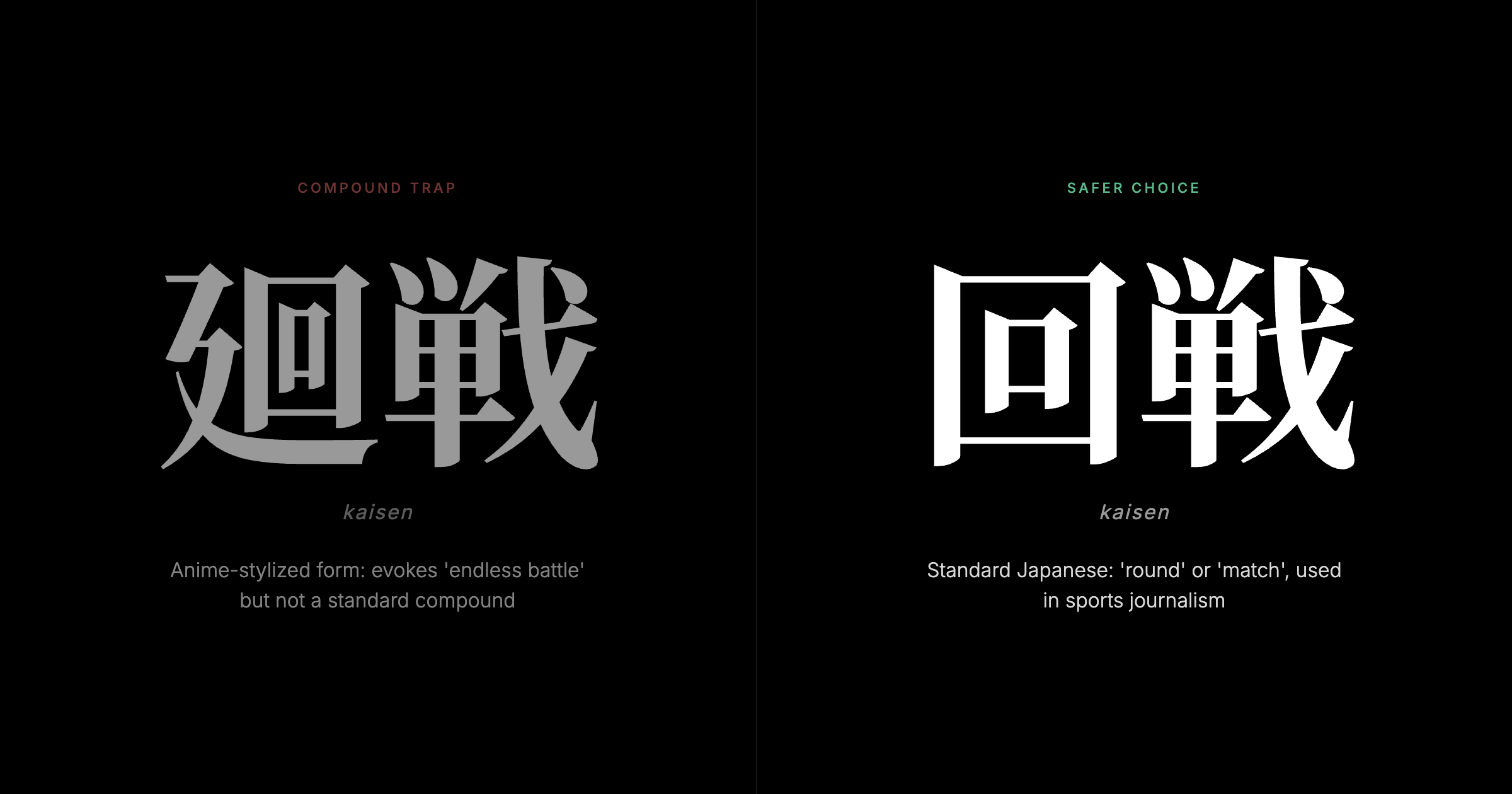
One of the most famous fake Japanese kanji anime tattoo examples is the Jujutsu Kaisen title 呪術廻戦 (juujutsu kaisen — literally "cursed technique revolving battle"), which has been tattooed tens of thousands of times since the series launched. Fans translate the fake anime kanji roughly as "Sorcery Fight," which is close enough for a subtitle — but not the meaning they think they're wearing.
Break it down:
- 呪術 (juujutsu — curse technique; the standard compound used in supernatural fiction and in actual academic discussion of cursed practices)
- 廻 (kai — to rotate, revolve, or cycle; an archaic/literary variant of 回 that survives mainly in classical texts and proper nouns. You'll see it in 廻廊 (kairou — a roofed corridor/gallery), but modern Japanese uses 回 for everyday words like 回転 (kaiten — rotation))
- 戦 (sen — battle, war; a standard character seen in political headlines and sports coverage alike)
The compound 廻戦 (kaisen) is the stylized part. In real Japanese, 回戦 (also read kaisen) is a legitimate word meaning "a round" or "a match" — you'll see it in sports reporting to describe rounds in a tournament. But the series uses 廻 instead of 回, selecting the character with the more archaic, spiritually weighty visual presence. That substitution is intentional design. The result reads like "endless cycling battle" to a native eye — evocative, slightly off, unmistakably anime-specific.
Getting 呪術廻戦 tattooed means getting a phrase that any Tokyo native will immediately identify as the anime title, not as a meaningful life statement. That may be exactly what you want — but it should be a conscious choice, not an assumption.
Bleach: The Number 69 and What It Actually Signals
Hisagi Shuuhei's chest tattoo — the number 69 — is one of the most replicated anime-inspired tattoos in existence. The in-series logic is that 9 marks his division number in the Gotei 13. The 6 has been the subject of years of fan speculation about thematic kanji associations Kubo Tite may have intended (different fan readings point to different characters, none confirmed in-canon), but the surname 檜佐木 itself does not contain those characters, and no official source ties 6 to a specific stroke count. Treat the 6 as a design choice with character-building intent: it draws on real yakuza numbering traditions where gang members tattooed identification numbers tied to their organization.
For deeper analysis of Bleach kanji tattoos specifically — including 死神 (shinigami), 卍解 (bankai), and why many Bleach choices don't exist as real Japanese compounds — see the comprehensive Bleach kanji tattoo guide.
The yakuza connection is documented historical fact. In post-war Japan, some organized crime members used numbered tattoos partly as affiliation markers. Kubo incorporated that tradition into Hisagi's design to give him visible cultural depth.
Here's what fans copying this tattoo often miss: the number 69 by itself carries no meaning in standard Japanese. It is not a word, not a compound, not a phrase. What you are inking is a piece of anime lore that references yakuza aesthetics — and a Tokyo native will read it exactly that way. Not as a personal statement about strength or duality, but as either an anime fan tattoo or an organized-crime-adjacent signal, depending on context. Neither reading is what most fans intend.
Attack on Titan and Demon Slayer: Visual Weight vs. Linguistic Meaning
Across both franchises, kanji appear on character uniforms, weapon blades, and rank insignia. Fans zoom in on these details, isolate the characters, and assume the combination carries direct meaning.
Based on KIO's verification reviews covering hundreds of anime-inspired tattoo inquiries, one of the most common patterns is clients presenting isolated kanji from visual contexts — a sword inscription, a uniform patch — without any awareness that the characters were chosen for how they look in frame rather than for what they say when read in sequence. Attack on Titan's 自由 and 戦え are notably exceptions — both characters carry authentic linguistic weight outside the anime, though execution precision on the complex 戦 kanji remains critical.
Not all anime franchises follow this pattern. Studio Ghibli kanji tattoos represent the opposite approach: Miyazaki's naming choices are grounded in classical Japanese linguistic tradition. Similarly, Naruto's kanji choices like 愛 and 火の意志 anchor the series in authentic Japanese meaning rather than visual invention. Dragon Ball's gi symbols are real kanji with centuries of martial arts tradition behind them, making these franchises rare among anime for having authentic rather than stylized character selection. Hiromu Arakawa follows this same commitment in Yomi no Tsugai, where her choice of 黄泉 over simpler underworld terminology reflects genuine Shinto mythological grounding. In the same Spring 2026 season, Witch Hat Atelier demonstrates how linguistic precision shapes storytelling, with the Japanese title 《とんがり帽子のアトリエ》 deliberately encoding craft philosophy through everyday register paired with artisan vocabulary — the opposite of visual stylization. And Marriage Toxin uses the katakana choice itself as a meta-statement about global audience and script register, turning the writing system distinction into thematic architecture.
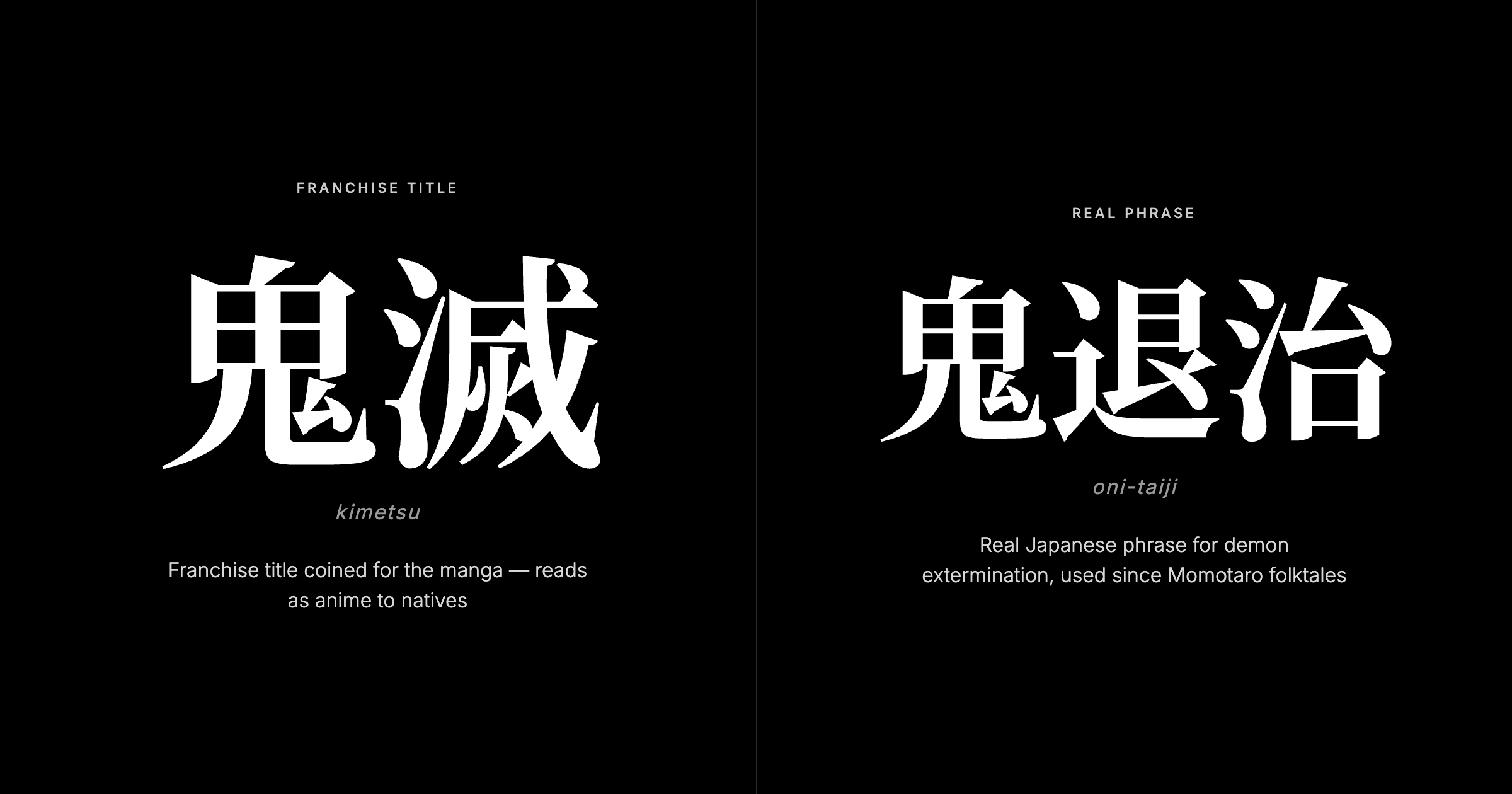
A blade inscription in Demon Slayer might use 鬼 (oni — demon, ogre; the character appears in everyday Japanese in compounds like 鬼ごっこ, the children's game of tag, as well as in describing frightening things more broadly) alongside characters selected for visual balance on the blade silhouette. Reading those characters as a compound, the way you'd read a word in a dictionary, produces nothing a Japanese speaker would recognize as a phrase. This mechanism differs from cases where the kanji itself is real but anime assigns it a different register: Hunter x Hunter's 念 is a genuinely real character with its own Japanese meaning, yet fans read it through the anime's power-system framing rather than its actual philosophical and Buddhist roots.
Demon Slayer's demon rank system (甲乙丙丁, kou otsu hei tei — the traditional tiered ranking system drawn from the Heavenly Stems, an ancient Chinese classification framework used in Japan for centuries in administrative and legal contexts) is actually one of the more linguistically grounded elements of any anime. These rank characters are real and carry real cultural weight. The trap is assuming the same is true of every kanji in every frame.
The Ariana Grande Problem: When Compounds Bite
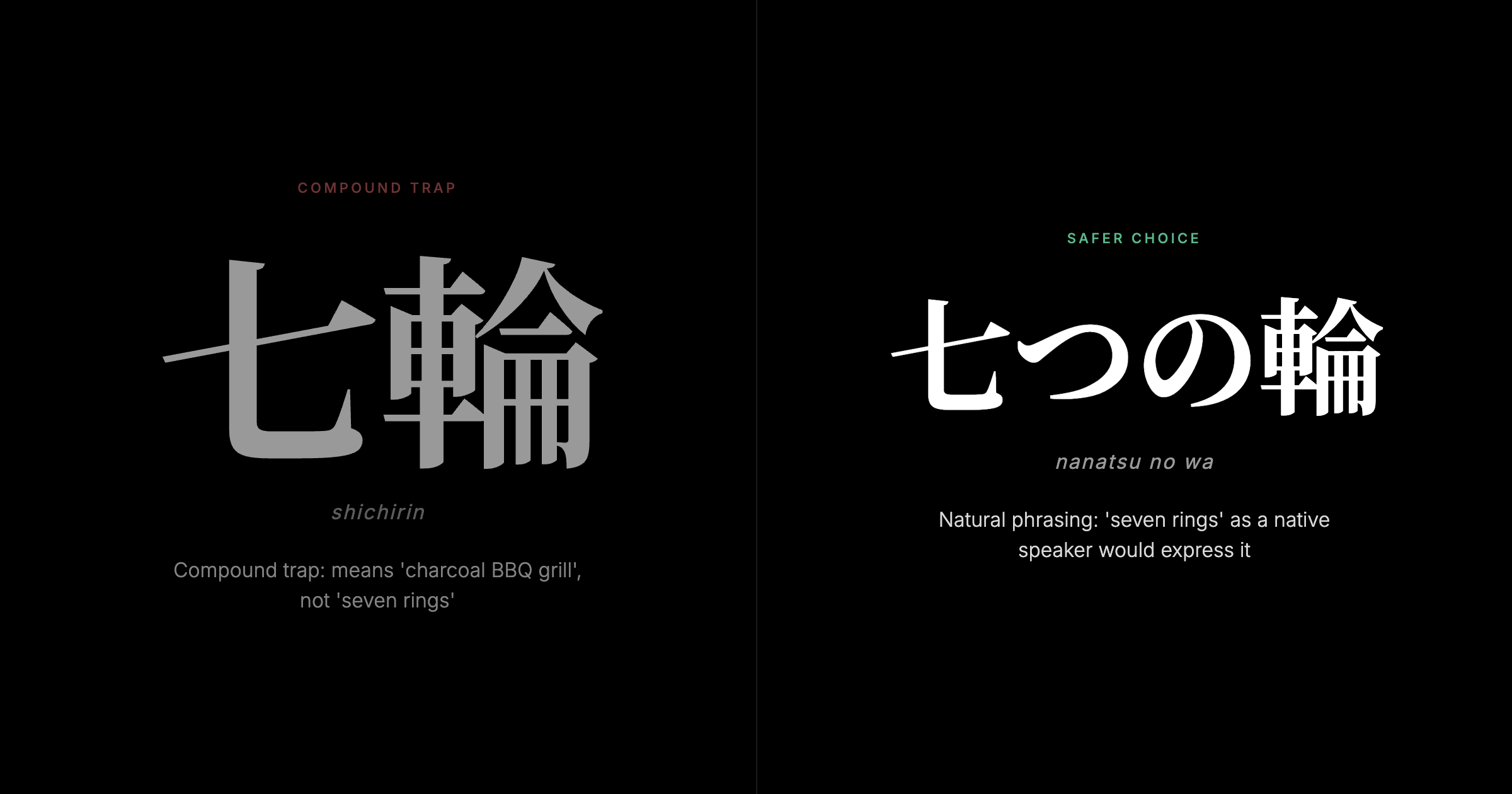
Ariana Grande's widely reported 2019 tattoo is the canonical example of compound kanji failure. She intended to tattoo "7 rings" — the title of her chart-topping single. She got 七輪 (shichirin — a traditional Japanese charcoal grill used for tabletop barbecue).
The mechanics: 七 (nana/shichi — seven; one of the most common characters in the language, appearing in days of the week, phone numbers, prices, and idioms like 七転び八起き meaning "fall seven times, rise eight") plus 輪 (wa/rin — circle, ring, wheel; appears in words for wheel, halo, Olympic rings, and flower garlands) do not stack to mean "seven rings" the way English words stack. Japanese compound logic doesn't work that way. The combination 七輪 was already a word — it had been a word for centuries — before Grande's tattoo became a viral lesson in why you verify compound combinations before you ink them.
This is the same mechanism that traps anime fans. Naruto's technique names combine characters: 螺旋丸 (rasengan — spiral sphere; 螺旋 meaning "spiral" in scientific and everyday Japanese, 丸 meaning "circle, sphere, or ship's name suffix") is a real compound that works linguistically. But 千鳥 (chidori — one thousand birds; a genuinely poetic compound, though in Kakashi's context it refers to the crackling sound of lightning, not birds) leans on an existing word for its resonance. Many other technique names combine characters whose individual readings add up to something evocative on paper but don't function as real Japanese words. Chainsaw Man presents a different problem entirely — the kanji are real and correct, but anime framing amplifies register so dramatically that fans expect spiritual weight a native speaker reads as ordinary. SPY×FAMILY takes the opposite approach entirely, with no official kanji title at all — an intentional design choice that forces fans to choose kanji that match which layer of the story resonates most.
Why Anime Kanji Has Built-in False Authority
A random internet generator produces kanji that looks suspicious to anyone who thinks twice. Anime kanji has something far more convincing: it was created by Japanese people, in Japan, for a Japanese audience.
That authority is real but limited. Anime is visual storytelling first, linguistic documentation second. Manga artists choose kanji for how characters look in panel compositions, how they read aloud in seiyuu (voice actor) performances, and how they land emotionally in context. The fact that the creator is Japanese does not make every kanji choice linguistically standard — any more than a Hollywood film's use of Latin phrases is a reliable guide to classical grammar.
This creates a unique blind spot that famous kanji tattoo failures don't address. When someone uses Google Translate, they know on some level they're trusting an algorithm. When someone copies fake anime kanji from Jujutsu Kaisen, they feel they're drawing on professional Japanese source material. That confidence is harder to question — and harder to walk back once the tattoo is done.
If you want to understand the full scope of how machine translation fails separately, our detailed guide to Google Translate kanji tattoo mistakes covers that mechanism in depth.
How to Spot Anime Kanji Before You Ink It
The question isn't whether anime kanji can be trusted — it's which kanji, from which franchise, in which context. Some anime kanji is linguistically sound. Some is deliberately stylized. The gap between those two categories is exactly what a pre-ink verification closes.
Practical steps before committing:
Check whether the combination exists in a Japanese dictionary. Not a fan wiki. Not the anime's official English localization. Jisho.org, for example, will tell you immediately whether a compound returns a real dictionary entry. If it doesn't, you're dealing with something anime-specific.
Ask whether the meaning was explained in-universe or just shown visually. Technique names that get on-screen kanji breakdowns (like some Naruto jutsu) at least give you the creator's intended reading. Visual-only kanji — sword inscriptions, uniform patches, background art — were almost certainly chosen for design reasons.
Run the individual characters through context, not just definition. Every character in 呪術廻戦 has a definition. That doesn't mean the fake anime kanji combination works as a phrase outside of the title. Learning how real kanji compounds are formed in Japanese is the foundational skill that prevents fake anime kanji from ruining your tattoo.
Verify with a native speaker who isn't a fan of the series. An enthusiastic fan might confirm what you want to hear. Someone unfamiliar with the franchise will tell you what a Tokyo native actually reads when they see fake anime kanji on your skin.
If you've already got an anime-adjacent tattoo and you're uncertain what it actually says, our guide to verifying whether your kanji tattoo is accurate walks through the verification process.
The Native Verdict
A Tokyo native spots an anime kanji tattoo within seconds. Not because they've memorized every franchise's visual vocabulary — but because certain kanji combinations simply don't appear outside of manga and anime. The stylized substitutions (廻 for 回, compound arrangements that don't exist in dictionaries) leave a distinctive fingerprint that any fluent reader recognizes.
Here's the cultural context that rarely makes it into English-language tattoo advice: tattoos in Japan carry yakuza associations that are still active in public consciousness. Sento (bathhouses), gyms, and some traditional venues still post no-tattoo policies. When a visible tattoo also displays anime-specific kanji, the reading a Tokyo native reaches for first isn't "anime fan" — it's a mixture of "foreign enthusiast" and "didn't verify." Not contemptuous, but not the statement the wearer likely intended.
What natives actually think, in the experience of KIO's Tokyo-based reviewers, is more nuanced than either respect or mockery. There's genuine appreciation for the enthusiasm. The anime and manga exports are a source of cultural pride. But the gap between loving a franchise and understanding its linguistic choices is legible to anyone who reads Japanese daily, and that gap reads on skin.
The cleaner path — for the wearer's own sake — is to separate the emotional attachment to a franchise from the kanji you want to carry permanently. If you love Jujutsu Kaisen, there are ways to find kanji that captures what the series means to you in linguistically real terms, rather than lifting the title and wearing something that signals "I watched the show" more than it signals any personal meaning.
KIO's Tokyo-native reviewers work through exactly this process: identifying what you want a tattoo to mean, finding how real Japanese expresses that meaning, and verifying the result against native standards. Before committing to fake anime kanji, get your design verified at Kanji Ink Oracle — it's the single most reliable way to close the gap between what anime implies and what Japanese actually says.
FAQ
Can I get a Bleach tattoo with the 69 and have it mean something real in Japanese?
The 69 by itself doesn't carry meaning in standard Japanese — it's a Kubo creation that combines yakuza numbering traditions with character-specific numbers from the series. If you want the tattoo, go in knowing you're getting anime lore, not a traditional Japanese cultural statement. A Tokyo native will recognize it as a fan tattoo, not a declaration of personal meaning.
Does "Jujutsu Kaisen" mean what anime fans think it means?
The title combines 呪術 (juujutsu — cursed technique) with 廻戦 (kaisen — poetically "endless cycling battle," but not a standard Japanese compound). Fans often translate it as "Sorcery Fight," which captures the feel but not the precise linguistic structure. Getting it tattooed means wearing a semi-fictional phrase — one any Japanese speaker will read as the anime title, not as an independent statement.
How do I know if my favorite anime's kanji is real or stylized?
Check three things: Does the combination appear in a Japanese dictionary (Jisho.org, not a fan wiki)? Is there a real-world context where this compound appears outside the franchise? Would a Japanese language student encounter this word in a textbook? If the answer to all three is no, the kanji is anime-specific. Verify with a native speaker before committing to ink.
What will Japanese people think if I get an anime kanji tattoo?
Native speakers will recognize it as an anime fan tattoo quickly. The response tends to be respectful of the enthusiasm but aware of the linguistic gap. In Japan, visible tattoos already carry cultural weight — the combination of non-standard kanji plus visible ink reads as either a tourist-style mistake or an earnest fan who didn't verify. Neither is the statement most wearers intend.
Can I still get an anime character's tattoo if I understand it might be wrong?
Yes — informed consent is the standard here. If you love the character or series and want to carry that connection, do it with full awareness of what the kanji actually says versus what the fandom assumes it means. Consider pairing it with a real kanji that captures the personal meaning you want, or choosing a visual element (the character's design, weapon, or symbol) rather than a kanji phrase you can't fully verify.
Why do anime creators use stylized kanji instead of standard words?
Anime prioritizes visual storytelling: characters need to look powerful, mysterious, or specific to their world. Real Japanese words may not carry the visual weight or cultural implication the creator needs. Stylized kanji lets creators control the aesthetic while implying meaning. This is intentional design, not carelessness — which is precisely why fans trust it, and precisely why that trust needs an extra layer of scrutiny before it becomes permanent.
Is there an anime tattoo that's actually correct in real Japanese?
Yes — many technique names and character names are real, or closely based on real, Japanese. Demon Slayer's rank system (甲乙丙丁, kou otsu hei tei) uses legitimate classical characters. Some of Naruto's jutsu names follow real naming conventions. The approach isn't to assume all anime kanji are wrong — it's to verify the specific kanji with native sources before inking, rather than assuming franchise credibility equals linguistic accuracy.
Still worried that you might be getting fake Japanese kanji anime tattoo mistakes like the ones in this article? Get your design verified at Kanji Ink Oracle — Tokyo-native reviewers return a plain-language assessment of meaning, register, and cultural context within 24 hours.