Tokyo Revengers Manji Tattoo: Buddhist Symbol or Minefield?
The manji symbol in Tokyo Revengers is sacred in Japan but a social hazard in the West. A Tokyo native explains the cultural context and safer alternatives.
The Tokyo Revengers manga ran from 2017 to 2022 and became one of the defining delinquent-action series of its generation — complete with time travel, gang warfare, and a symbol at its center that has been quietly edited out of the version most Western fans actually watched. That symbol is 卍, the manji, and it sits at the heart of the Tokyo Manji Gang (東京卍會, Toman) that drives the entire story. Fans who track down the original manga or Japanese broadcast discover the uncensored version and want it on their skin. This article is for those fans — and it starts not with warnings, but with the full Japanese cultural story, because you can't make a good decision about this tattoo without understanding why the symbol means something completely different depending on which country you're standing in.
The Manji: 4,000 Years of Buddhist History
Long before Tokyo Revengers — and long before the Nazi regime — the symbol now debated in anime fan forums was one of the most auspicious signs in the Buddhist, Hindu, and Jain traditions. The Sanskrit word is svastika, meaning "conducive to well-being." In Japanese it is 卍, pronounced manji (まんじ).
Walk through any traditional Japanese neighborhood today and you will see 卍 on maps — the standard icon used by the Geospatial Information Authority of Japan to mark Buddhist temples. Open any printed city guide, pull up Google Maps Japan, and there it is, pointing you toward the nearest temple. The symbol is as ordinary in Japan as a red cross marking a hospital or a green H marking a helipad. It sits on lanterns, carved into wooden gates, embroidered into ceremonial cloth, and painted onto temple walls. There is no shame attached to it. No whisper of controversy. It is a positive religious symbol in its original context, and that context has not changed in Japan.
The character also has an interesting modern life outside the temple. Young Japanese people use 卍 in texting and social media to express something like "extreme," "wild," or "that's insane" — closer to "🤯" in the Western emoji vocabulary than to anything religious. A teenager in Tokyo might text 「今日の授業超眠かった卍」("Today's class was so boring 卍") with the character functioning as a kind of intensity marker. This dual register — ancient sacred symbol and casual internet slang — is perfectly comfortable in Japan. The two uses coexist without tension because neither carries the weight that weighs so heavily in the West.
Based on hundreds of verification requests reviewed by KIO's Tokyo-native team, 卍 consistently appears in two categories: clients who want fandom tattoos and genuinely do not know the Western reception, and clients who know exactly what they're doing and are prepared to navigate the conversation. This article closes that gap.
How the Nazi Regime Transformed a Sacred Symbol
In the 1920s, the Nazi regime adopted a hooked cross — rotated 45 degrees and oriented clockwise — as its primary emblem, seeking an "Aryan" symbol with ancient roots. The German name Hakenkreuz (hooked cross) distinguishes it from the Buddhist manji, but that distinction is invisible once the symbol is on skin.
The Nazi appropriation is historically recent — roughly 100 years against the manji's 4,000-year history — but its cultural footprint in the West is total. The symbol is illegal to display in several European countries. In the United States, it is the most recognized hate symbol in use. Western viewers who see a hooked-cross shape do not perform an orientation check. They react.
The question is not who is right about the symbol's history, but what viewers see and how they respond — shaped by one of the twentieth century's worst atrocities.
Kanji Breakdown: 卍, 卐, and 東京卍會
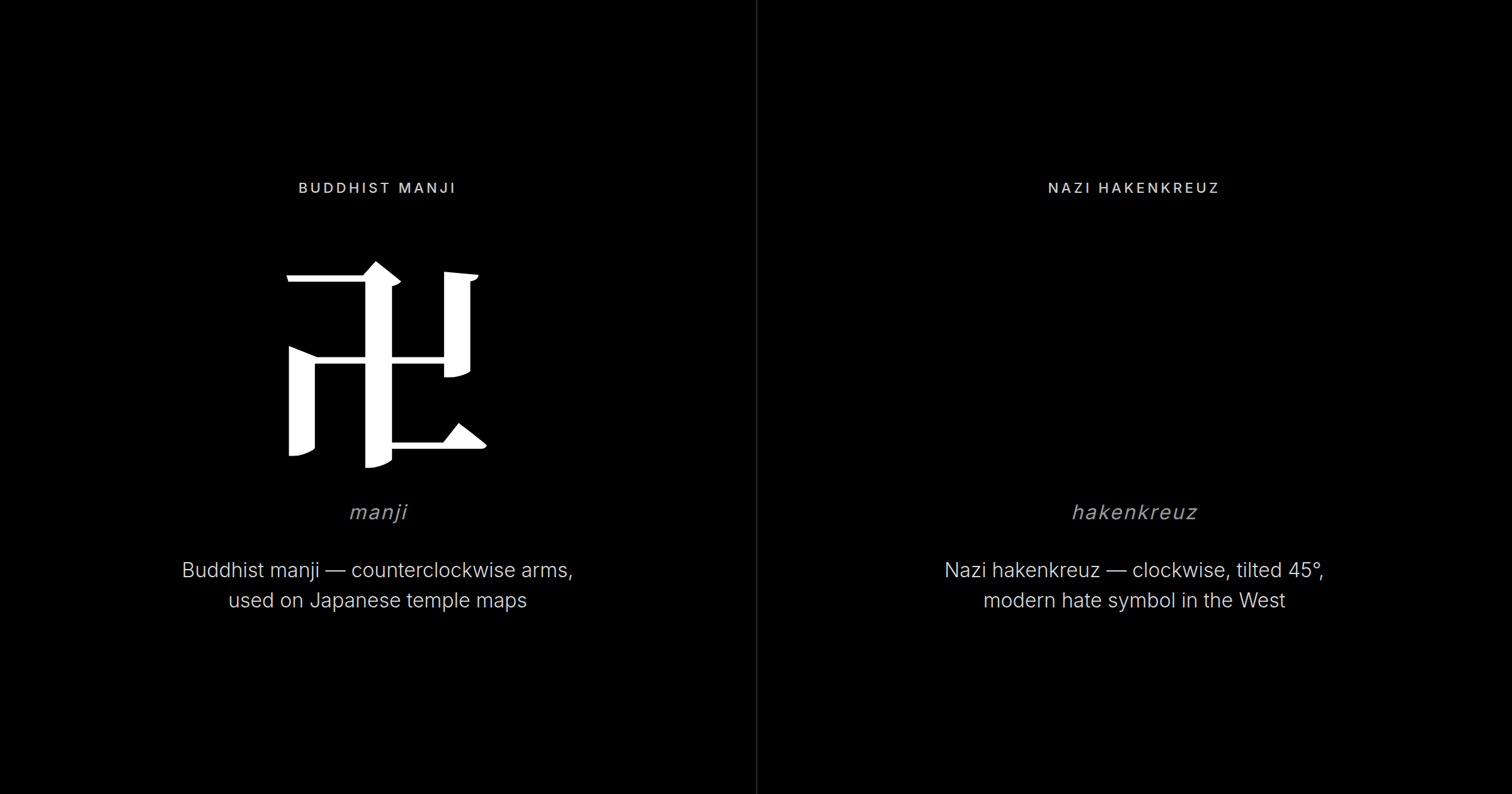
卍 (manji — the Buddhist svastika; appears on Japanese maps, temple decorations, and traditional textiles as a marker of auspiciousness and divine protection)
卐 (hakenkreuz — the Nazi swastika; clockwise rotation and 45-degree tilt distinguish it from the manji in reference images, but that distinction collapses under the emotional weight of Western viewers who simply see "that shape")
The two symbols differ in orientation. The Buddhist manji 卍 has arms that extend in a counterclockwise direction. The Nazi swastika 卐 rotates clockwise and is typically displayed at 45 degrees. In a calm, side-by-side reference comparison, the difference is visible. On someone's skin, seen at a glance on a crowded train or across a restaurant, it is not visible in any practically meaningful way. A viewer already associating the shape with hate will not stop to measure arm angles.
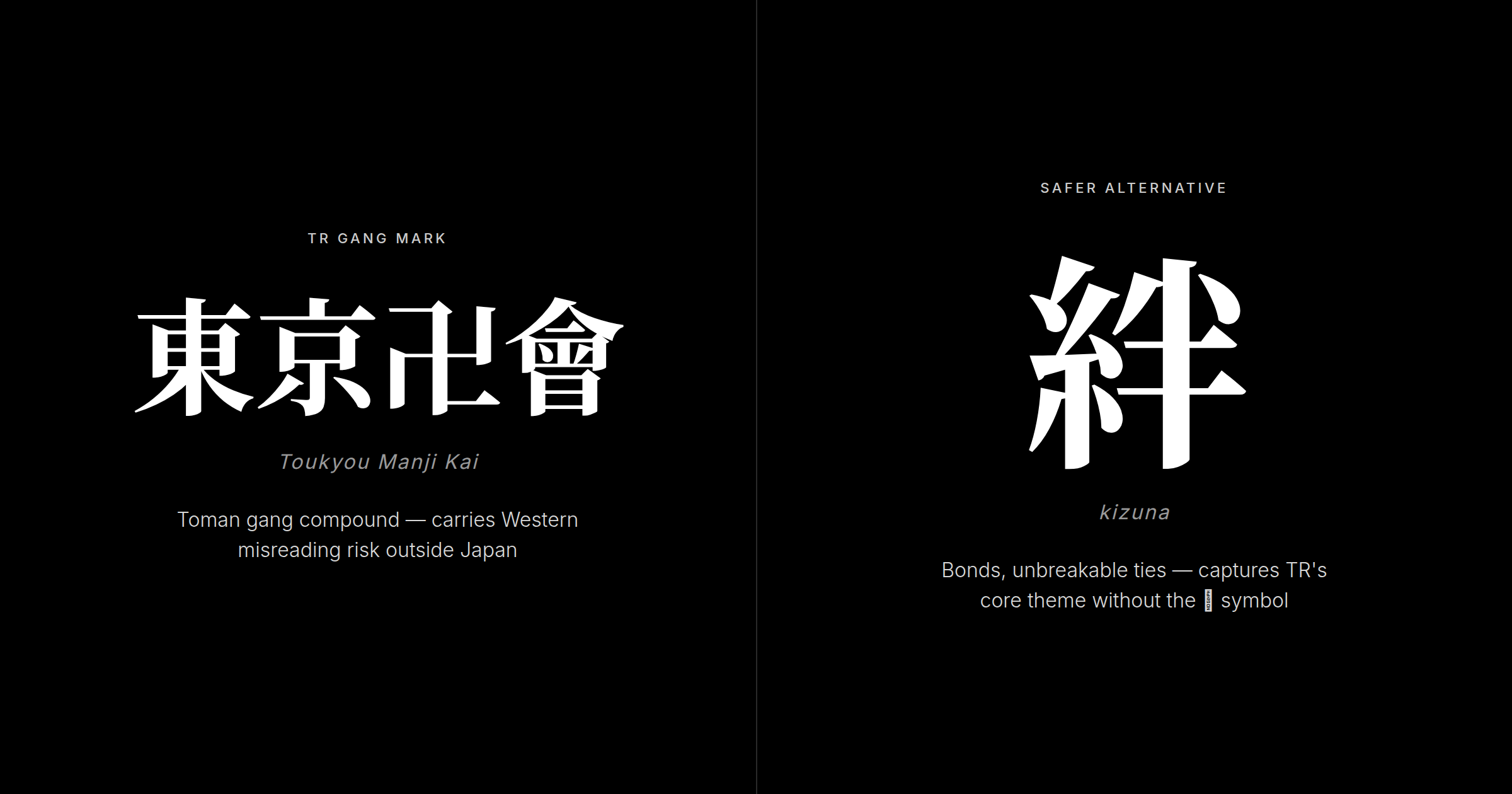
The Tokyo Revengers compound 東京卍會 (Toukyou Manji Kai — Tokyo Manji Gang) breaks down as: 東京 (Toukyou — Tokyo, the city), 卍 (manji — the symbol discussed above), and 會 (kai — assembly, association, group; an older character form of 会, both meaning "meeting" or "organization"). The full compound is an in-universe gang name with no real-world criminal meaning. In Japan, it reads as a stylized fandom reference and nothing else.
So What Happens When You Put This on Your Skin?
In Japan, nothing alarming. A manji tattoo in Tokyo reads as a Buddhist or cultural reference, a fandom marker, or an unusual decorative choice — normal, even interesting. Outside Japan, the calculus shifts entirely, and it shifts fast.
Native Verdict
A Tokyo native seeing 卍 on someone's skin reads it as a Buddhist symbol or an anime fan's tribute, and moves on. That same symbol on the same skin, in a Western country, will draw stares, confrontations, and assumptions that are genuinely dangerous to the wearer's social standing.
Here is the honest Tokyo perspective: we grew up with 卍 on the maps we used to find temples. We text it to friends as a joke intensifier. We watched Tokyo Revengers when it aired, uncensored, and thought the Toman symbol looked cool — because it does. In Japan, there is no weight attached to that shape beyond its historical and subcultural meaning.
We are also not naive about the Western context. Many of us work with international colleagues, watch Western media, and understand exactly why the symbol was blurred out of the Crunchyroll version of the anime. Japanese producers made that call before international distribution because they understood the reception. That is not an overreaction — it is accurate cultural calibration.
The verdict is not "don't get this tattoo because it's wrong." The verdict is "don't get this tattoo in a Western country unless you are genuinely prepared for the conversation you will have to have every time someone sees it." That conversation does not go smoothly. Explaining that your 卍 is Buddhist and not Nazi is a burden that falls entirely on you, repeatedly, with strangers who are already alarmed. The rotation angle will not save you. The anime reference will not save you. The historical footnote will not save you in the moment.
If you live in Japan, or plan to, this calculus is different. The tattoo has meaning here, it reads correctly here, and the social friction is essentially zero. But for a Westerner living in a Western city: this is a tattoo that requires more social resilience than most people are prepared for. The Crunchyroll censorship without explanation made the symbol more mysterious — and more sought after — while providing the least information to people most likely to get it wrong.
Better Alternatives for Tokyo Revengers Fans
If the 卍 feels too fraught but the show matters to you, there are kanji alternatives that carry the same thematic weight without the geographic hazard.
絆 (kizuna — bonds, the unbreakable ties between people; used in everything from post-earthquake recovery campaigns to team sports locker rooms to friendship speeches)
This is arguably the core theme of Tokyo Revengers — Takemichi's entire arc is about protecting the people he loves. 絆 captures that without any ambiguity. It is one of the most emotionally resonant single-character kanji in the Japanese language, consistently ranking in top-ten "kanji of the year" selections and appearing in every possible register from formal to casual.
Compared to the 東京卍會 gang mark, 絆 carries the same emotional weight of the story's found-family theme without the geographic complications the 卍 symbol introduces.
仁義 (jingi — honor, loyalty, the code of conduct between people; used in formal discourse about ethics, in yakuza films as the language of gang codes, and in everyday expressions of genuine respect)
仁義 (jingi) is composed of 仁 (jin — benevolence, humaneness; the Confucian virtue of care for others) and 義 (gi — righteousness, duty, loyalty). Together they describe the ethical code that runs beneath the gang's violence — the reason Mikey commands loyalty and the reason the story's moral stakes feel real.
万次郎 (Manjirou — Mikey's given name, origin of his nickname)
A character tribute that sidesteps the 卍 entirely while remaining unmistakably Toman-coded to any fan. 万 (man — ten thousand, abundance), 次 (ji — next, order), 郎 (rou — traditional suffix for male given names). The three characters render beautifully as calligraphy — recognizable to fans, neutral enough to everyone else that it reads simply as a Japanese name.
龍 (ryuu — dragon; appears in traditional Japanese art, tattoo culture, and family crests; the design on Mikey's gang jacket)
The dragon imagery associated with Toman carries zero Western political baggage and is immediately readable as a classic Japanese tattoo element. 龍 sits in a long tradition of Japanese tattoo art — associated with strength, protection, and transformative power — and reads correctly to both Japanese and Western viewers without explanation.
See Choosing Meaningful Kanji for Tattoos for a deeper look at how to find the single character that best fits your personal meaning, and Jujutsu Kaisen Kanji Tattoo for how this same research process works for another major anime franchise.
FAQ
What is the manji symbol in Tokyo Revengers?
The manji (卍) is an ancient Buddhist, Hindu, and Jain symbol representing auspiciousness and divine protection. Tokyo Revengers uses it in the name of the central gang, the Tokyo Manji Gang (東京卍會, Toman). In Japan it is a completely ordinary religious and cultural symbol seen on maps and temple signage. The international anime adaptation censored it due to its resemblance to the Nazi swastika in Western eyes.
Should I get a Tokyo Revengers manji tattoo?
This is the central question the whole article addresses. In Japan: yes, it reads as a cultural reference with no negative connotation. In Western countries: the manji will be read by most viewers as a Nazi swastika regardless of your intent or the symbol's orientation. The burden of explaining the context falls on you every time someone sees it. Unless you live in Japan or a community where the Buddhist history is widely understood, the social risk is significant and ongoing.
Isn't the manji just the Buddhist swastika? Why is it a problem?
Yes — the manji is the original Buddhist symbol that the Nazi regime later appropriated. The problem is not the symbol's true history but the Western emotional response to its shape. Most people in Western countries will not perceive the orientation difference between 卍 and 卐 at a glance. They see the shape and react to the Nazi association. The historical injustice is real, but knowing about it does not protect you from the social friction the tattoo will generate.
But it's rotated differently than the Nazi symbol, right? Can't I just explain that?
The rotation difference exists: the Buddhist manji 卍 typically has counterclockwise arms, while the Nazi hakenkreuz 卐 rotates clockwise at a 45-degree tilt. In a calm, side-by-side comparison, this is visible. On someone's skin, seen at a glance, it is not meaningfully distinct to viewers who already associate the shape with hate. You will have to explain your tattoo repeatedly, to strangers who are already alarmed, and the explanation often does not defuse the situation quickly.
If Tokyo Revengers uses the manji, doesn't that make it okay to tattoo?
The manga used the symbol because it is historically and culturally appropriate in Japan, where it has no political baggage. The anime's censorship for Western distribution proves the opposite point: producers recognized that the symbol carries a different weight internationally and chose to remove it rather than explain it to every viewer. The fact that it appears in the source material does not change the geographic risk. What is normal in Japan remains socially dangerous in Western countries.
Why did Crunchyroll censor the manji in Tokyo Revengers?
The censorship was applied by Japanese distributors preparing the international release, not by Crunchyroll independently. Producers blurred or blacked out the symbol throughout the international version. The decision reflects cultural calibration: explaining the Buddhist history to every Western viewer was not feasible, so removal was chosen. This same logic applies to your tattoo decision.
What should I tattoo instead if I want a Tokyo Revengers design?
Strong alternatives include: 絆 (kizuna — bonds/unbreakable ties, the thematic core of the story), 仁義 (jingi — honor and loyalty, the gang's code), 万次郎 (Manjirou — Mikey's full name as kanji calligraphy), or the dragon imagery (龍, ryuu) associated with Toman's visual identity. Each of these carries the show's spirit without the geographic hazard of the 卍 symbol. All require proper verification before inking — see our kanji tattoo verification guide.
Can I get a manji tattoo and have it removed or covered later if it becomes a problem?
Removal is possible but expensive, painful, and sometimes incomplete — laser removal of a symmetrical black-ink symbol takes multiple sessions and often leaves ghosting. Coverup is difficult because the manji's geometric symmetry is hard to incorporate into a design that genuinely conceals it. If you are already uncertain enough to consider removal as a backup plan, that uncertainty is worth taking seriously before the first appointment rather than after.
Does tattoo placement matter for a manji tattoo?
Yes, significantly. A manji on your upper arm or back can be concealed in professional or formal Western settings while remaining visible in casual contexts or in Japan. A manji on your neck, hand, or forearm is visible in almost every social situation and carries proportionally higher friction in the West. Placement does not eliminate the issue, but it affects how often you face it. Think honestly about your life: the climate you work in, the country you plan to be in long-term, and the social circles that matter to you.
What does 卍 mean in Japanese slang?
Outside its religious register, 卍 appears in Japanese youth texting and social media as an intensity marker — something like "extreme" or "wild." This casual register coexists comfortably with the symbol's religious meaning in Japan, where neither usage carries political weight.
If you are set on getting this tattoo, have a Tokyo native review the design first. Kanji Ink Oracle provides a native Japanese assessment of your symbol, its register, and whether the design reads correctly. For a decision this permanent, verification is the cheapest part of the process.
Also worth reading before you decide: Is My Kanji Tattoo Wrong? for how to catch problems before they are inked, and Wrong Kanji Tattoo Removal and Cover-Up for what happens when a tattoo turns out to carry meanings its wearer did not intend.