How to Choose Meaningful Kanji for Tattoos: Native Framework
Choosing meaningful kanji for tattoos: a Tokyo-native framework — research, compound checks, register, and verification before you commit to ink.
Choosing meaningful kanji for tattoos sounds like a research problem — and it is — but the hard part is not finding a character that looks good. You have a concept in mind (strength, love, resilience, family) and want it on your skin permanently. The hard part is finding one that means what you actually intend, carries the right cultural weight, and holds up under the scrutiny of the people whose language you are borrowing. This guide gives you a systematic framework for doing exactly that.
The Stakes of Getting It Wrong
Ariana Grande's widely reported 2019 tattoo is the canonical cautionary tale. Intending to write "7 rings" (the title of her song), she ended up with something a Japanese speaker would read as "shichirin" — a small charcoal grill used for barbecuing. The kanji were individually correct; the combination without a connecting particle produced an entirely different meaning. A single verification conversation with a native speaker would have caught it before the needle touched skin. For a fuller breakdown of the Grande case — and four other high-profile mistakes, each diagnosing a distinct error type — see famous celebrity kanji tattoo fails.
Patterns from KIO's verification work consistently show that the most common failures are confident choices made with incomplete information — the client "knew" the meaning, had checked Google Translate, had shown it to a friend who "studied Japanese for two years," and yet the result was wrong or embarrassing. Japanese readers who notice rarely say anything — that would be impolite — but the involuntary pause exists. Getting it right is about respecting the language and honouring the meaning. For more examples of how these errors happen, see our guide to kanji tattoos that mean something else.
Step 1: Define What "Meaningful" Actually Means to You
Before you search a single character, ask: what do you want this tattoo to do for you in twenty years?
A kanji chosen for visual appeal is a different commitment from one that captures something true about who you are. Aesthetics fade; meaning deepens. Work through these questions first:
- What concept am I trying to express — a value, a relationship, a state of mind, a moment?
- Is this concept something I can articulate clearly in English? If not, the kanji search will be vague.
- Will this meaning resonate with me in five, ten, twenty years, or does it belong to a specific chapter of my life that may close?
- Am I choosing this kanji for myself, or because I want others to see it a certain way?
The answers shape everything that follows. Someone choosing a kanji because they survived a difficult illness is choosing from a different place than someone who liked how it looked online. The intention is different — and intention is exactly what a Tokyo native will sense when they ask about your tattoo.
Step 2: Understand That Kanji Have Layers
Japanese dictionaries will give you a definition. What they will not give you is the feel of a word — how it lands, who uses it, in what contexts it appears.
Consider two kanji that both translate roughly as "strength":
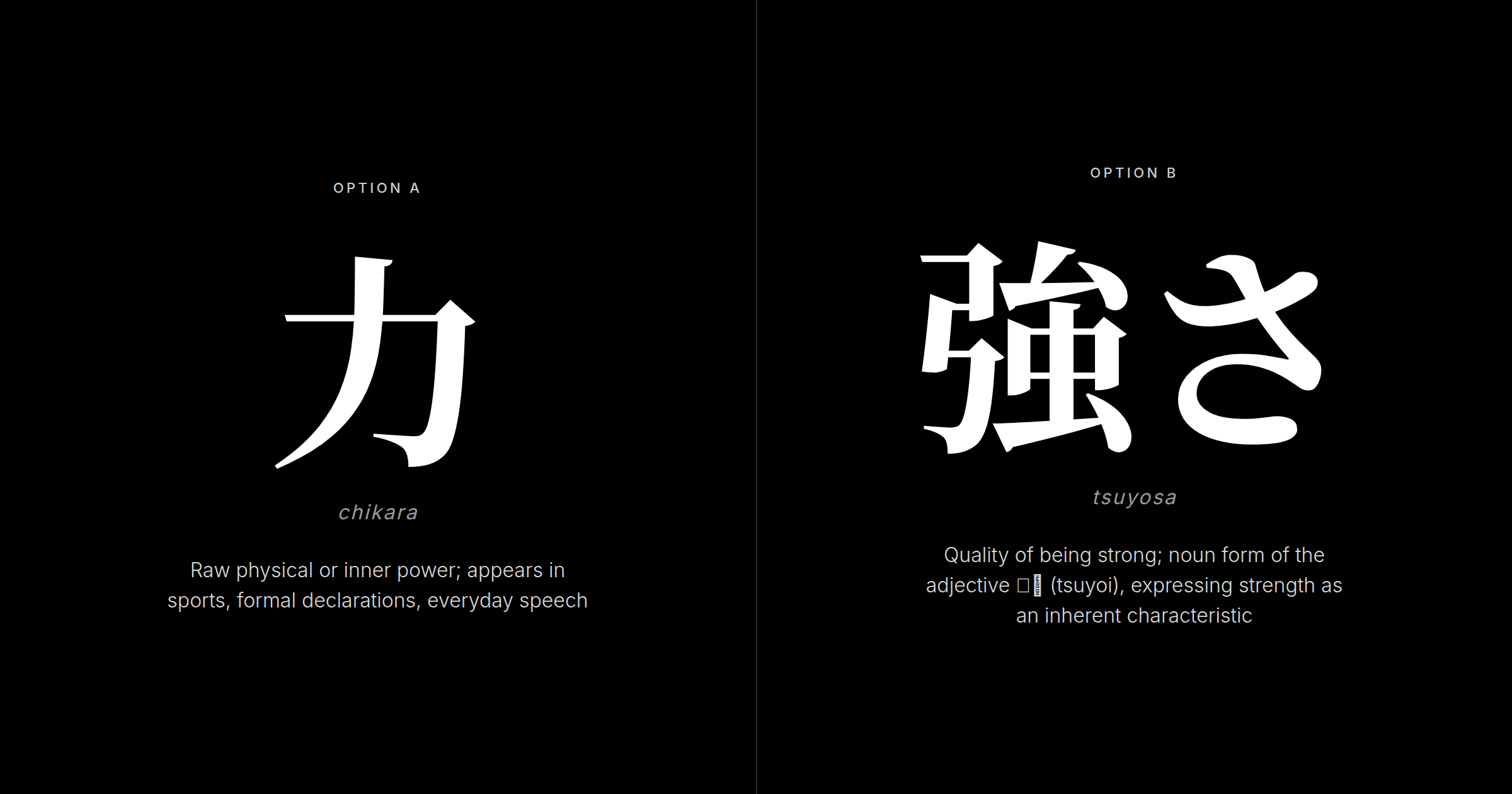
力 (chikara — power, strength; the energy behind physical effort, emotional resolve, and institutional authority — you see it in sports journalism, formal speeches, and everyday motivational use) is raw and immediate. It refers to the force or capacity itself.
強さ (tsuyosa — strength as a quality; the state of being strong rather than the force itself) describes a trait over time. Note: this comparison is conceptual — 強さ in isolation is rarely chosen as a standalone tattoo by native designers, who would more often use 力 alone or a compound that anchors the meaning. The two-form comparison is here so you understand the register difference, not as a recommendation to ink 強さ on its own.
Both are correct Japanese. But they are not interchangeable, and a dictionary alone will not tell you which one matches your intent. This principle applies across all kanji choices: how anime creators like Arakawa differentiate between registers — choosing 黄泉 over 冥界 for genuine cultural weight — shows how register carries meaning beyond definitions. The same layering appears in choosing kanji for SPY×FAMILY, where different characters (絆, 偽装, 家族) express entirely different readings of the same story — which layer resonates with you determines which kanji serves your values best.
Most kanji carry two systems of pronunciation: kun'yomi (native Japanese) and on'yomi (Sino-Japanese). 力 reads as "chikara" in kun'yomi and "ryoku" or "riki" in on'yomi. Alone on the skin, "chikara" is the reading most Japanese people would reach for — but context and combinations change this. This is why understanding why Google Translate fails for kanji matters: automated tools handle definitions reasonably but handle register and nuance almost not at all. AI-based tools add an additional layer of risk beyond translation errors — they can invent entirely new kanji characters that don't exist.
Step 3: Verify with Native Speakers — The Right Way
Verification is not "ask a Japanese friend if this looks right." That is one data point, coloured by the friend's desire to be helpful. Genuine verification is a structured conversation.
Ask these questions — not just "does this mean strength?":
- What is the first thing that comes to mind when you see this kanji in isolation?
- In what contexts would you use this word in daily life?
- Is there any negative connotation or specific register (medical, archaic, formal)?
- If you were choosing a kanji for this concept, would you pick this one?
- Are there any combinations I should avoid?
The multi-confirmation principle: one opinion is a start. Three consistent opinions from people with different backgrounds is a reasonable threshold. If you get diverging answers, dig deeper — do not average them.
Red flags: hesitation followed by "well, technically..."; an unexplained alternative suggestion; the phrase "foreigners usually use this one." Each signals that more conversation is needed.
For a full walkthrough, our step-by-step kanji tattoo verification guide covers each stage in detail.
Step 4: Consider Your Kanji in Combination
If your tattoo will contain more than one character, the verification work multiplies. Pairs and compounds in Japanese follow rules that are not visible to non-readers.
The compound trap is one of the most consequential risks in kanji tattoo design. Consider a reader who wants the concept "free spirit" and strings together two individually reasonable characters. The result might read to a native speaker as a medical term, a bureaucratic phrase, or — as in the 愛人 (aijin) case below — something with an entirely different social meaning than intended.
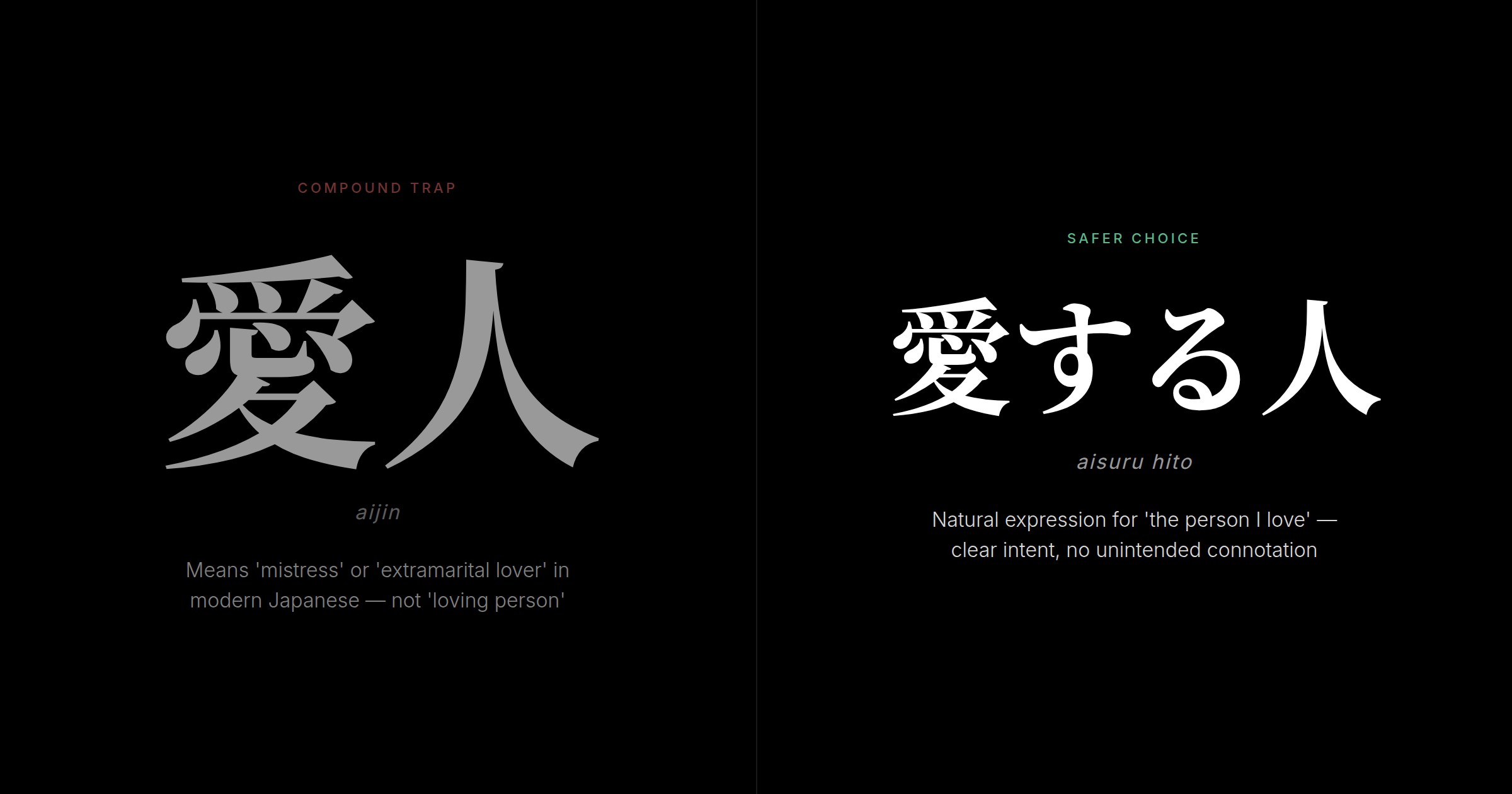
愛人 (aijin — in modern Japanese, this compound means "mistress" or "extramarital lover," not "loving person" as a Western reader might infer from its component characters) is the classic example. The individual kanji — 愛 (ai, love) and 人 (hito/jin, person) — are perfectly innocent. Together, they carry a very specific and socially loaded meaning. The image above contrasts the compound with the verb-phrase construction 愛する人 (aisuru hito — "the person I love"), which native readers parse as expressive prose rather than a fixed noun; for most tattoos, however, the standalone 愛 (ai) is the cleaner native-recommended choice. Anime creators who research their choices carefully — see the Demon Slayer character name breakdown for how Tanjiro's name 炭治郎 encodes identity through deliberate kanji selection — demonstrate the kind of meaningful character work that deepens over time.
Ordering matters too. Tattoo design often breaks standard reading-direction conventions for aesthetic reasons. A native reviewer should confirm that the arrangement your artist intends actually produces the meaning you want.
Ask your reviewer: does this pair form a real compound, and if so, what does the compound mean? Does reading these characters in sequence produce any unintended phrase?
Step 5: Work with a Tattoo Artist Who Takes Kanji Seriously
Not every tattoo artist who offers kanji designs has taken the time to understand kanji. This is not a criticism — it is a fact about specialisation. When interviewing an artist for a kanji tattoo, ask directly:
- Have you worked with native Japanese speakers on kanji designs before?
- Do you research each design individually, or do you work from reference sheets?
- If I bring you a kanji that has been verified by native speakers, will you render it from that verified source exactly rather than from a reference image?
Font selection and stroke rendering are not trivial. Kanji have prescribed stroke order and structure; a missing or altered stroke can change a character's meaning entirely. Understanding stroke order helps both you and your artist ensure the character is rendered with proper proportional balance and structural integrity. Ask whether your artist is willing to receive feedback from your native reviewer on the stencil before you commit. An artist who resists this step is telling you something important about their process. For a comprehensive guide on identifying and vetting genuine kanji specialists, see how to find a Japanese tattoo artist who won't mess up your kanji.
What Not to Do
The mistakes that account for most verification failures:
Using automated translation as your primary source. Google Translate and DeepL produce definitions, not cultural context or register. Our article on why Google Translate fails for kanji tattoos explains the specific failure modes in detail.
Choosing from other people's tattoo photos. This replicates any error the original wearer made. Even if their kanji was correct, it may not match your intended meaning.
Crowdsourcing on general forums. A well-meaning response from someone who studied Japanese casually is not verification from a native speaker who grew up with the language.
Stopping at one confirmation. One native speaker is a start, not a conclusion.
Skipping verification because "I'm pretty sure." The clients who come to KIO after a bad experience are almost universally certain they had done enough research before the appointment.
Native Verdict: What a Tokyo Native Actually Thinks
When a Japanese person raised in Tokyo sees a foreigner's kanji tattoo, the initial reaction is not a "cool" reflex. It is a rapid, involuntary assessment: does this person know what they are wearing?
When the kanji is accurate and the wearer can explain it, there is genuine quiet respect. When the kanji is wrong, the reaction is closer to sympathy — the feeling of watching someone confidently mispronounce a foreign word in public. You do not point it out. But you do not forget it either.
Japanese culture places high value on the relationship between what you say and what you mean. Kanji carry accumulated weight — they are not decorative marks. If your choice is accurate, you will be asked about it with genuine interest. If not, the conversation simply will not happen.
To understand the full range of how Tokyo natives react when they encounter your kanji tattoo—including the five main response patterns from quiet respect to gentle amusement to genuine discomfort—see what Japanese people actually think when they see your kanji tattoo.
On cultural appropriateness, our detailed article on kanji tattoo cultural appropriation covers the nuances — the short answer from Tokyo is that appropriateness comes from accuracy and intentionality, not origin.
Real-World Examples
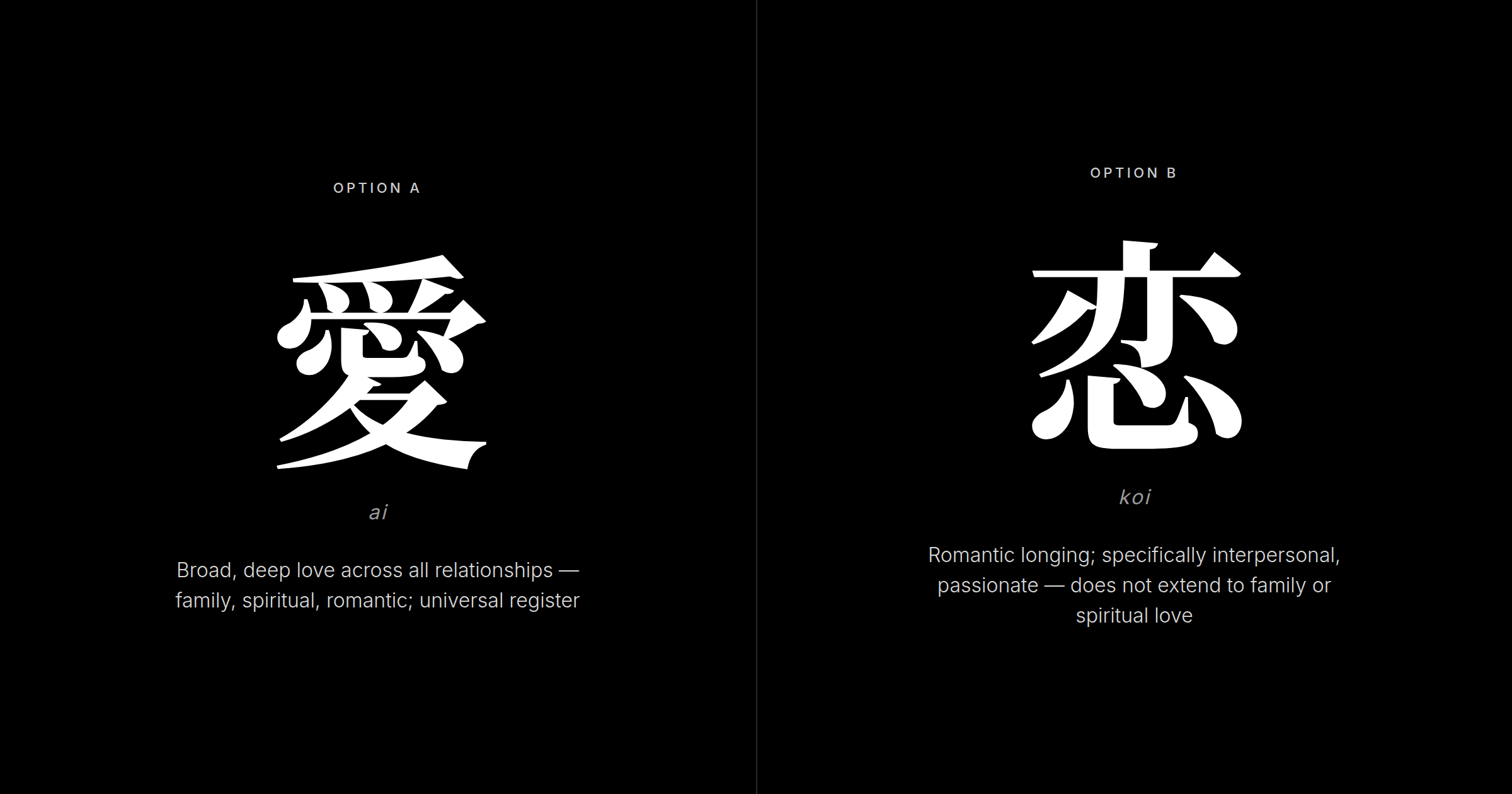
The 愛 case study. Consider a reader wanting to tattoo 愛 (ai — love; broad in register, covering family, romantic, spiritual, and platonic affection — it appears in popular song and formal literature alike). It is one of the most commonly chosen kanji and one of the most misunderstood.
What it sits beside matters. 恋 (koi — romantic longing; the pull of passionate feeling between people — it does not extend to family or spiritual contexts) reads very differently. A Japanese reader seeing 愛 reads a statement about love as a universal value; seeing 恋, something more charged and personal.
Neither is wrong. Knowing which one you mean is exactly what verification surfaces.
The compound verification case. Imagine someone wanting to express resilience. They find 不屈 (fukutsu — indomitable; unyielding under pressure — appears in sports journalism and political writing, not primarily historical or martial contexts) and feel it fits. Accurate. But a native reviewer might surface 忍耐 (nintai — patient endurance; resilience sustained over time, more internal than dramatic) as an alternative. These are not errors — they are distinctions verification is designed to surface.
Your Pre-Tattoo Checklist
Before booking your appointment, work through each of these:
Meaning and intent
- I can explain in clear English what concept this kanji expresses
- I understand why this specific kanji, not an alternative, captures that concept
- I have considered whether this meaning will resonate in ten or twenty years
Research and verification
- I have confirmed the meaning with at least two native Japanese speakers
- I have asked about register, connotation, and context — not just "does this mean X?"
- I have asked about any combinations I plan to use
Design and rendering
- My artist is working from a verified source, not a reference image
- A native speaker has reviewed the stencil before the appointment
Documentation
- I have saved the verification conversations in writing
- I can explain the meaning, reading, and cultural context when asked
If any item is unchecked, that is the next step — not the appointment.
For concrete examples of single kanji that pass this framework — verified by Tokyo natives and ready to research further — see the 10 best single kanji for tattoos.
Verify your kanji at Kanji Ink Oracle — Tokyo-based reviewers return an assessment within 24 hours and will walk through the meaning, register, and any concerns with your specific choice.
Frequently Asked Questions
Is it okay to get a kanji tattoo if I don't speak Japanese?
Yes, provided you complete the verification process first. The language barrier is not the obstacle — skipping verification is. You do not need to read Japanese. You need to understand the meaning, cultural context, and register of the kanji you have chosen — all of which are accessible through careful consultation with native speakers.
How do I know if my chosen kanji is culturally appropriate?
Appropriateness depends on accuracy, intentionality, and context — not on whether you are Japanese. Some kanji carry connotations foreigners do not recognise: associations with illness, misfortune, or socially specific situations. When consulting a native speaker, ask where the character typically appears in Japanese life, whether it has any sensitivities, and whether your intended meaning matches actual usage. Our detailed guide to kanji tattoo cultural appropriation covers this in depth.
Should I get a kanji tattoo with Japanese characters I can't read?
You do not need to read the characters — but you need to deeply understand what you are wearing. Build genuine comprehension through verification: what the kanji means, how it is read, in what contexts it appears, and what it says to someone who can read it. Prepare an explanation you can give when asked. A person who cannot read the kanji but can explain its meaning and cultural context is far better positioned than someone who chose it casually.
Can I use Google Translate to check my kanji choice?
Google Translate is a starting point, not a destination. It will return a definition but miss nuance, register, and cultural weight. The canonical problem: automated tools treat all translations as equivalent — 愛 and 恋 both come back as "love," with no indication of the difference. Always follow automated translation with human native consultation. Our companion piece on why Google Translate fails for kanji tattoos explains the specific failure points.
What is the difference between 愛 (love) and 恋 (love) for a tattoo?
Both translate as "love" in English, but they describe different experiences. 愛 (ai) is broad — family, spiritual, long-term romantic, and universal love as a value. 恋 (koi) is specific — the pull of romantic longing, particularly in its early or passionate phase. It does not extend to family or spiritual contexts. If you want love as a principle, 愛 is the natural choice. If you want romantic love specifically, 恋 is worth discussing with a native speaker before committing.
How many native speakers should I consult before getting the tattoo?
A minimum of two to three, from different backgrounds: a professional translator, someone who grew up in Japan, and ideally someone without a stake in telling you what you want to hear. Three consistent opinions from independent native speakers is a solid threshold. If anyone hesitates, suggests an alternative without explaining why, or qualifies their answer with "well, technically..." — dig deeper before you proceed.
What if I want a kanji tattoo but I am worried I will regret it?
The verification framework is the antidote to regret. Most regret comes from rushed choices and incomplete research. Going through the five-step process — defining your intent, understanding the layers, verifying with native speakers, checking combinations, and working with a careful artist — builds intentionality that does not fade. If you have completed the verification process and are still uncertain, that is information: pause and return to Step 1. Hesitation after thorough verification means the choice has not fully settled, not that the process has failed.