Yomi no Tsugai: Arakawa's 2026 Anime Explained
What does Yomi no Tsugai anime title mean? Explore the Shinto mythology of 黄泉 (yomi) and the pairing concept of ツガイ (tsugai), explained by Tokyo natives.
Spring 2026 brought one of the most anticipated anime premieres in years: 黄泉のツガイ, known in English as Daemons of the Shadow Realm. For Western fans, the excitement centers on the creator — Hiromu Arakawa, the mangaka behind Fullmetal Alchemist, returning with a new supernatural epic. But for Japanese audiences, the anticipation runs deeper and is rooted in something the English title only partially captures: the weight of two specific Japanese words that carry centuries of mythological and cultural resonance.
What Is Yomi no Tsugai?
Yomi no Tsugai is a two-cour, 24-episode anime series that premiered on April 4, 2026, simultaneously on Crunchyroll worldwide and on Japanese broadcast networks Tokyo MX and BS11. It is produced by Bones Film (a studio under the Bones banner; Bones made the acclaimed Fullmetal Alchemist: Brotherhood) and directed by Masahiro Andou, with series composition by Noboru Takagi and music by Kenichiro Suehiro.
The story follows twin siblings, Yuru and Asa, who were born "between day and night" — Yuru at dusk and Asa at dawn — and separated shortly after birth. Yuru grows up in a premodern, isolated mountain village; Asa is raised in the contemporary world after their parents flee with her. When their village is attacked, the two reunite and discover they share an extraordinary ability: together, they can control all Daemons, the supernatural paired creatures that function as the story's central power system. Their journey to prevent a world-scale catastrophe forms the core of the series, layered with questions about their parents' fate and the prophecy that defined their birth.
The manga source has run in Monthly Shounen Gangan since December 2021 and is ongoing. Arakawa's involvement combined with Bones Film's production pedigree signals a sustained narrative commitment — not a promotional adaptation designed to push manga sales.
The Mythology Behind 黄泉 (Yomi)
To understand why 黄泉のツガイ lands differently for Japanese audiences, you need to understand what 黄泉 (yomi — the realm of the dead in Shinto mythology) actually means at a cultural level.
黄泉 is not a generic fantasy word for "underworld." It is the specific land of the dead described in the 古事記 (Kojiki — Japan's oldest extant chronicle, compiled in 712 CE), the foundational mythological text of Shinto tradition. In the Kojiki account, the creator deity 伊邪那美 (Izanami — "the female who invites") dies and descends to Yomi. Her husband 伊邪那岐 (Izanagi — "the male who invites") follows; when he lights a torch and sees her decomposed form, she rages at his violation. He flees; she pursues. He escapes, seals the entrance, and the two exchange a fateful promise: she will kill a thousand people each day, and he will ensure a thousand and five hundred births. This exchange is the mythological root of death and life in Shinto cosmology.
For Japanese schoolchildren, this story is standard curriculum. It appears in Japanese-language textbooks, literature classes, and cultural education in a way roughly comparable to how Greek myth functions in Western education — except that Shinto mythology is tied to living religious tradition and national identity in ways Greek myth no longer is in modern Europe or America. When a title opens with 黄泉, Japanese audiences do not think "generic dark fantasy world." They think: that specific myth. That specific weight.
Compare this to the alternative that Arakawa could have chosen:
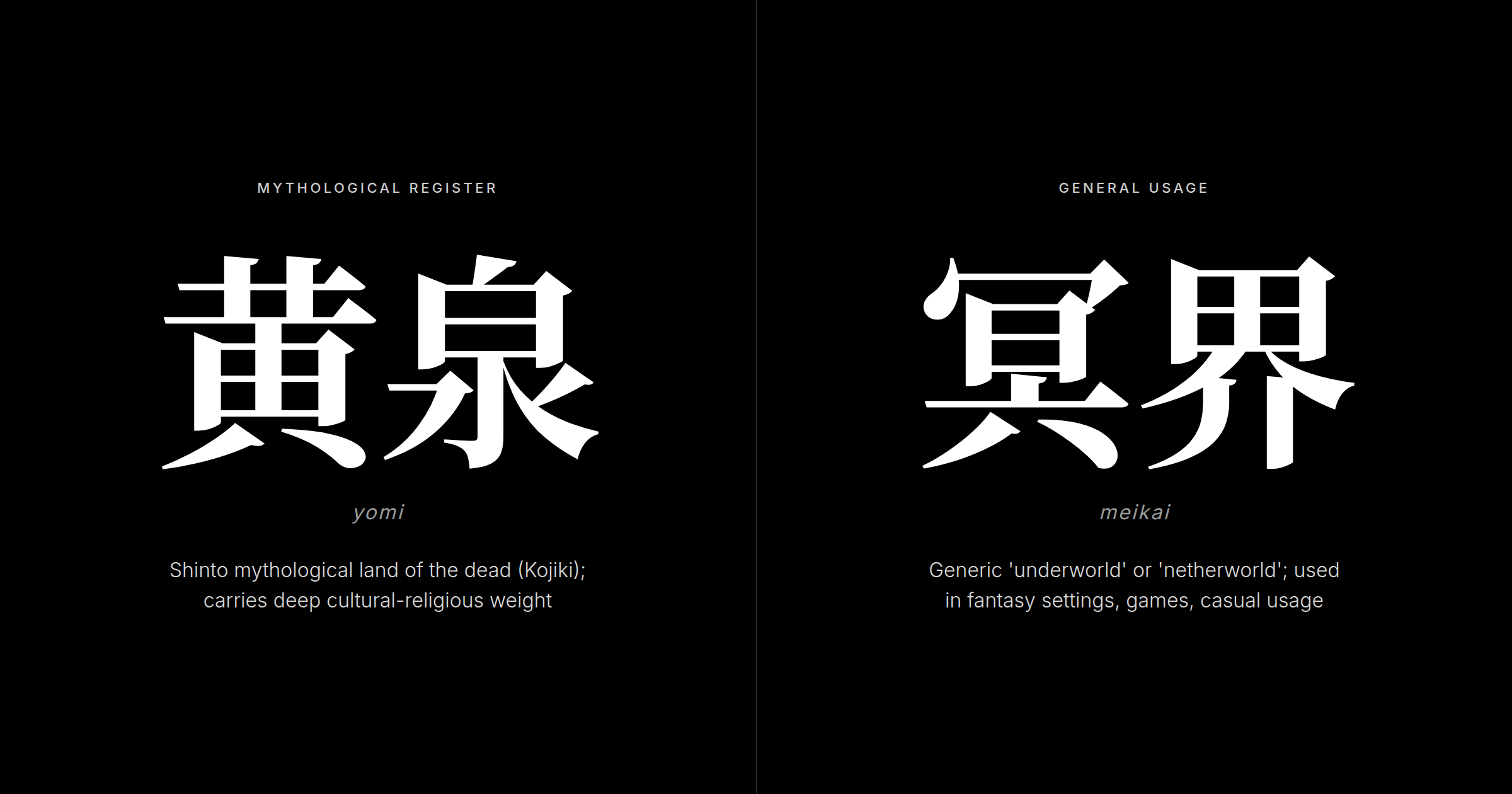
冥界 (meikai — the netherworld or generic underworld) is the term you see in video games, light novels, and mainstream fantasy anime when a writer needs a word for "place of the dead." It is neutral, serviceable, and carries no particular mythological charge. 黄泉 is the opposite: specific, archaic, and inseparable from Izanami's story. Choosing 黄泉 for this title is a statement about the register Arakawa is working in. It announces that the supernatural world in this story is not borrowed from Western fantasy conventions or generic genre shorthand. It is rooted in Japanese cosmological tradition.
Understanding ツガイ: Pairs, Bonds, and the Word Behind the Concept
The second half of the title is ツガイ (tsugai — a matched pair, a mated couple, or two complementary things bound together). The word appears in katakana in the title rather than kanji, which itself carries meaning: katakana in Japanese can signal foreign origin, emphasis, or a kind of visual distinctiveness — here it gives ツガイ a slightly alien, supernatural quality that pure hiragana would not.
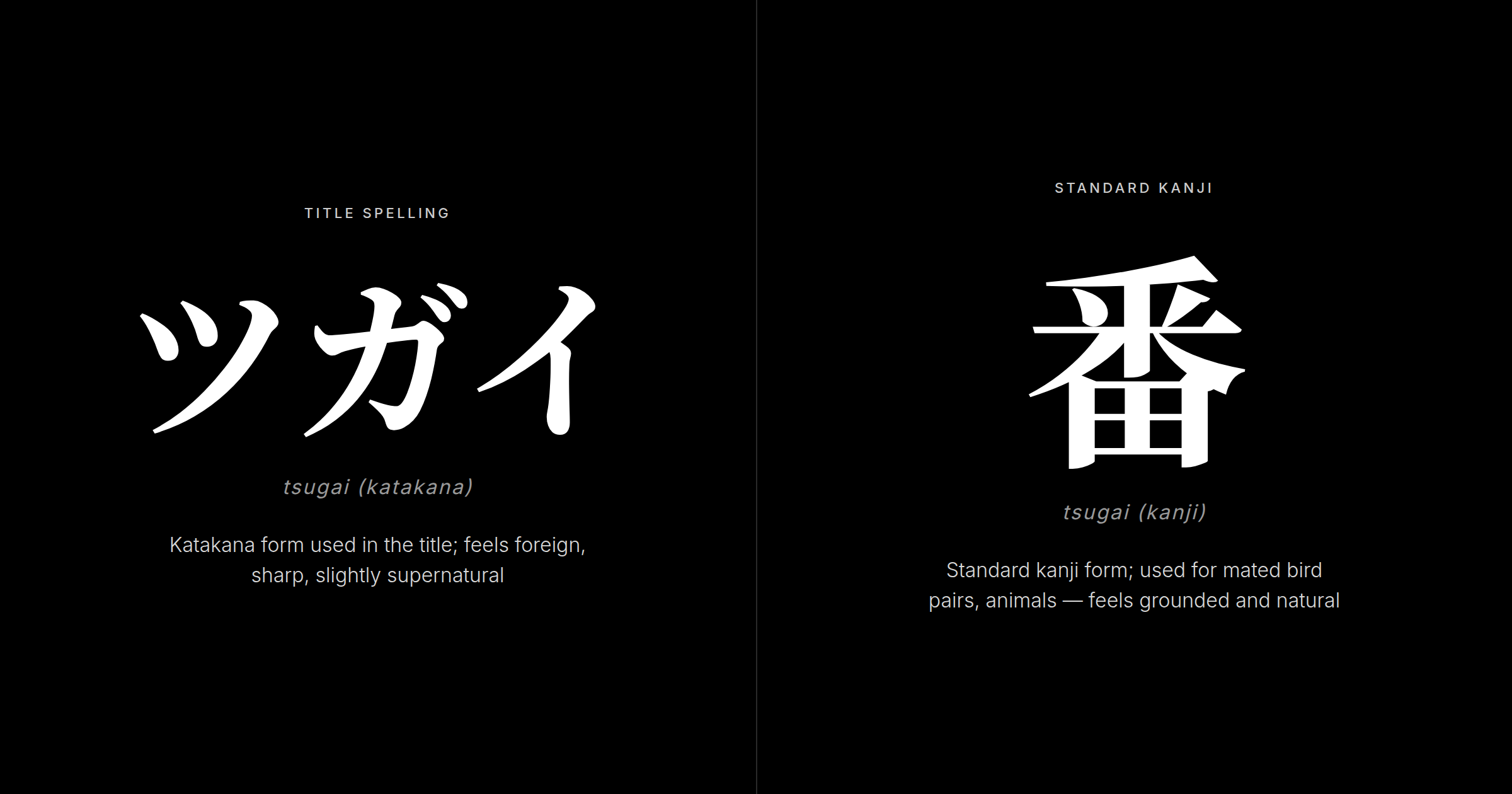
When written in kanji, the word becomes 番 (tsugai — a mated pair; most commonly applied to birds and animals that travel, nest, or hunt as a bonded unit, as in ツルの番, a pair of cranes). In dictionaries and field guides, 番 is the standard written form. The title's katakana choice is therefore a deliberate register signal — it removes the naturalistic, everyday quality and gives the word a slightly alien, supernatural edge.
In its most concrete usage, ツガイ describes mated bird pairs — a male-female pair that travels and nests together. A field guide might note that a pair of cranes (ツルのツガイ) appears each winter. The word carries this sense of natural complementary pairing: two things that belong together because they complete each other, not simply because they coexist. It implies interdependence and mutual function in a way that a simpler word like "pair" (ペア) does not.
In the context of Yomi no Tsugai, the term operates on multiple layers simultaneously. The Daemons that human wielders control come in pairs — each wielder controls a set of two supernatural creatures that function as a bonded unit. The twin protagonists, Yuru and Asa, are themselves a ツガイ: born of the same event (the space between day and night), they embody complementary forces (darkness and light, isolation and engagement, the premodern and the modern). The title therefore contains its own thematic architecture: it is not just a label for the story's creatures, but a statement about the story's deepest subject — what it means to be bound to another as a necessary counterpart.
It is not a coincidence that Arakawa chose this word. The aesthetics of paired, complementary forces run throughout Japanese visual art, literature, and religious thought. ツガイ signals to native readers precisely what the story's emotional core will be about.
The Twin Protagonists: Yuru and Asa
The character names reinforce the thematic layering. Yuru (ゆる) is the elder twin, born at night; Asa (朝 — asa, morning) is the younger, born at dawn. The name Asa means "morning" in Japanese, immediately placing her character in the day register. Yuru's name is less semantically loaded but its phonetic softness contrasts with the hard edges of Asa's kanji. The two control the story's central power system from opposite directions: Yuru commands paired Daemon warriors (Left and Right), while Asa wields "Break," a destructive ability that operates differently from the paired-creature model.
When they reunite, Yuru and Asa are not just two siblings: they are two different ways of inheriting the same mythological tradition — one shaped by premodern isolation, the other by modern disconnection from it.
The Daemons: Shikigami Tradition, Modernized
The Daemons of Yomi no Tsugai are not demons in the Western Christian sense — fallen angels, adversaries of divinity, symbols of moral corruption. The Japanese cultural framework closest to them is 式神 (shikigami — familiar spirits or supernatural beings bound to and controlled by a practitioner). In the Heian-period tradition of onmyoudou (陰陽道 — yin-yang divination practice), skilled practitioners called onmyouji were believed to bind and deploy shikigami for various purposes. The contemporary anime Onmyouji and the game Onmyoji have made this concept familiar to modern Japanese audiences, but its roots are in court ritual and esoteric practice from over a thousand years ago.
Arakawa's Daemons update this tradition: rather than a practitioner controlling one shikigami, each wielder controls a ツガイ — a bound pair — and the pairing is itself the source of power. The design choice is elegant. It ties the supernatural system to the title's central concept, ensures that the ツガイ framework is not merely a naming convention but a structural principle, and grounds the story's fantasy elements in a specifically Japanese spiritual tradition rather than generic fantasy taxonomy.
Arakawa's Track Record and Why This Matters
Hiromu Arakawa published Fullmetal Alchemist in Monthly Shounen Gangan from 2001 to 2010 — over 80 million copies worldwide; the Brotherhood adaptation remains one of the most praised anime ever made. Silver Spoon (manga 2011–2019, anime 2013–2014) demonstrated her range beyond fantasy. Yomi no Tsugai, produced by Bones Film (a studio under the Bones banner, which animated both FMA adaptations), is her return to high-concept supernatural narrative — and for many Western fans, their first Arakawa series to watch in real time.
Tokyo-Native Take: What Japanese Audiences Are Actually Watching
A Japanese viewer sitting down with 黄泉のツガイ experiences it with a double exposure that Western viewers do not fully share.
The first layer is the mythology. 黄泉 (yomi) is not a word Japanese viewers encounter and file under "interesting fantasy concept." It is a word they know from school, from folk tradition, from the ambient presence of Shinto mythology in everyday Japanese life. Izanami's story — her death, her transformation, Izanagi's grief and his horrified flight — is a foundational emotional narrative in Japanese culture. It carries the weight of something ancient and true. When Yomi no Tsugai invokes 黄泉, it is making a claim: this story is in conversation with that tradition. Whether it earns that claim is what Japanese reviewers are watching for.
The second layer is the precision of ツガイ. Native speakers recognize immediately that "pairing" here is not decorative but structural — the word carries the weight of natural complementarity, of two things that are incomplete without each other. Combined with 黄泉, the title reads to a native eye as something like: "the paired beings that emerge from where the dead go." It is dense, archaic in register, and thematically loaded in a way that "Daemons of the Shadow Realm" — while evocative — does not fully convey.
The third layer is Arakawa's reputation in Japan. She is not primarily known as an entertainment property; she is known as a writer who takes her source material seriously. Based on patterns consistently observed across similar myth-grounded anime that have performed well with Japanese audiences, this kind of cultural-linguistic precision in a title tends to signal that the creator intends to honor the tradition rather than merely borrow its aesthetics. Japanese fans are cautiously optimistic that Arakawa will continue to demonstrate that in Yomi no Tsugai — bringing contemporary narrative craft to mythology that deserves that level of respect.
FAQ
What does Yomi no Tsugai mean in English?
黄泉 (yomi) is the land of the dead from Japanese mythology, specifically the underworld described in the Kojiki (712 CE), where the creator deity Izanami descended after death. ツガイ (tsugai) means a matched pair or mated couple — two complementary things bound together. The official English title, Daemons of the Shadow Realm, captures some of this but loses both the specific Shinto mythological reference of 黄泉 and the pairing-as-theme implied by ツガイ. A more literal translation might be "Paired Beings of the Underworld," though even that understates the mythological weight of 黄泉 for Japanese audiences.
Is Yomi no Tsugai connected to Fullmetal Alchemist?
Not by plot — Yomi no Tsugai is an entirely new story with different characters, setting, and mythology. The connection is creative: both are by Hiromu Arakawa and produced by Bones Film. Think of it as Arakawa's next major work rather than a sequel or spinoff. If you loved FMA for its narrative depth, its willingness to take serious themes seriously, and its emotional character work, Yomi no Tsugai comes from the same creative sensibility — applied to Japanese Shinto mythology rather than European alchemical fantasy.
When does the anime air, and how many episodes are there?
Yomi no Tsugai premiered on April 4, 2026, on Crunchyroll worldwide with simultaneous English subtitles, and on Japanese networks Tokyo MX and BS11. It runs for two consecutive cours — 24 total episodes — broadcasting over approximately six months without a break between cours. This format gives the story substantial room to develop without the pacing problems of shorter adaptations.
What is the plot of Yomi no Tsugai?
Twin siblings Yuru and Asa are born between day and night, fulfilling a prophecy. They are separated at birth: Yuru grows up in an isolated premodern mountain village; Asa is raised in the contemporary world after their parents flee. When the village is attacked, they reunite and discover they can control all Daemons — supernatural paired creatures (ツガイ) that other wielders can only partially control. The story follows their journey to prevent world destruction, uncover their parents' history, and navigate both the supernatural world and the radical difference in the lives they have led.
What makes the Yomi no Tsugai anime different from other 2026 releases?
Three things stand out. First, Arakawa's involvement: her return to a high-concept supernatural series, coming off a legacy that includes one of the highest-rated anime series ever made. Second, the mythology grounding: the story draws on Shinto mythology (黄泉, Kojiki tradition) rather than generic fantasy conventions, giving it a cultural specificity that most contemporary anime lack. Third, production commitment: two cours (24 episodes) from Bones Film means this is designed to be a complete, sustained narrative, not a promotional adaptation.
Who are the main characters, and what are their powers?
Yuru, the elder twin, was born at night and grew up in the premodern village. He controls Left and Right — a pair of oni-like Daemon warriors. Asa, the younger twin, was born at dawn and was raised in the modern world. Her power is "Break," a destructive ability distinct from standard Daemon control. Supporting characters include Dera and Hana (warriors) and Jin (a member of the Kagemori clan). The core dynamic is Yuru and Asa's interdependence: alone, each is powerful but incomplete; as a ツガイ, they can control all Daemons.
What is a "Daemon" in Yomi no Tsugai?
The Daemons are supernatural beings that exist in pairs (ツガイ) and can be controlled by human wielders. They are not demons in the Western sense (fallen angels, embodiments of moral corruption). The closest Japanese cultural parallel is 式神 (shikigami — familiar spirits bound to and deployed by a practitioner), which has roots in Heian-period onmyoudou (yin-yang divination practice). Arakawa updates this tradition: instead of one practitioner and one shikigami, the system requires a bound pair — the ツガイ of the title.
Is there a manga? How far ahead is it?
Yes. The manga by Hiromu Arakawa has run in Monthly Shounen Gangan since December 2021 and is ongoing at the time of the anime's premiere. This means the anime is adapting an active story without a completed ending to spoil. The ongoing nature also means Arakawa is writing the story in real time alongside the adaptation, which may allow the anime to follow the manga's direction more closely than adaptations of older, completed works.
The linguistic precision of 黄泉のツガイ is exactly what KIO exists to explain. If the kanji in this series caught your eye — the weight of a single character, the way a compound can fold mythology into two strokes — our guides on untranslatable Japanese kanji and what makes kanji meaningful go deeper into the cultural and linguistic layers behind the characters you see on screen. And if you have ever wondered whether the anime kanji you love translates cleanly to other contexts, fake Japanese kanji in anime is a useful companion read. For another 2026 anime that foregrounds writing system choice as thematic architecture—Marriage Toxin anime explains how katakana register signals global audience while kanji choices ground the story world in Japanese heritage.