Witch Hat Atelier Anime: What the Japanese Title Means
The Japanese title of Witch Hat Atelier anime reveals how language shapes storytelling. Tongari Boushi no Atorie emphasizes craft over magic.
Spring 2026's most-praised anime premiere arrived quietly: no power-level tournaments, no isekai portal, no chosen hero discovering a secret bloodline. Instead, Witch Hat Atelier opened on a young girl watching a forbidden spell being drawn — and in that image, the show announced everything about what it was going to be. By episode five, it was being hailed as one of 2026's best episodes. The 4.9/5.0 Crunchyroll rating and 8.75 MAL score tell you how it landed. But to understand why the show resonates the way it does — particularly with Japanese audiences — you need to start somewhere most Western coverage skips: the title itself.
What Is Witch Hat Atelier?
Witch Hat Atelier is a Spring 2026 anime produced by Studio Bug Films and directed by Ayumu Watanabe. It premiered April 6, 2026, with a double-episode launch on Crunchyroll globally. The source manga, drawn by Kamome Shirahama, has been serializing since 2016 with over 7.5 million copies in circulation — so unlike many seasonal adaptations, the anime is not introducing a new property to Japanese audiences. It is bringing a well-loved manga to animation, and that context matters for how it was received.
The story follows Coco, a girl who dreams of becoming a witch in a world where magic is the exclusive domain of those born with the ability. When Coco accidentally witnesses a secret spell being cast, she inadvertently turns her mother to stone. To restore her, she becomes an apprentice to the wandering witch Qifrey and begins learning magic — despite not being one of the magically-born.
The magic system is the show's most distinctive feature: spells are not spoken or waved into existence. They are drawn — with special conjuring ink, in precise geometric patterns called sigils, requiring deep technical knowledge of how each component symbol interacts. Magic here is a craft practiced at a desk, not a power conjured through will. Apprentices make mistakes, revisit their diagrams, and improve through iteration. The workshop is a real space of work, not a dramatic stage for supernatural spectacle.
Studio Bug Films delayed production for a full year — originally planned for 2025 — to maintain the animation quality throughout the run. In a season of strong premieres, Witch Hat Atelier distinguished itself through consistency: no quality dips, a visual style that preserves Shirahama's detailed storybook aesthetic in motion, and music by Yuka Kitamura (the composer behind Dark Souls) that scores contemplation rather than action.
The Japanese Title: とんがり帽子のアトリエ
The English title Witch Hat Atelier is serviceable. It tells you there are witches, there are hats, and there is an atelier. What it does not tell you — what it cannot tell you without the Japanese — is the register those words carry.
The Japanese title is: とんがり帽子のアトリエ (Tongari Boushi no Atorie).
Break it down word by word:
とんがり (tongari — pointed, tapered to a tip) is an everyday Japanese adjective. You use it for ice cream cones, peaked rooftops, or a child's drawing of a mountain. It is not mystical. It is not elevated. It is the same word a parent might use to describe the shape of an onigiri. The word carries no magical authority — it simply and accurately describes the physical shape of the hat: pointed.
帽子 (boushi — hat) is the most common word for hat in Japanese, the same word a child learns for any hat — a baseball cap, a wool beanie, a sun hat. No mystery. No heraldry. Hat.
Together, とんがり帽子 (tongari boushi — pointy hat) is the least dramatic name for a magical accessory that a fantasy story could possibly choose. And that is entirely deliberate.
の (no) is the possessive particle: "the atelier of the pointy hat."
アトリエ (atorie — atelier, from the French) is the borrowed word that carries the cultural weight. In Japanese, アトリエ is used for the creative workspaces of artists, fashion designers, ceramicists, and craftspeople. It appears over the doors of painting studios and textiles shops. It implies a space where craft is practiced by hand, where mastery is accumulated over years, where a student watches a teacher and learns not through instruction alone but through observation and repetition. It is not a school, not a lab, not a headquarters. It is a studio — the kind where the work is visible and ongoing.
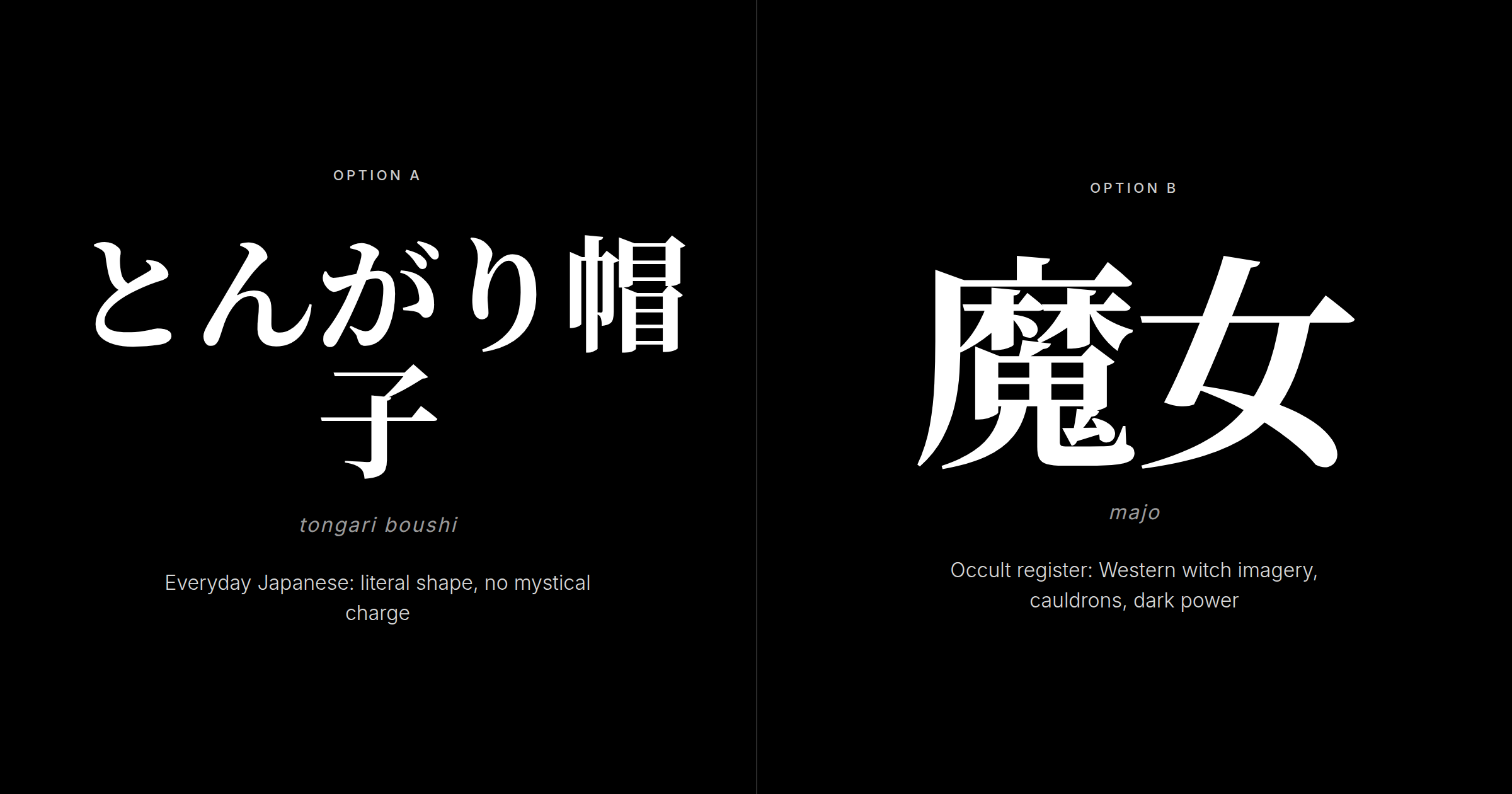
So the full Japanese title, read as a Japanese speaker reads it, is: The Studio of the Pointy Hat. Or more naturally: The Pointy-Hat Workshop.
Compare that to what "Witch Hat Atelier" evokes in English. A Western audience hears "witch hat" and reaches for a dense cluster of associations: black hats, cauldrons, grimoires, Halloween iconography, witchcraft as secret and dangerous knowledge. The word "atelier" in English sounds elevated and French — more Balenciaga than Hogwarts, but still aesthetically rarefied. The English title promises something that is either darkly occult or stylishly sophisticated.
The Japanese title promises neither. It promises a pointed hat, and a place where people work.
The Workshop Philosophy: Magic as Craft
This is not accidental naming. The title announces, in the plainest possible Japanese, what the show is actually about: a workshop where a specific craft is learned and practiced.
The drawing-based magic system is the title's philosophy made tangible. Spells require the same discipline as learning calligraphy or woodworking — there is a correct way to form each symbol, and deviation produces either a failed spell or an unintended one. Apprentices sit at desks. They practice strokes. They study the theory behind each sigil before attempting to draw it in practice. Progress is incremental and visible in their sketchbooks, just as it would be visible in a craftsperson's workshop drawings or a painter's studies.
This philosophy aligns with what Japanese culture calls 職人 (shokunin — a craftsperson or artisan who has attained mastery through sustained dedicated practice). 職 (shoku) carries the meaning of occupation or vocation, and 人 (nin/jin) means person — literally, a person of a vocation. But the cultural connotation of 職人 extends far beyond "someone with a job." A 職人 is someone who has made a complete commitment to mastering a practice. You see the term in profiles of sushi chefs, lacquerware makers, traditional thatchers, typographers. It connotes decades of single-minded dedication, the kind of mastery that cannot be shortcut or faked.
The atorie in the title is where 職人 are made. Not where they arrive already gifted. Where they are made, through the slow accumulation of practice.
This directly supports the plot's central premise: Coco has no innate magical talent. In a world where magic is supposedly restricted to the naturally gifted, she becomes a witch by learning the craft deeply enough to create spells through pure technical competence. The title tells you this is possible before the story does. The workshop is the proof.
Reception: What Japanese Audiences Read vs. What Western Viewers See
Western coverage of Witch Hat Atelier consistently focuses on three things: animation quality, the female lead in a non-romance story, and the absence of isekai or power-fantasy tropes. All of these are real and valid. But they describe the show's appeal by what it lacks, rather than what it is built on.
Japanese audiences, approaching a manga that has been beloved for a decade, read the anime through the lens of the source material's precision. The manga's critical reception in Japan has always centered on Shirahama's commitment to visual detail — her panels contain the equivalent of full architectural diagrams of magical theory, drawn with an illustrator's care rather than a weekly manga's production speed. That the anime preserves this quality — and that Bug Films delayed a full production year to ensure it — was widely welcomed by fans as a sign of creative respect rather than a marketing calculation.
The title's language reinforces this reading. By naming the story Tongari Boushi no Atorie rather than, say, Mahou no Atorie (魔法のアトリエ, the magical atelier) or Mahoutsukai no Ie (魔法使いの家, the witch's house), Shirahama made a specific choice: to keep magic off the marquee. The hat is pointed. The space is a workshop. The rest follows from there.
Tokyo-Native Take: What the Title Signals Before the Story Starts
A Japanese viewer encountering Tongari Boushi no Atorie as a title — before watching a single frame — draws a set of inferences that the English title does not support.
First: this is not a standard magical-girl narrative. Magical-girl titles in Japan tend toward abstract nouns and light (光, hikari; 星, hoshi; 希望, kibou) or toward compound phrases that promise transformation and destiny. Tongari Boushi promises neither transformation nor destiny. It promises a hat, and a workshop.
Second: the French loanword アトリエ sitting alongside everyday Japanese tongari boushi signals an intentional register hybrid. The creator is not reaching for generic fantasy vocabulary. She is making a precise aesthetic choice — pairing the most mundane possible Japanese (the shape of a hat) with a loanword that carries European artisan craft culture. This reads as a statement of creative intent: this story belongs to the tradition of craft narratives, not the tradition of power fantasy.
Third: アトリエ (atelier) evokes an active, working studio — a place where craft is happening now, not a ruin or a legendary academy long past. The loanword carries a living, hands-on connotation that frames the story as ongoing process, not recovered history.
Japanese audiences who have followed the manga since 2016 find the anime's treatment consistent with these inferences. The year-long production delay resonates particularly in Japan, where seasonal anime schedules are genuinely constrained. Bug Films choosing to miss a season rather than deliver substandard animation is read as the studio understanding that Tongari Boushi no Atorie is the kind of work where quality is not separable from the meaning of the story itself. A poorly animated workshop is not a workshop. It is a mockery of the thing the title names.
The Spring 2026 season has been stacked with strong premieres, but Witch Hat Atelier has sustained its momentum past the initial buzz. That is the truest measure of quality in seasonal anime: not the premiere spike, but the episode-five audience. And it held.
FAQ
What does "Tongari Boushi no Atelier" mean, and why is it called "Witch Hat Atelier" in English?
Tongari Boushi (とんがり帽子) literally means "pointy hat" — a simple, everyday Japanese term. Atelier (アトリエ) is a French loanword meaning workshop or creative studio. The full title is "Pointy-Hat Workshop." The English title "Witch Hat Atelier" translates the concept but loses the everyday, craft-focused quality of the Japanese framing. Japanese viewers immediately understand from the title that this is a learning and apprenticeship story, not dark fantasy. The English title invokes Western witch imagery that the anime deliberately avoids. The naming difference reveals the cultural gap between how Japanese and Western audiences read "magic" as a concept.
Is this a dark fantasy anime, or is it actually cozy and wholesome?
The anime contains genuine stakes and conflicts — Coco's mother is still stone, and the antagonists (the Brimmed Caps) pose real threats — but the framing and pacing are contemplative and craft-focused rather than action-driven. It is "wholesome" in the sense that there is no gratuitous darkness, no romance subplot as a central plot, and no "chosen one" predestination. The apprentices support each other; Qifrey teaches with patience and rigor. Viewers describe it as having cozy workshop elements (learning, collaboration, incremental progress) combined with real narrative tension. Think Fullmetal Alchemist's pacing and thematic depth, not Demon Slayer's action.
Why is the magic system based on drawing instead of spells or wands?
The drawing-based system — spells as geometric seals drawn with special ink — directly reflects the title's philosophy: magic is a craft that can be learned and mastered through diligent practice, not something restricted to the naturally talented. This allows Coco, who has no innate magical ability, to become a witch through studying magic theory and practicing the art of spell-drawing. It grounds the magic system in visual and artistic discipline rather than mysticism, making every character's progress feel earned. The image of apprentices at desks practicing spell designs reinforces that this is a workshop environment, not an occult mystery school.
How faithful is the anime to the manga?
The anime is described by reviewers as faithful to Kamome Shirahama's visual style and worldbuilding. Studio Bug Films deliberately delayed production by one full year — originally planned for 2025 — to ensure animation quality matched the manga's detailed, storybook aesthetic. The anime preserves Shirahama's character designs, background detail, and pacing philosophy. Some reviewers note the adaptation's writing is more streamlined than the manga's full complexity, but this is standard for the format. The critical consensus is that the anime respects the source material rather than simplifying it for mass appeal.
Is Witch Hat Atelier still ongoing, and how many episodes will the anime have?
The manga is still serializing as of June 2026. The anime premiered April 6, 2026, with a double-episode premiere on Crunchyroll. The first cour runs through summer 2026 (around a dozen episodes), and further episodes are expected, though the full run length for the complete series has not yet been announced. Crunchyroll is streaming it globally.
Why is Witch Hat Atelier ranked so highly compared to other 2026 anime?
The combination of animation quality, faithful adaptation, character-driven storytelling, and freedom from typical anime tropes — no isekai, no harem, no power-fantasy framing — has resonated with both casual and dedicated anime fans. The 4.9/5.0 Crunchyroll rating and 8.75 MAL score place it ahead of typical seasonal releases. Reviewers specifically praise the animation consistency, the worldbuilding coherence, and the pacing that allows character relationships to develop naturally. Episode 5 was widely hailed as one of 2026's best, elevating its visibility and sustaining audience growth past the premiere spike.
Who should watch Witch Hat Atelier, and what kind of fan would like it?
Ideal for viewers who love character-driven fantasy — like Fullmetal Alchemist or Arcane — who prefer worldbuilding and craft over action spectacle, and who want a female lead in a story that is not romance-focused. It resonates with viewers interested in Japanese cultural philosophy: the emphasis on artisanal mastery and apprenticeship reflects values that Japanese audiences recognize as 職人 (shokunin) culture. Both newcomers and longtime anime fans rate it highly; it is accessible without being shallow. If you have been waiting for an anime that trusts its audience to find deliberate learning as compelling as fighting, this is it.
If the kanji embedded in Witch Hat Atelier caught your eye — the way 帽子 (boushi) carries its meaning so plainly, or how アトリエ creates a hybrid of everyday Japanese and French artisan vocabulary — you might find it worthwhile to explore how those same instincts apply to kanji choices in permanent contexts. KIO's guides to choosing meaningful kanji and what Japanese people actually think of kanji in Western contexts cover the same gap between Western expectation and Japanese register that the title of this anime illustrates so cleanly. And if you want to see how another 2026 anime builds its entire mythology from Japanese linguistic precision, the Yomi no Tsugai explainer covers the Shinto weight of 黄泉 in comparable depth. For a complementary dive into how script choice itself becomes narrative meaning—not just kanji, but the katakana versus kanji split as thematic architecture—Marriage Toxin anime uses the all-katakana title to signal international register while embedding kanji meaning within the story world.