Dragon Ball Kanji Tattoo: What 亀 Really Means to Natives
Dragon Ball's gi symbols are real kanji rooted in Japanese martial arts tradition. Before you ink 亀, 悟, or 神, learn what Tokyo natives actually read on your skin.
Dragon Ball has been shaping how the world imagines Japan since 1984. Goku's journey from a tailed boy to a universal guardian is not just an anime franchise — it is, for an entire generation of viewers, a moral education wrapped in fight scenes. The values woven into it — discipline, perseverance, pushing past your limits — are ones people genuinely want to carry on their skin as tattoos.
What sets Dragon Ball apart from most anime for tattoo purposes is that the symbols Goku wears on his gi are real Japanese kanji tattoos. They are dictionary-correct characters with centuries of meaning in Japanese culture. That authenticity is part of the appeal. But "authentic kanji" and "kanji that means what you think it means" are two different things, and that gap is exactly what this kanji tattoo guide is for.
Why Dragon Ball's Symbols Are Everywhere in Tattoo Culture
Dragon Ball introduced Western audiences to real Japanese kanji at scale, and it did so through a mechanism that makes the symbols feel earned: the gi. In Japanese martial arts tradition — and Dragon Ball draws on this faithfully — a student wears their master's symbol on their uniform as a mark of lineage. The back of the gi carries the current school's mark; the front can honor previous masters. It is not decorative. It is a declaration of where you trained and who shaped you.
Akira Toriyama built this into Dragon Ball's visual DNA from the beginning. Goku's gi changes as his training evolves: the 亀 marks his years under Master Roshi at the Turtle School; the 界王 marks his training under King Kai in the afterlife; and later, his own 悟 stands for his own identity as a fighter. Each symbol traces a chapter of growth. That narrative arc — symbols changing with the person — is part of why fans feel a connection to these characters as tattoo subjects. They carry a story of transformation, and the kanji record it.
The four symbols that dominate Dragon Ball fan tattoos are:
- 亀 (kame — turtle; the Turtle School symbol) — Goku's earliest and most iconic gi mark
- 悟 (go — comprehension, enlightenment; from Goku's name 孫悟空) — his personal identity kanji
- 神 (kami — god, divine; from the character Kami and used in spiritual contexts) — associated with godlike power arcs
- 界王 (kaiou — World King; the title of King Kai) — a two-character compound earned through the Other World arc
These four cover the range from Goku's humblest training to his celestial development. No other anime franchise has given fans such a coherent set of kanji anchored in a coherent narrative of growth.
Dragon Ball in Japan: More Than an Anime Franchise
Within Japan, Dragon Ball occupies a cultural position that Western fans sometimes underestimate. It is woven into mainstream Japanese life like Star Wars in the United States — everyone has seen it, references land across generations, and saying someone "went Super Saiyan" (超サイヤ人 — chou Saiya-jin) is understood even by people who have never watched an episode.
Dragon Ball ran in Weekly Shonen Jump from 1984 to 1995; Dragon Ball Z aired from 1989 to 1996, through Japan's economic bubble years and the post-bubble period that followed. The franchise became cultural shorthand in a way that stuck.
When a Japanese person sees a Dragon Ball kanji on a forearm, they are not mystified. They know it immediately. That recognition changes the register of your tattoo: it reads less as "tribute to a foreign culture" and more as "homage to a shared global franchise." Whether that is what you want from your ink is worth thinking about before you commit.
The Kanji Breakdown: What Each Symbol Actually Says
This is where cultural depth meets dictionary meaning. Each Dragon Ball gi symbol is linguistically real — none of them were invented for the anime, and none of them carry hidden negative meanings. But each one reads differently to a native speaker than it does to a fan.
亀 (kame — turtle)
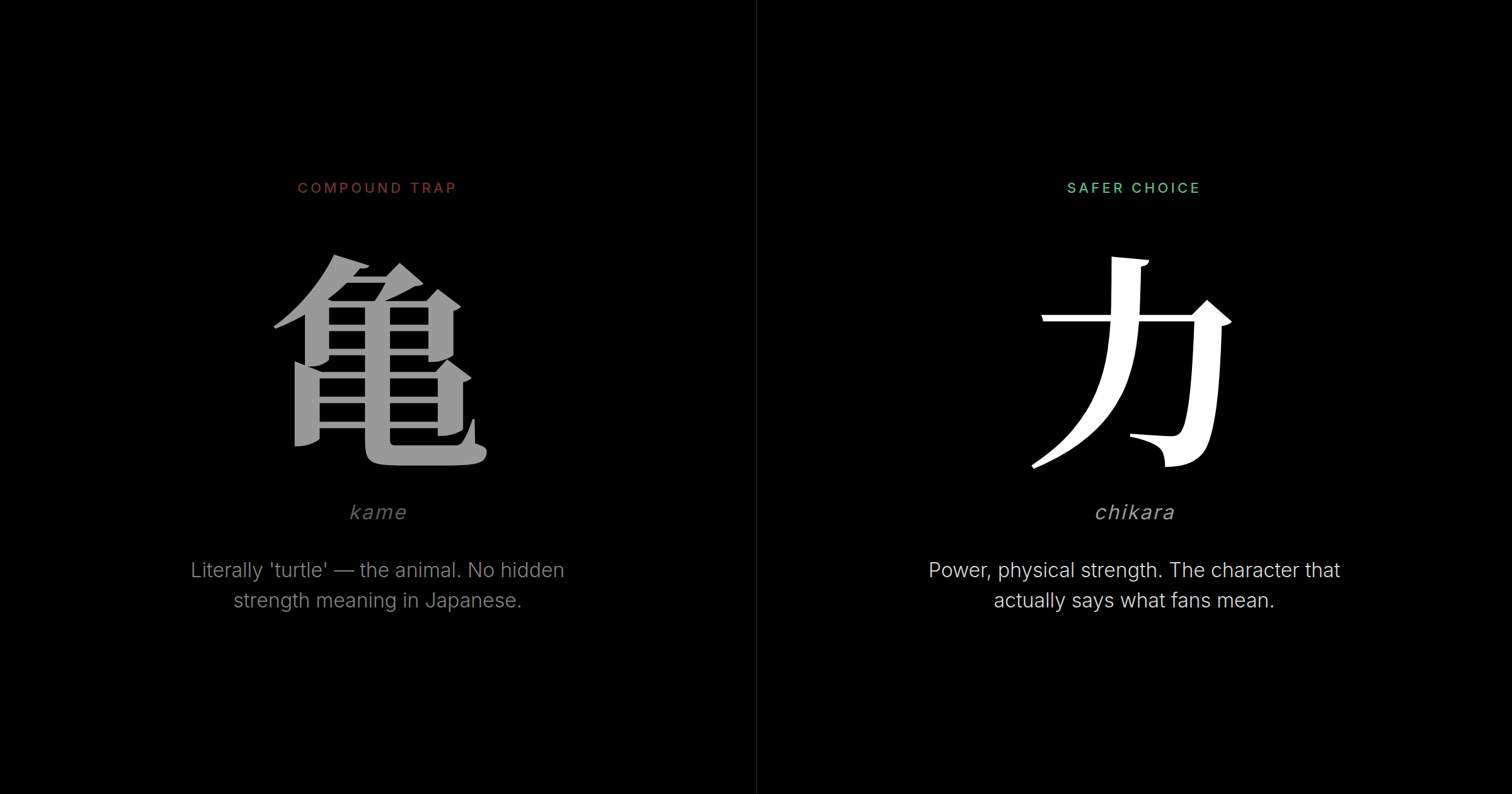
亀 (kame — turtle, tortoise; the everyday Japanese word for the reptile, found in children's books, nature documentaries, and aquarium signage) is the symbol Goku wears longest. It appears on Roshi's students' gi, the school's flag, and the boat to the Tenkaichi Budokai.
To a native Japanese speaker, 亀 means turtle. Full stop. There is no secondary meaning of strength or martial achievement. The character appears in picture books for toddlers and haiku about slow-moving animals. The connection to power exists entirely within the Dragon Ball narrative — Roshi's school is powerful because of what Roshi teaches, not because of what the kanji says. A native reading 亀 on your shoulder sees a turtle first, and the Dragon Ball reference second. The power reading requires the anime as a lens.
This is a clarifying fact, not a disqualifying one. If what you love is the Turtle School's meaning within the story, you can own that. But going in thinking "this symbol means martial mastery" in Japanese is a misconception the ink will not correct.
悟 (go — comprehension, enlightenment)
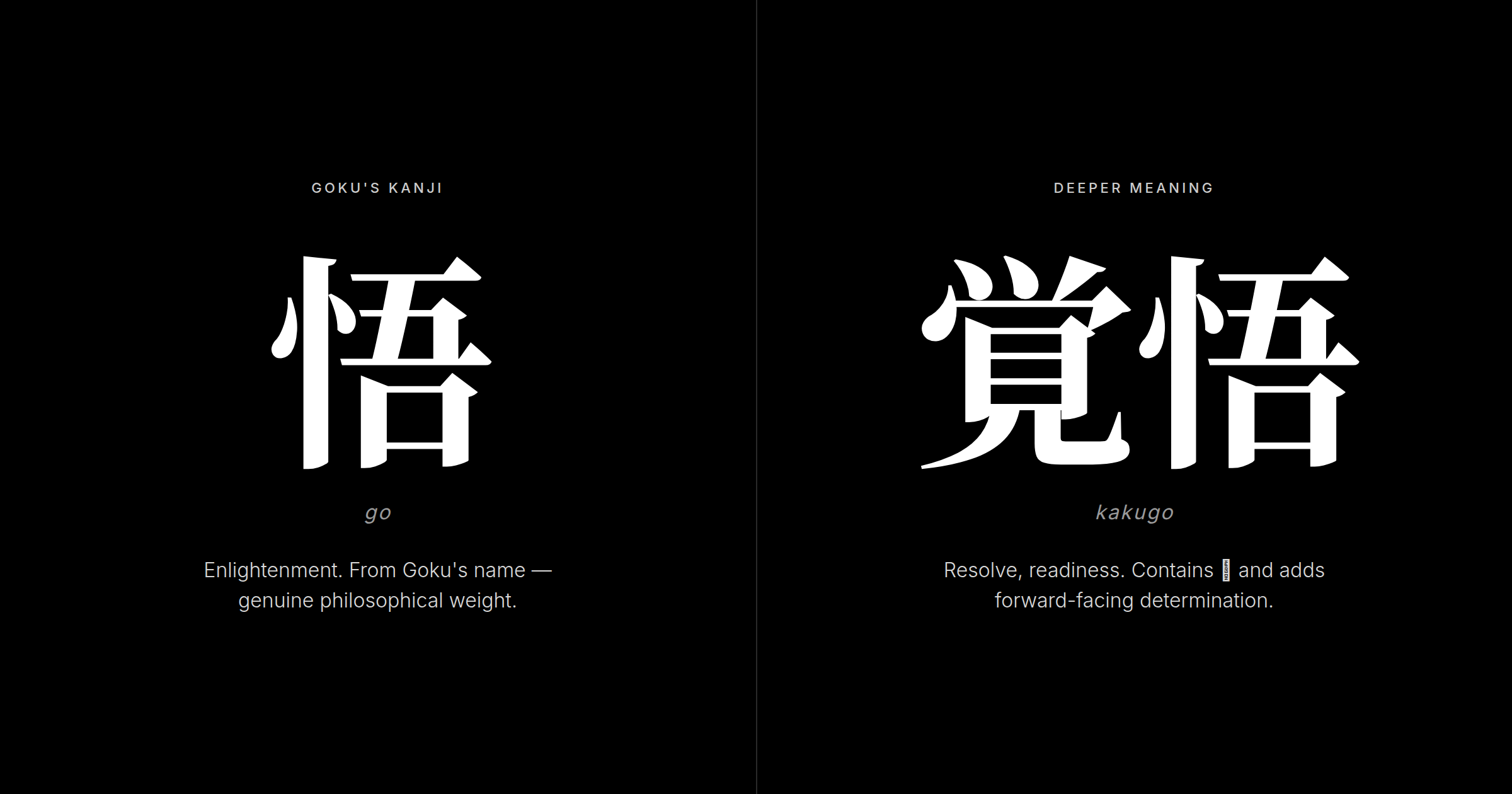
悟 (go — to perceive, to comprehend, to attain understanding; used in philosophical, religious, and self-development contexts across Japanese literature and formal writing) is the character at the heart of Goku's name. His full name, 孫悟空 (Son Gokuu), is drawn from Sun Wukong, the Monkey King protagonist of the 16th-century Chinese novel Journey to the West, where 悟 specifically references the enlightenment achieved through struggle.
In Japanese, 悟 appears in 悟り (satori — a Zen term for sudden understanding) and in compounds like 覚悟 (kakugo — resolve, readiness for what is to come). It belongs to a register associated with personal growth, philosophy, and formal declarations of intent. A Tokyo native seeing 悟 on a forearm reads a genuine philosophical statement, not just an anime reference — making it one of the most resonant Dragon Ball kanji for tattoo purposes.
神 (kami — god, divine)
神 (kami — god, deity, the divine; foundational Shinto term appearing in 神社 jinja "Shinto shrine" and 神道 Shinto "the Shinto religion") is among the most significant kanji in the language. In everyday speech it also functions as internet and youth slang — calling something 神 means "divine/incredible," the equivalent of "godlike." The character spans from ancient religious register to modern casual praise, and it is both.
Dragon Ball's use of 神 for the guardian of Earth is an entirely natural application. As a tattoo, a native reads it as a genuine spiritual declaration — or a recognition of something extraordinary. Neither reading is off. It is among the safest single-character picks on this list.
界王 (kaiou — World King)
界王 (kaiou — World King; the title given to King Kai and other cosmic rulers) is a two-character compound: 界 (kai — boundary, realm; used in 世界 sekai "the world") combined with 王 (ou — king, ruler). Unlike the single-character options above, 界王 is not a standard dictionary entry in everyday Japanese — it reads as the Dragon Ball title it is. A native sees it and thinks King Kai. If that specific arc of Goku's training matters to you, the compound is coherent; but it carries less independent weight outside the anime than 悟 or 神 do.
So What Happens When You Put This on Your Skin?
You carry real kanji with real meanings — and that is already a more honest position than many anime tattoos. Dragon Ball's symbols were not invented for aesthetic effect; they trace actual martial arts lineage tradition, reference genuine philosophy (悟's connection to Journey to the West), and draw on words that appear in Japanese dictionaries without footnotes. That legitimacy matters.
But legitimacy is not the same as carrying the meaning you intend. A native reader in Tokyo sees your 亀 and reads "turtle" first, Dragon Ball second. They see your 悟 and read "enlightenment" first, Goku's name second. The emotional amplification — the sense that these symbols hold martial power, supernatural connection, the weight of Goku's entire journey — that is the anime's contribution, and it does not transfer through the kanji alone.
Native Verdict: What a Tokyo Reader Actually Sees
KIO Native Verdict — Dragon Ball kanji tattoos
Based on thousands of verification requests reviewed by KIO's Tokyo-native team, Dragon Ball kanji are among the cleanest anime tattoo choices linguistically. There are no hidden negative meanings, no compound-word traps, no characters that accidentally reference something embarrassing. A native reading your Dragon Ball tattoo will not wince.
What they will do is lead with the dictionary meaning, not the anime meaning. 亀 reads as turtle — a character that calls to mind aquariums, nature programs, and children's picture books, then connects to the anime reference. 神 reads as a genuine spiritual word with real weight. 悟 reads as an authentic philosophical concept. 界王 reads as the King Kai title. This "dictionary first, anime second" reading pattern appears across all anime kanji; Chainsaw Man's register mismatch is particularly stark because 契約 is correct but reads as "apartment lease" — the literal opposite of the mystical weight fans project onto it.
The native verdict, specifically: a Tokyoite seeing 亀 on your forearm will read it as "this person has affection for the Turtle School — cute, a bit childlike as a symbol, clearly a Dragon Ball fan." They will not read it as "this person channels ancient martial power." That gap is not a failure of the kanji. It is a feature of how language works: the character holds the dictionary meaning; the emotional freight of the anime does not survive the translation from screen to skin.
Compare this to other anime kanji tattoos that do carry linguistic risk. Dragon Ball sits in a much safer position — the concern is register and emotional expectation, not error.
Better Alternatives: If You Want the Value, Not Just the Symbol
If you are drawn to Dragon Ball kanji because of what they represent — growth through discipline, the pursuit of self-transcendence — there are kanji that carry those values more directly in native Japanese.
If you want: the growth and wisdom Goku embodies
悟 is already a strong choice on its own terms. If you want to sharpen the intention, consider 覚悟 (kakugo — resolve, readiness; the word used when someone steels themselves for a difficult truth ahead) as a compound that preserves 悟 and adds forward-facing determination.
If you want: strength and power (what fans project onto 亀)
力 (chikara — power, strength, physical and inner force; appears in 努力 doryoku "effort" and 全力 zenryoku "full strength") says what many Dragon Ball fans actually mean when they reach for 亀. The kanji for power says power directly.
If you want: the dragon itself
龍 (ryuu — dragon; used in classical literature, place names, and temple art) is the creature the franchise is named after — yet almost no fans consider it. A native reading 龍 sees a deeply traditional symbol with real gravitas. If Dragon Ball connection matters, the dragon is right there in the title.
For readers exploring kanji that carry genuine personal meaning beyond any anime franchise, choosing meaningful kanji for tattoos is a practical next step for your kanji tattoo journey. And for a direct comparison to how another beloved anime handles kanji tattoo choices, One Piece kanji tattoos covers similar territory with 仲間 and 最強.
Common Mistakes (and How to Sidestep Them)
Projecting anime power onto a literal word. 亀 is a turtle. Roshi's school is powerful; the kanji for his school is just the kanji for the animal. Keep that distinction clear before you commit.
Stacking symbols without understanding the martial arts context. The gi progression — 亀 to 界王 to 悟 — traces Goku's training arc in sequence. Combining all four without that personal context reads as aesthetic accumulation, not narrative. Each symbol earned its place through chapters of development; on your body, they should earn their place too.
Choosing based on visual complexity. 界王 is two characters and looks impressive. 亀 is compact. Neither is more "powerful" in Japanese. If 界王 doesn't connect to the King Kai arc specifically, 悟 alone carries more genuine weight.
Skipping the native read-through. The most common regret in kanji tattoos is discovering post-ink that the character reads differently to native speakers than the anime suggested. Verify your kanji tattoo design before getting inked is the single most effective step you can take to avoid mistakes.
FAQ: Dragon Ball Kanji Tattoo
Does 亀 (kame) actually mean "power" or "strength" in Japanese?
No. 亀 literally and only means "turtle" — the animal. It is not a hidden power symbol or mystical martial mark. Goku wore it because his master was the Turtle Hermit (Kame-Sen'nin), whose name literally contains this character. To a native speaker, it reads as a cute animal symbol tied to the Turtle School, not as strength. This is not a mistake; it is just a different reading than the anime's emotional framing suggests.
What's the difference between how a fan and a native Japanese person will read my Dragon Ball tattoo?
A fan reads the anime narrative: 亀 = Turtle School legacy, martial honor, connection to Goku's journey. A native reads the literal character: 亀 = turtle (the animal), plus a likely recognition of the Dragon Ball reference. Neither reading is wrong. The difference is that natives lead with dictionary meaning; fans lead with story meaning. Being aware of this gap helps you choose kanji that align with what you actually want the tattoo to say.
Which Dragon Ball kanji should I avoid?
Avoid combining all four main symbols (亀, 悟, 神, 界王) into one piece — visual overload and muddy meaning. Avoid choosing based purely on how cool the character looks (more strokes does not mean more power). Avoid random placement without understanding the martial arts context (gi symbols work on chest or shoulder). All Dragon Ball kanji are linguistically safe — no hidden bad meanings like some other anime choices — so the risks are aesthetic and personal, not linguistic.
How is a Dragon Ball kanji tattoo different from the anime tattoos in "fail" galleries?
Dragon Ball's kanji are real, dictionary-correct, and grounded in authentic martial arts culture. They do not have hidden alternate meanings like some anime picks — unlike characters that accidentally mean "mistress" or "gout." The risk with Dragon Ball kanji is not linguistic error but register mismatch: fans project anime-grade emotional weight onto characters that natives read more straightforwardly. This is a feature, not a bug — it means the kanji are safe and legible. For contrast with riskier anime tattoo territory, see fake Japanese kanji from anime.
How do I verify my Dragon Ball kanji tattoo design before getting inked?
Confirm the character's dictionary meaning in a reliable source like Jisho; check for compound-word traps (usually not an issue with Dragon Ball single kanji, but worth confirming for 界王); have a native Japanese speaker review your design file including font, size, and orientation; and ask yourself whether the meaning resonates with you outside the anime context. KIO's verification service connects you with Tokyo-based reviewers who return an assessment within 24 hours.
Ready to move forward with your Dragon Ball kanji tattoo? Verify your design at Kanji Ink Oracle — Tokyo-native reviewers assess your specific character, font, and placement within 24 hours, giving you the native-reader perspective before your appointment. Every Dragon Ball kanji covered in this article is reviewable, from the simplest 亀 to the two-character 界王 compound.