SPY×FAMILY Kanji Tattoo: Which Symbol Fits—家族, 絆, or 偽装?
SPY×FAMILY has no official kanji. Learn why 家族 feels cold to Tokyo natives, and which kanji—絆, 偽装, or others—resonates most when tattooed on skin.
SPY×FAMILY landed like a cultural phenomenon. The manga broke Shonen Jump records, the anime pulled in viewers who hadn't watched a seasonal show in years, and suddenly the Forger family—a story about found family built on lies—was everywhere. When that kind of momentum hits, fans reach for permanence: a tattoo. But a SPY×FAMILY kanji tattoo is trickier than most anime ink.
The core problem: SPY×FAMILY has no official kanji title. English words and a multiplication sign—no Japanese script. This breaks the assumption most anime fans carry into kanji tattoo research: that every anime property has an official Japanese kanji equivalent waiting to be discovered. It doesn't. That gap is exactly where the most common SPY×FAMILY kanji tattoo mistakes happen.
The SPY×FAMILY Problem: No Kanji Title to Tattoo
The official title is written as SPY×FAMILY — English words, a multiplication sign, no kanji. The main characters carry katakana names: アーニャ (Anya), ヨル (Yor), ロイド (Loid). These are not romanizations of kanji names with hidden meaning. They are transcriptions of foreign names, written in the script that Japanese uses for foreign words.
This is intentional. The story follows a spy who has infiltrated a civilian life, building a fake family to complete a mission. Using katakana for the characters' names is a form of worldbuilding: these people don't fully belong to the world they're operating in. The title itself refuses to settle into Japanese script. The show about deception gives you a title that won't be pinned down.
So when a fan types "spy family kanji" into a search engine looking for the official answer, there isn't one. What exists instead is a set of choices — and those choices say a lot about how deeply you've understood the show.
Why 家族 (Kazoku) Is the Obvious Choice — and Why It Falls Flat
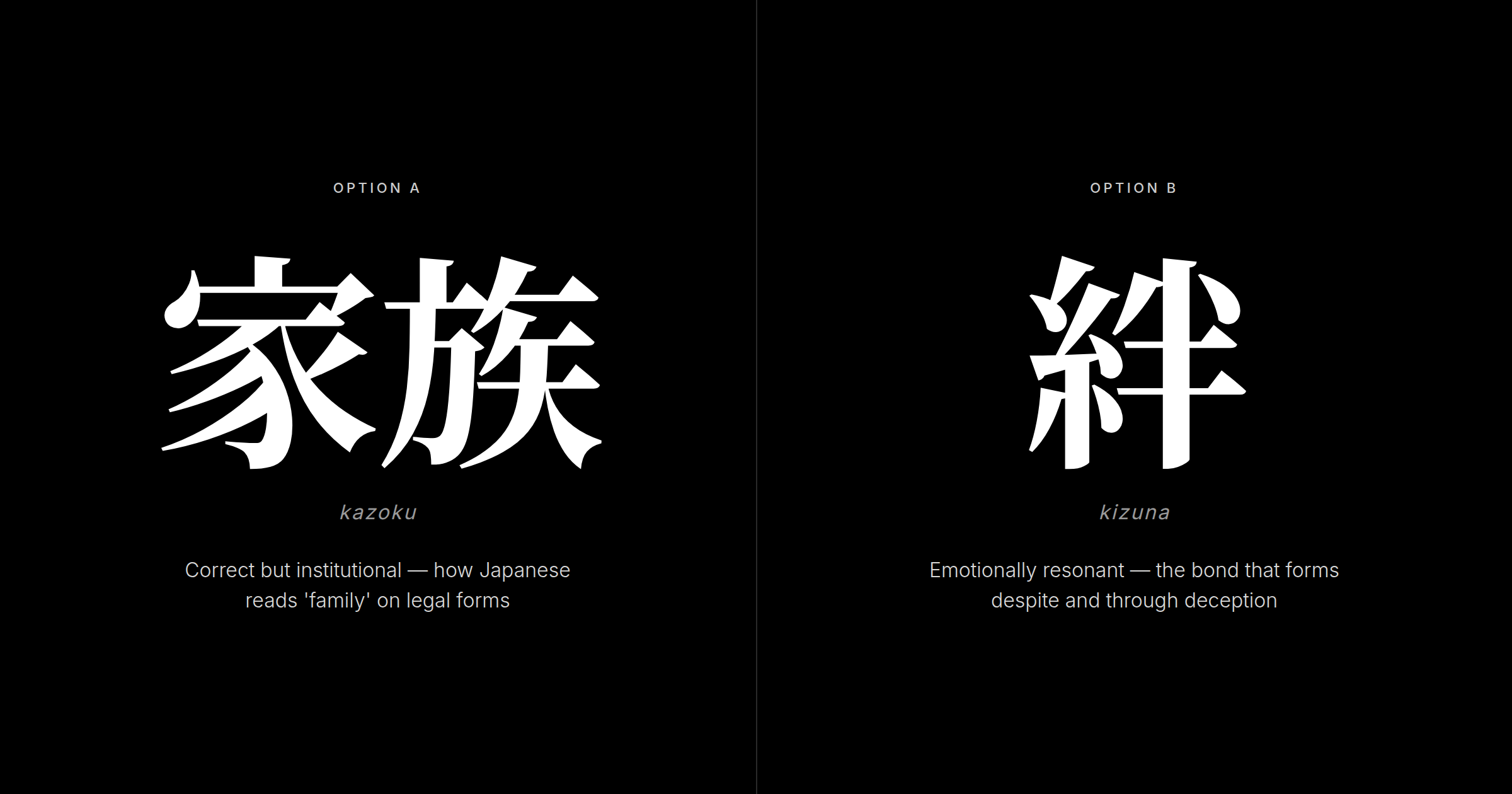
The first kanji most fans land on is 家族 (kazoku — family; the combination of 家, meaning home or house, and 族, meaning clan or tribe). Semantically, it is correct. The show is about a family. 家族 means family.
But "correct" and "resonant" are different things, and this is where native Japanese intuition diverges sharply from Western fan expectation.
In everyday Japanese, 家族 is a functional word. You use it on forms at the ward office. You hear it in news broadcasts and insurance commercials. A news anchor might say "被害者の家族は…" (the victim's family…) in the flat register of a report. It is not a warm word. It is the word you reach for to communicate the structural fact of a family unit.
When English speakers hear "family," they feel something. When Japanese speakers read 家族 alone on skin, many feel the same thing they'd feel reading "next of kin" on a hospital form — accurate, but cold.
Based on the patterns KIO's Tokyo-native review team sees across hundreds of kanji tattoo consultations, 家族 is consistently flagged as one of the most semantically-correct but emotionally-thin choices fans submit. Clients who love SPY×FAMILY choose it expecting the warmth of the Forgers' relationship to come through. Native reviewers read something closer to "household members."
The kanji doesn't capture what the show actually earns over 25-plus episodes: a fake family, forced together by lies and missions and an absurd telepathic child, slowly becoming something real.
The Show's Actual Premise: 偽装 (Gisou)
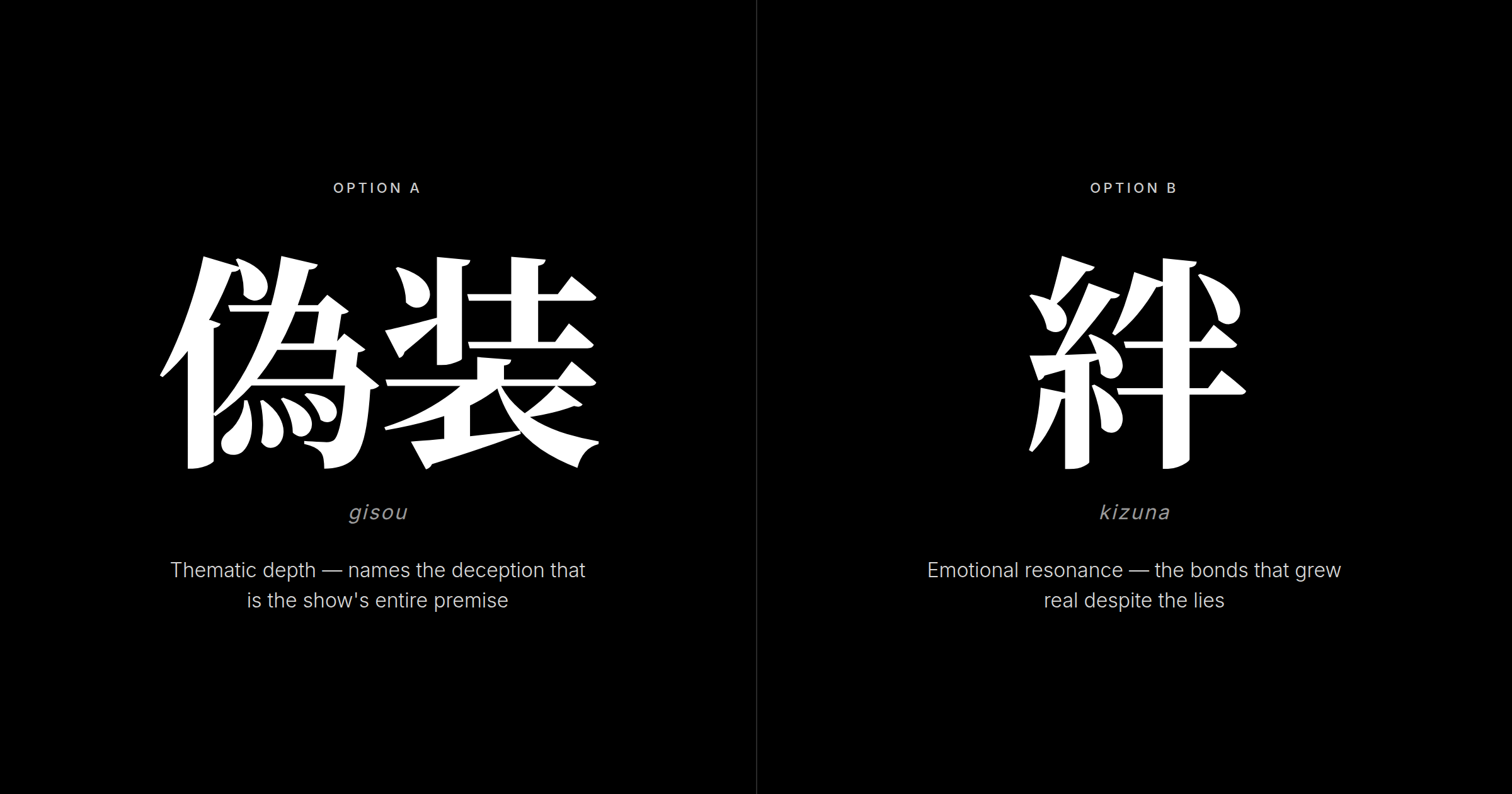
If 家族 is the obvious surface answer, 偽装 (gisou — disguise, camouflage, or infiltration) is the thematically honest one.
The kanji breaks down as: 偽 (gi — falsehood, deception, counterfeit) paired with 装 (sou — attire, disguise, equipment). Together they describe something deliberately made to appear as something it is not. Operation Strix, the mission that sets the entire story in motion, is built on 偽装. Loid's civilian identity is 偽装. The Forger family name is 偽装. Even Anya's enrollment in Eden Academy is 偽装.
This is darker than fans typically land on, and that's precisely what makes it worth considering. SPY×FAMILY is not purely a heartwarming comedy — it is a story about a man extraordinarily good at lying, paired with a child who reads minds, watched over by a wife who is secretly an assassin. The emotional warmth is real, but it is inseparable from the deception underneath.
A fan who chooses 偽装 is signaling: I understood the spy narrative, not just the found-family arc.
The Found-Family Layer: 絆 (Kizuna) and 愛 (Ai)
For fans whose connection to SPY×FAMILY is primarily the found-family theme — the slow accumulation of genuine care between people who started as strangers with ulterior motives — there are two kanji that carry that emotional register far more effectively than 家族.
絆 (kizuna — bonds, ties between people; literally the threads that bind) was Japan's Kanji of the Year in 2011, selected after the Tohoku earthquake to name the bonds between communities that survived disaster and rebuilt. That resonance hasn't faded. A Japanese reader seeing 絆 on skin reads: this bond persisted through something real. That is exactly what the Forger family is — a connection that survived missions, crises, and a school exam gone sideways. The kanji carries the weight of endurance, of threads that held when they could have frayed.
愛 (ai — love; used in romantic, familial, and unconditional contexts) is the other natural candidate. Where 絆 emphasizes the bond itself, 愛 emphasizes the feeling underlying it. Yor's love for Anya and Loid's evolving protective instinct form the show's long emotional arc. 愛 alone works powerfully for fans who want to capture the core warmth beneath the operational deception.
The choice between them reflects which aspect of the Forger dynamic resonates deepest: 絆 says "we endured together"; 愛 says "we love." Both read authentically to native speakers. For fans drawn to the operational premise, 偽装 (gisou — disguise) stands apart: not what the Forgers became, but how they started.
When Anime Breaks the Kanji Rule: The Katakana Trap
Not every anime property contains native kanji waiting to be extracted — and SPY×FAMILY makes this lesson explicit. Tatsuya Endo wrote アーニャ, ヨル, and ロイド in katakana because they are foreigners in the show's Central European-inspired fictional setting. Assigning kanji to those names would contradict the design — adding certainty where the creator deliberately placed ambiguity.
KIO's katakana name tattoo guide covers why anime character names stay in katakana. The broader lesson — that forcing kanji onto anime properties that use other scripts is a form of mistranslation — is explored in our fake Japanese kanji in anime piece.
Cultural Context: Found Family in Japan vs the West
Japanese storytelling proves emotional connection through action under obligation rather than declared feeling. Loid keeps showing up, keeps protecting Anya when the mission doesn't require it — the bond is proven by endurance, not by speech. 家族 is a structural word for a structural fact. The emotional proof of the Forger family is that they keep choosing each other when they don't have to. That's 絆 territory.
KIO's One Piece kanji tattoo guide covers nakama (仲間) in depth — one of the most instructive parallels to this SPY×FAMILY dynamic.
Single Kanji vs Compound: The 家 Option
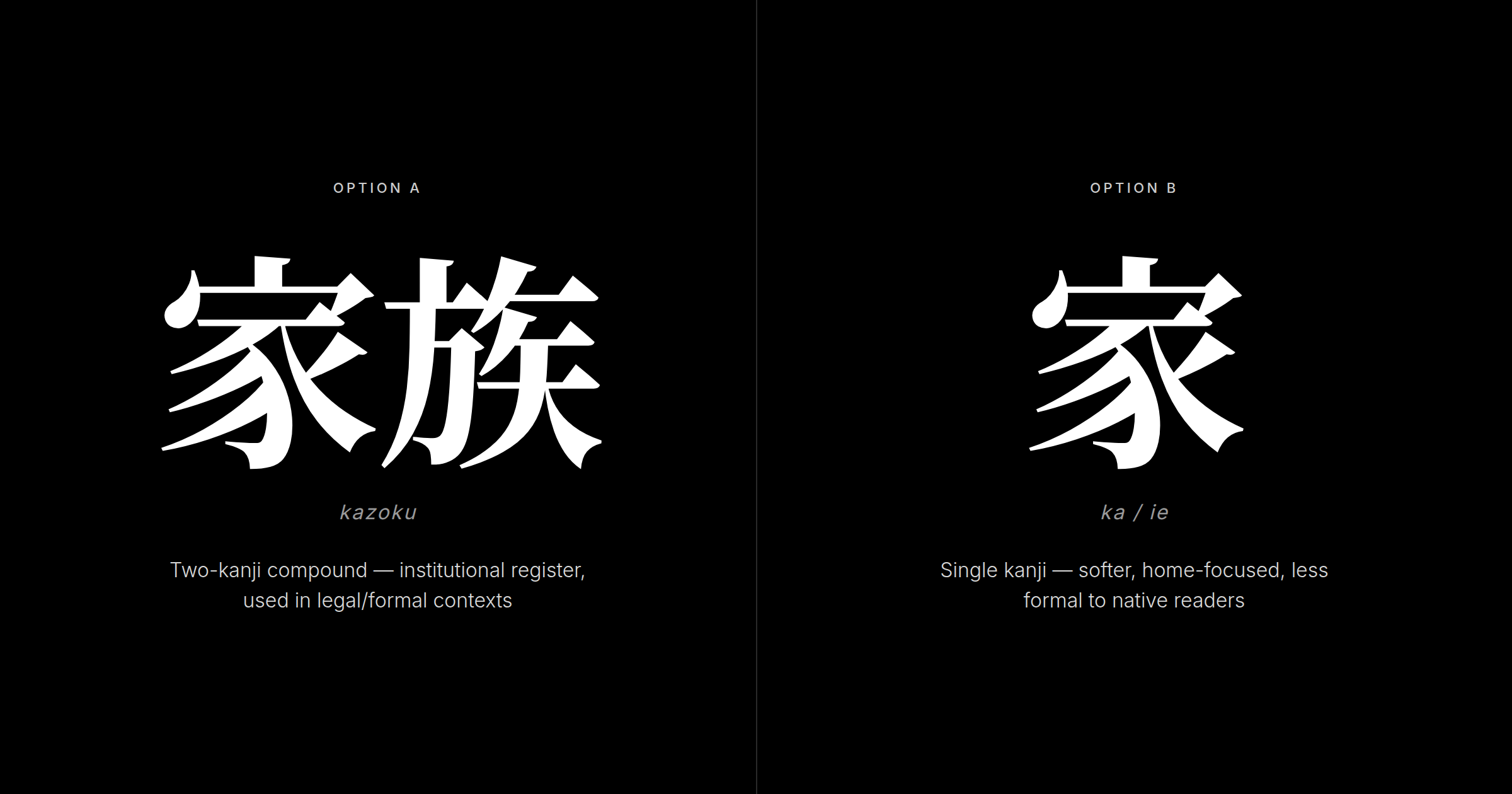
One frequently overlooked alternative is 家 (ka — home, house) alone, without the 族 suffix.
Where 家族 names the institutional family unit, 家 alone names the place — the home itself, the space where the family exists. For fans who find 家族 too cold but want to stay in the semantic neighborhood of "family," 家 reads softer in Japanese. It suggests something closer to "this is where I belong" than "this is my household composition."
The yojijukugo (four-character compound) 一期一会 (ichigoichie — "one time, one meeting"; treasure each encounter because it will not repeat) is worth considering for fans drawn to the show's theme of temporary arrangements becoming permanent. It comes from Zen tea ceremony culture and carries connotations of cherishing a moment with another person because it cannot be replicated.
So What Happens When You Put This on Your Skin?
SPY×FAMILY is about a man professionally skilled at making things appear to be what they're not. A kanji tattoo inspired by this show performs the same operation — it will be read by observers who bring their own frameworks to it. The question is not just "what does this kanji mean?" but "what does this kanji mean to a Japanese speaker who reads it on your arm?"
Native Verdict
Key Finding: KIO's verification data shows 家族 is semantically correct but emotionally thin for SPY×FAMILY tattoos. A Tokyo native reading 家族 as a tattoo would recognize the semantic intent and quietly note the cultural gap. 家族 is the word used at the ward office, on hospital forms, in news broadcasts. It is a category label, not an emotional expression.
The deeper irony a KIO native reviewer flags: SPY×FAMILY is about a man who performs 偽装 so convincingly that even he forgets what's real. Choosing 家族 — the official, bureaucratic term — mirrors the show's central tension: right form, wrong substance.
A Tokyo native seeing 絆 on an SPY×FAMILY fan's skin recognizes a wearer who spent time with the material and landed on a kanji Japanese speakers associate with bonds that endured something meaningful. For fans drawn to the operational premise, 偽装 generates immediate recognition: the wearer grasped what SPY×FAMILY actually depicts beneath the found-family surface.
For a deeper exploration of how Japanese speakers interpret kanji tattoos and cultural register, see what Japanese people actually think when they encounter kanji tattoos.
Better Alternatives to 家族
The kanji options below each capture a different layer of what SPY×FAMILY means. The choice isn't about which one is "right" — it's about which resonates with your personal reading of the show.
絆 (kizuna) — the strongest general recommendation for found-family fans. Maps precisely onto the "fake thing becoming real" arc: a bond that endured something meaningful. Native Japanese readers register emotional depth when they see 絆 as a tattoo — it signals the wearer understands connection on a deeper register than simple family structure.
偽装 (gisou) — for fans drawn to the spy-operation premise. Darker, more intellectually honest about what SPY×FAMILY is actually about: constructed identity, infiltration, the blurred line between role-play and reality. Japanese speakers who know the series will recognize immediately that the wearer understood the show's central tension.
愛 (ai) — simpler, more universal. Works for fans focused on the emotional core: Yor's awakening to love, Loid's slow dissolution of his emotional compartments. The unconditional care beneath the lies.
縁 (en — fate, circumstantial connection) — the sleeper candidate. Fits the Forger formation precisely: thrown together by necessity, found genuine connection. Carries connotations of fate meeting intention.
家 (ka / ie) — softer single-kanji option for fans who want home-and-family register without 家族's institutional coldness. Emphasizes belonging and place.
For a deeper framework on choosing kanji that resonates personally with your values and interpretation, KIO's tattoo kanji selection guide covers the decision-making process in detail.
FAQ
Is there an "official" kanji for SPY×FAMILY I should get tattooed?
No. The SPY×FAMILY title is English, and character names — アーニャ (Anya), ヨル (Yor), ロイド (Loid) — are katakana. There is no canonical kanji version. This is intentional: the show's premise involves infiltration and foreign identity, and the title refuses to settle into Japanese script. Choose kanji that captures the show's themes — 家族 for family structure, 偽装 for the deception premise, 絆 for the emotional bonds — based on which layer resonates most.
Should I get 家族 (kazoku — family) for a SPY×FAMILY tattoo?
Semantically correct, but it carries a register problem. 家族 reads as institutional — the term used on legal documents, not the word a Japanese speaker reaches for to describe emotional bonds. For SPY×FAMILY's theme of a fake family becoming real, 絆 (kizuna — bonds) or 愛 (ai — love) carry more emotional weight. If 家族 is still your choice, pair it with a show-specific visual element to make the reference explicit.
What kanji best represents the show's core premise?
偽装 (gisou — disguise, infiltration, camouflage) captures the show's operational premise most precisely. The entire story runs on Operation Strix, where Loid constructs a fake life and family to access a target. 偽装 names that construction directly — 偽 (deception/falsehood) plus 装 (attire/disguise). It's a darker, more thematically honest choice than 家族, and a Japanese reader who knows the series will recognize immediately that the wearer understood what the show is actually about.
What do Japanese people think when they see 家族 as a tattoo?
Native Japanese speakers read 家族 as formal and institutional — the word used in news broadcasts, hospital paperwork, and legal filings. It's a category label, not an expression of feeling. A consistent pattern in KIO's verification work: 家族 is "right" in dictionary terms but "cold" in cultural register. 絆 reads as considerably more thoughtful to a native Japanese audience.
Are there better alternatives to 家族 for a found-family tattoo?
Yes. 絆 (kizuna — bonds, ties) is emotionally richer and carries widespread cultural recognition as Japan's Kanji of the Year in 2011, meaning "the threads binding people together." 愛 (ai — love) captures the emotional core of the Forger relationships. 縁 (en — fate, circumstantial connection) fits the "thrown together and became real" origin story. For something more complex, 一期一会 (ichigoichie — "one time, one meeting; treasure each encounter") reflects the show's theme of temporary arrangements becoming permanent bonds.
Can I combine kanji with katakana character initials for a SPY×FAMILY design?
Yes. A composition pairing 絆 with katakana initials (ア for Anya, ヨ for Yor, ロ for Loid) makes the reference explicit while grounding it in meaningful kanji. Have any combined design reviewed by a native speaker before committing — the interaction between kanji and katakana in the same composition can produce unintended readings.
What's the difference between 家 and 家族 for a tattoo?
家 (ka / ie — home, house) is a single kanji that emphasizes the place of belonging rather than the structure of a family unit. 家族 (kazoku — family) names the group itself. To a native Japanese speaker, 家 alone reads softer and less institutional than 家族 — it suggests "where I belong" rather than "the family unit I am part of." For a SPY×FAMILY tattoo, 家 offers a gentler semantic register than 家族 while staying in the home-and-family neighborhood. The tradeoff is slightly less semantic precision.
How do I verify my SPY×FAMILY kanji choice is correct before getting a tattoo?
Show your chosen kanji — along with the context that it's for a SPY×FAMILY tattoo — to a native Japanese speaker before committing. Ask: Does this kanji read naturally? How does it feel emotionally? Could the register be improved? KIO's Tokyo-native review team assesses your chosen kanji within 24 hours at Kanji Ink Oracle — not just semantic accuracy, but the cultural resonance: how the kanji actually lands on native speakers who encounter it.
Not sure whether 絆, 偽装, or something else fits your SPY×FAMILY vision? Kanji Ink Oracle connects you with Tokyo-native reviewers who assess your chosen kanji in context — how it reads culturally, what register it signals, and whether a better alternative exists. Verification takes 24 hours and is permanent-ink insurance.