Famous Celebrity Kanji Tattoo Fails: A Tokyo Verdict
Ariana Grande got a charcoal grill instead of 7 rings. Tokyo-native breakdown of famous kanji tattoo fails: celebrity mistakes and how to verify your design.
Famous celebrity kanji tattoo fails are their own internet genre now. You've seen the memes. You've read the headlines. A global superstar gets a kanji tattoo, the internet erupts with laughter, and the celebrity spends a week apologizing. If you're thinking about your own kanji tattoo right now, those stories are doing their job: they're making you nervous, and nervous is good. Nervous means you're paying attention.
Celebrity kanji tattoo fails are more useful than entertainment. Each famous kanji tattoo mistake contains a specific, diagnosable error that anyone — with any budget, not just pop star budgets — can avoid with the right preparation. This breakdown of celebrity tattoo fails examines exactly what went wrong, why it went wrong, and what that means for you.
The Ariana Grande Effect: Why Celebrity Kanji Fails Go Viral
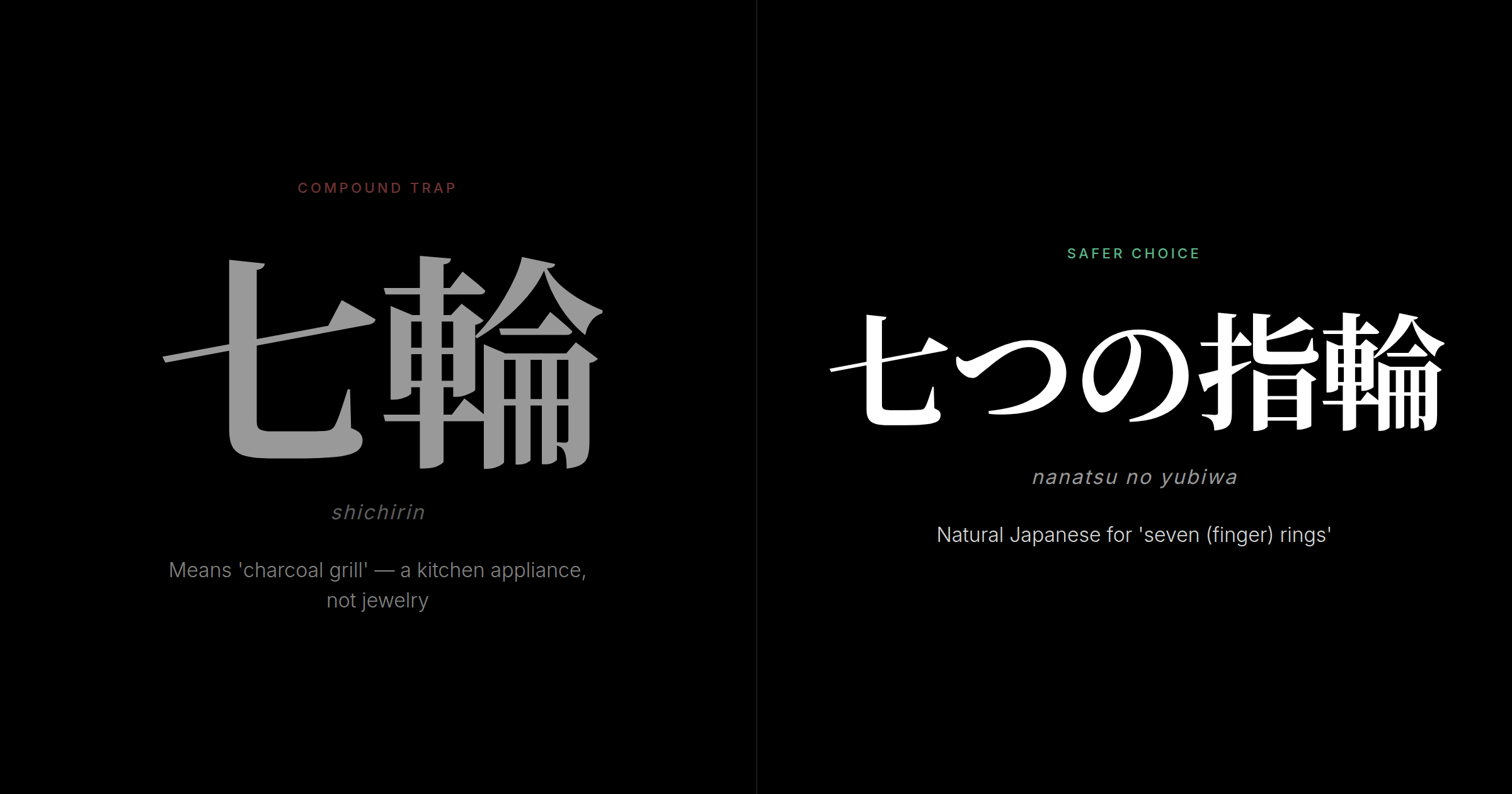
In January 2019, Ariana Grande debuted a palm tattoo to celebrate her hit song "7 Rings." The characters she chose were 七輪 — and within hours, Japanese speakers around the world were sharing screenshots. Not because the tattoo was offensive. Because it said shichirin, the word for a small portable charcoal cooking grill.
七輪 (shichirin — a small charcoal brazier used for tabletop grilling; you'd see one at a yakiniku restaurant, not on a celebrity's palm) is a perfectly ordinary compound word in Japanese. It just has nothing to do with rings, rings worn on fingers, or the number seven functioning as a stand-alone quantity. Her tattoo artist had likely assembled the characters 七 (seven) and 輪 (ring/circle/wheel) from separate dictionary lookups without understanding that the compound they form is a fixed, unrelated word.
Grande attempted a correction. The fix added 指 (yubi — finger; used in words like 指輪, "finger ring") and 小 (shou — small; appears in formal and everyday contexts alike) to the existing tattoo, producing something that now read approximately as "small charcoal grill, finger." The correction compounded the problem because it still didn't produce natural Japanese — it just added characters around a broken compound.
This story went viral for a reason that matters to anyone planning a kanji tattoo: it demonstrated, to millions of people simultaneously, that kanji cannot be assembled from parts. The meaning of a compound word is not always the sum of its characters.
Five Well-Documented Celebrity Kanji Fails (And What They Actually Mean)
1. 七輪 — The Charcoal Grill (Ariana Grande)
Already covered above, but worth stating precisely: the error pattern here is compound word collision. Seven (七) plus circle/ring (輪) does not produce "seven rings" in Japanese. It produces a kitchen appliance. This happens because kanji compounds function as vocabulary items, not math equations.
2. The "Loyalty" That Read as Noodles
A widely circulated case involves a tattoo intended to mean "loyalty" that used characters resembling 忠 (chuu — loyalty, fidelity; appears in political and formal contexts, including news coverage of loyal public servants and steadfast athletes) but was executed with strokes that more closely matched a character associated with noodles or pasta dishes, depending on which simplified variant the artist copied. The execution problem — poor stroke order, misdrawn radicals — is as dangerous as the translation problem. Even a correctly chosen kanji becomes nonsense if the strokes are wrong. For a deeper explanation of why stroke order and kanji anatomy directly impact tattoo quality, this guide covers how professional artists internalize character structure through stroke knowledge.
3. "Love and Peace" in the Wrong Script
Another documented pattern: a celebrity who wanted 愛 (ai — love; one of the most common kanji in Japanese pop music, advertising, and everyday written expression) in combination with a peace character, but received characters in a simplified Chinese form that doesn't appear in Japanese kanji at all. To Japanese readers, the tattoo read as visually foreign — recognizable in origin but not Japanese script. This distinction matters: Chinese hanzi and Japanese kanji overlap extensively but are not identical sets.
4. The Register Problem: "Strength" That Reads as a Warning Label
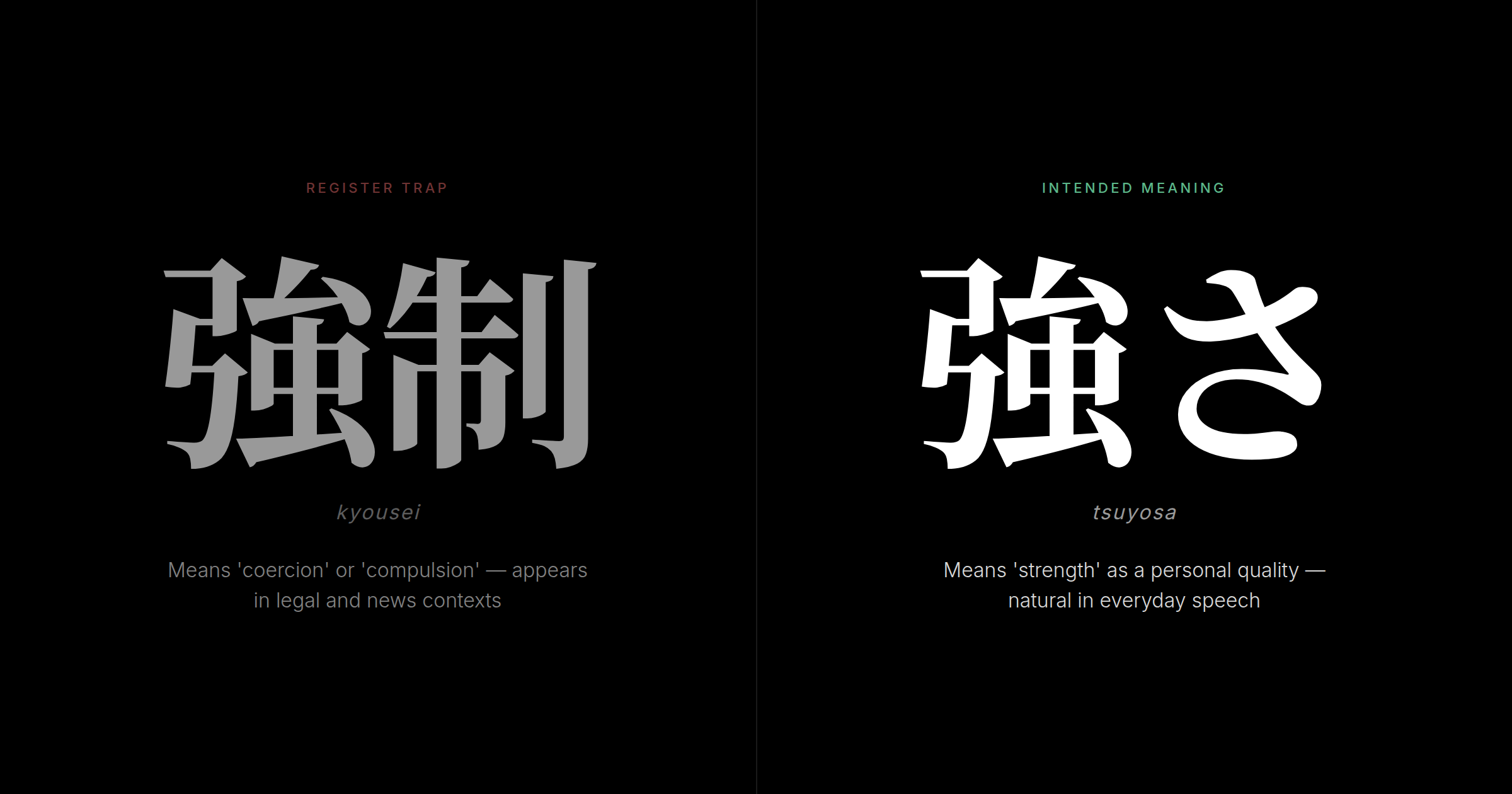
A less-discussed category involves kanji that are technically correct in meaning but wrong in register. Imagine someone wanting 強 (tsuyoi / kyou — strong, powerful; used widely in sports commentary, business contexts, and casual speech) but receiving 強制 (kyousei — coercion, compulsion; appears primarily in legal documents, news reports about abuse of authority, and policy contexts). The individual character 強 is correct. The compound is alarming.
5. The Upside-Down Problem
Several documented cases involve kanji applied by artists who couldn't distinguish orientation. 山 (yama — mountain; one of the most visually recognizable kanji, appearing everywhere from geography to personal names) inverted reads as an abstract shape to Japanese speakers — not as the intended meaning. Stroke direction and orientation are not optional aesthetic choices in kanji. They are structural.
Why Do These Fails Happen? The Three Core Mistakes
Based on thousands of verification requests reviewed by KIO's Tokyo-native team, celebrity tattoo fails and private-client tattoo fails share the same root causes. The budget is different. The errors are identical.
Mistake 1: Using machine translation to generate source characters. Google Translate and similar tools approach kanji by matching English keywords to Japanese characters. They cannot account for compound-word collisions (like shichirin), register mismatches, or the difference between dictionary entries and tattoo-appropriate usage. A Google Translate kanji tattoo starts at a structural disadvantage — the tool was built for reading comprehension, not permanent ink decisions. AI-based generators like ChatGPT or Stable Diffusion add a distinct risk: they don't just misapply real kanji, they can invent characters that don't exist in Japanese at all. For a deeper look at how AI generators hallucinate kanji and how to spot the fakes before committing to ink, see how AI kanji generators create characters that don't exist.
Mistake 2: Trusting a tattoo artist to verify the meaning. Most Western tattoo artists work from reference images. They can reproduce strokes with precision. What they generally cannot do is read the characters, assess cultural context, or flag compound-word problems. The artist who inked Grande's palm almost certainly had no idea 七輪 was a kitchen appliance. They reproduced what they were shown.
Mistake 3: Treating kanji as decoration rather than language. This is the philosophical root of all the above. Kanji is a writing system. Every stroke has structural purpose. Every compound has a meaning that emerged from historical usage, not logical assembly. When a kanji tattoo is treated as visual design first and language second, the verification step feels optional. It isn't.
The Native Verdict: What Japanese Speakers Actually Think
The internet frames celebrity kanji fails as embarrassing scandals. Japanese speakers experience them differently. The dominant reaction to Grande's charcoal grill tattoo is not offense — it's bemused recognition of the gap between intention and result, with underlying appreciation that someone cared enough to try.
Japanese cultural attitudes toward foreigners engaging with kanji are more generous than Western coverage suggests. The more common reaction is: "You wanted this permanently on your body — that's a real commitment. It's a shame no one helped you get it right."
What registers poorly is obvious laziness: a tattoo that appears chosen from a stock website with no research. Japanese speakers distinguish between a mistranslation that reflects earnest effort and one that reflects indifference. Your tattoo doesn't need to be perfect in every dimension. It does need to show that someone who speaks Japanese was involved. That difference is visible in the result.
For a comprehensive look at the full spectrum of native reactions—from quiet respect for well-researched tattoos to gentle amusement at honest mistakes to genuine discomfort at certain errors—see what Japanese people actually think when they see your kanji tattoo.
For deeper context on how Japanese people engage with non-native kanji usage, the kanji tattoo cultural appropriation article covers respectful engagement in detail.
How to Avoid Your Own Kanji Tattoo Disaster: A Pre-Ink Checklist
The celebrity fails above are not unlucky accidents. They are predictable outcomes of skipping steps. Here is the process that prevents them.
Step 1: Start from concept, not translation. Do not take an English phrase to Google Translate and present the output to a tattoo artist. Instead, describe to a native Japanese speaker what feeling, value, or concept you want to convey. Let them suggest the kanji or phrase that expresses that concept naturally.
Step 2: Understand what you're getting. Before committing, make sure you can explain what the kanji means — not just the English gloss, but the actual nuance. 力 (chikara — power, physical strength; used in athletic contexts, motivational speech, and personal declarations of resolve) and 強さ (tsuyosa — strength as an abstract quality; appears in self-help writing, sports journalism, and character description) both relate to "strength," but they feel different in Japanese. Know which one you want and why.
Step 3: Get independent verification. Having one Japanese speaker confirm a tattoo is better than having zero. Having two who arrived at their assessments independently is significantly better. If both confirm the same reading and appropriateness, you have real confidence. If they disagree, you have valuable information before the needle touches skin.
Step 4: Discuss stroke integrity with your artist. Find an artist who has experience with Japanese characters and understands that stroke direction and count are not stylistic options. A beautifully rendered wrong stroke is still wrong. Ask to see examples of their kanji work and confirm they understand the structural requirements.
A detailed walkthrough of this process — including what to ask a native speaker and how to evaluate their feedback — is in the how to verify a kanji tattoo before getting it guide.
Can You Fix a Bad Kanji Tattoo? What the Celebrity Cases Teach Us
Grande's correction attempt is the canonical cautionary tale for tattoo modification. She added characters to an already-broken compound and produced something that read as even more nonsensical. The lesson is structural: you cannot fix broken Japanese by adding more Japanese around it if the core characters form a fixed compound.
The options for correction depend on how the original tattoo fails:
Wrong compound, correct strokes. Adding strokes to change the compound is the highest-risk approach. Each kanji character has fixed forms; adding strokes to change meaning often produces a character that either doesn't exist or looks malformed. This is what happened with Grande's fix. A better approach is redesigning the tattoo to incorporate the existing characters into a larger image that contextualizes or obscures them.
Correct compound, wrong strokes. This is more fixable with a skilled artist who understands kanji structure. A single malformed stroke can sometimes be corrected in a touch-up if the surrounding ink hasn't spread. More severe stroke damage generally requires cover-up.
Correct kanji, wrong meaning for you. This is the case where you learn, years later, that your "strength" tattoo actually means "coercion." Cover-up or removal is the realistic path. Laser removal followed by a new, verified tattoo is increasingly common and, for most people, the cleanest long-term outcome.
The wrong kanji tattoo removal and cover-up article covers costs, timelines, and what to expect from each option in detail.
The Flip Side: What Getting It Right Looks Like
Celebrity fails dominate the coverage, but quieter success stories exist. Several musicians and athletes with visible kanji tattoos appear to have worked with native speakers before inking. The tell is consistency: kanji that appears in natural Japanese usage, in a form that matches standard stroke requirements, with a meaning that aligns coherently with what the person says it means.
The process is not glamorous. It involves a conversation with a native speaker, back-and-forth on options, a second opinion, and a briefing for the tattoo artist — days or weeks before the appointment. None of that makes headlines.
What the correct tattoos share is permanence without regret. That's the entire goal. For a starting point of 10 single kanji that have already been vetted through this exact process by Tokyo natives, see the guide to the best single kanji for tattoos — each comes with context on its cultural weight, stroke count, and why it earns quiet respect from native readers.
Frequently Asked Questions
Why did Ariana Grande's kanji tattoo say 'charcoal grill' instead of '7 rings'?
She used 七輪 (shichirin), which is the Japanese word for a small portable charcoal cooking grill used in tabletop grilling. The characters 七 (seven) and 輪 (circle/ring/wheel) do form the compound shichirin, but that compound refers to a kitchen appliance, not jewelry. Her tattoo artist likely sourced the characters from separate dictionary lookups without checking whether the resulting compound already existed as a fixed Japanese word — which it did, and which it does not mean "seven rings."
How would you actually say '7 rings' in Japanese?
The song's original title is more naturally rendered in katakana as セブン・リングス, which is the phonetic Japanese transliteration. If kanji were required, 七つの指輪 (nanatsu no yubiwa — seven finger-rings; note this is a literal descriptive phrase, not an idiomatic title, which is exactly why Japanese speakers default to the katakana song name) would be the natural expression. The lesson is that English concepts don't always translate directly into kanji; a native speaker's guidance on how to express the intended concept is more valuable than a direct character-for-character translation.
Are kanji tattoo fails actually offensive to Japanese people, or just funny?
Mostly funny, with underlying appreciation for the effort. Japanese people generally don't take offense at Western tattoo mishaps — they recognize that the intent is usually sincere. What registers poorly is not the error itself but evidence of zero care: a tattoo that looks like it was chosen from a stock image site with no research. A tattoo that shows genuine effort, even with a mistake, reads differently than one that shows no engagement with Japanese language at all. For a comprehensive look at how Japanese people actually react to kanji tattoos across different contexts and error types, see what Japanese people actually think when they see your kanji tattoo.
Can you fix a bad kanji tattoo the way Ariana Grande tried?
Technically yes, practically risky. Grande's attempt to add characters around 七輪 produced something that read as even more incoherent because the original compound was still there. Options for correction include redesigning the tattoo to incorporate or obscure the existing characters, cover-up with new art, or laser removal followed by a new verified design. The fundamental rule: you cannot fix broken Japanese by adding more Japanese around a broken compound. Prevention is always cleaner than correction.
How do I make sure my kanji tattoo is correct before I get it?
Start with a native Japanese speaker, not a translation app. Describe the concept you want to express in your own words and ask them to suggest the kanji that would convey it naturally. Get a second native speaker to independently verify the suggestion. Once you have verified kanji, brief your tattoo artist on stroke requirements and ask to see their experience with Japanese characters. The whole process should happen before your appointment, not at it.
Why is it risky to rely on a non-Japanese tattoo artist for kanji accuracy?
Most Western tattoo artists work from reference images and cannot read the characters they're reproducing. They can execute strokes with precision but cannot assess whether the compound is correct, whether the characters form an unintended word, or whether the cultural register is appropriate. The artist who inked Grande's tattoo reproduced the characters they were given — that's their job. Verifying the meaning before the appointment is the client's responsibility, best fulfilled with native-speaker consultation.
If you're planning a kanji tattoo — or if you already have one and aren't 100% certain it says what you think it says — get a verification from Kanji Ink Oracle. KIO's Tokyo-native reviewers assess kanji for meaning, register, stroke accuracy, and cultural appropriateness, returning a detailed written assessment within 24 hours. The celebrities who got it wrong didn't have that option. You do.