How to Find a Japanese Tattoo Artist Who Won't Mess Up Your Kanji
Discover the key difference between a tattoo artist and a kanji specialist. Learn what makes a true kanji expert and the critical questions to ask before booking.
You've settled on a kanji tattoo and you're ready to find an artist. You've been scrolling Instagram, watching flash sheets, maybe even emailing a few studios. But something keeps nagging at you: how do you actually know if a tattoo artist understands kanji — not just as a visual shape, but as a language?
That nagging feeling is correct. Finding someone who can execute a technically impressive tattoo and finding someone who understands kanji are two very different searches, and conflating them is the root cause of most kanji tattoo mistakes.
Why Tattoo Skill and Kanji Literacy Are Separate Things
A skilled tattoo artist has spent years mastering needle pressure, ink saturation, line weight, and composition — skills that have nothing to do with reading Japanese. Kanji literacy requires a different training entirely: formal study of a writing system with roughly 2,000 commonly used characters, each with multiple readings, stroke orders, and contextual meanings.
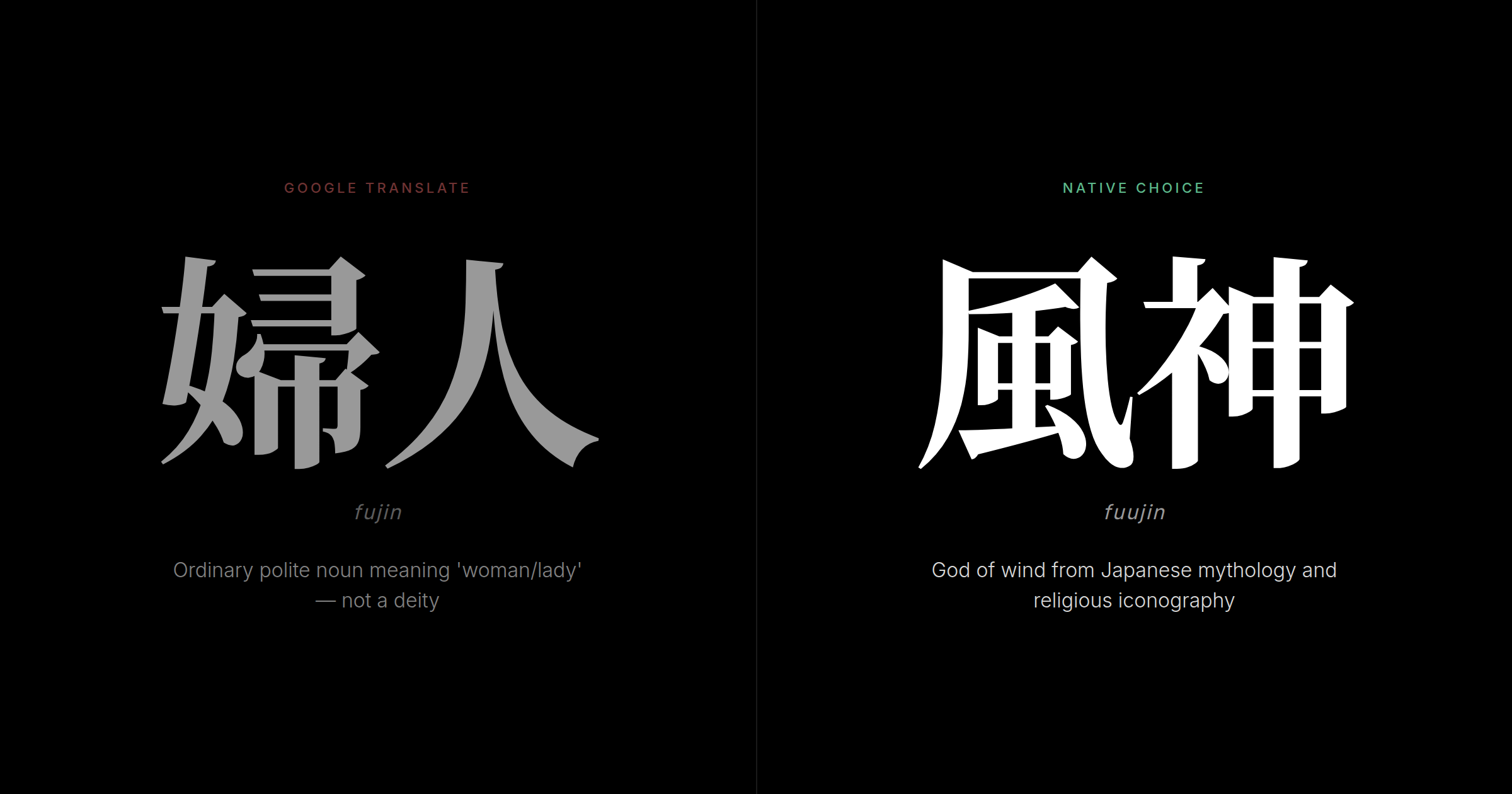
The difference between 婦人 (fujin — a formal word for "woman" or "lady", used in polite address and signage contexts) and 風神 (fuujin — the god of wind, a figure from Japanese mythology and religious art) comes down to a single component. To an untrained eye, both look like "something Japanese." To a native reader, one is an ordinary polite noun and the other is a deity.
Based on patterns emerging from KIO's verification work, this category — single-component confusion between visually similar characters — accounts for a significant share of the errors submitted by readers who had already been tattooed. In most cases, the tattoo artist had copied a reference image without the literacy to notice the difference.
The Difference: Regular Tattoo Artist vs. Kanji Specialist
A regular tattoo artist approaches kanji as a design element — the composition of strokes, the balance of density and negative space. What they typically cannot do is distinguish which strokes are semantically load-bearing and which are merely stylistic variations.
In calligraphic traditions, every component carries meaning. The radical (semantic root, usually on the left or bottom) signals the general category of meaning. The phonetic component (often on the right) indicates how the character is read. An artist without kanji literacy may treat a simplified font or stylistic flourish as equivalent to the original — not because they are careless, but because to their eye, it still looks like "the character." A native reader sees a different word.
Genuine kanji specialists bring three things to the table: native or near-native Japanese reading ability; formal calligraphic training (artists who have reached a Shihan (師範 — "master instructor") rank have spent years learning how each stroke is constructed and why); and the precision that comes from training systems where every stroke placement is assessed. This combination is rare even in Japan. The correct frame for your search is not "a tattoo artist who does Japanese characters" — it is "someone who understands kanji as a linguistic system and also tattoos."
What to Look for in a Kanji Tattoo Artist
Bilingual fluency — not just the ability to copy
The first question to settle: can the artist actually read and write in Japanese? Bilingual fluency means they can take your intended meaning in English, identify the correct character or compound, and explain why that character is appropriate — not just copy a reference. "I tattoo a lot of Japanese designs" describes a portfolio, not a linguistic capability.
Formal credentials worth asking about
The Shihan (師範 — "master instructor" rank in traditional calligraphy schools; the highest teaching credential in many classical arts) credential is a meaningful marker. Institutions like the Nihon Shodou Kyouiku Gakkai (日本書道教育学会 — Japan Calligraphy Education Association) issue these ranks after years of supervised examination — assessing the ability to write characters correctly, not just beautifully. Not every excellent kanji tattoo artist will have a formal rank, but their answer to "what is your formal training in Japanese calligraphy?" should be substantive.
Portfolio specifics to check
Traditional Japanese tattooing — irezumi (入れ墨 — "inserting ink"; the classical Japanese tattooing tradition; 入れ墨 historically carries punitive/yakuza stigma in Japan, with 刺青 (also read irezumi) as the contemporary neutral term) — may involve kanji peripherally or not at all. An irezumi artist can be exceptional without any specific training in kanji as a linguistic system. When reviewing a portfolio, look specifically for:
- Stand-alone kanji or compound tattoos (not kanji embedded in larger irezumi compositions)
- Evidence that the artist discusses meaning, not just aesthetics
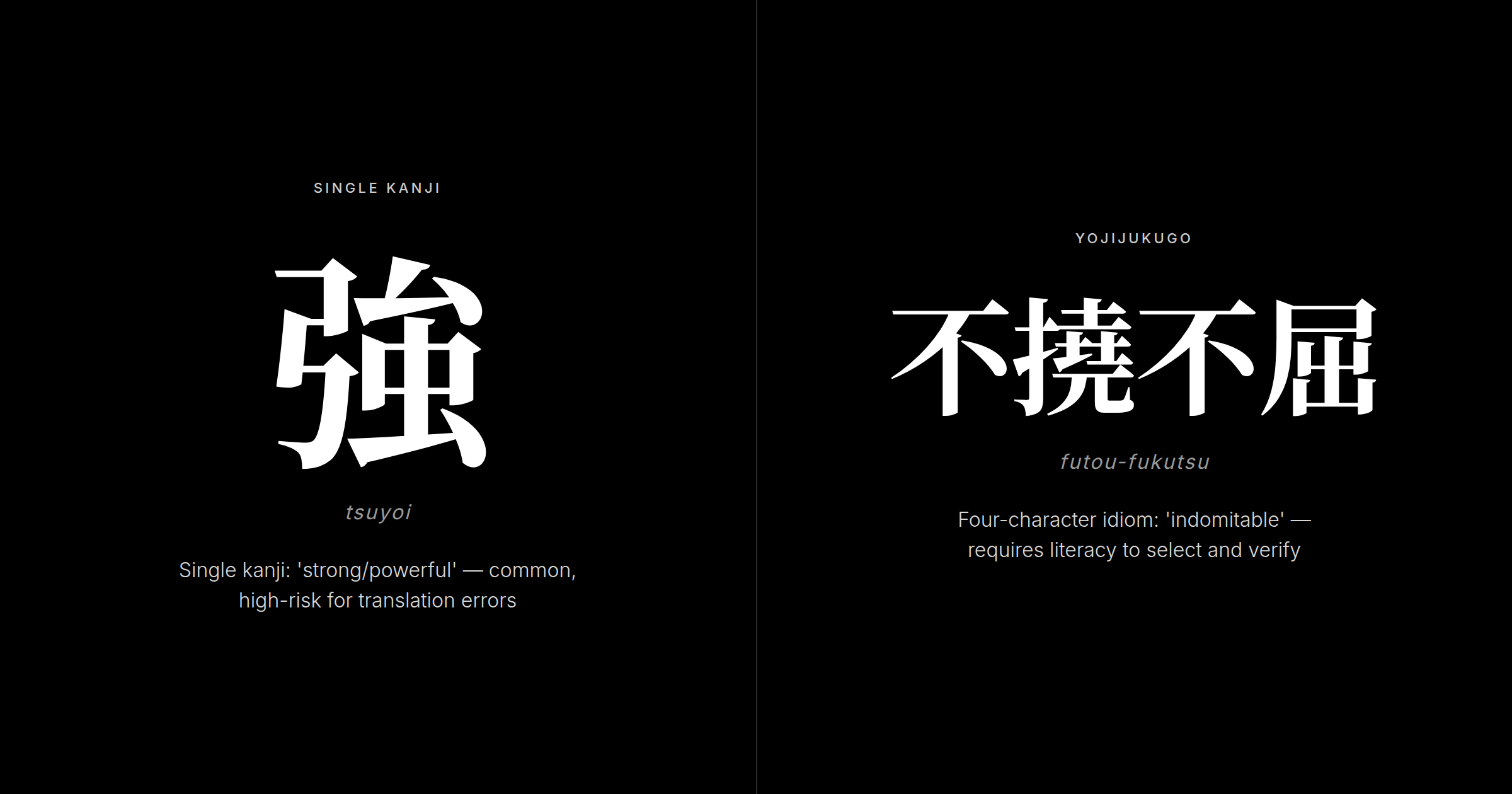
- Examples of yojijukugo (四字熟語 — yojijukugo; four-character compound idioms used in formal speeches, literary writing, and school examinations) — these require genuine literacy to handle correctly
How they handle the consultation
A genuinely qualified artist slows the process down. Expect them to ask about your intended meaning before proposing characters, offer multiple options with explanations, discuss how font style interacts with the specific character's structure, and provide a finalised design in writing before any booking is made. If an artist immediately names a character without discussion, or says "just bring me a reference image and I'll copy it," keep looking.
The Pre-Ink Consultation: What Should Happen Before the Needle
The consultation is not a formality. For kanji, it is the entire point of the process. A thorough consultation should move through four stages:
Meaning discussion: You describe your intended concept in plain English — not characters. A good artist asks whether this is a personal value, a memorial, or a declaration, because the answer determines which characters are appropriate.
Character proposal: The artist presents two or three options with explanations of how each is used in modern Japanese — register (formal vs. casual), typical contexts, and any associations that read differently to a Japanese audience than a Western one.
Style and placement discussion: How a character is rendered — stroke weight, proportions, ink style — affects aesthetics without changing linguistic content. A specialist walks you through these choices within the constraints of correctness. For a deep dive into how body location, size, and reading direction shape cultural coherence, see the placement guide covering size, direction, and body location.
Written confirmation: Before any appointment is booked, you should have a finalised stencil with the exact character confirmed in writing. "The meaning is whatever you want it to mean" is not a consultation outcome. A confirmed design document is.
Any artist who finds this process excessive is an artist to avoid.
Where to Find Legitimate Kanji Tattoo Artists
Japan-based studios with bilingual staff
Studios in Japan with English-speaking staff and kanji-literate artists are one of the most reliable options — particularly in Tokyo, Osaka, and Kyoto. Research before travelling, and confirm that the specific artist, not just the studio, has demonstrated kanji expertise.
Internationally based specialists
Major cities with Japanese diaspora communities — New York, Los Angeles, London, Sydney — have kanji specialists who are Japanese natives or trained under Japanese calligraphic traditions. Instagram is the most practical research tool: search for portfolios showing stand-alone kanji work with captions in both English and Japanese. An artist who discusses the meaning of their work publicly is demonstrating literacy, not just technique.
Master calligraphers who offer tattoo design services
Work with a classically trained calligrapher to produce a design, then bring it to a tattoo artist for execution on skin. This separates the two skill sets deliberately: the calligrapher handles character selection and accuracy; the tattoo artist handles placement and skin technique. If you choose this path, deliver the design as a high-resolution image and brief the tattoo artist explicitly not to modify the character composition.
Red flags to watch for
- An artist who uses Google Translate or a translation app during your consultation to look up characters
- An artist who says "your meaning is what matters most" without engaging with what the character actually means in Japanese
- An artist who rushes the process, discourages questions about meaning, or cannot explain stroke structure
- A portfolio with kanji work but no captions, explanations, or client discussion documented
The consultation phase reveals almost everything. An artist who finds questions about accuracy inconvenient is giving you the information you need.
Common Mistakes Westerners Make When Choosing an Artist
Assuming any Japanese tattoo artist knows kanji well: Traditional irezumi artists may be exceptional at their craft without having studied kanji as a linguistic system. Being Japanese does not automatically confer expertise in character accuracy for every context.
Choosing based on price: Legitimate kanji specialists charge for consultation time, not just needle time. Consider the cost of laser removal — covered in detail at kanji tattoo removal and cover-up options — against the upfront cost of getting it right.
Skipping independent verification: Even with a skilled artist, an independent second opinion from a Japanese native speaker is sensible. Reddit's r/LearnJapanese and r/translator communities, Japanese language teachers, or a verification service can review your stencil before you commit.
Using online translators to source the character: The dangers of Google Translate for kanji tattoos article covers this fully. The short version: machine translation produces plausible-looking but frequently wrong results and cannot tell you which of several valid characters fits your intended nuance.
Not specifying the font: Computer fonts render kanji with standardised, sometimes simplified strokes. A calligrapher may write the same character with different proportions for aesthetic reasons — which is fine, but requires confirming the result still reads correctly. Ask to see the final brush rendering before the appointment.
Native Verdict: What Tokyo-Native Kanji Experts Wish Western Clients Knew
The core insight from professionals trained in traditional Japanese calligraphic schools: kanji is not primarily an aesthetic system. It is a linguistic system where a single stroke difference changes meaning.
Western tattoo traditions are fundamentally design traditions — visual impact first. Japanese calligraphic training runs in the opposite direction: the character must be correct first; aesthetic choices happen within the constraints of correctness. This gap explains most kanji tattoo errors. Western tattoo artists are not careless — they are applying their training's standard, which is visual fidelity to a reference image. Kanji requires linguistic fidelity to the character's stroke structure. They are genuinely different measures of accuracy.
The "right" character is never a neutral choice. 仁 (jin — benevolence, humaneness; used in formal and literary Japanese to describe compassionate leadership and moral integrity) and 人 (hito/jin — person, human being; the most ordinary of characters, found in countless everyday words) are visually close but entirely different in register. An artist who understands both helps you choose with intention. An artist who doesn't will ink whichever one you hand them.
Waiting lists of two to six months for sought-after kanji specialists are not unusual. Use that time to read about how to choose meaningful kanji for your tattoo and have your design reviewed before the appointment. You are not just hiring a tattoo artist. You are hiring a guardian of meaning and precision.
FAQ
Can a regular tattoo artist create a kanji design if I bring them the character?
A tattoo artist can copy the stroke pattern you provide, but cannot verify the character means what you intend, spot stroke-level differences that change meaning, or advise on style choices within the constraints of correctness. Think of it like asking a typesetter to copy a document in a language they cannot read — the visual will be reproduced with fidelity, but errors in content go uncaught.
How do I know if my potential artist actually knows kanji?
Ask three questions: Can you read and write kanji fluently? What is your formal training in Japanese calligraphy? Can you walk me through the stroke construction and modern usage of the character I am considering? A qualified artist answers all three with confidence. If they hesitate, redirect to aesthetics, or say "the meaning is whatever you want it to mean," find someone else.
Is it better to get kanji designed by a calligrapher, then show a tattoo artist?
This is one of the most reliable approaches available. You engage a classically trained calligrapher to handle character selection, accuracy, and brush style. You then bring the finalised high-resolution design to a skilled tattoo artist for execution on skin. Each professional focuses on what they have trained for. The key requirement is that the tattoo artist must reproduce the calligrapher's final design accurately without modifying the character's composition. Brief them explicitly on this point.
Why do some Japanese tattoo artists charge so much more than others for kanji?
Legitimate kanji specialists have invested years in a skill set beyond needle technique, and they spend significant pre-ink consultation time that other tattoo artists do not bill for. You are paying for character verification, stroke knowledge, and professional accountability. Low-cost kanji tattoos typically mean abbreviated consultation and higher error risk. Compare the price against the cost of laser removal.
What is the difference between getting kanji done in Japan versus my home country?
Studios in Japan are more likely to have staff with native Japanese literacy. That said, excellent kanji specialists work internationally, and Instagram has made them findable globally. Location matters far less than credentials. A specialist in London who trained in Japan and holds a calligraphic teaching rank is a better choice than a Japan-based studio without demonstrable kanji literacy.
How far in advance should I book a kanji tattoo?
Top kanji specialists often carry waiting lists of two to six months — and that lead time is a benefit, not a problem. Use it to research your character thoroughly and have the design verified independently before the appointment. Rushing the process to fit a shorter schedule is how permanent mistakes happen.
Should I get my kanji design verified by someone other than the artist?
Yes, even when working with a highly qualified artist. An independent review catches edge cases that might arise from regional variation, personal interpretation, or simple oversight. Learn how to verify your kanji tattoo before getting it, which covers the full verification process. Options include Japanese language communities on Reddit, Japanese language teachers, and dedicated verification services. A second opinion on your finalised stencil costs very little.
What if my artist says multiple correct versions exist for one meaning?
This is often accurate — many concepts can be expressed through more than one kanji or compound, each with different register or cultural association. A qualified artist presents these options with clear explanations of the differences. Be alert only if the artist cannot explain the distinctions or treats the choice as arbitrary. Genuine expertise produces specific reasoning. Uncertainty without explanation is a red flag.
Before you find an artist, make sure the character you have in mind is actually right for your intention. Kanji Ink Oracle offers character verification by Tokyo-native reviewers — submit your design or proposed character and receive an assessment of accuracy, register, and cultural appropriateness within 24 hours. A verified design gives both you and your chosen artist a solid foundation to work from.
For further reading: learn how to tell if your kanji tattoo is wrong and discover what Japanese people really think about kanji tattoos to understand the cultural context that shapes how your tattoo will be read by native speakers.