One Piece Kanji Tattoos: 仲間 and What Natives Really Read
One Piece fans love its kanji — but a Tokyo native reads 仲間 differently than anime frames it. The real verdict on nakama, saikyou, and safer choices for your skin.
One Piece has sold over 530 million manga volumes worldwide, making it the best-selling manga series in history. For many Western fans, Monkey D. Luffy's journey from a rubber-limbed kid to the freest person on the seas is not just entertainment — it is a formative text. The themes of chosen family, relentless pursuit of dreams, and the right to live by your own rules land with real emotional weight. It is no surprise that many fans want to carry those values on their skin.
But the kanji at the heart of One Piece — 仲間 (nakama), 最強 (saikyou), 夢 (yume), 自由 (jiyuu) — exist in real Japanese language before they existed in the story. What they mean inside Luffy's world and what they read like to a native speaker walking down Shibuya are not the same thing. For anyone considering a One Piece tattoo, understanding this gap between anime meaning and native interpretation is essential.
One Piece's Philosophical Core: The Words That Drive the Series
Eiichiro Oda built One Piece around a small set of themes that are genuinely central to Japanese cultural and ethical discourse: the freedom to define your own life, the importance of one's crew or group, the transformative power of dreams, and the weight of becoming the strongest. These are not invented abstractions — they map onto real Japanese values that appear in sports journalism, company philosophy statements, formal speeches, and everyday conversation.
The series draws on these themes with unusual consistency. Where many shonen manga use power and rivalry as their primary engine, One Piece keeps returning to 仲間 — the idea that Luffy's strength comes from his bonds, not just his abilities. This framework is legible to Japanese readers because it echoes something real in how the culture talks about groups, belonging, and shared purpose.
That cultural rootedness is precisely why the kanji feel meaningful enough to tattoo. But it also means they carry connotations, register, and everyday contexts that the anime never shows.
The 仲間 (Nakama) Phenomenon: What the Word Actually Carries
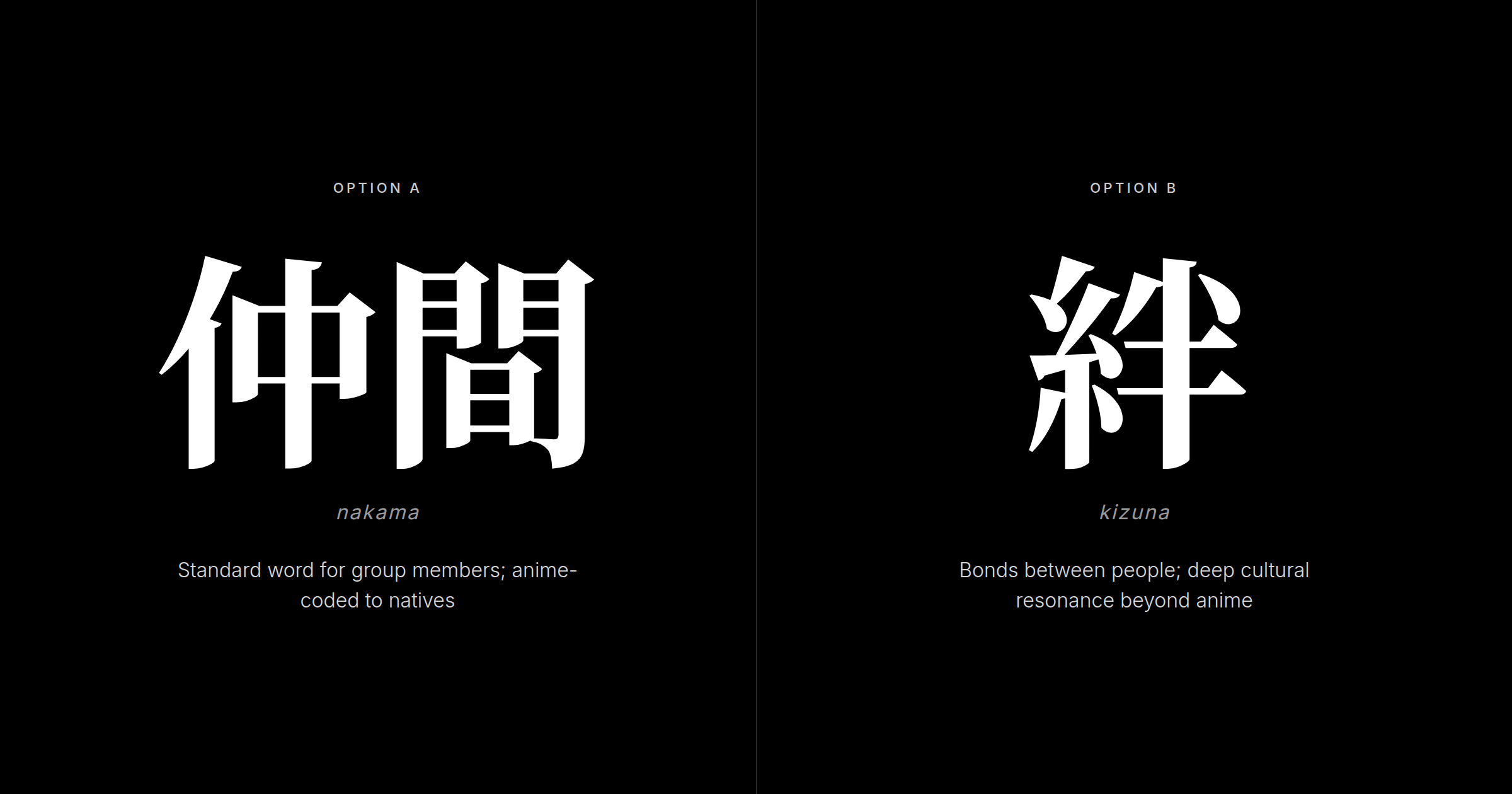
仲間 (nakama — comrades, companions, members of a shared group; a standard, versatile Japanese word used across a wide range of social and professional contexts) is the word most associated with One Piece in Western fandom circles. Luffy uses it to describe his crew as an unbreakable unit — chosen family, people he would risk everything for. The English subtitles sometimes translate it as "friends," sometimes "crew," depending on context, but fans have settled on keeping the Japanese term because it feels irreplaceable.
The etymology reinforces this feeling: 仲 (naka — relations, middle ground, the space between people) combined with 間 (ma — space, interval, distance). The compound literally gestures at the ground shared between people — those you do things alongside, who occupy the same social space you do.
In standard Japanese usage, however, 仲間 is workaday vocabulary. Your colleagues at a job you dislike are still your 仲間 if you are working toward a shared goal. A school club's members are 仲間. A neighborhood cleanup committee is made up of 仲間. The word appears in corporate mission statements, sports team profiles, political organizing, and children's textbooks. It is no more elevated or sacred in Japanese than the English word "colleagues" — functional, warm when used among close groups, but not spiritually charged.
Based on KIO's verification work across thousands of kanji tattoo requests, 仲間 is among the most frequently submitted One Piece terms — and it is consistently flagged not for linguistic error but for register misalignment: fans expect the kanji to carry the anime's emotional amplification, and that expectation is what a native speaker cannot share. The same gap appears in Hunter x Hunter's 念 (nen) tattoos, where the anime frames the character as power but real Japanese reads it as spiritual focus.
The distinction matters on skin. When a Western fan tattoos 仲間, they are reaching for the One Piece meaning: unbreakable chosen family, bonds that transcend blood. When a Japanese person reads it on a forearm, they see the standard word for group members with an anime gloss. The kanji is not wrong. The emotional weight the fan carries into it simply does not transfer through the characters themselves.
The Kanji: Breaking Down the Characters
The five most tattooed One Piece kanji each have their own linguistic profile that shapes how they read outside the anime context.
仲間 (nakama — comrades, group members)
仲 (naka — relations, the state between people) combined with 間 (ma — space, interval; foundational kanji found in 時間 jikan and 人間 ningen). The compound reads smoothly with no hidden meaning or alternate dangerous reading. What a native sees on your arm is exactly what it says — with an inevitable One Piece association attached.
最強 (saikyou — the strongest)
最 (sai — utmost, superlative prefix) combined with 強 (kyou — strong). 最強 appears in sports journalism, business copy, and everyday speech. It is clean and versatile without anime-exclusive associations — you will see it on a wrestler's poster as readily as in One Piece.
夢 (yume — dream, aspiration)
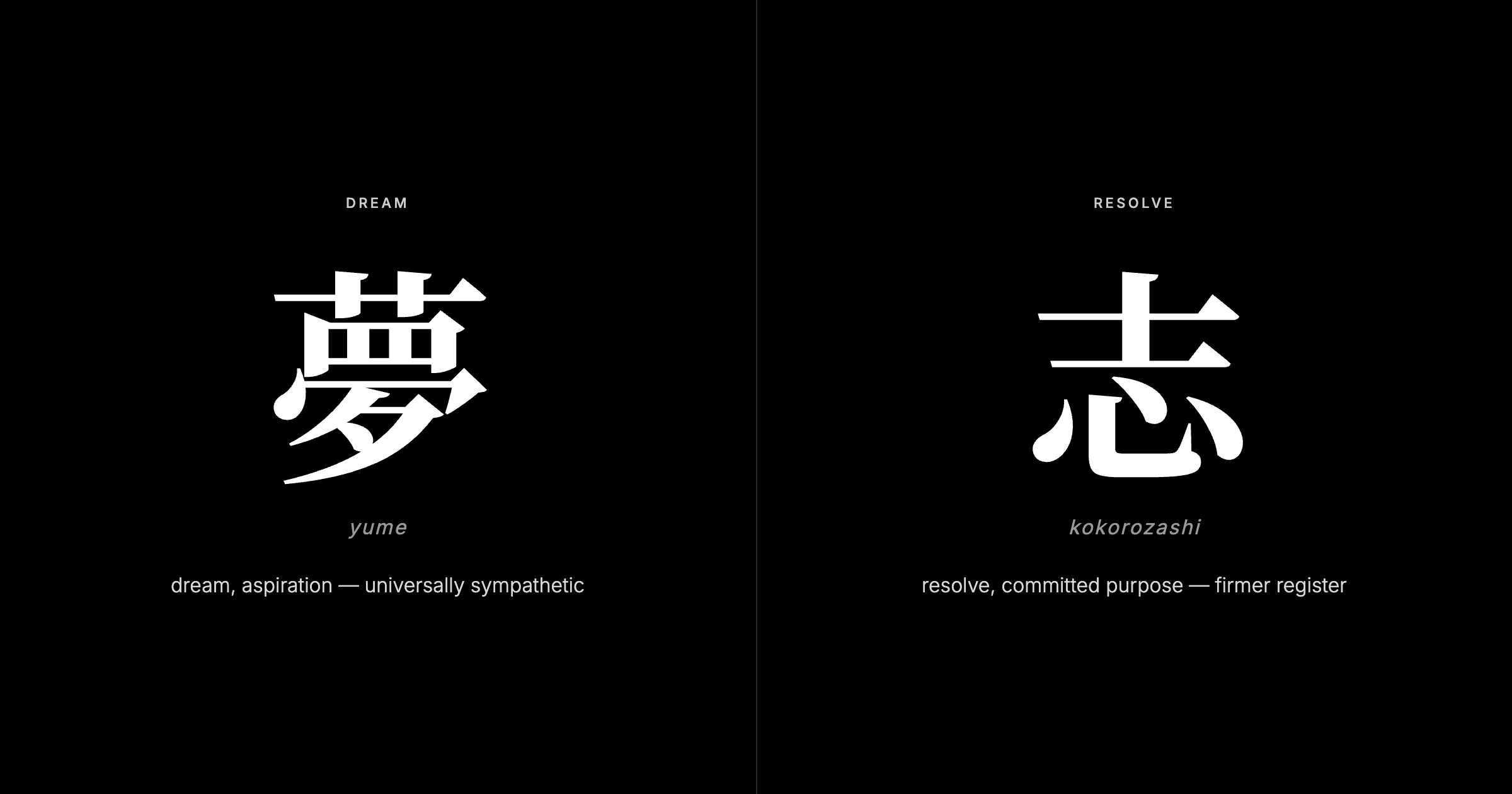
夢 appears in company names, song lyrics, and political speeches. Genuinely versatile as a standalone tattoo — it carries Luffy's meaning without being owned by the anime. A native reader will not immediately think One Piece when they see 夢 alone.
自由 (jiyuu — freedom)
自 (ji — self) combined with 由 (yuu — reason, source). 自由 appears in constitutional law, civil liberty discourse, and everyday speech about personal autonomy. Luffy's version of freedom maps cleanly onto this word's actual meaning. It is the least anime-coded option on this list. Attack on Titan also centers its philosophy around this same kanji, making 自由 one of the rare anime values that carries equivalent weight in both franchises.
海賊 (kaizoku — pirate)
海 (kai — sea) combined with 賊 (zoku — bandit, criminal). A precise word for pirate that appears in history textbooks and news journalism. Vivid and on-theme as a tattoo, but reads as narrative statement rather than personal value — "I love pirates" rather than "I value freedom."
So What Happens When You Put This on Your Skin?
The cultural depth of these words is real — they are not invented anime vocabulary, they are part of a living language. But the moment you isolate a kanji on your body, it exits the story's context and enters the reading context of whoever encounters it. That gap is where most One Piece tattoo decisions go wrong — not linguistically, but in terms of what the wearer expects the kanji to communicate versus what a native speaker actually receives.
Native Verdict: What a Tokyo Speaker Actually Reads
Native Verdict
A Tokyo native encountering 仲間 tattooed on a Western person's forearm processes it quickly. The kanji is correct — there is no linguistic error to wince at. The reading is immediate: this person loves One Piece, or at minimum values the idea of camaraderie. The reaction is typically mild curiosity or quiet recognition, not offense.
What will not transfer is the emotional charge. In the anime, 仲間 carries enormous weight — it is the word Luffy says with complete conviction when he declares he will not abandon his crew. For a native speaker, that same word is what you use to describe the people on your volunteer committee. The gap between those two registers is not a flaw in the kanji — it is a feature of how the anime exports Japanese vocabulary with amplified emotional framing that does not exist in the original usage.
最強 (saikyou — the strongest) reads cleanly without One Piece associations. You might as well have a sports brand slogan on your arm — vivid, direct, and understood. 夢 (yume — dream) is the most universally legible choice here; a native will read it as a personal aspiration statement rather than an anime reference. 自由 (jiyuu — freedom) reads as a genuine philosophical statement — the most grown-up choice of the group.
海賊 (kaizoku — pirate) will prompt a smile. It is not offensive; it is theme-specific. The native reads it as "this person loves pirates or One Piece" — which may be exactly the statement the wearer intends.
For 仲間 specifically: the verdict is not "don't get this." The verdict is "understand that a native reader will see your fandom before they see your philosophy." If that is the statement you want to make — "I love One Piece, and these bonds matter to me" — then 仲間 delivers it cleanly. If you want a tattoo that reads as a universal statement about camaraderie and belonging independent of the anime, there are better options.
Better Alternatives: Kanji That Carry the Feeling Without the Anime Filter
If the underlying value matters more than the One Piece reference, these kanji carry similar emotional weight with different native-speaker associations.
絆 (kizuna — bonds, ties between people)
絆 (kizuna — emotional bonds, ties connecting people) became one of the most culturally resonant words in modern Japan after the 2011 Tohoku earthquake and tsunami, when it was adopted as a nationwide symbol of social solidarity and mutual support. It appears in news coverage, public campaigns, and everyday speech about meaningful relationships. It conveys what One Piece fans reach for when they say "nakama" — the unbreakable tie between people — but it carries that meaning without the anime association. A native reader sees 絆 on your forearm and reads loyalty, human connection, and resilience; they do not immediately reach for a fictional reference. This same kanji carries particular power for fans of found-family narratives more broadly — it appears repeatedly across anime that center emotional bonds over blood kinship, most recently as a top-tier choice for SPY×FAMILY tattoos where it signals bonds that survived operational deception.
For the freedom-seeker: 自由 (jiyuu — freedom)
If 自由 resonates because of Luffy's arc, you are already holding the better choice. 自由 is the word Japan's constitution uses for personal autonomy; it appears in civil liberty discourse and everyday speech. It does not need One Piece credentials — it carries its own weight. A native reader sees a genuine philosophical statement, not anime fandom.
For the dream-holder: 夢 (yume — dream, aspiration)
夢 delivers Luffy's driving force without requiring anime knowledge. A native reads it as personal aspiration, with the anime connection secondary. For a firmer register, 志 (kokorozashi — resolve, a committed purpose one sets out to achieve) carries a similar forward-looking spirit with more gravity and less whimsy: it names a long-held determination rather than a wish. Between the two, 夢 reads as the more universally sympathetic choice, while 志 signals discipline.
See our guide on choosing meaningful kanji for tattoos for a broader framework on how to select kanji that will age well.
Common Mistakes One Piece Fans Make Before the Needle Touches Skin
The failures KIO reviewers see most often in anime submissions involve verification gaps. The Google Translate kanji tattoo problem is common: fans get kanji output and assume it is sufficient, without checking if the compound forms a real phrase.
The compound combination trap. Stacking characters to create a personal phrase often fails because Japanese requires specific readings and grammatical structure. Ariana Grande's 七輪 (shichirin — charcoal grill, not "seven rings") is the canonical example: combining characters without verifying how they function as a compound produces unintended meanings.
The screenshot trap. Fan wikis often contain stroke errors or radical substitutions. A screenshot is not a verified source. See fake Japanese kanji in anime for details.
Before committing, verify your kanji design properly — the process is straightforward and makes the difference between a tattoo you explain proudly and one you make excuses for.
See our guides on Naruto kanji tattoos, Dragon Ball's authentic gi symbols, and Studio Ghibli kanji for how other anime properties export Japanese language differently. The Chainsaw Man register mismatch guide goes deeper into how correct kanji can still read as mundane to natives — a pattern relevant across anime-inspired tattoos where emotional weight doesn't transfer from screen to skin. And for understanding how symbols can carry completely different meanings depending on geography, the Tokyo Revengers manji guide explores a case where the tattoo is culturally sacred in Japan but carries significant social risk in the West.
FAQ: Your One Piece Kanji Tattoo Questions Answered
Is getting a 仲間 (nakama) tattoo offensive to Japanese people?
No, it is not offensive if the kanji is correct, and 仲間 is correct. Native speakers will recognize you as an anime fan and most will find it endearing or amusing. The issue is not respect — it is linguistic register: nakama in real Japan is an everyday word for group members, without the emotional amplification One Piece attaches to it. Japanese people tend to respond with curiosity rather than judgment. The real concern is accuracy, not appropriation.
What does a native Japanese person actually think when they see a nakama tattoo?
They will likely read: "This person loves One Piece" or "They value camaraderie." They may find the emotional intensity slightly amusing, because in everyday Japanese 仲間 is functional — your coworkers are your nakama if you share a goal. Natives understand that anime exports a romanticized version of Japanese values. Most reactions are positive or neutral, and a Tokyo native will not consider the kanji wrong.
Why is nakama better or worse than other One Piece kanji like saikyou or jiyuu?
All three are linguistically correct. 最強 (saikyou — the strongest) and 自由 (jiyuu — freedom) are arguably more universally meaningful outside the anime context — they appear in sports, politics, and daily life without anime associations. 仲間 is more One Piece-coded because the series popularized it in the West and because everyday Japanese uses it more neutrally than the anime frames it. Choose based on personal connection: the crew bond (nakama), Luffy's philosophy of freedom (jiyuu), or the pursuit of being the best (saikyou)?
Can I just combine nakama with other kanji to make a phrase?
No. Japanese does not work by chaining concepts the way English does. Combining kanji requires knowing which readings to use, whether the combination forms a real phrase, and whether unintended meanings emerge. Ariana Grande's 七輪 (shichirin — charcoal grill) became the canonical example of what happens when you trust character combination without verification. Always confirm compound designs with a native speaker before finalizing.
What if I get a nakama tattoo and then stop loving One Piece?
The kanji itself means comrades or group members — a concept that holds value beyond the anime. But you will always know the origin, and most Japanese speakers will too. Consider whether the concept of camaraderie and chosen bonds matters to you independently of the series. If the answer is yes, 仲間 is worth it. If the connection is purely fandom, be honest with yourself before committing to something permanent.
Is there a "better" way to say "friends" or "crew" in Japanese for a tattoo?
絆 (kizuna — bonds between people) carries deeper cultural resonance than 仲間 for someone wanting to express meaningful human connection, without the One Piece association. 友 (tomo — friend) is simpler and cleaner but less emotionally rich. 仲間 remains the best choice if you specifically want both the linguistic accuracy and the anime emotional weight — just enter it knowing that a native will hear the fandom before they hear the philosophy.
How do I verify my One Piece kanji tattoo before getting it?
Research through Japanese dictionary sources rather than Google Translate or anime episode subtitles. Check stroke order, radical components, and all possible readings. Ask a native Japanese speaker whether the kanji sounds natural as a standalone tattoo design. Work with a tattoo artist who has experience with kanji and can verify stroke accuracy against a proper source. If you have any doubt, a native verification step before you book the appointment is the single most effective protection against permanent error.
Before you book the appointment, bring your exact design to Kanji Ink Oracle — Tokyo-native reviewers assess character accuracy, stroke structure, and whether the kanji you've chosen carries the meaning you intend. Assessments returned within 24 hours.