Japanese People React to Western Kanji Tattoos
What do Japanese people think of Western kanji tattoos? Reactions range from admiration to amusement to discomfort. Here's what Tokyo natives actually assess.
You want to know what a Japanese person actually thinks when they see your kanji tattoo — not the polite version they'll say to your face, but the real one. The flicker of recognition, the internal assessment, the quiet judgment they run before deciding whether to smile or look away. That's a completely reasonable thing to want to know before something is permanently on your skin.
The honest answer covers a wider emotional range than most people expect. Not everything is a disaster. Some Western kanji tattoos genuinely impress Tokyo-native eyes. Some trigger quiet amusement. Some land with a soft wince that the native will do everything possible to hide. And a handful — a smaller group than the internet suggests — are genuinely worth being embarrassed about.
Why Kanji Sits at the Center of Japanese Identity
To understand the reaction, you have to understand what kanji means to someone who grew up reading and writing it.
Kanji is not decorative script. It is the primary writing system for meaning, nuance, register, and cultural weight. Every adult who went through the Japanese school system spent years learning the 常用漢字 (jouyou kanji — the roughly 2,136 characters designated for daily use, taught progressively through twelve years of education). When they see kanji on a Westerner's arm, they read it the same way they read a newspaper headline: instantly, automatically, completely.
There is also a second layer. Tattoos carry their own cultural weight in Japan. Because of the historical association between visible body ink and the yakuza, many Japanese people — particularly older generations — still associate tattoos with organized crime or social marginalization. A Westerner with kanji on their arm is already a double surprise: a foreigner displaying Japan's writing system on what is simultaneously a symbol of a subculture most Japanese people work hard to distance themselves from. Not offense, usually. More like a layered moment of genuine cultural surreality.
The Full Range: What Tokyo Natives Actually Feel
Based on thousands of kanji tattoo verification requests reviewed by KIO's Tokyo-native team, native reactions fall into five distinct categories — and the distribution is not what you might guess from reaction videos or cautionary blog posts.
1. Genuine Appreciation (Rarer Than You Hope, More Common Than You Fear)
Some Western kanji tattoos are genuinely beautiful, and Tokyo natives will say so. What earns this reaction is not "good taste" — it is evidence that you engaged seriously with the material: calligraphy executed by someone who knows the script's proportions, a character that is natural in contemporary Japanese, and a wearer who can explain their choice with more than "I liked how it looked."
Consider the difference: imagine someone who settled on 静 (sei / shizuka — stillness, serenity; used in poetry and everyday Japanese to describe a room gone quiet or a person who holds themselves calmly) after extended research, had the character rendered by a Japanese calligrapher, and can explain what register it carries. A Tokyo native who encounters that person leaves with something closer to respect than amusement.
2. Quiet Amusement (The Most Common Reaction to Harmless Errors)
The most frequently documented response to a mistranslated but non-offensive kanji tattoo is not horror or anger. It is a kind of gentle, somewhat sad humor — the same feeling a native English speaker gets seeing "Anglish is beauty" on someone's T-shirt in Tokyo.
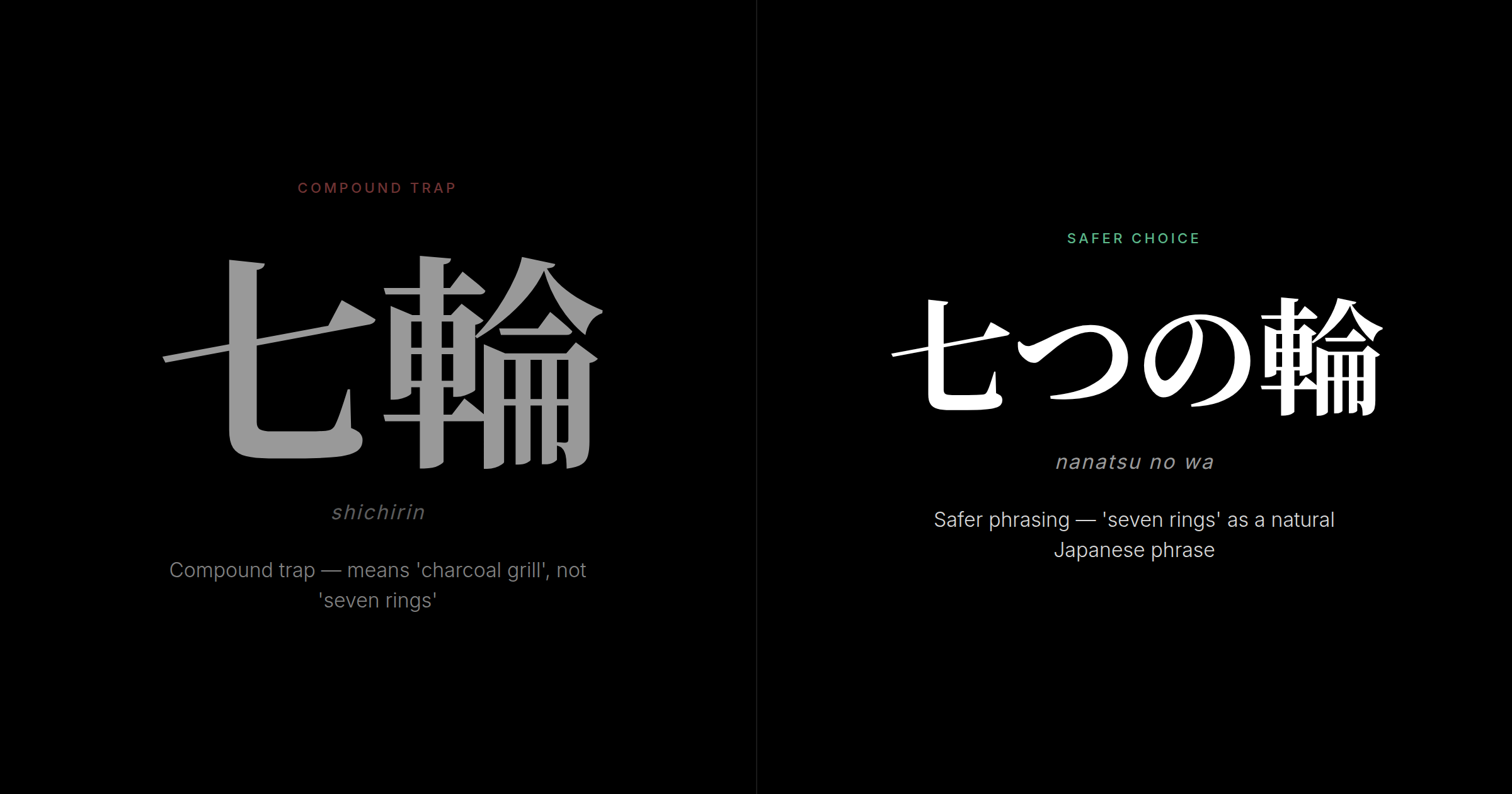
The Ariana Grande case is the canonical example. In January 2019, she debuted a tattoo meant to celebrate her hit "7 Rings." The characters 七輪 (shichirin — a small portable charcoal grill used for tabletop cooking at yakiniku restaurants; the kind you'd see on a restaurant table, not on a pop star's palm) had been assembled from separate dictionary lookups for the number seven and the character for ring or wheel, without knowing that the compound these two characters form is a fixed, everyday word with a completely unrelated meaning.
Japanese speakers who saw it were not outraged. The dominant reaction, documented across social media at the time, was amused disbelief — the "oh no, oh no, oh no" energy of watching a very confident person walk into a very obvious mistake. Grande later had the tattoo partially corrected. The charcoal grill version remains the most-cited example in this topic because it captures the specific comedy of a translation tool being certain where it should be uncertain.
3. The Soft Wince (Wrong but Harmless)
A step below quiet amusement: a soft wince, the kind polite people suppress immediately. This is the reaction to a tattoo that is wrong but not funny — just incorrect. The native can see the effort. They can also see the mistake.
A pattern KIO reviewers encounter frequently: someone wants "strength" and runs it through a translation tool. The tool might return 強さ (tsuyosa — strength in the sense of physical or personal power, common in everyday Japanese), or 力 (chikara — physical force; you see this on gym signage and athletic club branding), or an invented compound that no Japanese speaker would write. Each registers differently to a native. The difference between them requires knowing the script — and that knowledge is exactly what translation tools do not provide.
4. The Silent Read (When the Kanji Is Simply Odd)
Some kanji choices produce a reaction that is harder to describe: a native reads it, understands it, and simply has no idea why a Westerner would choose it. Not because it is wrong. Because it is strange.
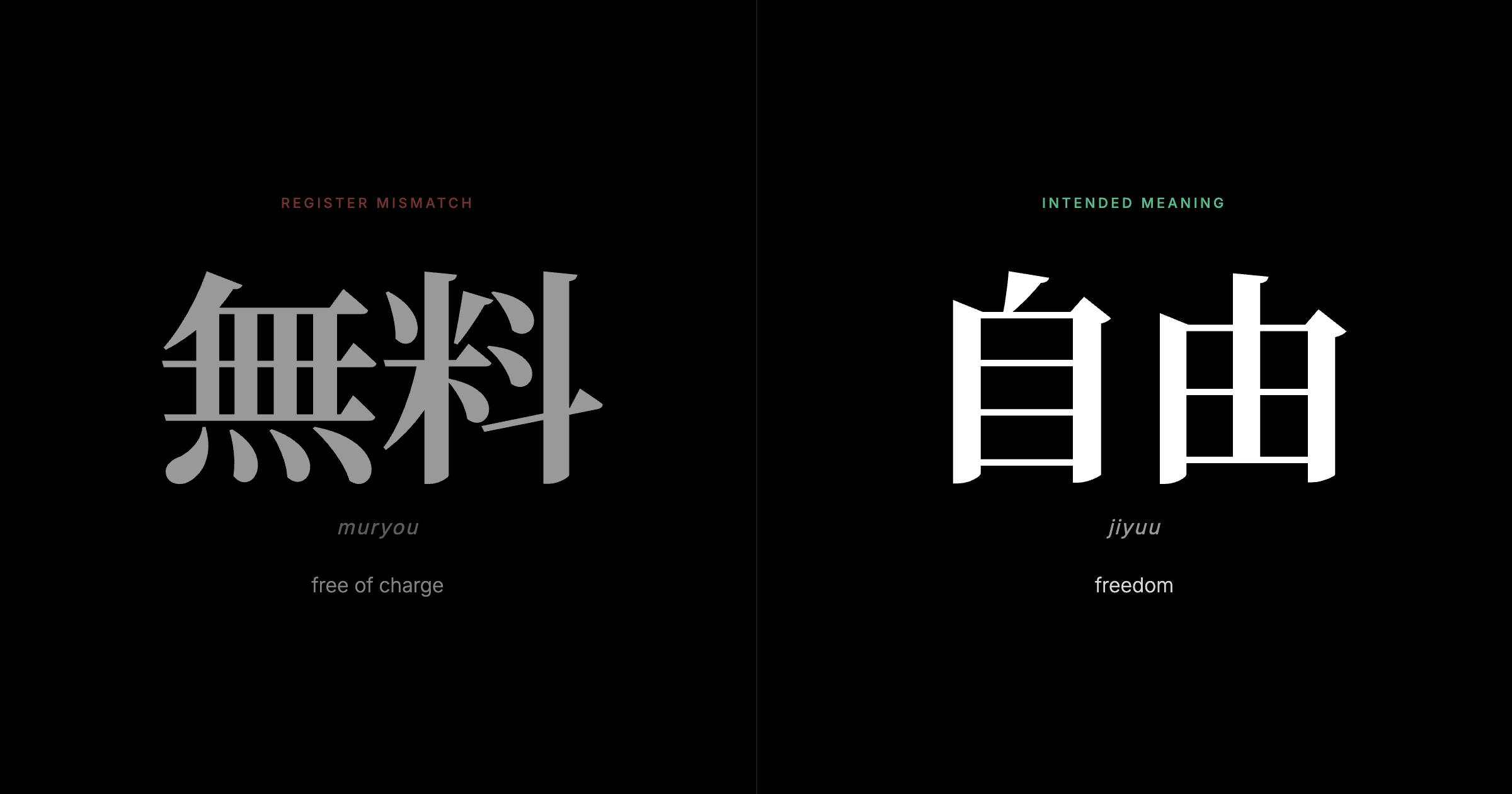
This is a register failure. The classic example: someone searches "free" and encounters 無料 (muryou — free of charge, complimentary; the word on fliers and websites announcing no admission fee) instead of 自由 (jiyuu — freedom, liberty; the word used in political speech and personal expression). A Tokyo native reading a 無料 tattoo has the same reaction as a Japanese person seeing "No Charge" tattooed on a forearm. The characters are accurate. The situation is bewildering.
5. Genuine Discomfort (The Rarest Category, but Worth Knowing)
A small subset of kanji tattoos cause real discomfort — not from mistranslation but from using correct characters without understanding what they signal in Japanese culture. A term carrying heavy historical associations, a compound used in specific political contexts, or a word whose register is clinical or administrative rather than personal can read as unsettling when worn permanently. A dictionary definition is not enough here. What you need is a native who can tell you not just what a character means but what it implies in contemporary Japan.
The Most Common Failure Modes (Native Perspective)
Across the categories above, the same structural errors appear again and again.
Compound word traps. Japanese compounds regularly produce meanings that have nothing to do with their component characters. 七輪 is the most famous example. Another: 愛人 (aijin — a mistress or affair partner; the characters suggest "love person," which looks like "beloved" to a non-reader but carries a specific, unwelcome meaning to anyone who knows Japanese).

Stroke precision failures. Kanji is stroke-precise. One wrong line changes the character entirely. The pair KIO reviewers cite most often: 士 (shi — a title used in formal compounds for professionals and people of standing) versus 土 (tsuchi — earth, soil, dirt). The only difference is the relative length of the bottom horizontal stroke. A calligrapher catches this instantly. A tattoo artist without Japanese reading ability may not.
Register mismatches. A word that is technically accurate may be completely wrong in register for a personal statement on skin. Japanese distinguishes formal writing, casual speech, commercial language, and literary usage — and the difference matters permanently. Choosing 決意 (ketsui — determination, resolve; standard in formal speeches and official documents) is appropriate for a serious declaration. Choosing the same concept in commercial phrasing reads like tattooing a mission statement.
One character for complex English concepts. Japanese often achieves the complexity of an abstract English noun through two-character compounds. "Resilience" translates most naturally to 不屈 (fukutsu — unyielding, indomitable; used in sports reporting, political commentary, and formal discourse). Asking a translation tool for a single kanji for "resilience" produces something imprecise — a character that does not stand alone the way the person intends.
What Makes a Kanji Tattoo Beautiful (According to Tokyo Natives)
Three criteria appear consistently in native assessments of tattoos that earn genuine appreciation.
Calligraphy that reflects real knowledge. Proportions, stroke weight, and spatial relationships inside a kanji character are not arbitrary. A native reader can tell, at a glance, whether the character was rendered by someone who knows the script's rules or by someone approximating them from a reference image.
A character that functions naturally in contemporary Japanese. The most appreciated tattoos use kanji that appear in ordinary modern life — not invented pairings, not archaic literary compounds chosen to seem deep. A useful test: would a Tokyo native write this word in a text message or a diary entry? If yes, the kanji has genuine currency.
The wearer can explain their choice. This is what surprises most Westerners. Tokyo natives judge commitment more than aesthetics. A person who can say, even in basic terms, why they chose a specific character — what it means to them, where they learned about it, what research they did — signals genuine engagement. That is the difference between participation and extraction, and Tokyo natives respond to it.
Native Verdict
Most Western kanji tattoos are not offensive. They are either correct-and-appreciated or incorrect-and-quietly-amusing, with a smaller number causing more significant discomfort because of compound-word traps or register failures. The "kanji tattoos are disrespectful" framing that circulates in some online discussions does not reflect how most Tokyo natives actually respond.
What natives judge is not the act of choosing kanji but the quality of research behind the choice. A foreigner who consulted native speakers, worked with a calligrapher, and can speak to their decision receives something close to respect. Not because they're doing Japanese people a favor, but because they engaged with a writing system that demands seriousness.
The mistake that actually bothers Tokyo natives is not error — it is indifference. A tattoo that signals "I typed this into an app and liked how it looked" is a tattoo that treated kanji as decoration rather than meaning. That posture produces the real wince. Not the mistake. The implication of not caring enough to try.
Getting it right is about process: Have you asked? Have you had it read by someone who knows? Have you waited? Those three questions divide the tattoos Tokyo natives appreciate from the ones they hope the wearer never discusses with a Japanese speaker.
Before the needle touches skin, have your design reviewed at Kanji Ink Oracle — Tokyo-based native reviewers return an assessment within 24 hours, covering meaning, register, and calligraphic accuracy.
Can a Bad Kanji Tattoo Be Fixed?
Yes, and the options are more viable than most people realize. Cover-ups, partial corrections, and laser removal have all become more accessible. More importantly: the redemption arc matters to Tokyo natives. The reaction to someone who acknowledges a mistake and addresses it is markedly different from the reaction to someone who defends the error. Getting it wrong and then taking it seriously is a better story, in most Tokyo native eyes, than never having tried. KIO's article on removal and cover-up options covers the practical steps.
Frequently Asked Questions
Do Japanese people find kanji tattoos offensive?
Not inherently. Tokyo natives distinguish between respectful engagement — you researched, consulted a native, chose meaningful kanji — and aesthetic-first selection without verification. The offense, when it exists, is not in the tattoo but in the implication you did not care enough to check. Japan's broader tattoo stigma (the historical association with organized crime) means any tattooed foreigner is already a cultural anomaly before anyone reads the kanji.
What is the most common kanji tattoo mistake Westerners make?
Choosing a character from translation-tool output without consulting a native. The compound-word trap is the most damaging variant: two characters combine into a fixed compound with a completely different meaning. The Ariana Grande case (七輪, charcoal grill) is the best-documented example. Register failures are equally common: technically correct kanji, but in a commercial or clinical register that reads strangely as a personal statement.
Can a single wrong stroke really ruin a kanji tattoo?
Yes. Kanji is stroke-precise: one wrong line or proportion changes the character entirely. The frequently cited pair is 士 (warrior, scholar) versus 土 (earth, dirt) — the characters differ only in the relative length of the bottom horizontal stroke. Both characters are common; neither is obscure. A Japanese calligrapher or native reader catches this distinction instantly. A tattoo artist without kanji reading ability may not notice, and the stroke error becomes permanent.
How do I verify my kanji design is actually good before getting it tattooed?
Four steps: show the design to a native Japanese speaker who reads and writes kanji fluently; have a calligrapher review stroke structure; wait at least two weeks after native approval before booking; and confirm your tattoo artist has worked with Japanese script before. Skipping any of these is gambling with something permanent. KIO's verification checklist covers each step.
Is getting a kanji tattoo cultural appropriation?
Tokyo natives' consistent verdict: no, but disrespect is. Engaging seriously with kanji meaning and receiving native approval is participation, not appropriation. The problem arises when kanji is treated as decoration without any engagement with meaning — that posture signals that the cultural substance did not matter. KIO's full breakdown of this question covers the nuance in depth.
What makes a kanji tattoo beautiful in native Japanese eyes?
Three factors: calligraphic quality (correct proportions and stroke weight from someone who knows the script); natural currency (the character is actually used in contemporary Japanese, not invented); and the wearer's ability to explain the choice. That last factor is what most Westerners underestimate. Commitment signals respect, and Tokyo natives respond to respect.
What should I do if I already have a bad kanji tattoo?
Three paths: cover-up with a new design (get native input first); reframe — acknowledge the mistake, learn what the character actually says, own the story; or pursue laser removal and a corrected tattoo. Tokyo natives respond more warmly to someone who acknowledges an error than to someone who defends it. KIO's guide to kanji tattoo removal and cover-ups covers costs, timelines, and native perspectives.
Will a kanji tattoo hurt my job prospects in Japan?
Yes, but not because of the kanji — because of the tattoo. Japan's employment culture remains conservative about visible body ink; the historical association with organized crime still carries weight in many professional contexts. A well-executed kanji tattoo might signal cultural engagement to a perceptive native, but that impression rarely outweighs the tattoo stigma in traditional industries. The stance has been shifting among younger generations, but remains significant.