Katakana Name Tattoos: Why Foreign Names Aren't Kanji
Foreign names belong in katakana, not kanji. Learn why from a Tokyo native, and discover the most common mistakes to avoid before your Japanese name tattoo.
You want your name — or someone else's name — tattooed in Japanese script. You've seen options online that use kanji, and you're wondering whether that's more authentic than the angular symbols that come up when you search for katakana. Before you book the appointment, there is one thing you genuinely need to understand about how Japanese writing works: getting the script right is the difference between a tattoo that reads with dignity and one that reads as a mistake.
For foreign names, katakana is not the fallback option. It is the correct option. Kanji for a foreign name is almost always wrong, and the reasons go deeper than convention.
What Is Katakana, and Why Does It Exist?
Japanese uses three writing systems, and each carries a distinct function that is not interchangeable with the others.
Kanji are Chinese-derived characters that carry meaning — 山 (yama — mountain; used in geography, surnames, and nature poetry) or 愛 (ai — love; the character that appears in literature and sincere declarations of feeling). Every kanji encodes a concept, not just a sound.
Hiragana (e.g., あ、い、う) is the flowing, rounded syllabary for native Japanese words, grammatical particles, and anything that reads with softness and intimacy.
Katakana (e.g., ア、イ、ウ) is the angular syllabary for sounds arriving in Japanese from outside the language. Foreign loan words, technical terms, scientific names, and — critically — every foreign name that appears in Japanese text, from news articles to official documents, from business cards to school rosters: all written in katakana, without exception.
That convention is not arbitrary. It is a deliberate signal: when a Japanese reader sees katakana, they immediately know they are reading something from outside the native word stock. The script announces: foreign word, rendered phonetically.
Your name belongs in katakana because your name is not a Japanese word. It has no Japanese meaning to represent — it is a sound that identifies you, and katakana is the system Japan built to represent exactly that. This principle applies to anime as well: when creators like Tatsuya Endo deliberately choose katakana for foreign character names, the script choice is intentional worldbuilding. SPY×FAMILY's character names stay in katakana not by accident but by design — a signal that these characters don't fully belong to the world they're operating in.
The Critical Difference: Kanji vs. Katakana for Foreign Names
The core misunderstanding behind most kanji name tattoo mistakes is this: people assume kanji is more expressive or prestigious than katakana, so they want their name in kanji to give it more weight.
That instinct makes sense from outside the language. From inside the language, it produces the opposite effect.
Kanji does not just represent a sound. It represents a meaning. The character 力 (chikara — power, strength, force; the kanji that appears in athletic contexts, personal declarations of resolve, and formal expressions of capacity) does not just sound like something — it means something specific every time it appears. You cannot assign kanji to a foreign name without also assigning that meaning, even when no meaning was intended.
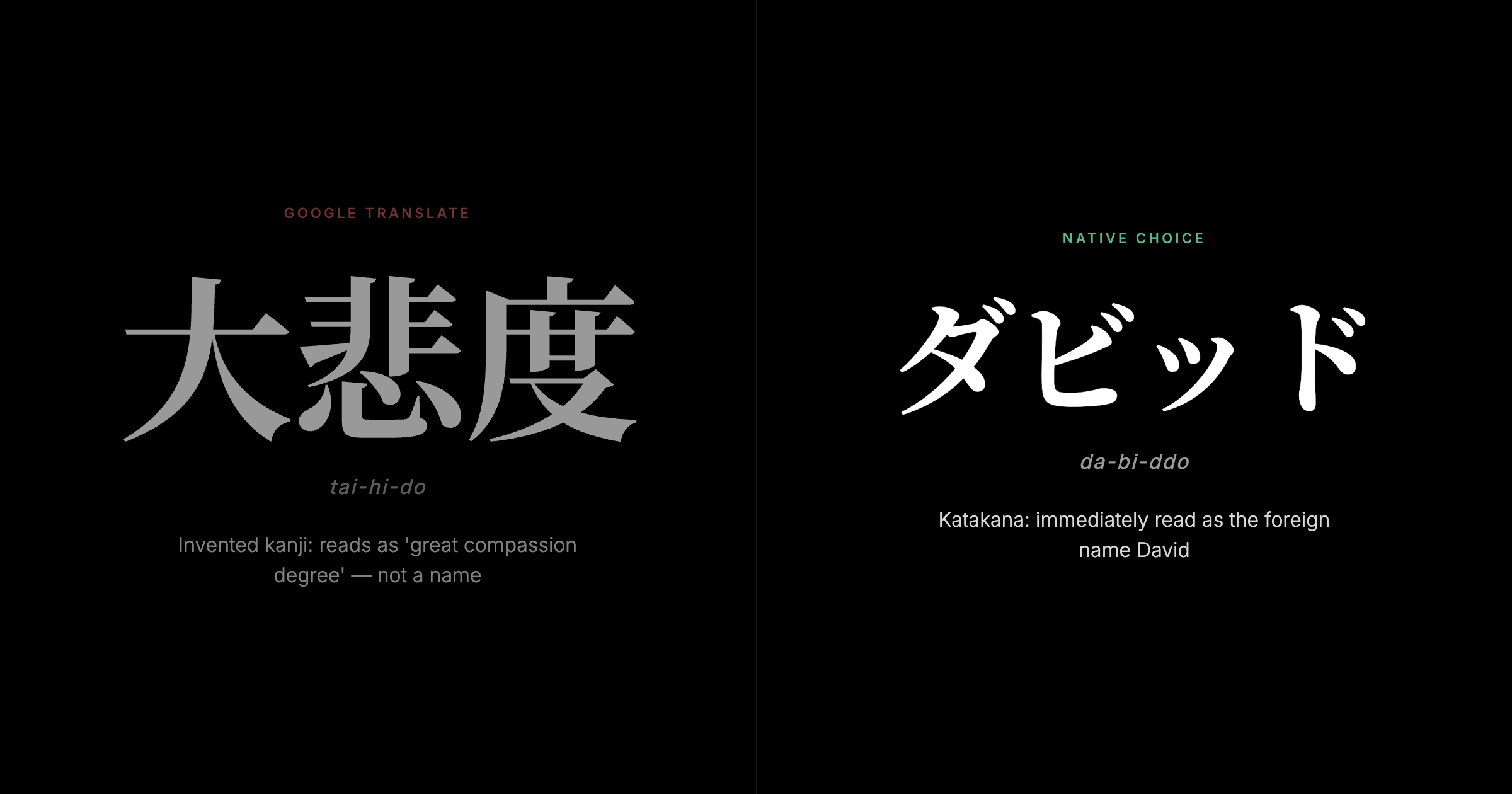
Consider the name "David." Attempting to write it in kanji means picking characters whose sounds approximate "da-vi-do" — but those characters carry their own unrelated meanings. Depending on which kanji are chosen, a "kanji David" might produce a combination that looks like an archaic Japanese name, a Chinese name, or a random-seeming phrase. A Japanese reader will not see a foreign name. They will see a kanji compound that reads as something other than what was intended.
In katakana, David is commonly rendered ダビッド (da-bi-ddo — with the doubled ッ representing the brief consonant stop before the final 'd'). Other valid renderings exist — デイビッド or ダビデ depending on the source pronunciation and tradition — so a native verifier helps you pick the one that best matches how you say your name. The point is illustrative: any standard katakana form gets read immediately as a foreign name. No ambiguity, no unintended meaning, no compound accident.
Based on patterns from KIO's verification work reviewing name tattoo requests from clients around the world, the kanji name mistake is one of the most common — and most permanent — errors we see. Machine translation tools sometimes generate kanji for foreign names by mapping sounds to available characters. The results are almost universally wrong to native readers in ways the requester cannot detect without reading Japanese. For a full breakdown of how machine translation fails for Japanese script tattoos, see why Google Translate gets kanji tattoos wrong.
Why Phonetics, Not Meaning
The impulse to find kanji that "mean something nice" and sound like your name comes from a real place. Names feel like they should carry weight, and kanji feels weighty. But this misreads what a name actually is.
A name is a phonetic entity. It exists to identify a specific person, not to convey a concept. Japanese culture understands this clearly: when any foreign name appears in Japanese text — news, history books, official documents — it is written in katakana regardless of how famous the person is. Karl Marx, Isaac Newton, the Beatles: all katakana. The standard is absolute.
Trying to add meaning to your name through kanji assignment works against Japanese tradition, not with it. It produces something that looks unusual and reads as an error.
If you want to add meaning, the tradition for this already exists. Many people pair a foreign name in katakana with a companion kanji. 命 (inochi — life, one's existence; used in philosophical and everyday contexts to describe the preciousness of being alive) is the most common choice for couples or memorial tattoos. The name stays in katakana; the meaning comes from the companion. Culturally coherent and honest.
Common Mistakes: What Not to Do
Mistake 1: Forcing the name into kanji because it "looks cooler."
Kanji looks impressive to non-readers because it carries visual density. But that density is meaning, not decoration. A Japanese reader looking at your kanji name is involuntarily reading it as a phrase — not reading your name. Well-formed katakana in calligraphy or brush stroke style is genuinely striking, and correctness is the source of its dignity.
Mistake 2: Using hiragana instead of katakana.
Hiragana is the script for native Japanese words. If your name appears in hiragana, Japanese readers do not read it as a foreign name — they read it as a Japanese word. This looks, at best, like a Japanese girl's given name and, at worst, like an arbitrary string. The distinction between hiragana and katakana is not aesthetic preference — it encodes whether something is or is not a foreign word. Foreign names require katakana.
Mistake 3: Relying on Google Translate or online converters without native verification.
Conversion tools make errors: incorrect rendering of long vowels, dropped double consonants, and choices between competing phonetic approximations that a native speaker would not make. The tool has no way to know how your name sounds in your accent, or which of two valid-looking renderings is the conventional choice. If you already have a Japanese script tattoo and suspect an error, the five-minute self-check for kanji tattoos covers the diagnostic in plain English.
Mistake 4: Not accounting for long vowels and double consonants.
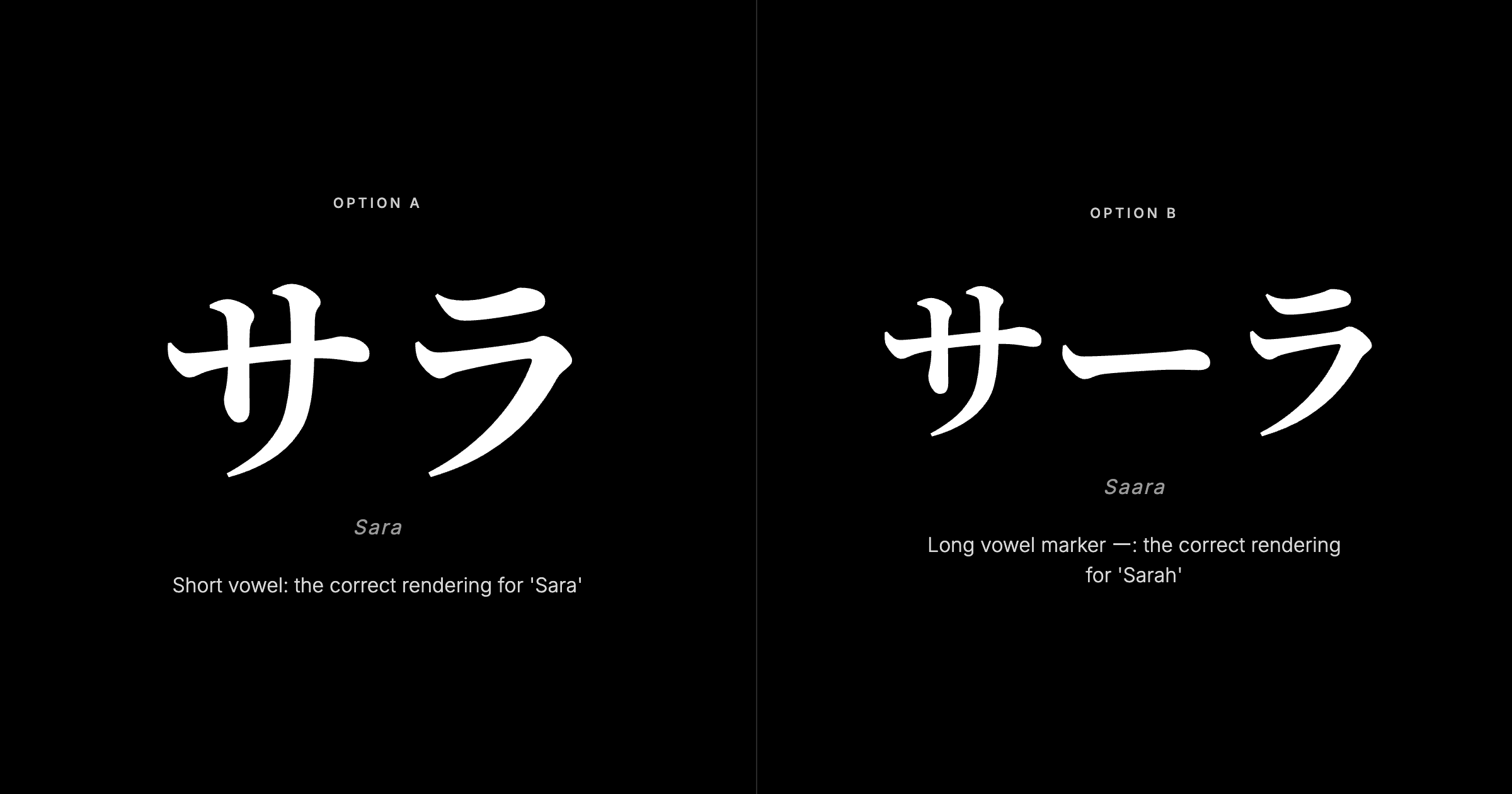
"Sara" and "Sarah" are not the same in katakana: サラ (Sara — two syllables, short vowels) vs. サーラ (Saara — with the long-vowel marker ー extending the final 'a'). "Matt" requires the small ッ consonant stop marker: マット (Matto). Getting these details right is what separates a rendering that reads accurately from one that represents a slightly different name to Japanese readers.
Mistake 5: Not considering how your name sounds in Japanese phonology.
The name "Steve" requires a phonetic approximation: スティーブ (Sutiibu — breaking the consonant cluster into syllables, marking the long 'ee'). That approximation is standard and correct — but it will sound different in a Japanese reading than in English. A native speaker can help you determine whether the standard rendering captures your name's feel or whether a slightly different form works better.
The Native Verdict: What Japanese People Actually See
Native Verdict — Tokyo Perspective
When I see a foreign name tattooed in well-formed katakana on a non-Japanese person, the reaction is specific and positive. It reads as someone who did their research. You knew the script. You understood that foreign names go in katakana, not in improvised kanji. That is not a low bar — plenty of people do not clear it. Clearing it communicates intentionality before you say a word.
What Japanese people evaluate is not whether you "have permission" to write in Japanese script. Japan does not operate on that framework. What we evaluate is whether the execution shows that the person engaged with actual writing conventions. A well-formed katakana name tattoo passes that test immediately.
The reaction to a kanji name tattoo is different. Not contempt — more like watching someone use a formal word in the wrong context and not knowing it. A Japanese reader looking at a kanji name is involuntarily processing the characters as meaning-bearing words, because that is what kanji does. When the characters form something nonsensical, there is a visible mismatch between what the person clearly wanted to express and what the tattoo actually says. That mismatch is 格好悪い (kakkowarui — uncool, embarrassing, not stylish; the plain everyday opposite of かっこいい, used for everything from a bad haircut to a misfired social moment).
The emotional dimension: paired name tattoos — particularly those pairing a foreign name in katakana with 命 (inochi — life, one's existence) — tap into a longstanding Japanese sentiment around lovers exchanging name tattoos as declarations of devotion (the specific katakana-plus-kanji form is modern, but the underlying practice it draws from is older). To someone raised in Japan, seeing it done correctly reads as a meaningful connection to that tradition. The correctness is what makes the connection real.
A name in hiragana, or a name forced into kanji, immediately registers as someone who could not tell the scripts apart. That is the one thing a tattoo meant to honor a name should avoid — the signal that the honoree's name was not handled with care.
Choosing Your Katakana Rendering: What to Confirm Before Inking
Once you understand why katakana is correct, the practical question is how to render your specific name accurately.
Work with a native Japanese speaker, not a converter tool. Rendering decisions — how to handle consonant clusters, which phonetic approximation best captures the sound of your name, whether a long vowel marker improves readability — require native judgment. A good rendering captures the name's sound, not just a rule-based approximation. For the full pre-ink verification process that covers script choice alongside all other checks, see our five-layer kanji tattoo verification framework.
English sounds that require katakana workarounds:
- The English "th" (as in "Matthew," "Ethan") has no direct equivalent; common renderings use similar-sounding syllables: マシュー (Mashuu), イーサン (Iisan)
- The English "v" appears as ヴ (vu) in formal katakana; in common usage, バ行 (ba-row consonants) is also standard
- The English "l" maps to ラ行 (ra-row consonants): ラ、リ、ル、レ、ロ
- Consonant clusters like "st" and "tr" are broken into Japanese syllables by inserting short vowels
These approximations are established conventions, not errors. Every Japanese reader understands the system.
Pairing options for added meaning. If you want the tattoo to carry emotional weight beyond the phonetic name, the companion kanji approach is culturally coherent:
- 命 (inochi — life, one's existence; the kanji most associated with the Japanese lover's name tattoo tradition)
- 愛 (ai — love; used in literature and sincere personal declarations)
- 絆 (kizuna — bond between people; used in everyday speech and journalism to describe lasting human connections)
The name in katakana plus a single meaningful kanji produces a tattoo that is phonetically correct and culturally resonant — a genuine form, not an improvisation.
FAQ: Your Katakana Name Tattoo Questions Answered
Can I use kanji instead of katakana for my foreign name tattoo? Wouldn't kanji look cooler?
No. Kanji represents meaning, not just sound — and your foreign name has no inherent meaning in Japanese. Assigning kanji to a foreign name means choosing characters whose sounds approximate the name, which will also carry their own unrelated meanings. The result reads to Japanese people like an invented phrase, a Chinese name, or an archaic Japanese name — not like the foreign name you intended. Katakana is the correct, standard, dignified choice. The apparent coolness of kanji comes from its visual density; that density is meaning, and without meaning, the effect is confusion rather than weight.
What if my name has a 'th' sound (like 'Matthew' or 'Ethan')? How does that work in katakana?
Japanese does not have a 'th' sound, so katakana uses established phonetic approximations. 'Matthew' is commonly rendered マシュー (Mashuu — the 'th' absorbed into the 'sh', with the long 'yoo' vowel). 'Ethan' becomes イーサン (Iisan — long 'ee' opening, phonetic approximation of the 'th-an'). These are standard, recognized renderings. Work with a native speaker to confirm which approximation best captures your specific name as you pronounce it.
Is there a difference between hiragana and katakana for name tattoos? Can I use hiragana instead?
Yes, and the difference is significant. Hiragana is for native Japanese words — soft, rounded, intimate in register. Katakana is the script Japan officially uses for foreign words and names — angular, clear, explicitly marked as non-native. Using hiragana for a foreign name signals to Japanese readers that they are reading a Japanese word, not a foreign name. At best, it reads like a Japanese girl's given name; at worst, it reads like an arbitrary string. Always use katakana for foreign names.
How do I know if the katakana spelling of my name is correct before I get the tattoo?
Do not rely on Google Translate or online converters as your final authority. Consult with a native Japanese speaker — specifically someone raised and educated in Japan — and ask them to render your name and explain their choices. Have a second native speaker verify before committing. Pay attention to long vowels and double consonants, which automated tools frequently drop or mishandle. KIO's verification service covers name rendering specifically, returning a native-reviewed katakana form with an explanation of the phonetic choices made.
Can I add a meaningful kanji with my name tattoo? Like a companion character?
Yes, and this reflects a genuine Japanese tradition. Pairing a foreign name in katakana with a companion kanji is culturally coherent and aesthetically strong. 命 (inochi — life, one's existence) is the most traditional pairing in the lover's name tattoo context — a longstanding way of declaring that someone's existence is as precious as life itself. Other meaningful companions include 愛 (ai — love), 絆 (kizuna — bond between people), and 強 (tsuyoi/kyou — strong). The name stays in katakana; the companion kanji provides the emotional statement.
Get Your Name Right Before You Ink
A katakana name tattoo done correctly is clean, readable, and — to anyone who knows Japanese — a clear signal that you understood the writing system. The rendering decisions made before the appointment determine what Japanese readers will see for the rest of your life.
Verify your name at Kanji Ink Oracle — Tokyo-native reviewers confirm your katakana rendering, flag issues with long vowels or consonant rendering, and explain the phonetic choices so you can bring a verified design to your tattoo appointment with confidence.