TikTok's 'Aura Kanji' Tattoo: A Tokyo Native's Verdict
The TikTok aura kanji tattoo trend claims 気 means 'aura.' A Tokyo native explains what the character truly means and why using it alone is linguistically incomplete.
You've seen it on your For You page: someone shows off a kanji tattoo and the caption reads something like "got the aura kanji — 気 means spiritual energy." The comments light up with "so cool" and "I need this." Now you're wondering if you should get it too — or maybe you already have, and you're second-guessing yourself. Either way, you deserve a straight answer before the needle touches skin.
The short version is this: 気 (ki — spirit, energy, mood, atmosphere; the single most common kanji for "inner state" in the Japanese language) is a real character with genuine depth, but the TikTok framing of it as a standalone "aura tattoo" misrepresents how the character actually functions. This guide explains why — and what your options are if spiritual energy is the concept you actually want to carry.
The TikTok Aura Trend Explained
The trend follows a familiar pattern. A creator posts a video showing a kanji, usually 気, and explains that it means "aura" or "spiritual energy." The visual is clean, the font is striking, and the connection to anime — shows like Naruto, Dragon Ball, and Solo Leveling (technically Korean manhwa, but widely consumed alongside anime) — gives it a ready-made cultural hook. "This is the kanji for the aura you feel coming off a powerful character."
Hundreds of thousands of views follow. Tattoo artists start fielding requests. People book appointments.
The appeal is understandable. 気 looks intentional on skin. It connects to something viewers have absorbed through a decade of anime. And the word "aura" carries exactly the kind of mystical weight that a permanent mark feels like it should have. The algorithm rewards this: it is visual, emotional, and simple enough to absorb in eight seconds.
What the algorithm does not reward is the follow-up — the explanation of how Japanese compounds work, why context changes everything, and what a Japanese speaker actually reads when they see this character alone.
The Kanji People Are Actually Getting Tattooed
Before criticizing the trend, it is worth being precise about what the character is and where it comes from, because 気 is not a bad kanji. It is one of the most important in the language.
気 (ki — inner energy, spirit, mood, atmosphere; one of the foundational characters in classical Chinese medicine that entered Japanese as the concept of life-force or vital energy) appears in hundreds of everyday Japanese words. A few examples show its range:
- 気力 (kiryoku — willpower, physical and mental energy; the compound you see in sports journalism and motivational writing)
- 勇気 (yuuki — courage; literally "brave ki," one of the most common compounds in formal and everyday speech)
- 雰囲気 (fun'iki — atmosphere, vibe, the feeling of a place; the word you'd use to describe a restaurant's mood or a city's energy)
- 天気 (tenki — weather; literally "sky ki," so ordinary it appears in children's first vocabulary)
- 元気 (genki — health, liveliness; the word friends use when asking "are you doing okay?")
The character is everywhere. It carries real semantic weight. And in the specific context of martial arts, traditional medicine, and some spiritual practices, 気 does connect to the concept of energy that animates living things — which is the closest Japanese equivalent to the English "aura" in certain registers.
So the trend is not inventing a meaning from nothing. It is plucking a real meaning from a character that has many meanings and presenting it as the primary, definitive one.
Why the TikTok Version Is Wrong
The problem is not the character. The problem is the framing.
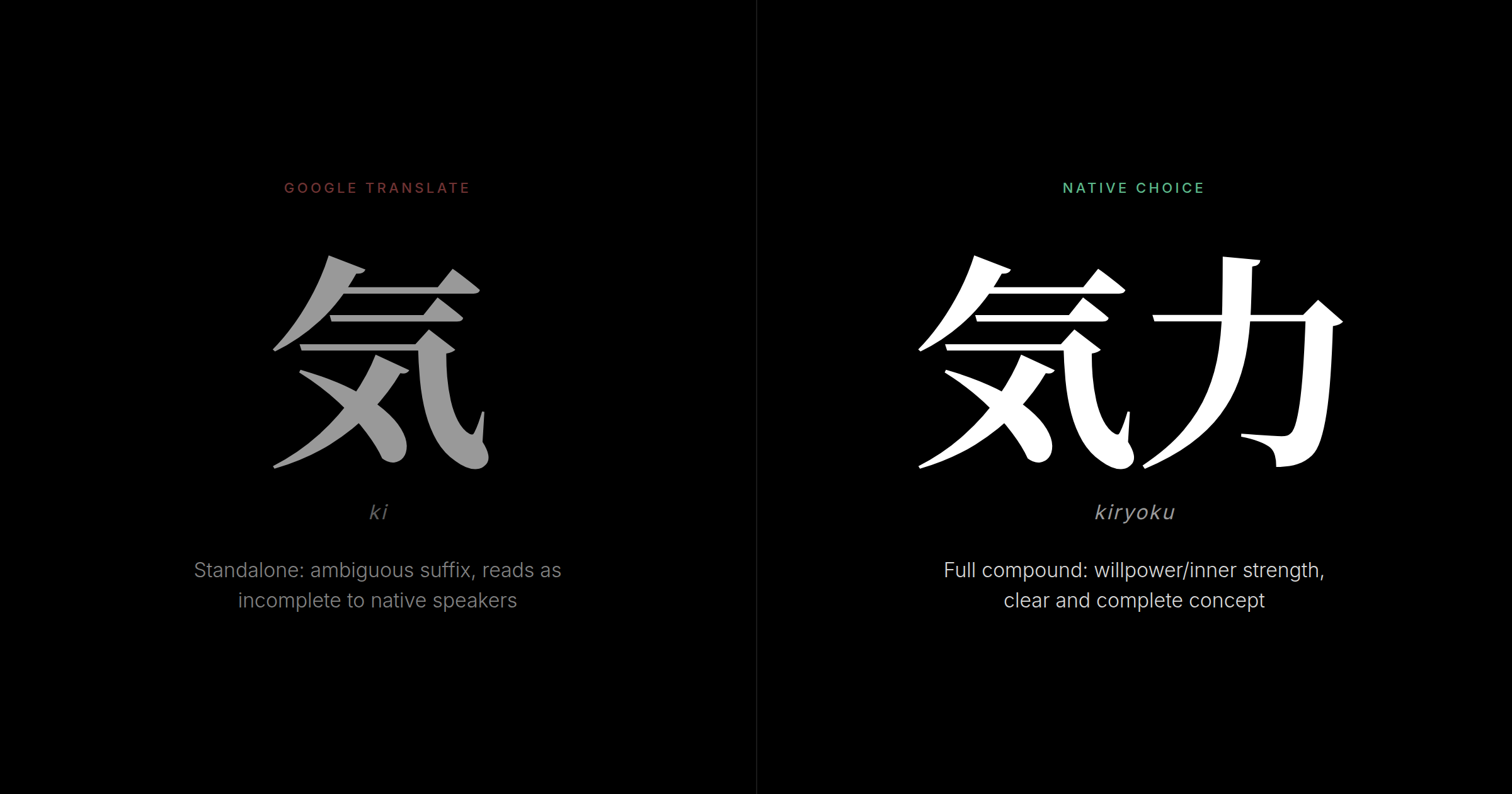
In Japanese, 気 almost never appears alone as a standalone noun meaning "aura" or "spiritual energy." It functions primarily as a component of compound words — it is the element that other words are built around, not the finished word itself. Using it alone is a bit like tattooing the root "-ology" and saying it means "deep knowledge." Technically it does, in the sense that it appears in every word for a field of knowledge. But stripped of its companions, it reads as incomplete.
Based on thousands of verification requests reviewed by KIO's Tokyo-native team, the single-character tattoo mistake is one of the most common patterns we see in social media-influenced requests. Characters with rich compound vocabularies get extracted from those compounds, stripped of context, and presented as though the root meaning is the complete meaning. 気 is one of the most frequent examples.
The confusion is compounded by how dictionary tools present the character. Type 気 into Google Translate or a basic kanji lookup and you will see a list of possible meanings: energy, spirit, mood, atmosphere, mind, heart, feeling. "Aura" is not usually on that list directly, but "spiritual energy" or "vital force" can appear in certain dictionaries' extended entries. A TikTok creator who wants to make a compelling video picks the most evocative meaning and runs with it. The character looks right; the vibe feels right; the comments agree.
What no one in that comments section is asking: show us a sentence where a Japanese person uses 気 alone to mean "aura." Because that sentence, in normal modern Japanese usage, does not exist.
What Native Japanese People Actually See
A Tokyo native encountering a 気 tattoo has a specific reaction — not offense, not admiration, but recognition. Recognition of a pattern.
To someone who grew up with the language, 気 alone reads the way an English speaker would read someone who tattooed the word "ness." The suffix "-ness" creates nouns: happiness, darkness, kindness. It has semantic meaning. But tattooed alone, it signals that the person understood part of the word's function without understanding how the system works.
The character exists and is correctly drawn. It is not reversed, not a different character, not a slur. A native will not walk up to the person and explain what went wrong. But the internal reading — the split-second linguistic assessment — is: "This person found this on TikTok or Google Translate and picked the definition that felt the most spiritual." For a deeper exploration of this reaction pattern, what Japanese people actually think when they see kanji tattoos covers the social dynamics in detail. This same phenomenon appears across anime kanji tattoos: the register gap between anime meaning and real Japanese affects Hunter x Hunter's 念 similarly, where the character means contemplation or prayer but fans read it as anime power.
The character 気 exists naturally in compounds that Japanese speakers encounter dozens of times a day. Seeing it alone is unusual in the same way that a fragment of a common word is unusual. It is not wrong in the way that a misspelled name or a reversed character is wrong. But it is transparently incomplete.
How Trends Make You Vulnerable to Mistakes
TikTok's structure creates the conditions for this kind of error to spread. The algorithm rewards simplicity — "気 means aura" performs better than "気 only carries meaning inside compound words" — and the comments section reinforces the simpler version. Creators with genuine interest in Japanese aesthetics may not have consulted a native speaker, and English-language sources that confirm each other do not amount to consulting the language itself.
There is also an Orientalism component worth naming. The appeal of "aura kanji" partly comes from the idea that Japanese contains secret spiritual wisdom that English lacks — framing the language as mystical rather than as a living language used by 125 million people for ordinary things like checking the weather (天気) and asking how a friend is doing (元気).
For more on how Google Translate contributes to this pattern, why Google Translate fails for kanji tattoos has the full breakdown.
The Right Way to Think About Energy Kanji
If the concept you want is genuine — if you are drawn to the idea of inner energy, vital force, or the kind of presence that animates a person — there are compound options that capture that idea in a way that actually functions in Japanese.
If you want willpower or inner drive: 気力 (kiryoku — willpower, physical and mental energy; common in sports writing, self-help contexts, and formal speeches about perseverance) uses 気 properly as part of a complete concept.
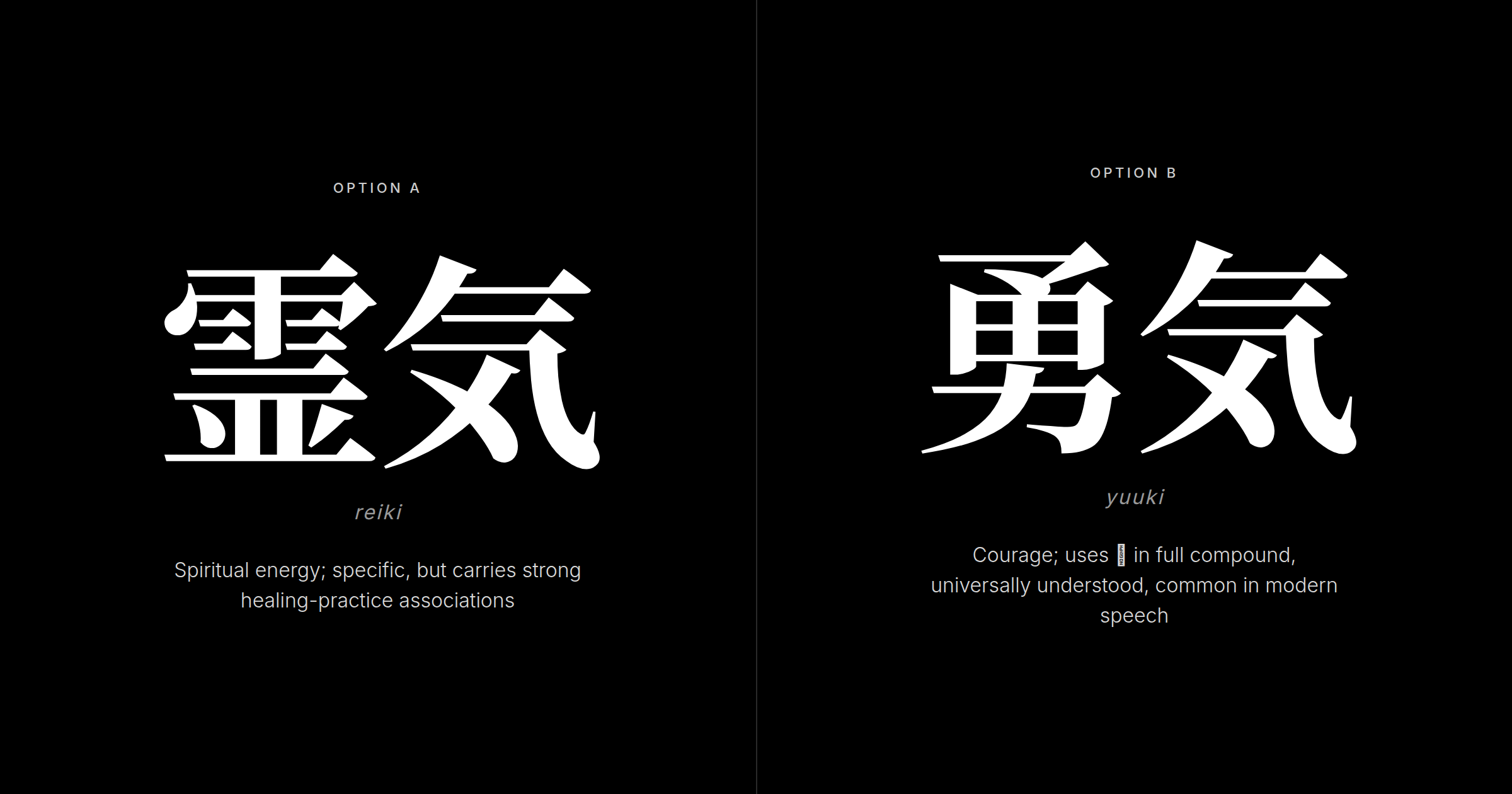
If you want courage as an expression of inner energy: 勇気 (yuuki — courage; one of the most widely used compound nouns in contemporary Japanese, appearing in everything from schoolchildren's reading materials to political speeches) carries the spirit meaning of 気 within a full word.
If you specifically want spiritual energy: 霊気 (reiki — spiritual energy, life force; note that in Japan this primarily refers to the healing practice and would be understood in that specific context) is the more direct choice, though it comes with the practical complication that it has strong associations with a specific therapeutic tradition.
If you want a complete phrase about unwavering focus: 一心不乱 (isshin furan — single-minded focus, total concentration; a four-character compound used in formal writing, sports commentary, and personal declarations of commitment) communicates dedication without the ambiguity of a single character.
If you want ikigai: 生き甲斐 (ikigai — reason for living, the thing that makes getting up worthwhile; a concept that has become well-known internationally through wellness writing) is a complete, coherent concept with real cultural weight. It is also unusual as a tattoo choice precisely because it is a full idea rather than a fragment, which is a mark in its favor.
The principle here is worth stating plainly: single-character tattoos are not wrong by definition. They exist in Japanese tattoo culture. But they require justification — a specific reason why the single character captures exactly what you mean, rather than a compound that completes the thought. Choosing a single kanji for your tattoo walks through when single characters work and when they do not.
If you want guidance on building a meaningful compound or verifying a specific character, choosing meaningful kanji for your tattoo covers the selection framework in depth.
How to Spot Kanji Tattoo Trends That Are Wrong
Not all social media kanji content is misleading, but there are reliable signals that a trend is simplifying the language for engagement.
Red flags: The claim is simpler than the actual Japanese ("one character = one deep concept"). No compound words are shown. The meaning is emotional or spiritual rather than concrete. It is framed as secret knowledge — "what your anime showed you but schools won't teach."
Green flag: The creator shows full compound words, cites native speaker input, demonstrates example sentences in context, and acknowledges that single-character meanings are partial.
For a broader guide on avoiding this class of error before you book your appointment, how to verify a kanji tattoo before getting it is the process-level resource.
Native Verdict
Here is the honest assessment from a Tokyo-native perspective:
A person with 気 tattooed alone will not be shamed, confronted, or treated differently by Japanese people. The character is real, correctly formed, and not offensive. If you have already gotten this tattoo, this is not a crisis.
But the read is transparent. Any Japanese speaker who sees it will understand immediately that this came from a social media trend, not from deep engagement with the language. The character exists naturally in dozens of compounds that Japanese people encounter every day — seeing it isolated is unusual in a way that signals unfamiliarity with how compounds work.
The more important point is this: if you have not gotten the tattoo yet, you have time to choose something that actually says what you mean. Not "here is a character component associated with energy" but "here is a complete concept — willpower, courage, spiritual force — expressed in a form that functions in the language it comes from."
The TikTok version is not deeply wrong. It is incompletely right. And for a permanent mark, incomplete right is worth revisiting.
If your situation is more complex — if you have already found a kanji and you want to know whether it functions the way the source claims — is my kanji tattoo wrong? covers the diagnostic process. And for the broader question of what Japanese speakers observe when they see kanji tattoos on Western skin, what Japanese people think about kanji tattoos is worth reading before you finalize any design.
Verify your kanji at Kanji Ink Oracle before the appointment. KIO's Tokyo-based reviewers assess your specific character or compound in context and return a full verdict within 24 hours — covering whether the kanji means what you think it means, how it reads to a native speaker, and whether there is a better option for the concept you actually want to carry.
Frequently Asked Questions
What kanji is the TikTok aura trend actually using?
The character most commonly referenced in "aura kanji" TikTok videos is 気 (ki), which relates to spirit, energy, inner state, and atmosphere in Japanese. The character genuinely connects to the concept of energy in traditional medicine and martial arts contexts. However, it almost never appears alone as a standalone noun meaning "aura" — it functions primarily as a component of compound words like 気力 (kiryoku, willpower), 勇気 (yuuki, courage), and 雰囲気 (fun'iki, atmosphere or vibe). If you want spiritual energy more specifically, 霊気 (reiki) is a more direct choice, though it carries specific associations with a healing practice tradition.
Is getting 気 as a tattoo a bad idea or just trendy?
It is not "bad" in the sense of reversed strokes or mistaken characters — 気 is correctly formed and exists. But it is semantically incomplete. To a Japanese speaker, it reads as a fragment of a compound rather than a finished concept. The reaction is not offense but recognition: the person who has this tattoo likely found it on social media and chose the most evocative dictionary definition without understanding how compound words work. It signals incomplete research more than it signals anything about the wearer's character. Not a disaster, but fixable if you choose a full compound instead.
Why do TikTok trends get kanji meanings wrong so often?
The platform's algorithm rewards emotional and visual appeal over linguistic accuracy. Creators simplify complex grammatical concepts because "this character is a component that only makes sense in compounds" is less engaging than "this character means spiritual aura." Comments sections reward enthusiasm, not correction. Dictionary tools show multiple meanings and creators naturally select the most compelling one. There is no accountability mechanism — a creator who posts inaccurate kanji content does not receive a correction from the algorithm; they receive views. The result is a feedback loop where simplified, evocative interpretations spread further than accurate ones.
How can I verify a kanji tattoo before getting it?
Go beyond a single source. Look up the character in multiple kanji dictionaries that include example sentences, not just meaning lists. Search for native usage — actual Japanese text using the character — rather than English explanations of what the character "means." Check whether the character ever appears alone in sentences with your intended meaning, or whether it only appears in compounds. If possible, consult a native speaker who understands both the tattoo context and the linguistic one. If the creator who inspired you cannot show you a full sentence using the character the way they claim, that is a meaningful red flag.
If I get this tattoo, will Japanese people judge me?
Not harshly. Japanese social norms generally lean toward politeness, and no one is going to confront a stranger about their tattoo. But internally, a native speaker will recognize the character as incomplete and understand that it came from social media rather than genuine engagement with the language. They will likely assume — accurately — that you encountered this through a trend and did not consult anyone who speaks Japanese before getting it. It is the kind of thing that reads as a cultural moment rather than a personal statement. The honest answer: you will not be shamed, but you will be seen through.
What should I get instead if I want "aura" or spiritual energy?
Several compound options capture this concept in complete, functional form: 気力 (kiryoku — willpower and inner drive, common in sports and motivational contexts), 勇気 (yuuki — courage, one of the most widely used compounds in the language), 霊気 (reiki — spiritual energy, direct but carries healing-practice associations), 一心不乱 (isshin furan — single-minded focus, a four-character compound used in formal and personal declarations), or 生き甲斐 (ikigai — reason for living, internationally recognized and culturally grounded). The key is choosing a concept that actually matches what you want to carry, not just the one that looked best in a TikTok.
Are other anime and gaming kanji tattoo trends on TikTok similarly misleading?
Yes. The pattern repeats across any trend that frames a Japanese character as a "secret meaning" discovered through pop culture rather than engagement with the language. Watch for: no native speaker credited, no compound words shown, the meaning presented is more poetic than the actual usage, and the framing implies Western fans have uncovered something that ordinary Japanese people do not know. Anime itself varies widely — some series like Demon Slayer use kanji correctly, but many popular franchises from Jujutsu Kaisen to Naruto to Bleach rely on stylized characters designed for visual impact rather than linguistic accuracy. The problem is TikTok reframings of those characters that extract them from their grammatical context for visual appeal — and a broader pattern where fans trust anime kanji without realizing it may be deliberately designed to look powerful rather than mean what they expect. When a trend is about the aesthetic of Japanese rather than the language of Japanese, accuracy is usually not its priority. For a detailed breakdown of which anime franchises use stylized kanji that shouldn't be tattooed, see our comprehensive guide to distinguishing anime kanji that's linguistically sound from kanji that prioritizes visual storytelling. For an in-depth example of anime kanji done correctly, see the Demon Slayer kanji guide with Tokyo-native verification — creator Koyoharu Gotouge made deliberately sophisticated character choices that hold up under native scrutiny.