Ikigai Kanji Tattoo: What Japanese People Actually Say
The Western 4-circle ikigai framework is a business-coach invention. Here's what 生き甲斐 actually means in Tokyo daily life — and why the tattoo still works.
Ikigai has become one of the most-searched Japanese wellness concepts in the English-speaking world. Podcasts feature it, productivity books dedicate chapters to it, and the four-circle Venn diagram — passion, mission, vocation, profession — has appeared on corporate presentation slides, café blackboards, and skin across North America and Europe. If you've encountered that diagram, you've met the Western version of ikigai. The Japanese version is something quieter, and considerably more interesting.
The Diagram That Japan Never Drew
The four-circle framework is not Japanese. It was assembled by Western business coaches and bloggers in the 2000s and early 2010s, drawing loosely on concepts from Okinawa longevity research and popularized through TED-adjacent content and self-help publishing. The framework is elegant — which is exactly why it spread — but Japanese speakers didn't invent it, don't teach it to their children, and largely encounter it only when asked by foreign journalists about ikigai.
This is not a debunking exercise. The word 生き甲斐 (ikigai) is real, old, and genuinely resonant. But the gap between what the word means in a Tokyo conversation and what it has come to mean in a London wellness workshop is large enough to matter — especially before you put it on your body permanently.
In Japan, ikigai is an everyday word. A mother says her children are her ikigai. A retired schoolteacher says tending her garden is her ikigai. An office worker in his thirties says football practice on Sundays is his ikigai. The word doesn't demand a life audit or a diagram. It asks one simple question: what makes you feel glad to be alive today?
That ordinariness is, paradoxically, the source of its depth. Because the Japanese version of ikigai is personal and specific rather than abstract and universal, it carries real weight. It isn't a philosophy about the balance of all life's domains. It's a word for the thing — singular, often humble — that makes each day feel worth showing up for.
What 生き甲斐 Actually Means: A Kanji Breakdown
The compound 生き甲斐 is written with three graphic units: the kanji 生, the hiragana character き, and the kanji compound 甲斐.
生 (sei / iki) is the character for life, living, being born. You find it everywhere in Japanese: 生活 (seikatsu — daily life), 先生 (sensei — teacher, literally "one who came before"), 生ビール (nama biiru — draft beer, literally "live beer"). As a standalone it carries ideas of vitality and existence. In the word ikigai, it functions as a verbal stem: the iki reading means "living" or "being alive" as an ongoing state.
き — the hiragana character between the kanji components — is not decorative. It's the continuative form of the verb 生きる (ikiru — to live), and its presence is what makes the compound feel like an ongoing experience rather than a fixed noun. Without it, the characters would read differently. With it, the compound breathes.
甲斐 (kai / gai) is the part that carries the most cultural weight. The characters that compose it suggest: 甲 (kou) carrying ideas of "first" or "grade A" — as in the first of the ten heavenly stems in the old Chinese calendar system still embedded in Japanese — and 斐 (hai/bi) with nuances of beauty, pattern, and distinction. Together, 甲斐 means worth, value, or reward — specifically the sense of meaningful return on effort or existence. The reading changes from kai to gai when it appears as a suffix, which is how it works in ikigai.
Put it together: ikigai is "the worth/value of being alive" — or more naturally in English, "what makes being alive worthwhile." It's not grand or mystical in Japanese. It's honest.
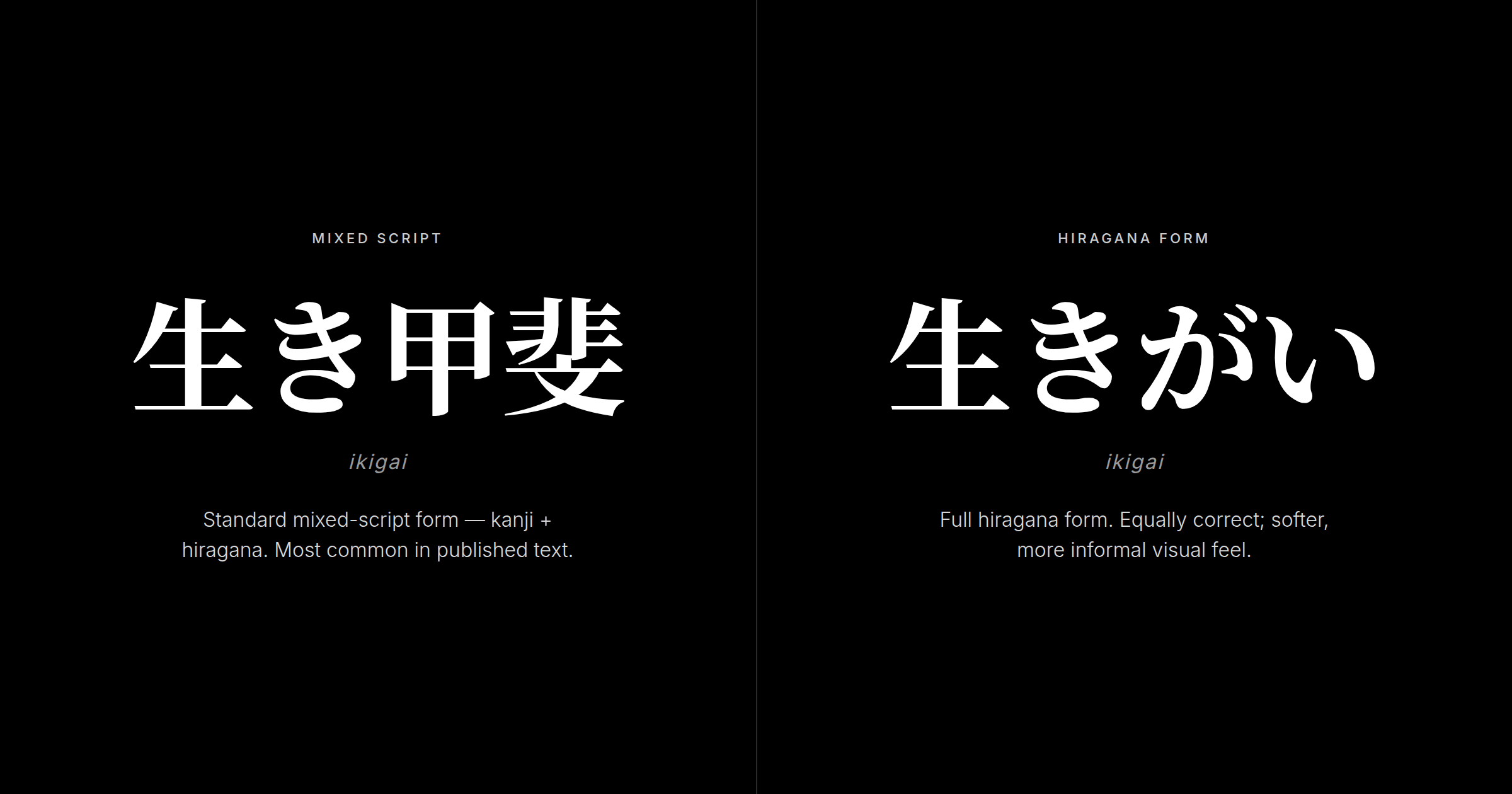
Based on thousands of verification requests reviewed by KIO's Tokyo-native team, the mixed-script form 生き甲斐 is the version most tattoo clients encounter and bring to us — and it's the correct, standard form. The full hiragana version 生きがい is equally legitimate and appears frequently in children's books and informal writing. Both are recognized by every native speaker. The choice is aesthetic, not one of accuracy.
Historical register and everyday use
The word has existed in Japanese for centuries, but it became genuinely common in everyday speech during the post-WWII economic recovery, when questions of meaning and purpose acquired new urgency across Japanese society. Researchers studying longevity in Okinawa — the "Blue Zone" study that first drew Western attention — documented ikigai as one of the reported factors in long, healthy lives. This gave the word an epidemiological foothold in Western academic and journalistic writing, which is where the four-circle framework later attached itself.
Today the word appears in lifestyle journalism, retirement guidance, parenting columns, and ordinary speech. It is not academic. It is not rare. If you say "ikigai" to a Japanese person, they will understand immediately — and they will picture something specific from their own life, not a diagram.
What ikigai is not
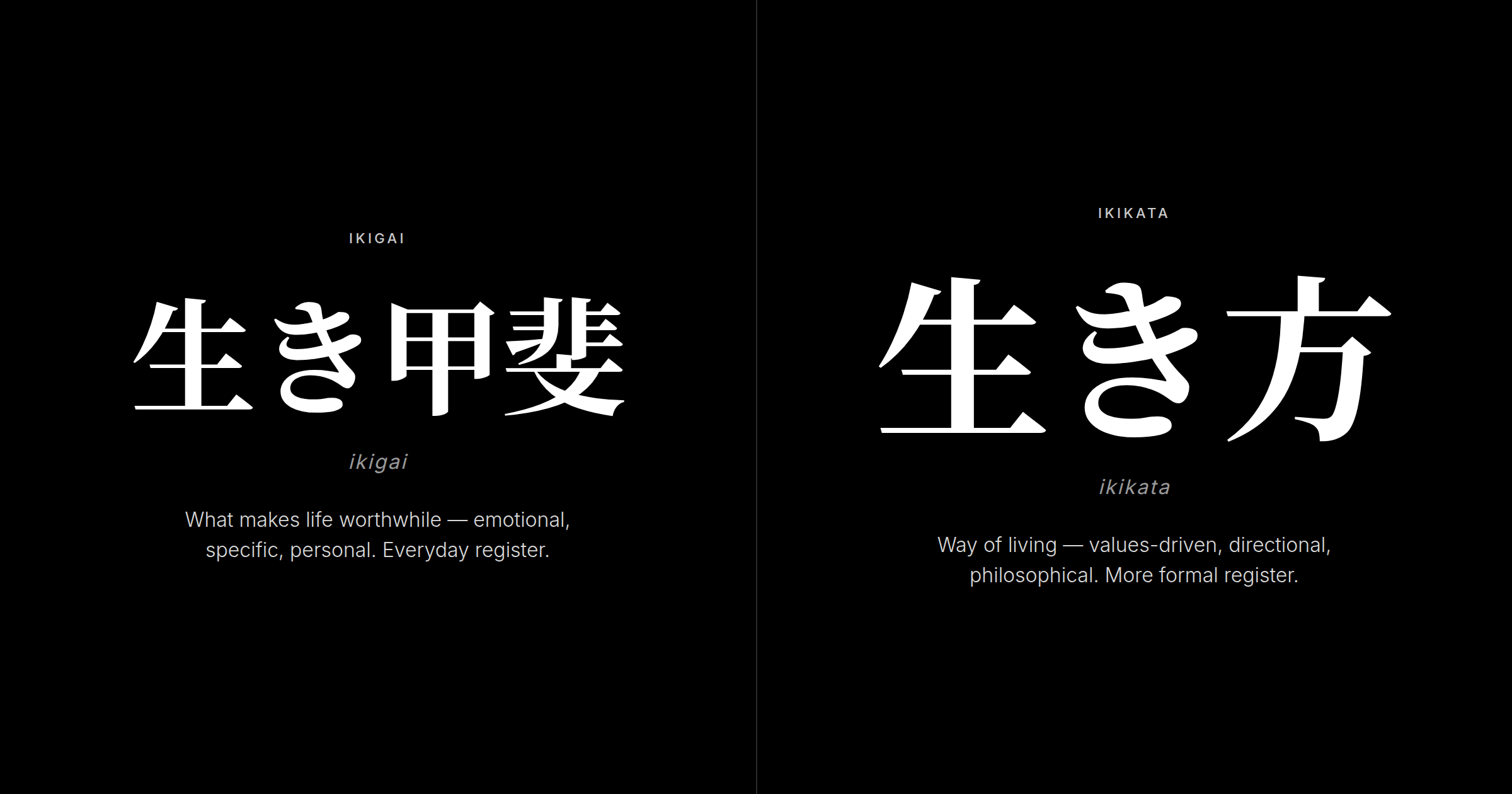
Understanding ikigai also means knowing what adjacent words it isn't. 生き方 (ikikata — "way of living") is about the manner or values of how you live; it's more philosophical and directional. 人生 (jinsei — "human life" in the broad sense) is more abstract and grand. 甲斐 alone (kai — worth, reward) appears in phrases like 働き甲斐 (hatarakigai — "worth of working," the reason work is fulfilling) and 生き甲斐 but rarely on its own as a standalone sentiment.
So What Happens When You Put This on Your Skin?
The cultural weight of 生き甲斐 is real — but it is the weight of an ordinary, deeply human word, not of an ancient code or a wellness algorithm. When you move it from conversation to permanent ink, the question shifts: not whether the word is worthy, but whether it is true for you.
Native Verdict: What a Tokyo Native Reads on Your Forearm
Definition in cultural context: A Tokyo native seeing 生き甲斐 on a forearm will read it as a deeply personal statement — the same way you might read a tattoo that says "my daughter" or "the sea." They will not picture the four-circle Venn diagram. They will picture something specific: a person, a practice, a feeling. They may briefly wonder what yours is.
Cultural reception: What they will not feel is the reverence that Western wellness marketing attaches to the word. Ikigai is not a sacred text or a samurai maxim. It's a word Japanese people use at the dinner table, in retirement pamphlets, in birthday messages to their parents. That is precisely what makes it a strong tattoo word: it is alive in living speech, not frozen in a museum display case.
Technical authenticity: The authenticity question for a native eye is not whether you deserve to use the word — they will not gatekeep a foreigner's genuine search for meaning. The question is whether the kanji is rendered correctly and whether you understand what you're saying. A poorly formed 甲斐 with misaligned strokes reads to a calligraphy-aware Japanese eye the same way a misspelled English tattoo reads to a native English speaker: embarrassing in a way that undermines the sincerity it was meant to convey. The character 斐 in particular has a stroke structure that requires a practiced hand — see the stroke order guide for kanji tattoos if you haven't already confirmed your artist's credentials.
Final verdict: 生き甲斐 is a word worth tattooing. It is beautiful in the kanji, honest in the meaning, and flexible enough to grow with you — your ikigai at 30 and your ikigai at 60 may be different things, and the word holds both without contradiction. The only version of this ikigai kanji tattoo that falls flat is the one acquired because a diagram made it look like a shortcut to purpose. If you can complete the sentence "my ikigai is ___" with something true and specific, you have earned the word.
Native Verdict: 生き甲斐 on skin reads as quiet, personal, and sincere. A Tokyo native will respect the ikigai tattoo choice — provided the kanji is correct and the intention is yours, not a trend's.
Better Alternatives to an Ikigai Kanji Tattoo
If after reflection ikigai feels too broad, too associated with the Western wellness hype, or simply not the word that matches your interior experience, several alternatives carry related meaning with different registers.
生き方 (ikikata — way of living)
- Suits someone whose tattoo is less about a single joy and more about a chosen path or set of values
- Meaning: "how I choose to live" rather than "what makes me glad I'm alive"
- Register: more formal and philosophical than ikigai
- Best for: those seeking directional, values-driven meaning
甲斐 (kai — worth, reward)
- A compact single-character option if you're reaching for the sense that effort has meaning
- Appears in compounds across Japanese; carries understated confidence
- Tone: "I do things that are worth doing"
- Register: somewhat old-fashioned in isolation, but can read as intentional
- Best for: those valuing minimalism and understated expression
意味 (imi — meaning)
- A simpler, more neutral word for "meaning"
- Often appears in 人生の意味 (jinsei no imi — the meaning of life)
- Everyday neutrality can feel either too plain or refreshingly honest
- Best for: those seeking straightforward simplicity without emotional weight
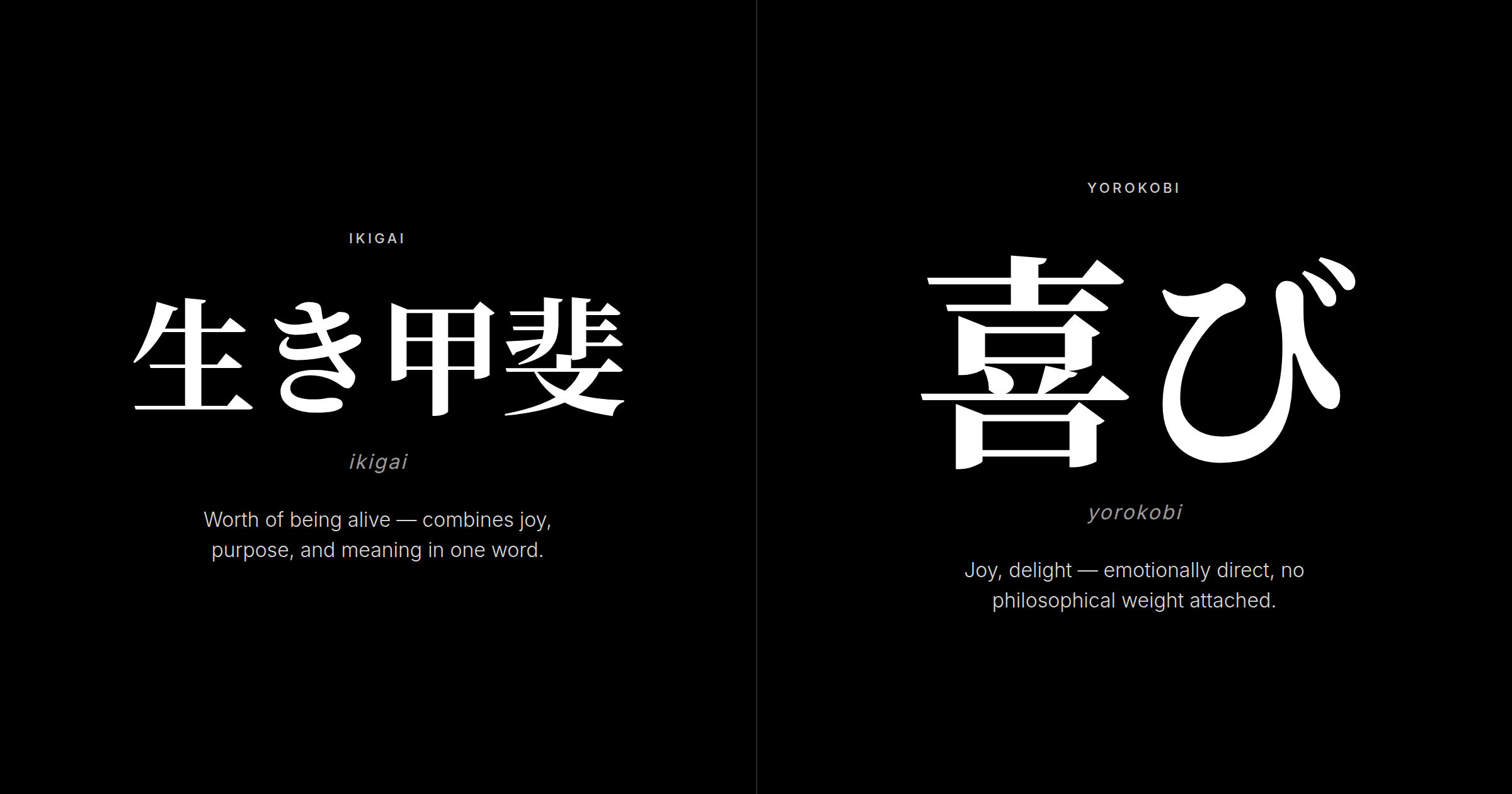
喜び (yorokobi — joy, delight)
- Goes in a different direction: names emotion rather than philosophical worth
- Most emotionally direct alternative to ikigai
- Meaning: joy itself, unweighted by purpose or value
- Best for: those prioritizing emotional immediacy over existential depth
For a deeper comparison of these and other meaningful single-kanji or compound options, the guide to choosing meaningful kanji for tattoos walks through the selection process from a native-register perspective.
Placement and Calligraphy Notes
生き甲斐 is five graphic units (三字 + hiragana き = a five-character run), which makes it longer than single-character tattoos but still compact enough for most placements. The forearm, collarbone, and spine are the most forgiving canvases for keeping all five units legible. For the forearm, consider whether you want it reading vertically (traditional Japanese orientation) or horizontally (more visible in Western reading order). A full guide to orientation, sizing, and body location is available at kanji tattoo placement, size and direction.
The character 斐 in 甲斐 is the calligraphic test in this design. In kaisho (formal block style), the strokes are geometric and clean. In gyousho (semi-cursive, the most common style for artistic tattoos), the character flows but can become ambiguous if the artist is not confident with it. Ask to see previous examples of 甲斐 specifically from your artist before committing. If they cannot provide them, that is a signal to find a calligraphy-trained collaborator.
For a before-you-sit checklist that covers these verification steps in full, see how to verify a kanji tattoo before getting it.
Frequently Asked Questions
Is ikigai really an ancient Japanese philosophy or is the 4-circle thing made up?
The word 生き甲斐 has existed in Japanese for centuries — it's not new. But the four-circle Venn diagram dividing life into passion, mission, vocation, and profession is a Western creation, assembled by bloggers and business coaches in the 2000s and 2010s. Japanese people don't think of ikigai that way. In Japan the word is everyday and personal, not diagrammatic. Both the word's authenticity and the framework's Western origins can be true at the same time.
What if my ikigai changes after I get it tattooed?
Ikigai is designed to evolve. The word itself is flexible — Japanese speakers understand that your ikigai at 25 (a career, a sport, a relationship) may not be your ikigai at 50 (grandchildren, a creative practice, a community). The tattoo becomes a marker of what was true at a particular moment, not a permanent contract. Japanese culture is not uncomfortable with that kind of temporal honesty. The word will hold you as you change.
Is the ikigai kanji tattoo disrespectful to Japanese culture?
No. Native Japanese speakers consistently see a foreigner's ikigai tattoo as a mark of respect — you chose a real Japanese word, with real meaning, and committed to it. The only concerns are practical: is the kanji correctly rendered, and do you understand what you're saying? Treating the word as a mystical charm you chose because it sounded profound is the version that can feel hollow — both to you over time and to native readers. Get it right, mean it genuinely, and the cultural reception will be warm.
What's the most common mistake people make with ikigai tattoos?
The two most frequent errors KIO's review team sees: omitting the hiragana き (so the characters read 生甲斐 instead of 生き甲斐, which is incomplete), and commissioning the design from an artist who renders 甲斐 with incorrect stroke structure or proportions. The second error is often invisible until a native speaker points it out. A design verification before your appointment — with a native reader checking both the character selection and the calligraphy draft — catches both issues. Kanji Ink Oracle offers exactly this review.
How do I know if I should tattoo ikigai versus something else like "purpose" or "balance"?
Ikigai sits between "purpose" (which is directional and achievement-oriented) and "joy" (which is emotional and immediate). It is closer to "what makes being alive feel worthwhile" — which includes both joy and purpose but is constrained to neither. Test it concretely: can you complete the sentence "my ikigai is ___" with something specific and true? If yes, the word fits. If you're still searching, consider 生き方 (ikikata — way of living) for something more values-driven, or 喜び (yorokobi — joy) for something more emotionally direct.
Can I add the 4 circles (passion, mission, vocation, profession) to my ikigai tattoo?
Yes — but be intentional about it. The four-circle diagram is a Western addition; a Japanese person will recognize the circles as non-traditional and will read the overall design as a hybrid. That's not wrong — hybrid design can be thoughtful and intentional. What to avoid is presenting the circles as if they represent ancient Japanese philosophy. If the design is honest about its blended origins, it can work. If you want the purely Japanese reading of ikigai, the kanji alone carries it.
Do Japanese people find it strange if a Westerner gets an ikigai tattoo?
Generally, no. A Tokyo native seeing 生き甲斐 on a Westerner's forearm will typically read it the same way they'd read any personal tattoo: as a statement about what matters to that person. The kanji is a word they use themselves, for things they love. The cross-cultural reach reads as respect, not appropriation. What they notice — and what can undercut that respect — is incorrect calligraphy or an apparent lack of understanding of the word's actual meaning. Get both right and you'll be fine.
Ready to confirm your 生き甲斐 design before committing to ink? Kanji Ink Oracle connects you with Tokyo-native reviewers who assess both the character accuracy and the calligraphy quality of your design — with a written assessment returned within 24 hours. Take the step that turns a beautiful idea into a tattoo you'll carry with confidence.