Hunter x Hunter 念 Tattoo: One Kanji, Big Misread
Hunter x Hunter fans love the 念 kanji — but Japanese people read it as spiritual focus, not anime power. Here's what you're really committing to.
Hunter x Hunter is one of the most intellectually rich shonen anime ever made, and its power system — Nen — is a big reason why. It's not just flashy energy blasts; it's a complex framework of aura, discipline, and personal expression that rewards attentive viewers. Naturally, fans want to carry a piece of that with them. The single kanji 念 (nen) looks perfect for a tattoo: clean, minimal, visually striking, and loaded with meaning for anyone who's watched the series.
But here's what the tattoo forums don't tell you: 念 in everyday Japanese does not mean what the anime makes it mean. The register gap between Togashi's fictional power system and how real Japanese people use this character is wider than most fans expect — and it shapes exactly what a Japanese person will think when they see it on your forearm.
What 念 Actually Means in Japanese
Before thinking about tattoos, it's worth understanding what 念 is in the language that created it.
The character 念 is built from two components: 今 (ima — now, the present moment) over 心 (kokoro — heart, mind). Together they form something like "present mind" or "mind held in the now." The kanji has been part of written Japanese for over a millennium, arriving through Chinese Buddhism, and it carries that philosophical weight in its usage today.
In Buddhist practice, 念 appears in 念仏 (nenbutsu — Buddhist prayer through recitation). The act carries sustained, intentional attention toward something sacred, giving 念 its core register: mindful, internal, prayer-like concentration.
In modern Japanese, 念 shows up in patterns like 残念 (zannen — regret, disappointment). The 念 carries the weight of something held in mind that didn't come to pass. A teacher says zannen to a student who failed; a sportscaster uses it when a team loses; friends text it for mild disappointment.
Another usage is 念のため (nen no tame — just to be sure). You'd say this before confirming something a second time. The 念 here is careful, attentive thought applied before acting — practical and ordinary.
A third form is 念じる (nenjiru — to wish intensely, to pray). A parent might nenjiru for their child's success; an athlete mentally preparing might nenjiru a good result. It's internal, volitional, and deeply personal.
Notice the pattern: in every real Japanese context, 念 is about internal mental or spiritual states. It is contemplative, attentive, sometimes sorrowful, always inward-facing. There is no usage in standard Japanese where 念 means visible energy, external aura, or supernatural power.
The Kanji Itself: A Breakdown
念 (nen) is a single-character kanji with 8 strokes, sitting in the jouyou (regular-use) kanji list taught in Japanese elementary schools. That means every literate Japanese person knows this character.
Its core meanings as listed in Japanese dictionaries: thought, sense, attention, concern, consideration, prayer, care. The secondary Buddhist meaning of "mindful recitation" gives it a slightly elevated, contemplative feel in certain contexts.
Compounds with 念 cluster around sustained mental attention:
- 念頭 (nentou) — in mind; "念頭に置く" = "to keep in mind"
- 念願 (nengan) — a long-held wish or serious, sustained hope
- 観念 (kannen) — concept or resignation; the inevitable
- 専念 (sennen) — devote full attention
The register is consistent: serious, contemplative, internal. When a Japanese person sees 念 alone—as in a tattoo—their mental model draws from this vocabulary, not from anime.
The Register Gap: What Japanese People Actually See
This is where the Hunter x Hunter tattoo question gets genuinely interesting — and where KIO's perspective differs from the generic tattoo content you'll find on forums.
Based on thousands of verification requests reviewed by KIO's Tokyo-native team, anime kanji tattoos fall into two categories: kanji that don't exist in real Japanese (invented script, fan-made compounds), and kanji that do exist but carry a different meaning than the anime implies. 念 falls firmly in the second category — and that distinction matters enormously.
When a Japanese person who has never watched Hunter x Hunter sees 念 tattooed on someone's arm, their read is immediate: this person has some connection to contemplation, prayer, or focused intention. Not strength. Not power. Not energy. Attention. The connection to Buddhist practice makes it feel slightly formal, slightly old-fashioned in a dignified way — like wearing a word you'd find in a temple inscription.
In Hunter x Hunter, Nen is visual and external: characters manifest auras, project En (aura fields), perform feats through Nen categories. It's spectacular, kinetic, outward. Real Japanese 念 is none of these. The anime gave it a specialized, invented meaning—much like Jujutsu Kaisen did with 呪術 (jujutsu), a real word loaded with narrative meaning beyond its dictionary definition.
The important clarification: this isn't a mistake. Togashi (HxH's creator) knew what 念 meant when he chose it. The philosophical resonance between "focused mental attention" and a power system that rewards psychological discipline over raw strength is deliberate and elegant. The problem only arises when fans assume the anime meaning and the Japanese meaning are the same.
For fans who have read about the 気/aura register gap, this is a closely related phenomenon. Just as 気 (ki) carries everyday meanings like mood, feeling, and spirit rather than mystical energy, 念 sits in the register of contemplation and care rather than power. The aura kanji tattoo article on KIO covers the 気 comparison in depth — and the same logic applies here.
So What Happens When You Put 念 on Your Skin?
This is the pivot every HxH fan considering this tattoo needs to make: the question isn't whether 念 is a good character (it is), but whether you're comfortable with what it actually communicates.
A Tokyo native seeing 念 on your forearm will not think "Hunter x Hunter fan." They will think one of the following: this person values mindfulness, this person has a connection to Buddhist practice, this person is reflecting on something they're holding onto. Depending on context, they might think "zannen" (regret) rather than anything aspirational. The reading is philosophically serious — but it is not the reading of power, aura, or supernatural ability.
That's not a reason to avoid 念. It's a reason to want it with clear eyes.
Better Alternatives for the HxH Concept You're Actually After
If the real draw is the anime's meaning — external energy, visible power, aura — then 念 isn't your most accurate kanji. Here are the alternatives that native speakers would recognize as closer to the concept:
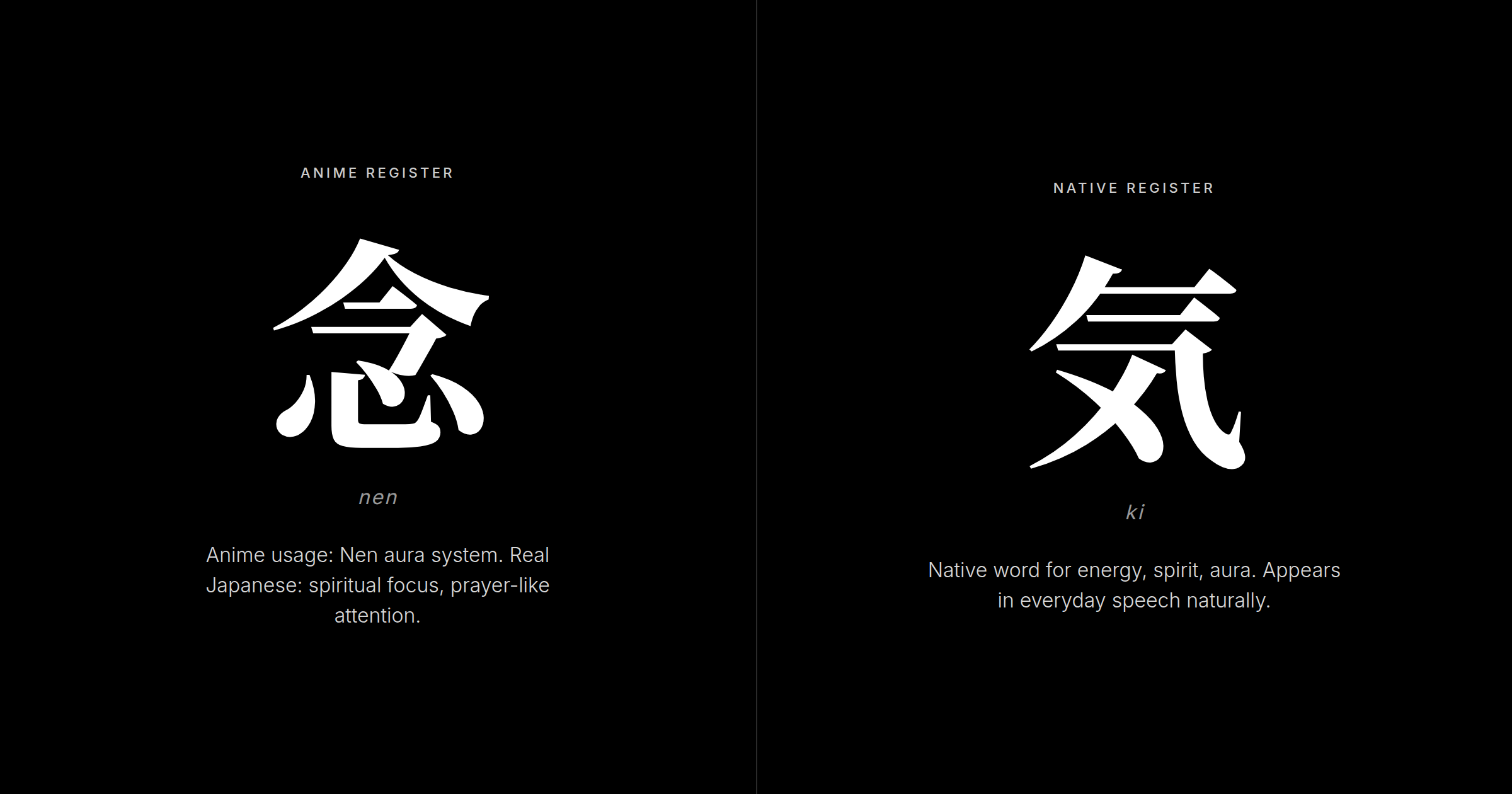
気 (ki — energy, spirit, aura, feeling) is the most natural Japanese word for the kind of life-energy HxH's Nen system visually resembles. Ki appears in martial arts, in everyday expressions of mood and feeling: kiai (気合い — fighting spirit/drive), kihaku (気迫 — force of will, intensity), kehai (気配 — sensing someone's presence or energy), kimochi (気持ち — feeling, emotional state). It's the word Japanese speakers actually use when they talk about someone's vibe or energy presence. For a kanji that reads as "energy/aura" rather than "focused attention," 気 is the native choice. KIO's aura kanji tattoo guide goes deep on this distinction.
The comparison below shows how 念 and 気 sit in different registers for a native Japanese eye.
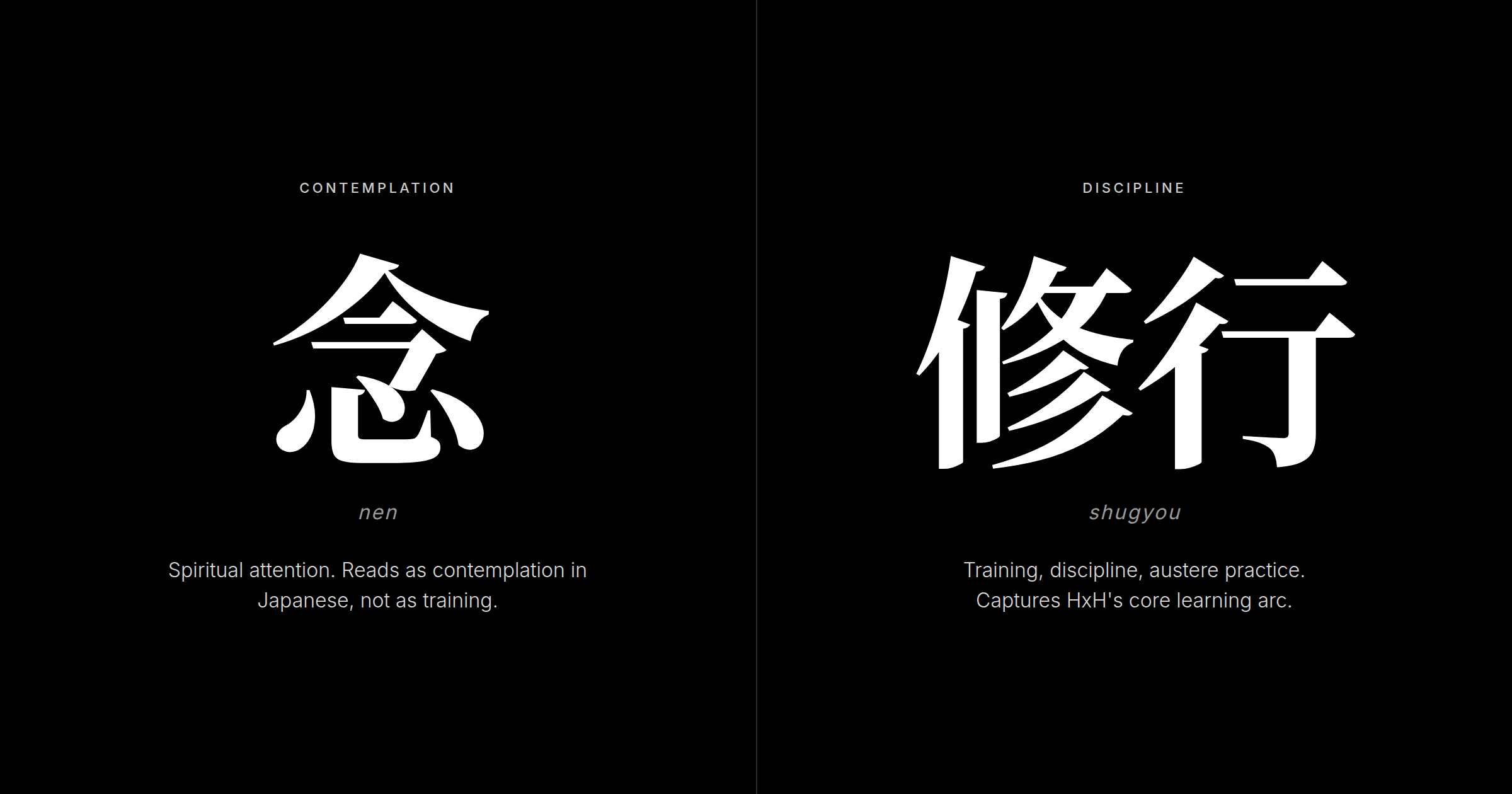
修行 (shugyou — training, discipline) is worth considering for HxH fans. Gon and Killua work for power under harsh conditions with methodical patience. Shugyou is the word for developing a skill through sustained effort, often under a teacher. It appears in martial arts, traditional arts, and religious training. If you want a compound that honors HxH's training arc, 修行 is most accurate. See KIO's guide to choosing meaningful kanji for alignment evaluation.
For fans weighing 念 against 修行 as a Hunter x Hunter kanji tattoo, the side-by-side below illustrates the distinction in register.
力 (chikara — power, strength) is the direct option for fans wanting power-system clarity. Chikara reads as physical or personal strength to any Japanese person. It lacks 念's philosophical register but compensates with clarity. See best single kanji for a tattoo for power-character comparisons.
心 (kokoro — heart, mind, spirit) works if the psychological dimension draws you: power shaped by who you are mentally and emotionally. Kokoro is softer than 念 and more universally readable, with its own depth.
Native Verdict
From a Tokyo-native perspective, 念 is one of the more interesting anime kanji tattoos we see — precisely because it isn't wrong.
Unlike fake kanji that anime invented or compounds that read as offensive when taken out of context, 念 is a real, legitimate, philosophically rich character. The verdict isn't "this is a mistake." The verdict is: "you are committing to something deeper and more austere than the anime depicts, and that deserves to be a conscious choice."
Japanese people encountering 念 on your arm will not laugh or cringe. They will read it seriously — possibly more seriously than you intended. A character that appears in Buddhist temple inscriptions, in formal expressions of regret, and in everyday exhortations to be careful carries quiet gravity. If you walk into a room in Japan with 念 tattooed on your wrist, the impression is contemplative, perhaps slightly formal, and genuinely interesting — but it is not "cool anime power."
What makes 念 genuinely worth considering as a long-term tattoo choice: it ages better than the anime. Fandoms fade; the appeal of Hunter x Hunter may sustain (it has so far), but the day you care less about the anime, 念 will still mean something profound in its own right. That's not true of every anime tattoo, and it's worth weighing. What Japanese people actually think about kanji tattoos explores this longevity dimension directly.
The honest recommendation: get 念 if you genuinely connect with "focused spiritual attention" as your real meaning. Get 気 or 修行 if you want the anime concept without the register gap. And whichever you choose, verify the design before committing — the next section explains how.
FAQ
Will Japanese people think I'm weird for getting 念 tattooed on my body?
No — but not for the reason you might expect. 念 is a real, culturally rooted kanji with deep ties to Buddhist practice and philosophical contemplation. Japanese people won't find it strange; they'll likely read you as someone drawn to introspective or spiritual themes. The one thing they won't do is connect it to Hunter x Hunter — 念 as an anime power-system term is invisible to non-fans. The result is a tattoo with zero "tryhard anime" risk in Japan, which for many wearers is actually the ideal outcome.
Does 念 actually mean "power" or "life energy" in Japanese like it does in the anime?
No. In standard Japanese, 念 means thought, focused attention, mindfulness, or prayer-like intention. The anime invented the visible, aura-based meaning for storytelling purposes — it's Togashi's specialized fictional usage, not a dictionary definition. If you want a kanji that genuinely means power, 力 (chikara) is the clear choice. If you want spirit or aura, 気 (ki) is closer to how Japanese speakers actually talk about that concept. 念 is better understood as "the mental state of profound, sustained attention" — which is genuinely beautiful, just different from what the anime depicts.
Should I add other characters or symbols next to 念 to make the Hunter x Hunter connection clear?
It depends on your intent. 念 alone ages well — it reads as a standalone philosophical statement and doesn't require the anime to give it meaning. If you want the HxH reference to be legible to other fans, consider pairing it with 修行 (shugyou — training, discipline), which together with 念 would read as a tribute to the show's intellectual discipline arc. Adding the Hunter Association badge as a design element is another route. The honest take: other HxH fans will recognize 念 with or without additions; Japanese people won't recognize the anime reference either way.
Is 念 difficult to tattoo compared to other kanji?
No. 念 has 8 strokes with good visual balance and no overly complex or fine-detail components. It reads cleanly at most sizes and works well in both minimalist line work and bolder styles. The character holds up at small scale (wrist, behind-ear) and looks strong at larger sizes too. The key variable isn't the character itself — it's your artist's experience with Japanese kanji. Always verify they have a track record with Japanese characters before booking. See KIO's guide how to verify kanji tattoo before getting it for the full pre-ink checklist.
Is getting 念 as a Hunter x Hunter tattoo the same as a "weeb tattoo"?
Not inherently. A "weeb tattoo" typically signals fandom without cultural grounding — a cartoon symbol or anime-specific invented character. 念 is the opposite: a kanji with over a millennium of real cultural history, appearing in Buddhist practice, classical literature, and everyday modern Japanese speech. What determines whether your tattoo falls into "weeb" territory is your own understanding: if you know 念 means focused spiritual attention and you're genuinely drawn to that meaning, you're on solid ground. If you're copying the anime without knowing what you're committing to, that's when the cultural disconnect becomes a problem.
How do I make absolutely sure I'm getting the correct kanji for Nen before I tattoo it?
Confirm that your tattoo artist is working from 念 as rendered in a reliable Japanese font — not a screenshot from the anime, which may use a stylized version. Cross-reference the character on Jisho.org (a trusted Japanese dictionary resource) and compare stroke-by-stroke. Have your artist print the reference from a standard Japanese font before stenciling. If you're uncertain at any point, verify the design with a native Japanese reviewer before committing. The investment is minimal compared to the permanence of the result.
Still deciding on your hunter x hunter nen tattoo? Verify your kanji at Kanji Ink Oracle — KIO's Tokyo-native team reviews your design and returns a plain-language verdict within 24 hours. Whether you're committing to 念 or exploring alternatives like 修行 or 気, the check costs far less than a cover-up.