Hell's Paradise Kanji Tattoo: 地獄楽 Meaning & Native Verdict
地獄楽 kanji tattoos decoded: Buddhist vocabulary, not anime invention. Register, Edo history, and Tokyo native assessment before you ink 地獄 on your skin.
Hell's Paradise arrived on screens in 2023 and immediately earned a reputation as one of the few anime titles with kanji worth actually thinking about. Unlike invented title strings or phonetic placeholders, 地獄楽 (Jigokuraku) is built from real Japanese vocabulary rooted in Buddhist theology, Edo-era history, and a deliberate philosophical paradox. That combination is why fans who engage seriously with the series keep arriving at the same question: could this kanji make a meaningful tattoo, or is it just a cool title?
The answer depends on what you understand about what these characters carry — and how Tokyo natives actually read them. This guide walks you through the linguistic weight of 地獄 (hell) and 楽 (pleasure), the historical context that makes them credible beyond fandom, and the Tokyo-native verdict on whether this anime reference holds up as permanent body art.
Why Hell's Paradise Stands Out Among Anime Kanji Tattoos
Most anime titles that fans want to tattoo fall into one of two traps: pure phonetic strings in katakana that carry no kanji meaning, or characters so common — like 愛 (love) or 力 (strength) — that the anime connection is invisible to native readers. Hell's Paradise Jigokuraku sidesteps both of these pitfalls.
地獄楽 is constructed from real Japanese vocabulary with genuine depth outside the anime context. 地獄 (jigoku — hell) has been in active use in Japanese Buddhist literature for over a thousand years. 楽 (raku — pleasure, ease) is one of the most versatile characters in the written language. Their combination reflects authentic cultural logic — not invented anime branding or phonetic placeholder syllables.
Based on patterns from KIO's kanji tattoo verification work, fans of this series ask better questions than average: they want to understand what they are committing to, not just how the title looks. That instinct is well-placed. These Jigokuraku characters carry serious weight on skin — but only if the wearer understands the difference between the anime reference and the cultural substance underneath.
Deconstructing 地獄楽 (Jigokuraku) — The Title
The title breaks cleanly into two halves, each drawn from a Buddhist concept with centuries of usage in Japanese.
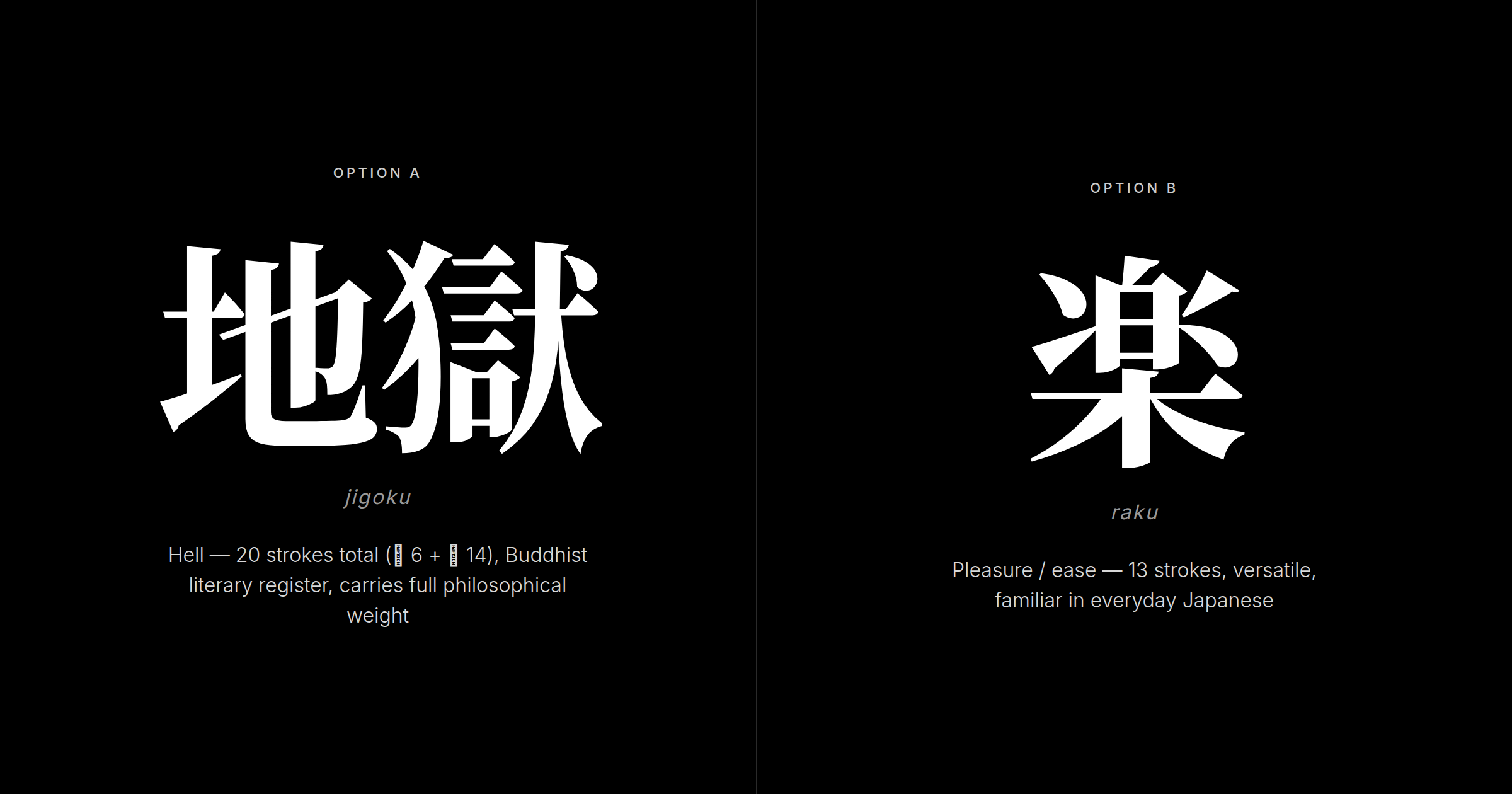
地獄 (jigoku — hell, literally "earth prison"): The first character, 地 (chi/ji — earth, ground, place), is one of the most ordinary characters in the language. You see it in 地震 (jishin — earthquake), 地点 (chiten — location), 地下 (chika — underground). By itself it carries no weight at all. The second character, 獄 (goku — prison, confinement, punishment), is formal and literary — it rarely appears outside compounds. Together, 地獄 shifts the register entirely into Buddhist/philosophical territory. This is the standard Japanese word for hell as understood in Buddhist doctrine: a realm of consequence, not metaphor.
楽 (raku/gaku — pleasure, ease, music, comfort): This character is the opposite in temperament. It reads variously as raku in compound nouns (楽観, rakukan — optimism; 気楽, kiraku — carefree) and as gaku in music contexts (音楽, ongaku — music). It suggests effortlessness and release from suffering.
The series title juxtaposes these two concepts deliberately. Author Yuji Kaku did not invent 地獄楽 as a string of syllables that sounds interesting — he constructed a portmanteau from 地獄 (hell) and the second character of 極楽 (gokuraku — paradise, the Pure Land in Buddhist cosmology). 極楽 and 地獄 are the two poles of Buddhist afterlife theology: the deepest hell and the highest paradise. Compressing them into a three-character title that can be read as "hell's pleasure" or "hell-paradise" is a specific philosophical act. The oxymoron is the content.
The Edo Period Setting — Why Historical Context Matters
Hell's Paradise is not set in an imagined fantasy landscape. The story is explicitly grounded in Japan's Edo period (1603–1868), the era before modernization when the Tokugawa shogunate controlled both the legal system and the cultural landscape. The premise — death-row criminals sent by the shogunate to a mysterious island (Shinsenkyo) to retrieve an immortality elixir — is rooted in specific Edo political and penal logic.
This matters for the tattoo conversation for one specific reason: the Edo period was the historical peak of irezumi (入墨 or 刺青 — traditional Japanese tattooing) as a punitive practice. Criminals were sometimes marked with irezumi as a permanent record of their sentence. The irony embedded in the series premise — convicted criminals sent on an impossible mission — is inseparable from this history. The 地獄 in the title is not abstract; it echoes specific Edo institutional violence.
Understanding this layer changes how a 地獄 tattoo reads to a Japanese speaker. "I like the anime" and "I understand the Edo execution-island premise and irezumi's punitive history" land in completely different registers.
The Single-Character Option: 地獄 Alone
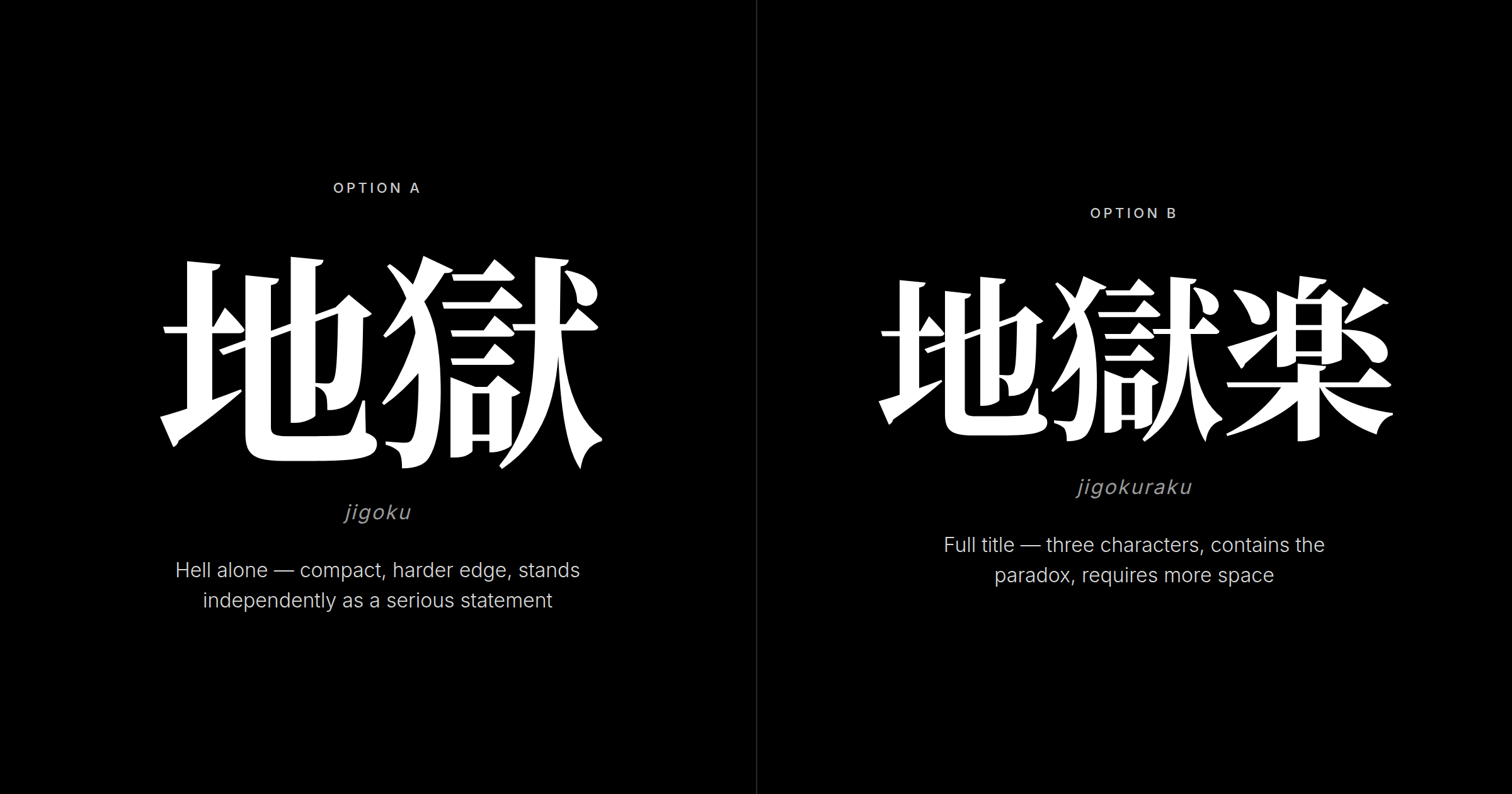
For most tattoo placements, the full 地獄楽 phrase is not the practical choice. 地獄 alone is a complete jukugo — a two-character compound that stands independently in standard Japanese. It appears in Buddhist texts, classical literature, and modern discourse. It is not a fragment; it is a word.
As a tattoo, 地獄 is immediately legible to any Japanese reader without the 楽 context. What it loses is the philosophical paradox — the oxymoron the title constructs. What it gains is compactness and a harder edge: "hell" as a serious, intentional statement.
Historical irezumi tradition includes hell-themed imagery — Jigoku Dayu (地獄太夫, the Hell Courtesan) is a classical subject in both woodblock prints and traditional tattoo iconography. A 地獄 tattoo on a forearm from a Western wearer is arriving into a visual tradition that already existed long before the anime. That is precisely what makes it credible beyond fandom.
What This Looks Like on Your Skin — The Pivot
So what happens when you put 地獄 or 地獄楽 on your skin?
A Jigokuraku kanji tattoo makes a specific claim about how you understand life. Unlike unambiguous kanji like 愛 (ai — love) or 力 (chikara — strength), 地獄 carries genuine philosophical weight and intentional darkness that is not softened by context. A native Japanese speaker encountering this Hell's Paradise kanji tattoo on a Western person's forearm will not read it as a mistake or as naïve anime fandom. They will read it as a deliberate choice — and they will be curious about what you understand behind it.
That curiosity is the key dynamic. A 地獄 tattoo invites a conversation. The cultural register of that conversation depends on what you can bring to it — whether you can explain the Edo period execution-island premise, the Buddhist theological weight, or the philosophical paradox at the series' core.
Native Verdict: What a Tokyo Native Actually Reads
A Tokyo native encountering 地獄 or 地獄楽 tattooed on a Western person's body will first recognize it as a Hell's Paradise reference. The 2023 MAPPA adaptation created significant cultural saturation in Japan — this is not a niche title. Readers aged 15–45 in particular will make the connection to Jigokuraku immediately.
First impression: recognition + curiosity, not judgment. Hell's Paradise (地獄楽) is culturally respected in Japan. The manga ran in Shonen Jump+ and the MAPPA studio adaptation was treated as serious media. A tattoo referencing it reads as engagement with respected source material, not low-brow or casual fandom.
The deeper read depends on you. Whether the tattoo registers as anime fandom or personal philosophy hinges on your ability to articulate meaning. If you can reference the Edo period execution-island premise, the Buddhist theological weight of 地獄 versus 極楽 (gokuraku — paradise), or the specific oxymoron the series constructs, the native assessment shifts toward cultural literacy. If your answer is only "I like the anime," the tattoo reads as pure fandom — not offensive, but not philosophically grounded.
No criminal association. One reassurance that matters for anyone concerned about perception: 地獄 carries no modern yakuza or gang-adjacent association in contemporary Japanese social reading. Unlike some kanji characters that carry coded criminal register, 地獄 is clean. The edginess is intentional, literary, and philosophical — not dangerous or criminal-coded.
The verdict: 地獄 is one of the strongest anime-sourced kanji choices available to Western tattoo seekers. It is authenticated Japanese vocabulary, philosophically grounded in centuries of Buddhist thought, historically connected to irezumi tradition, and carries weight outside the anime context entirely. A Tokyo native will read it as a serious statement — provided the wearer can support that reading in thoughtful conversation.
Better Alternatives if 地獄 or 地獄楽 Doesn't Fit
Not every wearer should commit to a word that means "hell." These alternatives carry related philosophical weight with different registers:
試練 (shiren — trial, ordeal): Captures the concept of going through something hard without the literal darkness of "hell." Appears in formal speeches, athletic commentary, religious discourse.
苦楽 (kuraku — hardship and pleasure together): Used in 苦楽をともに (sharing hardship and joy — heard in vows and speeches) — coexistence of difficulty and ease without 地獄's edginess.
陰陽 (in'you — yin and yang): Central to Japan's 陰陽師 (onmyoji) tradition — the same coexistence-of-opposites philosophy without the hell imagery.
If the edginess feels forced rather than true, that is meaningful information. The character should feel like yours. Our guide to choosing meaningful kanji for tattoos walks through the decision framework in more depth. For a deeper dive into related kanji choices, explore how Hell's Paradise compares to other anime tattoos in terms of linguistic weight and cultural credibility.
How 地獄 Compares to Other Anime Kanji Choices
Among anime kanji tattoos, 地獄楽 occupies a tier of its own: Buddhist-grounded vocabulary with irezumi historical roots, not invented branding. Naruto's 愛 (ai — love) is clean and credible but so common it loses the anime connection entirely — see our Naruto kanji tattoo breakdown. Jujutsu Kaisen's 呪 (ju — curse) is equally literary but less rooted in tattooing history — compare in our JJK guide. Bleach's 死神 (shinigami — death god) is philosophically close but lacks 地獄's direct irezumi classical tradition — see the Bleach article. Before committing, verify your exact design with a Tokyo-native review — 獄 is technically demanding and errors are not cheap to correct.
FAQ
Is 地獄楽 (Jigokuraku) a real Japanese word or just invented for the anime?
Partially real, deliberately constructed. 地獄 (hell) is a standard Buddhist and literary kanji compound with over a thousand years of usage in Japanese. 楽 (pleasure, ease) is a standard character with broad everyday and classical use. Author Yuji Kaku constructed the title as a portmanteau combining 地獄 and the second character of 極楽 (gokuraku — paradise, the Buddhist Pure Land), creating a three-character compound that captures the philosophical paradox of the series. Both halves are real Japanese vocabulary; the combination is the author's specific invention. This is substantially different from phonetic anime titles with no kanji depth — 地獄楽 is a legitimate philosophical juxtaposition using established vocabulary.
Can I just get 地獄 (hell) alone, or do I need the full 地獄楽 phrase?
地獄 alone is absolutely valid and more practical for most tattoo placements. It is a complete jukugo — a two-character compound that stands independently in standard Japanese, appearing in Buddhist texts, classical literature, and modern discourse. The trade-off: 地獄楽 holds the oxymoron that makes the title philosophically interesting — the coexistence of hell and pleasure. 地獄 alone is stronger and harder-edged but loses that paradox. Choose based on the space available and whether you want to signal the full anime-specific philosophical tension or the harder core concept alone.
Won't 地獄 (hell) be weird or edgy to have on my body? Won't Japanese people think it's weird?
It is intentionally edgy — that is the point. 地獄 is a serious, literary, somewhat formal character that does not appear casually in Japanese conversation. When a Japanese speaker sees it tattooed, they recognize it as a meaningful statement, not a casual impulse. The edginess registers as "this person is making a deliberate choice" rather than "this person made a mistake." Tokyo natives will be curious rather than judgmental, particularly if you can explain the Hell's Paradise and Edo period context. If the edginess feels forced rather than right to you, that is important information — this character should feel like yours.
Is there a difference between 地獄 and other ways to write "hell" in Japanese?
地獄 is the standard Buddhist and formal term for hell in Japanese. There is no competing kanji that carries the same weight in the context relevant to this series. The character 獄 alone means "prison" in a more literal sense and strips away the Buddhist theological dimension. 地獄 specifically bridges physical location (地 — earth, ground) and spiritual consequence (獄 — imprisonment, damnation) in the way Buddhist hell doctrine conceptualizes it. This combination is historically accurate to how Japanese culture has understood and depicted hell across centuries of religious art, literature, and now popular media.
How do I make sure the kanji are rendered correctly for my hells paradise jigokuraku kanji tattoo?
獄 has 14 strokes and a dense interior — it is among the most misrendered kanji at tattoo scale. Use a high-resolution reference from jisho.org or a kanji dictionary, not anime screenshots. Show the reference to your artist and confirm the proportions at your intended size. Have a Tokyo-native speaker verify the final stencil before you sit. KIO's service at https://kanji-ink-oracle.com/ covers exactly this step.
If I get 地獄 or 地獄楽, will people think I'm into the anime, or will it read as a personal philosophy?
Both, depending on context. In Japan, readers aged 15–45 will likely recognize the Hell's Paradise reference first. What shifts the reading is how you explain it: the Edo period premise, the Buddhist weight of 地獄 versus 極楽, or the oxymoron the title constructs all move the interpretation from "anime fan" toward "someone who engaged seriously." Outside Japan the anime connection is rarely recognized, and the kanji reads as a personal philosophical statement. Either way the tattoo holds — the vocabulary is real and grounded, not invented.
What placement should I get this? Does forehead placement make a difference?
Placement significantly affects how the tattoo reads culturally. Forehead placement immediately codes as "anime character cosplay" rather than a personal philosophy — it references the convention of facial tattoos on anime characters rather than the traditional placement of irezumi. For 地獄 or 地獄楽, preferred placements are the upper back (between the shoulder blades), upper arm, forearm, and calf. These signal intentional personal choice rather than character costume imitation. Vertical orientation (reading top to bottom) is traditional and most legible for kanji characters. For the full 地獄楽 phrase, each character should be at minimum 2 inches tall to preserve stroke detail and legibility. See our full guide to kanji tattoo placement, size, and direction for detailed advice on positioning and spacing.
Should I get 地獄楽 together, or split them into two separate tattoos?
The philosophical oxymoron requires both parts together. Splitting onto different body parts breaks the juxtaposition — each becomes an independent statement. If uncertain, start with 地獄 alone. Add 楽 when the full paradox is what resonates.
Before committing to 地獄 or 地獄楽 on your skin, verify the kanji with a Tokyo-native reviewer. The verification process checks your exact design for stroke accuracy, script style, and cultural register — returning a detailed assessment within 24 hours. One review before the appointment is the only way to know for certain what the characters actually say, and what they will say to every Japanese speaker who sees them for the rest of your life. Get your kanji verified at Kanji Ink Oracle.