Bleach Kanji Tattoos: 卍解, 死神, and What Works
Bleach kanji tattoos decoded: what 死神, 卍解, and 斬月 actually say to a Tokyo native, and which Bleach designs work as permanent ink versus anime reference.
Bleach is having a second cultural moment. The Thousand-Year Blood War arc's anime adaptation, which began in late 2022, brought a generation of lapsed fans back to Tite Kubo's world and pulled in an entirely new audience at the same time. With renewed attention has come a surge in tattoo demand — and Bleach is an unusually interesting case for kanji tattoos. The series is text-heavy by design. Nearly every technique, title, and character name is built around deliberate kanji choices that carry real-world meaning in Japanese. That meaning does not always translate the way Western fans expect.
What Makes Bleach Different for Kanji Tattoos
Most shonen anime have cool names. Bleach has a constructed vocabulary. Tite Kubo has discussed in interviews how he layers Japanese folk belief, Buddhist imagery, and classical register into the series' terminology. This makes Bleach kanji more rewarding to research — and more consequential to misread — than comparable anime tattoo designs.
The TYBW arc deepens this: the Quincy material introduced late in the story draws on a different register entirely than the shinigami world. Soul Society terminology reaches into Buddhist and Shinto frameworks. Quincy terms pull from German, which Kubo writes in romaji but pairs with Japanese kanji equivalents. For a fan designing a tattoo, these layers are exactly the reason Bleach kanji feels weighty — and exactly the reason a Tokyo-native read matters before committing to permanent ink.
Based on the verification requests KIO's Tokyo-native team processes, Bleach-related queries fall into two groups: fans who want one specific design confirmed, and fans who sense there is more to the kanji than they have found and want a fuller picture first.
The Real Meaning of 死神 (Shinigami)
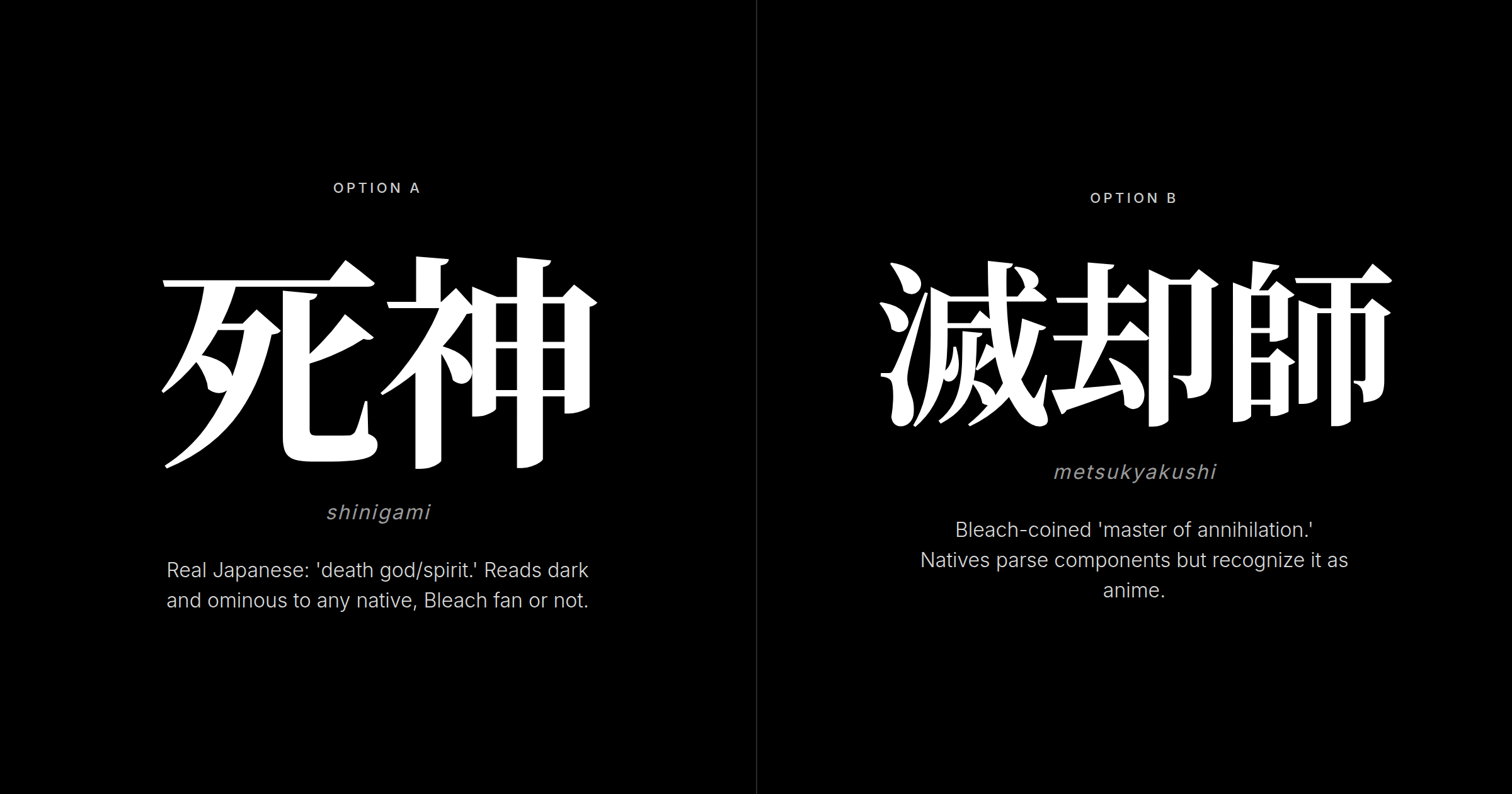
死神 (shinigami — death god or death spirit) exists in Japanese culture entirely apart from Bleach — and its cultural life is considerably darker than "soul reaper" implies.
In Japanese folk belief, shinigami are spirits associated with death's pull — not administrative soul management but something more like an ominous presence that draws people toward mortality. The word appears in classical rakugo (traditional comic storytelling) as a genuinely frightening figure. Meiji-era literature uses it as a death omen. Even in modern usage — sports commentary, news coverage — 死神 applied to a person carries foreboding, not professional status.
Bleach's English localization as "soul reaper" significantly softens the Japanese. Soul reaper suggests function and structure. 死神 suggests a death entity. A native speaker reading 死神 on a tattoo does not think of a spiritual bureaucrat. They read the literal meaning first, then (if they know Bleach) layer on the anime context. The two readings coexist, but the dark reading comes first.
The components confirm this. 死 (shi — death) is a word of consistent gravity in Japanese. It gives the number four its unlucky reputation — they share the same pronunciation — and appears in formal words for mortality (死亡 shibou, 死者 shisha). 神 (kami — god, spirit, divine being) spans from Shinto theology to modern exclamations of admiration, but in compound with 死, there is no lightness to it.
If your goal is to communicate shinigami as Bleach presents it, know that the Japanese is putting a death omen on your skin. That may be exactly what you want — but it is worth knowing before the appointment.
卍解 (Bankai): Real Kanji, Invented Compound
卍解 (bankai — the complete release of a shinigami's zanpakutou) is the series' most iconic term, and also its most linguistically unusual. The essential fact is this: 卍解 is not a real Japanese word. Kubo coined it for Bleach. A Japanese person who has not seen the series will not recognize it as existing vocabulary. They will parse the components correctly but understand immediately that this is invented terminology.
This matters for tattoo decisions. A tattoo of 死神 reads as real Japanese to every native speaker who encounters it, regardless of Bleach context. A tattoo of 卍解 reads as an anime reference — specifically, as a signal that the wearer knows Bleach — because the compound does not exist in standard Japanese.
The 卍 (Manji) Component
The first character, 卍 (manji), carries more cultural history than the Bleach frame captures. The manji is a Buddhist symbol of antiquity: it marks Buddhist temples on official Japanese maps (the standard cartographic symbol used by Japan's Geospatial Information Authority), appears carved into temple gates, and is embroidered into ceremonial cloth. It has been in continuous use in Japan for over a thousand years with no negative association whatsoever.
Younger Japanese people have also adopted 卍 as casual internet slang — an intensity marker in text messages, something like "that's wild" or "extreme," used in the way Western texters might use an exclamation emoji. The sacred and the casual coexist without tension in Japan, because neither carries the weight attached to it in the West.
The Western problem is specific: the Nazi regime's adoption of a visually similar hooked cross means that 卍 on skin, in Western public spaces, may be misread by people who have no Buddhist context and have not seen Bleach. This is the same issue that runs through the manji in Tokyo Revengers tattoos — a closely related analysis worth reading before any decision about 卍 on your body. In Japan the symbol is sacred and ordinary. In the West it is complicated by context that has nothing to do with Bleach or Buddhism.
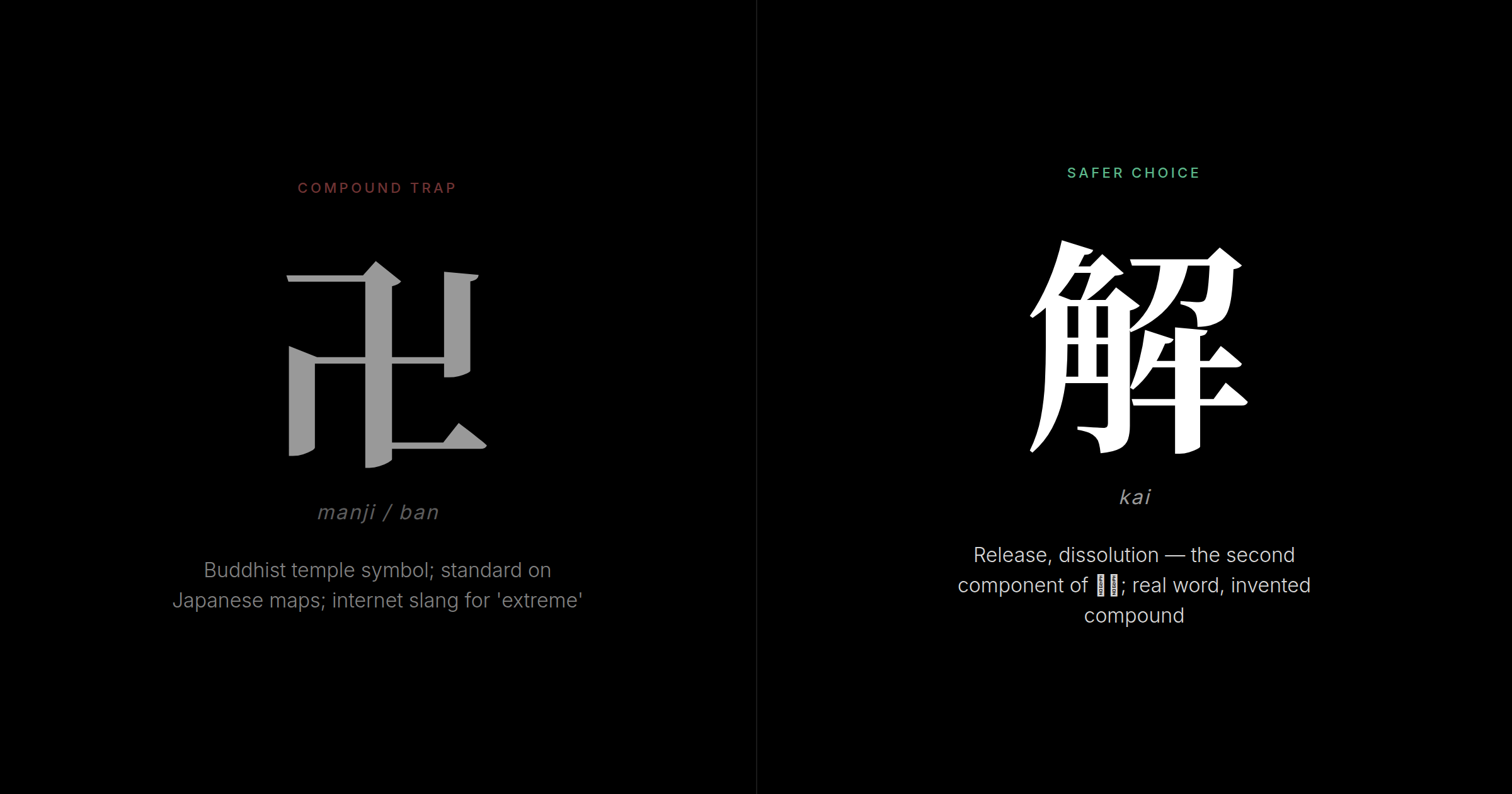
解 (Kai) — The Release Character
解 (kai — release, dissolution) is a genuinely versatile character in everyday Japanese. 解決 (kaiketsu — resolution), 解放 (kaihou — liberation), 理解 (rikai — understanding). In 卍解, it suggests the unlocking of power previously held in check. The construction is poetically coherent as Kubo built it. But the compound 卍解 exists only in Bleach.
Other Key Bleach Kanji Worth Knowing
斬魄刀 (Zanpakutou) — The Soul-Cutting Sword
斬魄刀 (zanpakutou — soul-cutting sword) combines 斬 (zan — to cut down, execute), 魄 (haku — the earthly soul in classical Taoist-influenced cosmology), and 刀 (tou — blade). 魄 is a genuine philosophical term from dual-soul theory, referring to the material aspect of the spirit that remains closer to the body. Kubo's naming here is sophisticated — a zanpakutou engages the more earthly aspect of the soul. But like 卍解, 斬魄刀 does not exist as a compound outside Bleach. Natives parse the components and recognize it as anime vocabulary.
滅却師 (Quincy) — Master of Annihilation
滅却師 (metsukyakushi — master of annihilation) is the Japanese rendering for Quincy. The core term 滅却 (metsukyaku — annihilation, total elimination) is a real and serious word. 滅 (metsu — extinction, destruction) appears in 絶滅 (zetsumetsu — species extinction) and 滅亡 (metsubou — ruin). 師 (shi — master, practitioner) appears in 医師 (ishi — physician) and 師匠 (shishou — master craftsman). Together: a practitioner of annihilation. The English "purification" used in fan contexts softens this considerably. A native reading 滅却師 registers something far darker than purification.
Placed side by side, 死神 and 滅却師 represent the two opposing supernatural factions in Bleach — each built from real Japanese vocabulary, each darker in register than its English localization suggests.
斬月 (Zangetsu) — The Poetic Option
斬月 (zangetsu — slashing moon) is one of the cleanest Bleach choices for a tattoo. Both components are visually strong: 斬 (zan — cutting, executing) and 月 (tsuki/getsu — moon). A native speaker who has not seen Bleach reads it as an invented poetic phrase — a blade that cuts by moonlight, a crescent-shaped cutting — rather than anime jargon. Unlike 死神 (which reads as a real word with dark connotations) or 卍解 (which reads as anime-only vocabulary), 斬月 functions simultaneously as a Bleach reference for fans and as invented poetry for everyone else.
Native Verdict: What a Tokyo Native Reads on Your Arm
A Tokyo native reading 死神 on a tattoo encounters a real Japanese word with a real cultural history — and that history is darker than Bleach suggests. The anime localization "soul reaper" implies professional function; 死神 implies a death omen. Someone unfamiliar with Bleach reads the ominous meaning first. Someone who knows Bleach reads both the anime reference and the ominous meaning simultaneously. Neither reading is wrong, but neither is "soul reaper."
Reading 卍解, a native immediately recognizes anime-only vocabulary. The components are real; the compound is not. They know you have gotten a Bleach tattoo, not a Japanese-language statement. The 卍 component draws no concern in Japan — but in Western public spaces, it may attract attention from strangers without Buddhist or anime context.
Reading 斬月, a native without Bleach knowledge sees an invented poetic phrase — striking visual imagery, not a recognized word. A Bleach fan recognizes the character name. This is the most versatile outcome: the tattoo communicates on multiple registers without requiring explanation.
Fans are often surprised by how much darker the Japanese reads compared to the English localization they grew up with. What Japanese people actually think when they see kanji tattoos covers this reaction — including why natives distinguish immediately between "knows what this says" and "copied it from a screenshot."
Better Alternatives for Bleach Fans
If the weight of 死神 is heavier than intended, or you want kanji with native-register depth alongside the Bleach connection, several options work well.
不屈 (fukutsu — indomitable, unbreakable resolve) appears in sports journalism, formal speeches, and political writing. It carries the quality many fans reach for in shinigami-related kanji — the refusal to stop — without the death connotation or the anime-exclusive limitation. It is a word that functions in real Japanese while capturing the essence of what draws many fans to Bleach characters.
斬月 (zangetsu) itself works for the reasons described above — invented poetry rather than fandom jargon.
護廷 (gotei — guard court), from the Soul Society's 護廷十三隊 (Gotei Juu-san Tai, the Thirteen Court Guard Squads), combines 護 (go — protect, guard) and 廷 (tei — court, hall of governance). A native reads "guard court" — poetic rather than anime-coded. Combined with a division number, it makes a reference that fans recognize while reading as literary to everyone else.
For a broader framework on selecting kanji that carry both personal meaning and native-register depth, choosing meaningful kanji for tattoos walks through how to find the underlying value — protection, persistence, transformation — rather than settling for a franchise label. Anime like Hell's Paradise, which grounds Buddhist vocabulary like 地獄 in genuine Edo-period history, offer a model of kanji that read with cultural depth to natives regardless of anime familiarity.
If you are uncertain whether your Bleach kanji source material is accurate, fake Japanese kanji in anime tattoos explains the difference between invented anime vocabulary, real words in invented compounds, and fabricated characters. Then verify the stroke accuracy with a native speaker before the appointment — the step most fans skip.
FAQ: Bleach Kanji Tattoo
Is 卍解 (Bankai) a real Japanese word?
卍解 is anime-exclusive terminology coined by Tite Kubo for Bleach. Japanese speakers who have not seen the series will not recognize it — they parse the components (卍 the Buddhist symbol, 解 meaning release) but the compound does not exist in standard Japanese. 卍 (manji) is real and carries centuries of Buddhist significance; 卍解 as a term lives only inside Bleach. Getting 卍解 tattooed signals a Bleach reference to any native speaker, whether or not they know the series.
Why do people worry about the 卍 symbol in a Bleach kanji tattoo?
The 卍 (manji) is a Buddhist symbol used for over two thousand years across Asia and is an entirely ordinary religious and cartographic symbol in Japan today. However, the Nazi regime's adoption of a visually similar hooked cross means that Western audiences without Buddhist context may misread it. For a Bleach tattoo worn in Western countries, this creates a gap: Japanese natives see Buddhist iconography and anime reference; Western strangers who do not know the context may see something very different. Many Bleach fans add the romaji "BANKAI" below the kanji or choose alternate designs that omit 卍 to avoid this conversation in Western settings.
What does 死神 (Shinigami) really mean to a Japanese person?
死神 (shinigami) means death god or death spirit — an ominous folkloric figure associated with mortality's pull, not a professional soul administrator. It appears in classical rakugo and Meiji literature as a genuinely foreboding presence. Bleach's English localization "soul reaper" softens this: soul reaper implies function and bureaucratic order, while 死神 implies a death omen. A native reading 死神 on a tattoo encounters the darker meaning first, then layers on the anime context if they know Bleach. If that is the register you intend, the kanji communicates it accurately. If you expected the warmer "soul reaper" tone, the Japanese is considerably heavier.
Can I get just "Zangetsu" as kanji?
Yes — 斬月 (zangetsu — slashing moon) works well as a bleach kanji tattoo because both components carry clear visual imagery and the compound reads as invented poetry rather than anime jargon. A native who has not seen Bleach reads "slashing moon" as a creative coined phrase, not a specific character name. This makes 斬月 one of the more versatile Bleach options: it signals the anime reference to fans and reads as evocative imagery to everyone else. You will not be explaining the symbol's origins to every stranger who sees it.
Should I use the full 朽木白哉 (Byakuya Kuchiki) or just part of the name?
The full name 朽木白哉 carries deliberate literary irony. 朽木 (kuchiki — rotting or decaying tree) is the noble family name: decay. 白 (haku/shiro — white, pure) begins the given name, creating a tension Kubo constructed intentionally. 哉 (ya) is a classical literary particle found in formal poetry, adding archaic weight. The combination is not random — it is poetic irony. If you want the full name, plan for a larger tattoo. If you prefer the poetic tension minimally, 白哉 alone preserves the purity-with-classical-register layer.
How do I know if my Bleach kanji is written correctly?
Stroke order, stroke count, and glyph form all matter — and none are verifiable through a screenshot or a Google Translate output. Common issues in Bleach-related verification requests KIO processes include designs sourced from low-resolution manga scans where fine strokes blur, kanji in stylized anime fonts that omit components, and AI-generated designs that produce plausible-looking but structurally incorrect characters. Before your appointment, have a native Japanese speaker review the actual artwork file going to your artist. Our guide on how to verify a kanji tattoo before getting inked walks through this process in detail.
Are there Bleach kanji that are actually wrong or made up?
Most Bleach kanji use real characters in invented combinations rather than fabricating characters outright. 卍解 uses real kanji in a non-existent compound; a fully fabricated character would be unreadable as Japanese entirely. The more common issue is that some Bleach terminology uses rare or archaic kanji — 魄 in 斬魄刀 is a genuine classical cosmology term, but rare enough that font rendering and fan reproduction frequently introduce errors. Designs sourced from fan art or unofficial merchandise carry higher risk of stroke-level mistakes that a native speaker catches immediately. Consult a native with your actual design file, not just the concept.
Before your Bleach tattoo appointment, get the design file reviewed by a Tokyo native — not the concept, the actual artwork. Kanji Ink Oracle offers pre-ink consultation where native speakers assess your chosen kanji for accuracy, stroke integrity, and cultural register. Knowing what 死神 actually says in Japanese, whether 卍解 reads as you intend, and whether your source file renders the strokes correctly is the difference between a tattoo you explain once and one you explain forever.